From Real Exams Quiz
A Level H1 General Paper Argument Evaluation Quiz
Free A Level H1 GP Argument Evaluation quiz, HY3 Exam version, with questions, answers, and A Level-style practice for Singapore students.
These static practice materials are generated from the site's syllabus and paper-generation workflow, with source and model context shown so students and parents can evaluate the material before use.
Questions
A-Level General Paper H1 Quiz - Argument Evaluation
Name: ___________________________
Class: ___________________________
Date: ___________________________
Score: _______ / 40
Duration: 60 minutes
Total Marks: 40
Topic: Argument Evaluation
Instructions:
This quiz tests your ability to analyse, evaluate, and assess arguments as required by the A-Level General Paper H1 syllabus (Area 2: Critical & Inventive Thinking). Answer all 20 questions. Section A consists of short structured responses. Section B requires you to evaluate argument structure and reasoning. Section C requires application to extended extracts. Use your own words as far as possible. Marks are indicated per question.
Section A: Identifying Argument Components (Questions 1–5)
1. [2 marks]
Read the statement: "Because electric vehicles reduce emissions, the government should subsidise all EV purchases."
Identify the conclusion and the premise in this argument.
Conclusion: ________________________________________________________
Premise: ____________________________________________________________
2. [2 marks]
State one function of a counter-argument in a balanced essay.
3. [2 marks]
"Social media improves connectivity; therefore, it must benefit mental health."
What type of reasoning flaw is present? Explain briefly.
4. [2 marks]
Give one example of a discourse marker that signals concession, and state its effect on an argument.
5. [2 marks]
According to critical thinking, what does it mean to assess the "credibility" of a source?
Section B: Evaluating Reasoning (Questions 6–10)
6. [2 marks]
A politician argues: "My opponent was absent from parliament 3 times; therefore, he is unfit to lead."
Identify the fallacy and explain why it weakens the argument.
7. [2 marks]
"All teenagers use TikTok. Amir is a teenager. Therefore, Amir uses TikTok."
Is this deductively valid? State yes/no and reason.
8. [2 marks]
An article claims: "Crime fell by 20% after CCTV was installed, so CCTV caused the drop."
What alternative explanation should a critical reader consider?
9. [2 marks]
Explain the difference between correlation and causation in evaluating evidence.
10. [2 marks]
A writer uses the phrase "of course" before stating that automation threatens jobs. What rhetorical effect does this have?
Section C: Applied Argument Analysis (Questions 11–20)
11. [2 marks]
Extract: "School uniforms are essential because they promote discipline. Without them, students would express anarchy."
Identify the assumed link and state whether it is justified.
12. [2 marks]
"Renewable energy is expensive now, but so was solar in 2010. Thus, renewables will soon be cheap."
What kind of analogy is used? State one weakness.
13. [2 marks]
An opinion piece states: "Experts agree climate action is urgent." Evaluate the strength of this appeal to authority.
14. [2 marks]
"Either we ban AI in schools or education collapses." Identify the false dilemma and suggest a middle path.
15. [2 marks]
Passage: "Volunteering builds character (line 4). It also reduces loneliness (line 7)."
How do these two claims function together in the author's argument?
16. [2 marks]
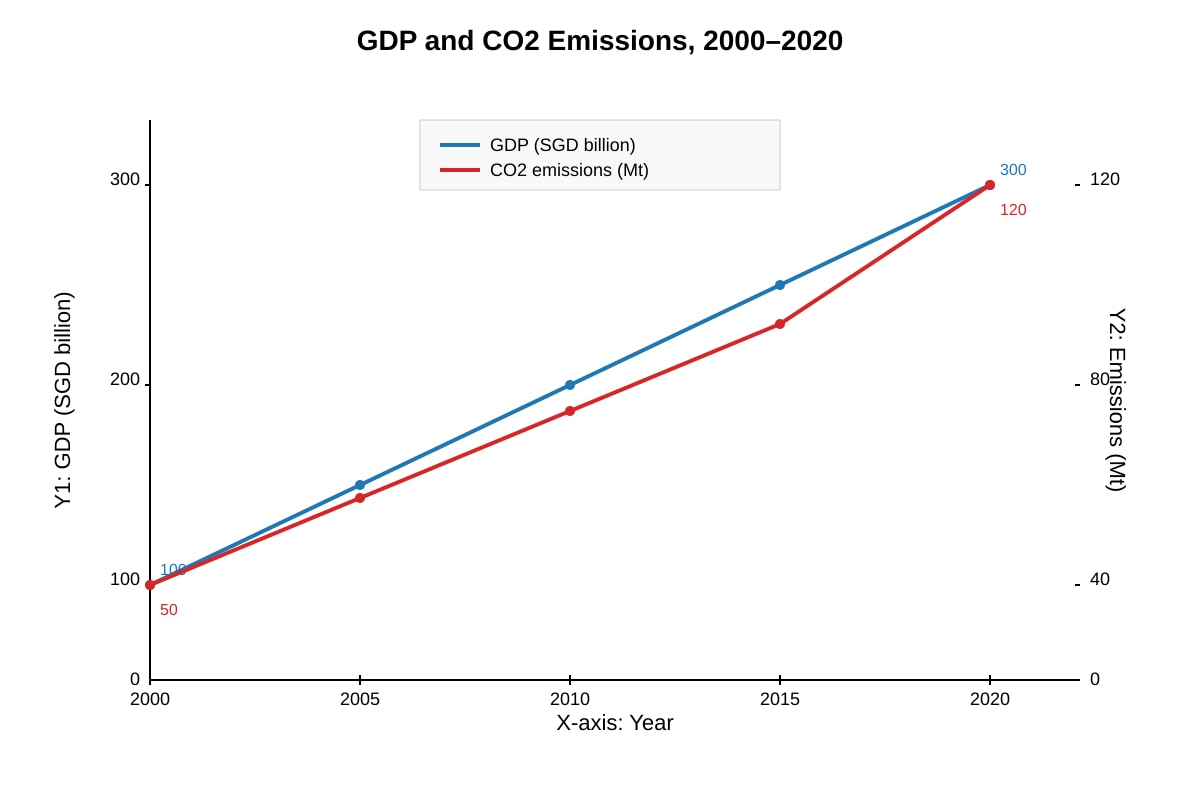
A graph shows rising GDP and rising pollution 2000–2020.
Image pending generation: graph for Q16.
What mistaken conclusion might a reader draw, and how should it be evaluated?
17. [2 marks]
"Because Singapore is small, it cannot influence global trade." Assess this generalisation.
18. [2 marks]
Extract: "The writer says 'even toddlers are not immune' (line 12) to screen time harm." Explain the effect of "even" on the argument.
19. [2 marks]
Essay claim: "Poverty can be solved by education alone." Give one reason why this is an oversimplification.
20. [2 marks]
"Historic buildings should be preserved because they are old." Evaluate the sufficiency of age as a reason.
Answers
A-Level General Paper H1 Quiz - Argument Evaluation: Answer Key
Total Marks: 40 (20 questions × 2 marks)
Section A: Identifying Argument Components
Q1 [2 marks]
- Conclusion: The government should subsidise all EV purchases. (1 mark)
- Premise: Electric vehicles reduce emissions. (1 mark)
Teaching note: The conclusion is the claim the writer wants you to accept; the premise is the supporting reason. Mark separately.
Q2 [2 marks]
Sample: A counter-argument acknowledges opposing views to strengthen credibility and show balance. (2 marks for clear function)
Common mistake: Saying it "weakens your essay" – incorrect; it shows critical thinking.
Q3 [2 marks]
Flaw: Unsupported causal leap / assumption. (1 mark) Connectivity does not necessarily benefit mental health; could harm it. (1 mark)
Teaching note: Identify the gap between premise and conclusion.
Q4 [2 marks]
Example: "however" / "although" (1 mark). Effect: signals concession, qualifies claim, shows awareness of limits. (1 mark)
Q5 [2 marks]
Assessing credibility means judging if the source is trustworthy, expert, unbiased, and evidence-based. (2 marks)
Marking: 1 mark for "trustworthy", 1 for method (expertise/evidence).
Section B: Evaluating Reasoning
Q6 [2 marks]
Fallacy: Hasty generalisation / ad hominem (1 mark). Weakness: Absence alone does not prove unfit; needs context of reasons. (1 mark)
Q7 [2 marks]
Yes (1 mark). It is valid deductively if premise "all teenagers use TikTok" is accepted; conclusion follows logically. (1 mark)
Note: Validity ≠ truth of premise.
Q8 [2 marks]
Alternative: Other factors (e.g., more police, economic growth) could explain crime drop. (2 marks)
Teaching: Correlation not causation.
Q9 [2 marks]
Correlation: two things occur together (1 mark). Causation: one directly produces the other (1 mark). Critical readers require evidence for causation.
Q10 [2 marks]
Effect: Presumes agreement, shuts down dissent, makes claim seem obvious without proof. (2 marks)
Section C: Applied Argument Analysis
Q11 [2 marks]
Assumed link: Uniforms → discipline → no anarchy (1 mark). Not justified: exaggeration; lacks evidence for "anarchy". (1 mark)
Q12 [2 marks]
Analogy: Historical cost decline of solar to predict renewables (1 mark). Weakness: different tech, subsidies, markets may differ. (1 mark)
Q13 [2 marks]
Strength depends: if experts are relevant and named, moderate; vague "experts" is weak appeal. (2 marks for evaluation)
Q14 [2 marks]
False dilemma: only two extremes given (1 mark). Middle: regulated AI use with training. (1 mark)
Q15 [2 marks]
They act as cumulative supporting premises for volunteering's value. (2 marks)
Q16 [2 marks]
Mistaken: GDP causes pollution (1 mark). Evaluate: correlation only; need proof of causal link, maybe both from growth. (1 mark)
Image note: Graph shows two rising lines, not causation.
Q17 [2 marks]
Generalisation flawed: size does not determine trade influence (e.g., Singapore is trade hub). (2 marks)
Q18 [2 marks]
"Even" emphasises surprise that young children are affected, strengthening urgency. (2 marks)
Q19 [2 marks]
Oversimplification: ignores structural issues like inequality, jobs. (2 marks)
Q20 [2 marks]
Age alone insufficient: need historical, cultural, or social value. (2 marks)
Free quiz and exam paper access
Enter your details to view this paper
Your access is remembered on this device.