AI Generated Exam Paper
A Level H1 General Paper Practice Paper 2
Free A Level H1 GP Practice Paper 2, HY3 AI version, with questions, answers, and A Level-style practice for Singapore students.
These static practice materials are generated from the site's syllabus and paper-generation workflow, with source and model context shown so students and parents can evaluate the material before use.
Questions
TuitionGoWhere Practice Paper - General Paper H1 A-Level
TuitionGoWhere Practice Paper (AI) — Version 2
Subject: General Paper H1
Level: A-Level
Paper: Practice Paper (Comprehension Focus)
Duration: 1 hour 30 minutes
Total Marks: 40
Name: ________________________
Class: ________________________
Date: ________________________
Instructions
- This practice paper contains 20 questions based on three short passages provided below.
- Answer all questions in the spaces provided.
- Use your own words as far as possible for explanation questions.
- Section marks and question marks sum to 40.
- This is a syllabus-aligned practice paper generated from LLM-inferred templates; it is not an official SEAB paper.
Passages
Passage A (Lines 1–18)
(1) The modern city has been described as a living organism, constantly adapting to the pressures of population and climate. (2) Yet this metaphor obscures a harsher truth: urban planning often serves the powerful rather than the public. (3) Consider the rapid redevelopment of Singapore’s heartland estates. (4) What is marketed as “refreshing” communal spaces is, in practice, the displacement of long-standing communities. (5) The author notes that even elderly residents are not immune to relocation orders. (6) Of course, the government argues that such moves improve living standards. (7) However, the word “improvement” here is coded, signalling economic uplift rather than social cohesion. (8) A 2023 survey showed that 62% of displaced residents felt a loss of neighbourhood trust. (9) The creeping privatisation of public housing is subtle but steady. (10) Critics warn that without intervention, the city will become a mosaic of gated enclaves. (11) Some planners counter that density demands difficult trade-offs. (12) Still, the human cost of these trade-offs is rarely quantified. (13) The phrase “sustainable growth” has spawned numerous policy papers but few tangible homes. (14) In truth, the balance between heritage and progress remains unresolved. (15) One resident remarked that the kampong spirit was merely a slogan on a banner. (16) Another noted that new estates feel like hotel lobbies — polished yet impersonal. (17) The state’s narrative of consensus safely avoids dissent. (18) Ultimately, the question is not whether cities change, but who pays the price.
Passage B (Lines 1–12)
(1) Artificial intelligence is frequently called a black box because its decisions elude simple explanation. (2) In healthcare, algorithms now triage patients faster than human staff. (3) Yet the same systems have denied coverage based on patterns no doctor can trace. (4) Why does the author begin with this paradox? (5) Because trust in medicine relies on transparency, and AI disrupts that foundation. (6) A 2022 study found that 41% of clinicians distrusted AI recommendations. (7) The term “efficiency” here merely masks the erosion of professional judgement. (8) Even prestigious hospitals adopt tools they do not fully understand. (9) The risk is not just error, but accountability drift. (10) When a machine denies care, who is responsible? (11) Policymakers have safely deferred this question to future committees. (12) Meanwhile, patients bear the consequence of opaque choices.
Passage C (Lines 1–10)
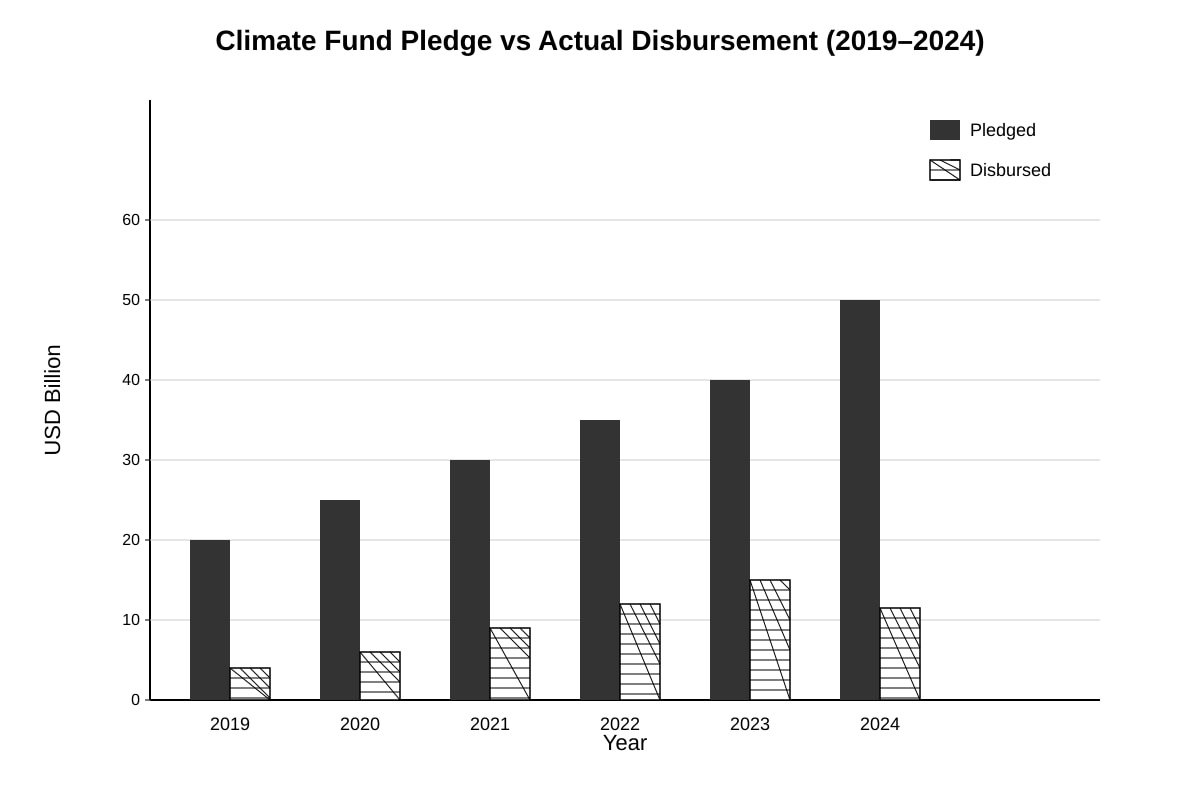
(1) Climate adaptation funds promised a just transition for vulnerable states. (2) However, only 23% of pledged monies reached local projects by 2024. (3) The author suggests that bureaucratic friction strangles goodwill. (4) Small island nations call the delay a slow violence. (5) Of course, donors cite complex compliance rules. (6) But the word “partnership” is coded, implying donor control rather than equality. (7) A chart below shows the gap between pledge and disbursement. (8) The creeping normalisation of broken promises weakens global trust. (9) Even adaptive communities are not immune to funding cliffs. (10) Ultimately, resilience is marketed more than materialised.
Image pending generation: chart for Q19.
Section A: Word and Phrase Analysis (Questions 1–7) — 11 marks
Q1. Explain the author’s use of the word “creeping” in line 9 of Passage A. [1]
Q2. Explain the author’s use of the phrase “even elderly residents” in line 5 of Passage A. [2]
Q3. Explain what the author means by calling the word “improvement” “coded” in line 7 of Passage A. [2]
Q4. Explain the author’s use of the word “spawned” in line 13 of Passage A. [1]
Q5. Explain the author’s use of the word “merely” in line 15 of Passage A. [1]
Q6. Explain the author’s use of the phrase “safely avoids” in line 17 of Passage A. [2]
Q7. Explain the author’s use of the word “black box” in line 1 of Passage B. [2]
Section B: Inference and Technique (Questions 8–14) — 14 marks
Q8. According to lines 2–4 of Passage A, how has urban redevelopment been presented versus what it actually does? [2]
Q9. Why does the author include the 2023 survey result in line 8 of Passage A? [2]
Q10. According to paragraph 2 (lines 1–5) of Passage B, what paradox does the author identify about AI in healthcare? [2]
Q11. Why does the author begin Passage B with a definition of AI as a “black box” (line 1)? [2]
Q12. According to lines 3–4 of Passage C, what does the author suggest about bureaucratic systems and climate funds? [2]
Q13. Explain the author’s use of the phrase “slow violence” in line 4 of Passage C. [2]
Q14. According to lines 8–10 of Passage C, how is resilience portrayed by those in power? [2]
Section C: Synthesis and Visual (Questions 15–20) — 15 marks
Q15. According to Passage A line 10 and Passage C line 8, what similar trend is described using the word “creeping”? [2]
Q16. Compare how the word “coded” is used in Passage A line 7 and Passage C line 6. [2]
Q17. According to Passage B lines 6–8, what attitude do clinicians and hospitals show toward AI? [2]
Q18. The author of Passage A (line 18) and Passage C (line 10) both end with a question or statement about responsibility. Summarise the common concern in your own words. [2]
Q19. Refer to the chart in Q19-fig1. According to the data, what is the trend in disbursement versus pledge from 2019 to 2024? [3]
Q20. Using Passages A, B, and C, explain how the authors use the technique of citing statistics to support their critiques. [4]
Answers
TuitionGoWhere Practice Paper — Answer Key (Version 2)
Subject: General Paper H1 | Level: A-Level | Total Marks: 40
Section A: Word and Phrase Analysis (11 marks)
Q1. [1 mark]
Answer: “Creeping” suggests that privatisation of public housing is happening gradually and almost unnoticed.
Teaching note: The word connotes slow, stealthy movement (like creeping plants). In context it implies the change is subtle but continuous. Common mistake: defining as “moving on hands and knees”.
Q2. [2 marks]
Answer: The author uses “even elderly residents” to emphasise that no group is excluded; the word “even” signals surprise that the vulnerable are also affected.
Mark breakdown: 1 mark for “even” showing inclusion of unexpected group; 1 mark for linking to displacement of vulnerable.
Teaching note: “Even” is a discourse marker of concession/emphasis. It highlights extremity of policy impact.
Q3. [2 marks]
Answer: By calling “improvement” coded, the author means the word secretly implies economic gain rather than social benefit.
Mark breakdown: 1 mark for “coded” = hidden meaning; 1 mark for stating the actual implied meaning (economic not social).
Teaching note: “Coded” language carries a secondary, often political, subtext.
Q4. [1 mark]
Answer: “Spawned” suggests the phrase produced many policy papers rapidly, with a slightly negative tone of uncontrolled multiplication.
Teaching note: Literal meaning = give birth; here metaphorical for generating documents.
Q5. [1 mark]
Answer: “Merely” reduces the kampong spirit to just a slogan, implying it is empty and insignificant.
Teaching note: “Merely” minimises the preceding noun.
Q6. [2 marks]
Answer: “Safely avoids” means the state escapes controversy by not addressing dissent.
Mark breakdown: 1 mark for “safely” = without risk; 1 mark for “avoids” = omits/ignores dissent.
Teaching note: Critiques narrative control via careful wording.
Q7. [2 marks]
Answer: “Black box” means AI’s decision process is hidden and unexplained.
Mark breakdown: 1 mark for hidden/internal; 1 mark for unexplained to users.
Teaching note: Metaphor from aviation where inputs/outputs known but internals unknown.
Section B: Inference and Technique (14 marks)
Q8. [2 marks]
Answer: Presented as “refreshing communal spaces” (line 4) but actually displaces communities.
Mark breakdown: 1 mark each side.
Teaching note: Contrast between marketing and reality is central to Passage A.
Q9. [2 marks]
Answer: To provide evidence that displacement harms social trust (62% felt loss).
Mark breakdown: 1 mark for citing stat; 1 mark for purpose (supports critique).
Teaching note: Statistics add credibility to anecdotal claim.
Q10. [2 marks]
Answer: AI triages faster (benefit) but denies coverage via untraceable patterns (harm).
Mark breakdown: 1 mark each.
Teaching note: Paradox = simultaneous advantage and risk.
Q11. [2 marks]
Answer: To frame the opacity problem before examples; sets theme of distrust.
Mark breakdown: 1 mark technique; 1 mark effect.
Teaching note: Opening definition primes reader.
Q12. [2 marks]
Answer: Bureaucracy blocks funds; goodwill fails due to friction.
Mark breakdown: 1 mark each.
Teaching note: “Strangles” = prevents flow.
Q13. [2 marks]
Answer: “Slow violence” = harm through delay not overt force.
Mark breakdown: 1 mark slow; 1 mark violence (harm).
Teaching note: Coined term by Nixon; here used for climate injustice.
Q14. [2 marks]
Answer: Resilience is advertised (marketed) but not delivered (materialised).
Mark breakdown: 1 mark each.
Teaching note: Irony between promise and reality.
Section C: Synthesis and Visual (15 marks)
Q15. [2 marks]
Answer: Both use “creeping” for gradual, unnoticed negative change (privatisation; normalisation of broken promises).
Mark breakdown: 1 mark each passage.
Teaching note: Cross-text lexical link.
Q16. [2 marks]
Answer: Both mean a word hides unequal power (economic control; donor control).
Mark breakdown: 1 mark each.
Teaching note: Same metaphor, different domain.
Q17. [2 marks]
Answer: Clinicians distrust (41%); hospitals adopt without understanding.
Mark breakdown: 1 mark each.
Teaching note: Contrasting institutional vs individual response.
Q18. [2 marks]
Answer: Both question who bears cost of top-down decisions (citizens pay; resilience unrealised).
Mark breakdown: 1 mark each text.
Teaching note: Shared concern with accountability.
Q19. [3 marks]
Answer: Pledge rises (20→50bn); disbursement lags (4→15 then drops to 11.5). Gap widens.
Mark breakdown: 1 mark trend pledge; 1 mark trend disbursed; 1 mark gap.
Teaching note: Chart shows hatched bars lower; 2024 anomaly.
Q20. [4 marks]
Answer: Each cites stats to ground critique (62% trust loss; 41% distrust; 23% funds).
Mark breakdown: 1 mark per passage example; 1 mark synthesis of method.
Teaching note: Stats = empirical backing for subjective claims.
Free quiz and exam paper access
Enter your details to view this paper
Your access is remembered on this device.