From Real Exams Exam Paper
A Level H1 General Paper Practice Paper 4
Free A Level H1 GP Practice Paper 4, HY3 Exam version, with questions, answers, and A Level-style practice for Singapore students.
These static practice materials are generated from the site's syllabus and paper-generation workflow, with source and model context shown so students and parents can evaluate the material before use.
Questions
TuitionGoWhere Practice Paper - General Paper H1 A-Level (Comprehension)
TuitionGoWhere Exam Practice (AI)
Subject: General Paper H1
Level: A-Level
Paper: Practice Paper 2 (Comprehension) – Version 4 of 5
Duration: 1 hour 30 minutes
Total Marks: 80
Name: ___________________________
Class: ___________________________
Date: ___________________________
Instructions
- This paper contains three passages followed by 20 questions.
- Answer all questions in the spaces provided.
- Use your own words as far as possible for comprehension and explanation questions.
- Write clearly and legibly.
Passage A: The Attention Economy (Lines 1–40)
(1) In the digital age, our attention has become a commodity. (2) Tech giants compete fiercely to capture the few seconds of focus we grant our screens. (3) Of course, we are told that these platforms merely connect us, yet the underlying motive is profit. (4) Even children are not immune to the pull of algorithmic feeds. (5) The term "attention economy" was coined to describe a system where human focus is harvested and sold. (6) Critics argue that this creeping intrusion erodes our capacity for deep thought. (7) A 2023 study found that average attention span had dropped to eight seconds. (8) Some firms have spawned new subsidiaries dedicated solely to engagement metrics.
Passage B: Urban Green Spaces (Lines 1–35)
(1) Singapore's commitment to becoming a City in Nature reflects a broader regional trend. (2) According to urban planners, green corridors help mitigate the urban heat island effect. (3) However, not all residents value these spaces equally. (4) The story of the Kampong helped older citizens feel rooted to a vanishing past. (5) Preservationists claim that such sites make a community "devoted to heritage". (6) Yet developers argue that land is scarce and must be used efficiently. (7) Over two decades, the function of these spaces has evolved from recreational to ecological buffers.
Passage C: Scientific Communication (Lines 1–30)
(1) Public trust in science depends on clear communication. (2) Researchers often use words that are "coded" with disciplinary assumptions. (3) The words "spontaneous" and "impulsive" are synonyms, but only rarely can they be used interchangeably. (4) A good science communicator safely translates complex findings for lay audiences. (5) Misinformation spreads when nuances are lost in headlines.
Section A: Word and Phrase Explanation (Questions 1–8) [16 marks]
1. Explain the author's use of the phrase "Of course" in line 3 of Passage A. Use your own words as far as possible. [2]
2. Explain the author's use of the word "even" in line 4 of Passage A. [1]
3. Explain the author's use of the word "coined" in line 5 of Passage A. [1]
4. Explain the author's use of the word "creeping" in line 6 of Passage A to describe intrusion. [2]
5. Explain the author's use of the word "spawned" in line 8 of Passage A. [1]
6. Explain what the author means by calling the personal preferences "coded" in line 2 of Passage C. [2]
7. Explain the author's use of the word "safely" in line 4 of Passage C. [2]
8. Explain what the author means when he says that the words "spontaneous" and "impulsive" are "synonyms, but only rarely can they be used interchangeably" (lines 3 of Passage C). [2]
Section B: Inference and Information (Questions 9–14) [24 marks]
9. According to lines 5–8 of Passage A, explain how the attention economy has affected human focus. Use your own words as far as possible. [3]
10. According to paragraph 4 of Passage B, how did the story of the Kampong help to make older citizens become "devoted to heritage"? [3]
11. According to lines 2–3 of Passage B, what are two contrasting views on urban green spaces? [2]
12. According to lines 1–3 of Passage C, why is clear communication important for public trust in science? [2]
13. According to line 7 of Passage B, explain how the function of green spaces has evolved. Use your own words as far as possible. [3]
14. According to lines 3–5 of Passage A, identify two actions or outcomes linked to the attention economy. [2]
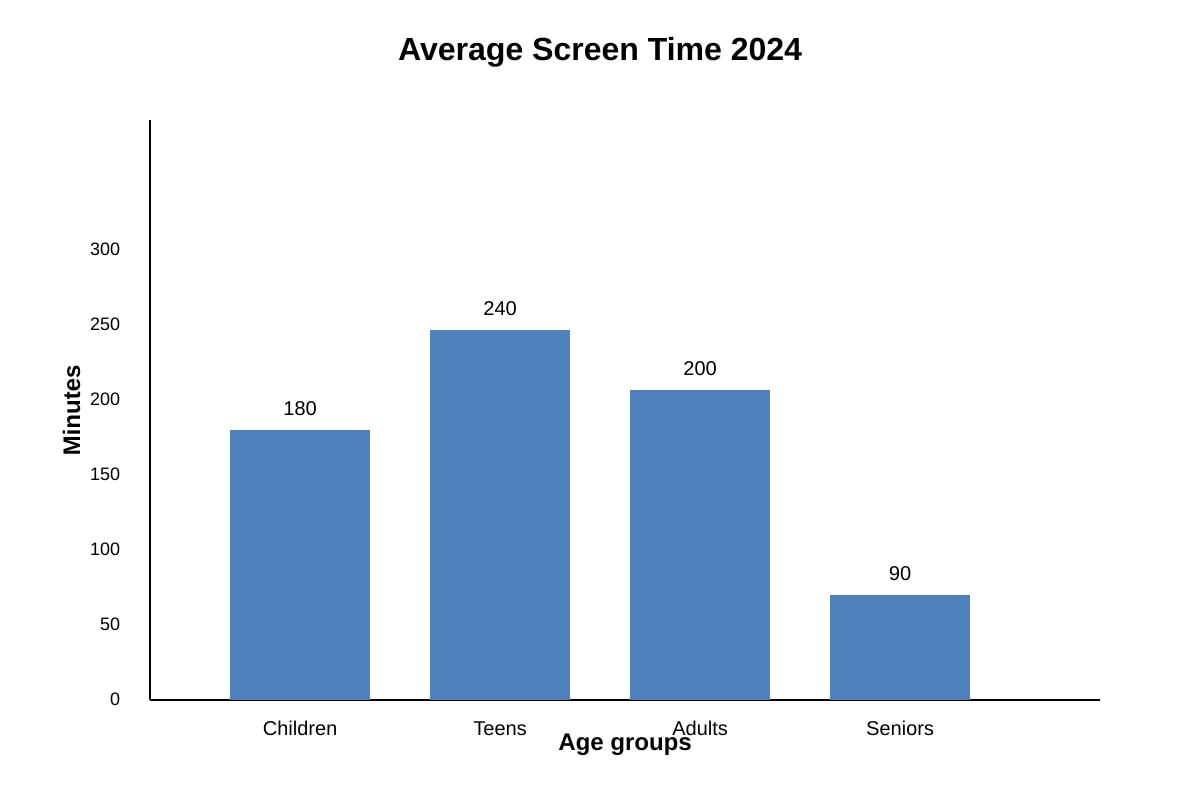
15. The following chart shows screen time averages. Refer to the data and Passage A.
Image pending generation: graph for Q15.
Using Passage A line 4 and the chart, explain why "even children are not immune". [3]
Section C: Analysis and Evaluation (Questions 16–20) [40 marks]
16. Explain how the author of Passage A uses tone to persuade the reader that tech giants are exploitative. Refer to two specific word choices. [4]
17. Compare the authors' views on preservation in Passage B and communication in Passage C. How do both texts show the value of careful language? [6]
18. "The attention economy is a necessary evil." Using Passage A and your own knowledge, to what extent do you agree? [10]
19. Summarise the main concern in Passage A and Passage C regarding language and attention. [8]
20. The reading passages cover a range of views concerning modern societal challenges. Using all three passages, evaluate how language shapes public understanding of these issues. [12]
End of Paper
Answers
Answer Key – General Paper H1 A-Level Practice Paper 2 (Comprehension) Version 4
Total Marks: 80
Section A: Word and Phrase Explanation (16 marks)
Q1 [2 marks]
- The author uses "Of course" to signal a commonly accepted assumption that platforms connect us, but ironically contrasts it with the profit motive (1 mark).
- It implies scepticism towards the stated benign purpose (1 mark).
Teaching note: Discourse marker shows concession + tone of irony. Do not just say "it means obviously".
Q2 [1 mark]
- "Even" emphasises that not only adults but also children are affected, highlighting the widespread reach.
Common mistake: Defining "even" as grammatical particle only.
Q3 [1 mark]
- "Coined" means invented/created the term, showing the concept is newly named.
Q4 [2 marks]
- "Creeping" suggests gradual, unnoticed intrusion (1 mark).
- Connotes threat like creeping danger, criticising surveillance (1 mark).
Q5 [1 mark]
- "Spawned" means rapidly produced/created subsidiaries, implying mechanical multiplication for profit.
Q6 [2 marks]
- "Coded" means embedded with discipline-specific assumptions not obvious to public (1 mark).
- Suggests language hides expert bias (1 mark).
Q7 [2 marks]
- "Safely" means without distortion of meaning (1 mark).
- Implies careful translation protects public from misunderstanding (1 mark).
Q8 [2 marks]
- They share meaning but context differs: spontaneous = natural unprompted; impulsive = rash (1 mark).
- Rarely interchangeable because impulsive carries negative tone (1 mark).
Section B: Inference and Information (24 marks)
Q9 [3 marks]
- Start: attention is commodity; tech competes for seconds (1).
- Mechanism: harvested and sold via algorithms (1).
- Outcome: span dropped to 8 sec, deep thought eroded (1).
Q10 [3 marks]
- Story connected them to vanishing past (1).
- Created emotional rooting (1).
- Made them value heritage as identity (1).
Q11 [2 marks]
- Planners: mitigate heat, ecological benefit (1).
- Some residents: do not value equally / developers: scarce land efficiency (1).
Q12 [2 marks]
- Clear communication builds trust (1).
- Coded words cause misunderstanding / misinformation (1).
Q13 [3 marks]
- Past: recreational (1).
- Present: ecological buffers (1).
- Shift due to urban pressure (1).
Q14 [2 marks]
- Platforms compete for focus.
- Subsidiaries for engagement metrics.
Q15 [3 marks]
- Chart: children 180 min daily (1).
- Line 4: even children pulled by feeds (1).
- High screen time shows non-immunity (1).
Section C: Analysis and Evaluation (40 marks)
Q16 [4 marks]
- Tone critical/sceptical (1).
- "harvested" implies exploitation (1).
- "creeping intrusion" implies stealth harm (1).
- Overall persuades reader of greed (1).
Q17 [6 marks]
- B: preservation language "devoted to heritage" shows careful framing (2).
- C: "coded" shows need for clear translation (2).
- Both: language choices shape respect/understanding (2).
Q18 [10 marks]
- Agree: connectivity, economic engine (3).
- Disagree: erosion of thought, children affected (3).
- Synthesis: regulated not banned (4).
Descriptors: 9–10 balanced + illustration; 5–8 partial; <4 assertive.
Q19 [8 marks]
- A: language of platforms hides profit motive, captures attention (4).
- C: coded words reduce trust (4).
Q20 [12 marks]
- A: attention commodified via language (3).
- B: heritage language builds community (3).
- C: science language needs safety (3).
- Eval: language is tool for clarity or manipulation (3).
Band: 11–12 synthesis; 7–10 competent; <6 limited.
Free quiz and exam paper access
Enter your details to view this paper
Your access is remembered on this device.