AI Generated Quiz
A Level H2 Geography Resources Sustainability Quiz
Free A Level H2 Geography Resources Sustainability quiz, HY3 AI version, with questions, answers, and A Level-style practice for Singapore students.
These static practice materials are generated from the site's syllabus and paper-generation workflow, with source and model context shown so students and parents can evaluate the material before use.
Questions
Free quiz and exam paper access
Enter your details to view this paper
Your access is remembered on this device.
Answers
A-Level Geography H2 Quiz - Resources Sustainability (Answer Key)
Total Marks: 40
Topic: Resources Sustainability (Syllabus 1.1)
Section A: Short Structured Questions
1. [2 marks]
Answer: Sustainable development is development that meets the needs of the present without compromising the ability of future generations to meet their own needs (Brundtland definition). It seeks to balance economic, environmental, and social goals, recognising trade-offs and limits.
Teaching note: Define using Brundtland. Award 1 mark for present–future needs; 1 mark for three dimensions / trade-offs. Common mistake: confusing with mere environmental protection.
2. [2 marks]
Answer: Provisioning: e.g., timber, fish, crops, freshwater. Regulating: e.g., climate regulation, flood control, water purification.
Teaching note: 1 mark each. Provisioning = products obtained; regulating = benefits from ecosystem processes.
3. [2 marks]
Answer: Proven reserves are quantities of a resource confirmed by exploration and recoverable under current tech/economics. Speculative reserves are undiscovered resources inferred to exist but not verified.
Teaching note: 1 mark each. Shows understanding of reserve classification.
4. [2 marks]
Answer: Thomas Malthus – population grows exponentially and will outstrip resource supply, causing limits. Ester Boserup – human ingenuity and technology expand resource base, preventing fixed limits.
Teaching note: 1 mark each. Contrasting views on limits vs technology.
5. [1 mark]
Answer: e.g., industrial effluent discharge, plastic pollution, oil spills.
Teaching note: Any pollution activity compromising ecosystems.
6. [1 mark]
Answer: e.g., intermittency (sun not always available), land use conflict, storage cost, not dispatchable at night.
Teaching note: Any one valid limitation for energy security.
7. [1 mark]
Answer: e.g., upstream withdrawal reduces downstream supply; unequal power; no binding treaty.
Teaching note: Conflict source on shared rivers.
8. [2 marks]
(i) R (ii) NR (iii) R (iv) NR
Teaching note: 0.5 each. Hydropower/geothermal renewable; gas/copper non-renewable.
9. [1 mark]
Answer: Technology increases food/resource output per unit land, raising carrying capacity.
Teaching note: Boserupian optimistic view.
10. [1 mark]
Answer: e.g., high cost of green transition, debt burden, unequal trade terms.
Teaching note: Economic challenge to SDGs.
Section B: Data / Source-Based
11. [5 marks]
Answer: Singapore has highest scores in all dimensions (E88, V79, S91; overall 86). Kuala Lumpur lower (75 overall) but stronger than Jakarta (62) and Manila (58). Jakarta exceeds Manila on every dimension. Environmental scores are consistently lowest relative to social/economic (e.g., Manila V51 vs S63).
Marking: 1 mark for stating Singapore highest; 1 for KL mid; 1 for Jakarta>Manila; 1 for dimension comparison; 1 for synthesis of pattern.
Teaching note: Use comparative language, reference all cities and dimensions.
12. [3 marks]
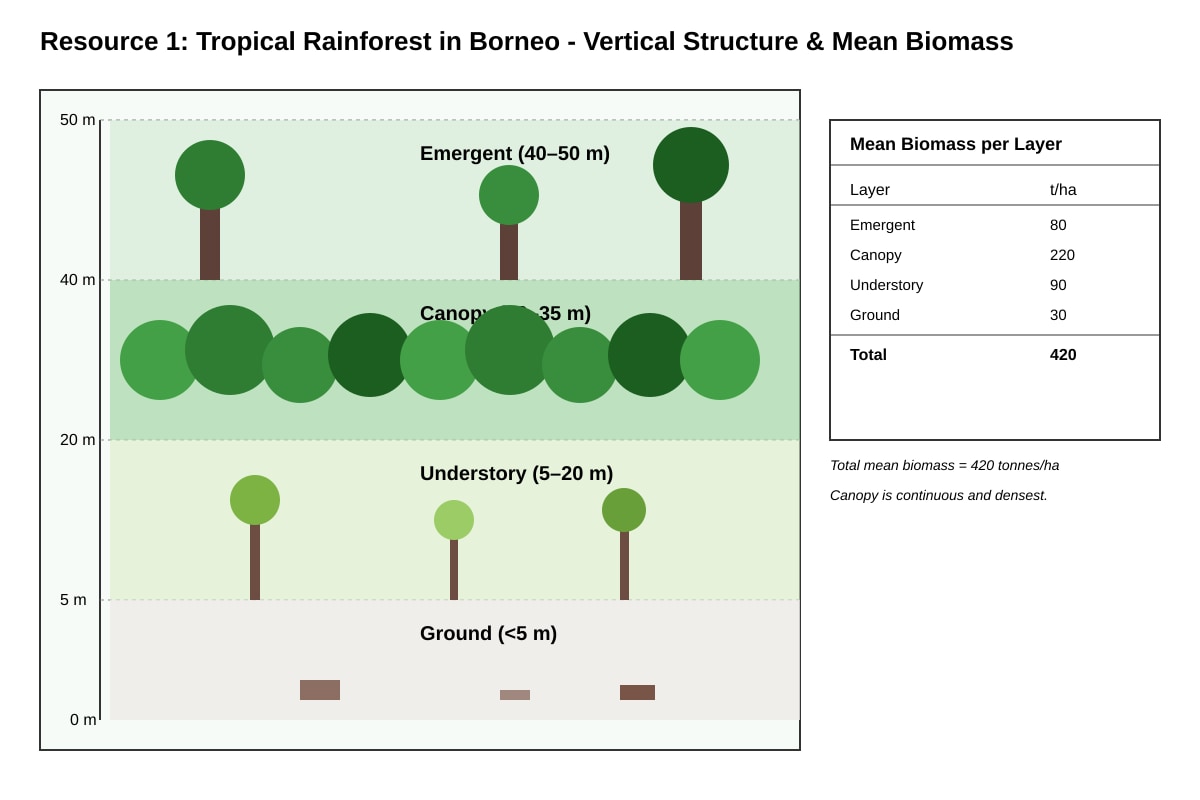
Answer: Structure: emergent layer 40–50 m (sparse tall trees), continuous canopy 20–35 m (dense), understory 5–20 m, ground <5 m. Mean biomass total 420 t/ha (Emergent 80, Canopy 220, Understory 90, Ground 30).
Marking: 1 layer description, 1 biomass total, 1 per extra detail.
Teaching note: Must describe vertical tiers and give number with unit.
13. [6 marks]
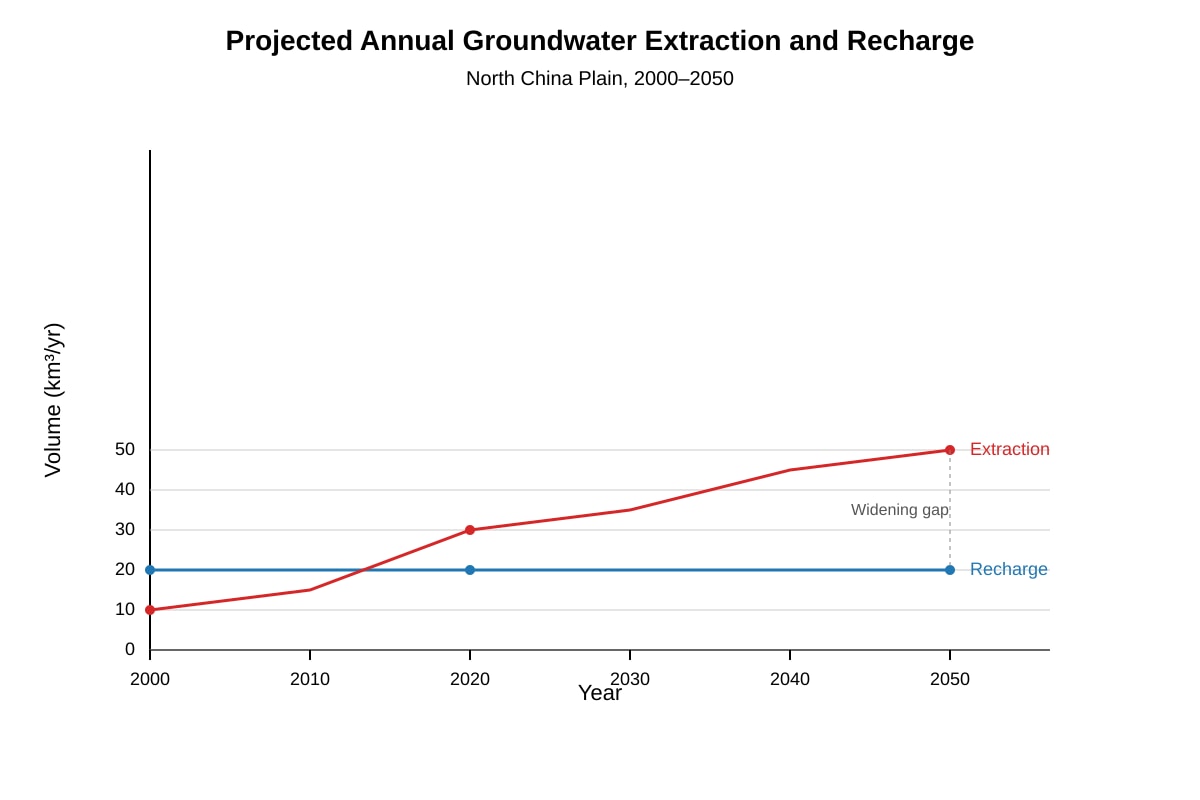
Answer: (a) Extraction exceeds recharge by growing margin (25 vs 20 in 2000; 45 vs 20 in 2050) due to intensive irrigation and urban demand. [3] (b) Limited rainfall recharge and climate variability mean natural input cannot sustain withdrawal. [3]
Marking: 3 per factor with evidence from graph.
Teaching note: Link line divergence to human + physical drivers.
14. [7 marks]
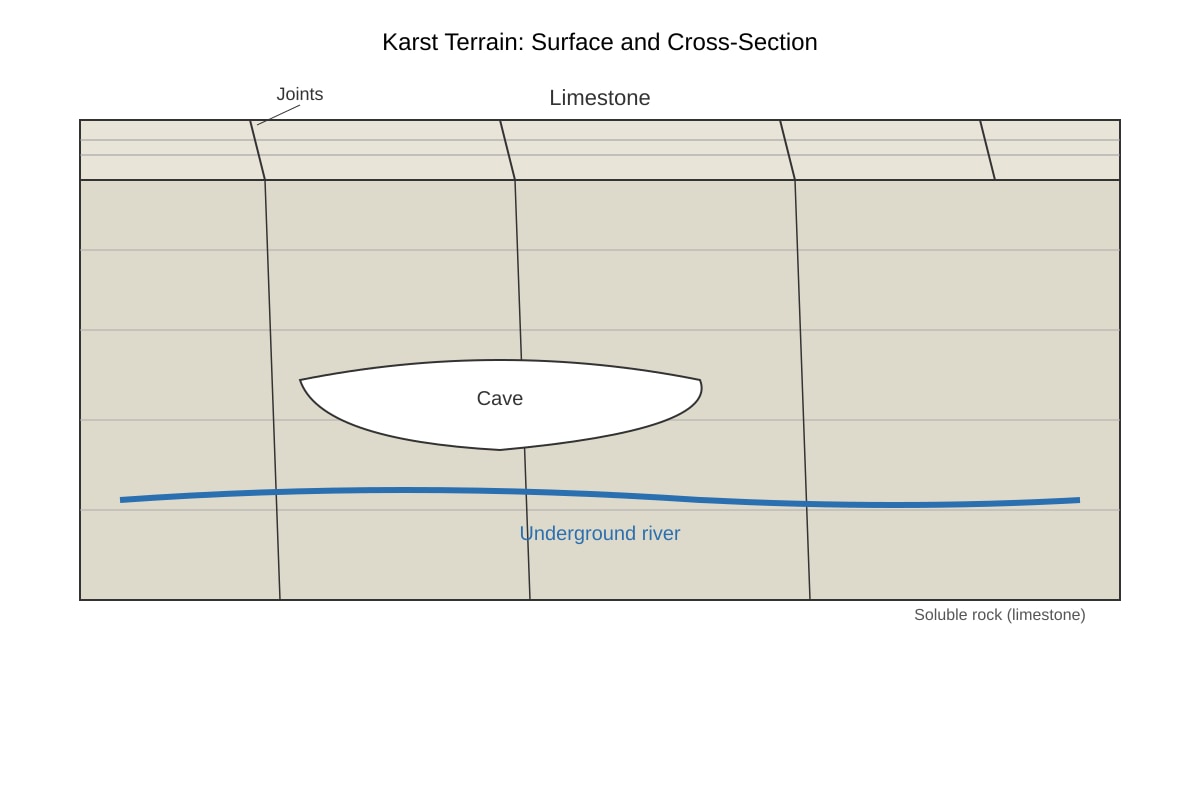
Answer: (1) Limestone (soluble carbonate) with joints/bedding planes. [1] (2) Rain + CO₂ → H₂CO₃ (weak acid) dissolves CaCO₃. [2] (3) Infiltration/percolation along joints enlarges cavities → cave. [2] (4) Surface sinkhole from roof collapse; pavement from surface dissolution. [2]
Teaching note: Chemical weathering core; link to shown features.
15. [4 marks]
Answer: (1) Joint river basin commission with data sharing. [2] (2) Benefit-sharing treaty (e.g., storage release rules). [2]
Marking: 2 each with brief elaboration.
Section C: Extended Response
16. [6 marks]
Answer: Economic: royalties vs Dutch disease. Environmental: tailings pollution localised. Social: jobs vs displacement. Example: Niger Delta oil (env/social conflict).
Marking: 2 each dimension with example.
Teaching note: Show spatial variation in impacts.
17. [8 marks]
Answer: For: solar/hydro cut CO₂, fossil substitution. Against: hydro displaces communities, solar needs land/storage. Extent: partial – trade-offs manageable with planning.
Marking: 4 for benefits, 4 for trade-offs/eval.
Teaching note: Balanced with syllabus trade-off concept.
18. [6 marks]
Answer: Still relevant where poverty limits tech (parts of Africa). Less in high-tech economies (Boserup). Conclusion: partially relevant.
Marking: 3 Malthus limit, 3 Boserup/modern context.
19. [5 marks]
Answer: Indonesia: forests regulate water, provision timber. Loss → flooding, income loss.
Marking: 2 services, 2 loss, 1 example link.
20. [5 marks]
Answer: SDG indicators quantify targets (e.g., 6.4 water efficiency). Limitation: uneven data, no enforcement. Effectiveness partial.
Marking: 2 measurement, 2 limits, 1 judgement.