AI Generated Quiz
A Level H2 Geography Human Geography Quiz
Free A Level H2 Geography Human Geography quiz, HY3 AI version, with questions, answers, and A Level-style practice for Singapore students.
These static practice materials are generated from the site's syllabus and paper-generation workflow, with source and model context shown so students and parents can evaluate the material before use.
Questions
Free quiz and exam paper access
Enter your details to view this paper
Your access is remembered on this device.
Answers
A-Level Geography H2 Quiz - Human Geography (Answer Key)
Total Marks: 40
Topic: Human Geography
Section A: Foundations (Q1–7)
Q1 [2 marks]
Answer: A Global Production Network (GPN) is the interconnected system through which transnational corporations organise the sourcing, transformation, distribution, and consumption of goods and services across different countries.
Teaching note: Define GPN as the full chain linking places via TNC activities. 1 mark for mentioning TNC coordination, 1 mark for naming the four stages (sourcing, transformation, distribution, consumption) or similar.
Common mistake: Confusing GPN with a single factory or only trade flows.
Q2 [1 mark]
Answer: Sustained economic growth / efficient resource use / meeting present economic needs without compromising future.
Teaching note: Brundtland Report (Our Common Future) lists economic, environmental, social dimensions. Any one economic dimension accepted.
Q3 [1 mark]
Answer: World Trade Organization (WTO).
Teaching note: WTO sets rules for international trade; not World Bank (development loans).
Q4 [1 mark]
Answer: Food, water, timber, fibre (any provisioning service).
Teaching note: Provisioning = products obtained from ecosystems. Regulating/cultural/support are other types.
Q5 [1 mark]
Answer: Limits imposed by the natural environment (food supply / resources).
Teaching note: Malthus argued population grows geometrically, resources arithmetically → environmental limit.
Q6 [1 mark]
Answer: Innovation (e.g., fertilisers, irrigation) increases agricultural yield / expands usable land.
Teaching note: Boserup contends technology prevents Malthusian crisis.
Q7 [1 mark]
Answer: Samsung, Foxconn, Intel (any electronics TNC).
Teaching note: Accept any verifiable TNC in electronics.
Section B: Source/Data (Q8–14)
Q8 [5 marks]
Answer: Country A has internet penetration of 94% and manufacturing 18% of GDP, while Country C has 31% and 16% respectively. Country A’s internet penetration is 63 percentage points higher; manufacturing share is only 2 pts higher. Thus digital access is far more unequal than manufacturing structure.
Mark breakdown: 2 marks compare internet (numbers + comparative lang), 2 marks compare manufacturing, 1 mark synthesis.
Teaching note: Use table values; show contrast not just list.
Q9 [2 marks]
Answer: Country C is lower-income with concentrated asset ownership / weak redistribution → higher inequality (Gini 0.48 vs 0.33).
Teaching note: Gini measures income dispersion; higher = more unequal.
Q10 [3 marks]
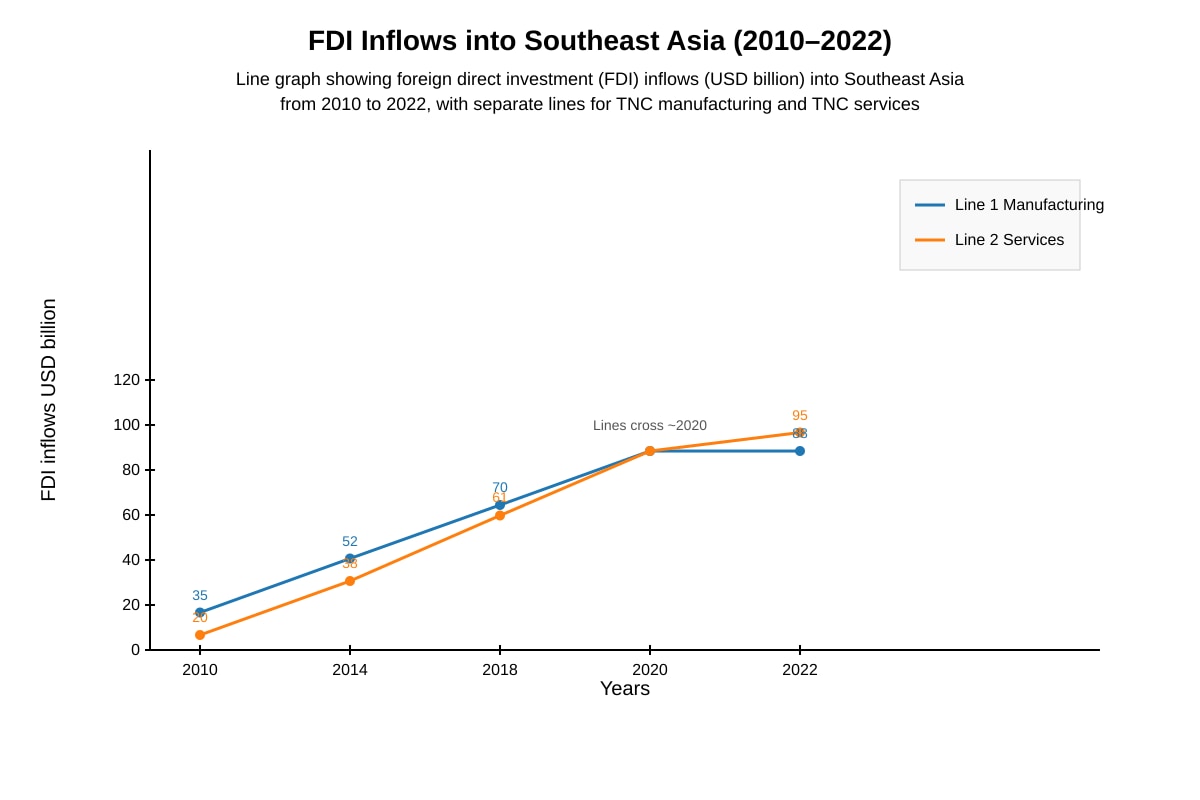
Answer: TNC services FDI rose from USD 20b (2010) to 95b (2022), overtaking manufacturing around 2020. Manufacturing also rose (35→88b) but services grew faster.
Mark breakdown: 1 mark start values, 1 mark end values, 1 mark crossover/relative speed.
Image need: Graph shows two lines, services steeper post-2014.
Q11 [6 marks]
Answer: ICT (internet, ERP, comms) lets Zara coordinate design, orders, inventory globally in real time [2]. Transport tech (container shipping, air freight) moves garments quickly from low-cost hubs to stores [2]. Together they enable fast-fashion GPN with short lead times [2].
Teaching note: Link to template on Zara GPN.
Q12 [4 marks]
Answer: Country D (45k) integrates into high-value trade (services, tech) while B (12.5k) relies on mid-tier manufacturing [2]. Trade flows favour D via capital/labour mobility [2].
Teaching note: Use global trade unevenness concept.
Q13 [2 marks]
Answer: Poor wages / long hours / unsafe conditions for workers in host plants.
Teaching note: Social impact on host, not home.
Q14 [3 marks]
Answer: Country B; GDP per capita 12,500 and internet 67% indicate middle-income emerging status [2], not high (A/D) or low (C) [1].
Section C: Extended (Q15–20)
Q15 [4 marks]
Answer: TNCs seek low-cost, skilled, or abundant labour [2]; e.g., routine manufacturing goes to low-wage states, R&D to skilled hubs [2].
Teaching note: Labour characteristics = cost, skill, availability.
Q16 [6 marks]
Answer: States can set laws, taxes, labour rules [2]; but TNCs may threaten exit, limiting state power [2]; influence varies by state capacity [2].
Markers: AO3 evaluation required.
Q17 [6 marks]
Answer: ASEAN/WTO lower tariffs, set norms [2]; they constrain states but lack enforcement on TNCs [2]; mixed success in equity [2].
Descriptors: L2 (3–4) lists, L3 (5–6) evaluates.
Q18 [4 marks]
Answer: Boserup: tech lifts limits via innovation [2]; limit: uneven access, not all places benefit [2].
Q19 [3 marks]
Answer: NGOs monitor factories, unions bargain, campaigns pressure brands [3].
Q20 [5 marks]
Answer: Data shows A/D high GDP low Gini, C low GDP high Gini → development may reduce inequality if inclusive [3]; but B shows mid GDP moderate Gini, not linear [2].
Teaching note: Use table + concept of Kuznets-style curve cautiously.