AI Generated Quiz
A Level H2 Geography Human Geography Quiz
Free A Level H2 Geography Human Geography quiz, AI version, with questions, answers, and A Level-style practice for Singapore students.
These static practice materials are generated from the site's syllabus and paper-generation workflow, with source and model context shown so students and parents can evaluate the material before use.
Questions
Free quiz and exam paper access
Enter your details to view this paper
Your access is remembered on this device.
Answers
A-Level Geography H2 Quiz - Human Geography: Answer Key
Total Marks: 50
Section A: Short Answer Questions
1. Define the term 'Global Production Network' (GPN) as it applies to the operations of Transnational Corporations (TNCs). [2]
Answer: A Global Production Network (GPN) is the interconnected web of activities, relationships, and flows that a TCN uses to organise the production, distribution, and consumption of a good or service across different locations globally. It involves sourcing raw materials/components from one place, transforming them in another, and distributing the finished product globally, linking home economies, host economies, and markets. [2 marks for a clear, comprehensive definition]
Marking Notes:
- 2 marks: Accurate definition including 'interconnected', 'global', 'from sourcing to consumption', and 'TNC'.
- 1 mark: Partial definition (e.g., only describes supply chain, not the network).
- 0 marks: No relevant definition.
2. State two ways in which a host government can regulate the operations of a Transnational Corporation (TNC) within its borders. [2]
Answer:
- Regulation 1: Imposing environmental standards and regulations (e.g., limits on pollution, requirement for Environmental Impact Assessments).
- Regulation 2: Enforcing labour laws (e.g., minimum wage, maximum working hours, health and safety standards, right to unionise).
Marking Notes:
- 1 mark per valid regulation. Accept other valid examples like: tax laws, intellectual property laws, performance requirements (e.g., local content requirements), profit repatriation controls. Must be a regulation, not just a general observation.
3. Explain one economic impact and one environmental impact of TNC activity on a host economy. [3]
Answer:
- Economic Impact (1.5 marks): TNC activity can stimulate economic growth in the host economy by creating jobs (direct and indirect), transferring advanced technology and management skills, increasing exports, and building infrastructure. For example, a TNC setting up a factory creates local employment and may train local workers in new skills. (1 mark for a clear economic impact, 0.5 for explanation).
- Environmental Impact (1.5 marks): TNC activity can lead to environmental degradation, such as pollution from factories (air, water, soil), resource depletion (e.g., deforestation, mining), and increased carbon emissions from production and transport. This can harm the local environment and contribute to global climate change. (1 mark for a clear environmental impact, 0.5 for explanation).
Marking Notes:
- Award marks for a valid impact and a brief but specific explanation. The explanation must link the impact to the TNC's activity. Accept positive or negative impacts as long as they are correctly stated.
4. What is meant by the term 'labour union'? [1]
Answer: A labour union is an organised group of workers whose main purpose is to represent and protect the collective interests of its members, particularly in negotiations with employers over wages, working conditions, and other terms of employment.
Marking Notes:
- 1 mark: A clear definition that mentions 'collective representation' or 'negotiating with employers'.
- 0 marks: An answer that just says 'a group of workers' without mentioning their purpose.
5. Identify two ways in which labour characteristics can influence TNC locational decisions. [2]
Answer:
- Labour cost: TNCs may be attracted to locations with lower wage rates to reduce production costs.
- Labour skills/education: TNCs may require a workforce with specific skills or a certain level of education (e.g., for high-tech manufacturing), influencing them to locate near universities or in urban clusters.
Marking Notes:
- 1 mark per valid point. Accept other valid characteristics like: availability of labour (size of workforce), labour productivity, labour flexibility (willingness to work shifts/contracts), and labour laws regarding unions.
Section B: Source-Based Analysis
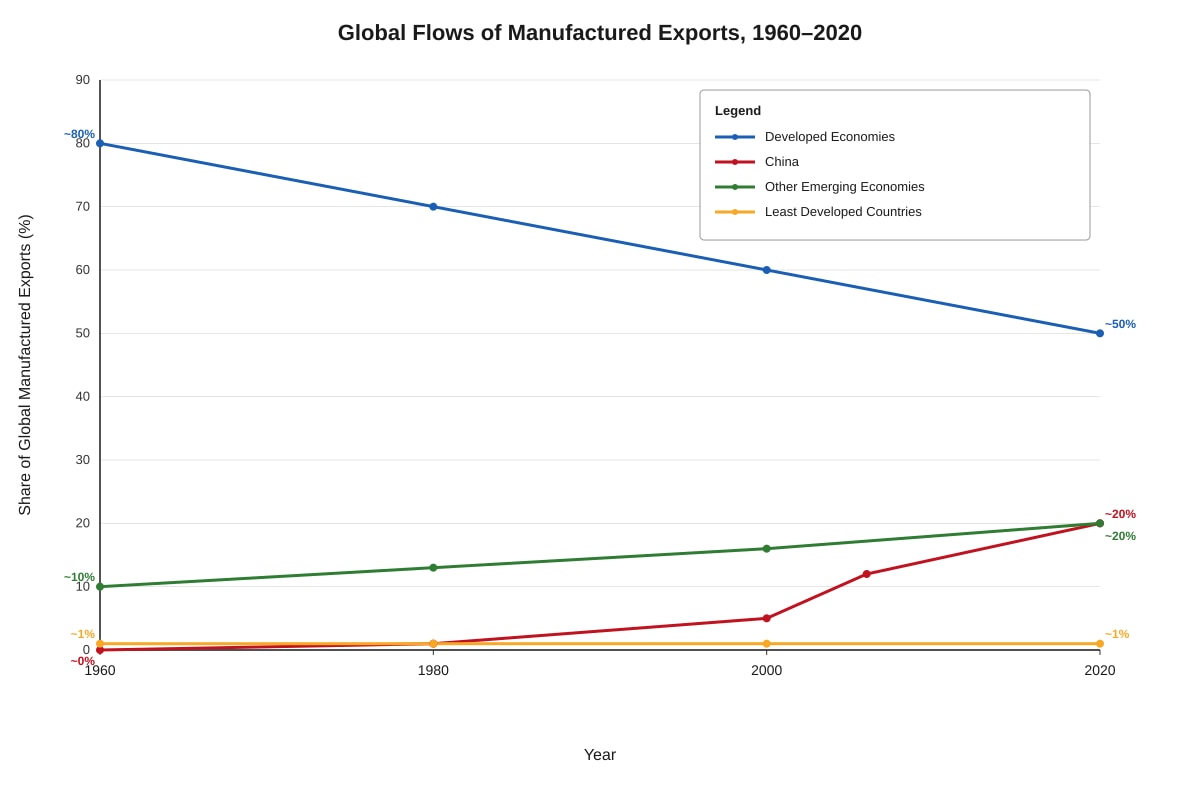
6. Using Resource 1, describe the main shift in the global pattern of manufactured exports between 1960 and 2020. [2]
Answer: The main shift is the declining share of manufactured exports from developed economies and the corresponding rise of China and other emerging economies. In 1960, developed economies dominated with ~80% share, but by 2020 this had fallen to ~50%. China's share rose from near 0% to ~20%, while other emerging economies grew from ~10% to ~20%. Least Developed Countries (LDCs) remained negligible throughout the period.
Marking Notes:
- 2 marks: Accurately describes the decline of developed economies and the rise of China and/or other emerging economies, with reference to data.
- 1 mark: Only describes one part of the shift (e.g., only mentions China's rise) or provides a vague description without data.
- 0 marks: Incorrect description.
7. Explain one way in which the pattern shown in Resource 1 is related to variations in levels of development across space. [2]
Answer: The pattern shows a shift of industrial production from high-development economies (developed) to medium-development economies (China and other emerging). This is because emerging economies, with lower wage costs and rapidly improving infrastructure, can offer TNCs lower production costs, allowing them to industrialise. Meanwhile, developed economies have shifted to services and high-value R&D, but this also means they are increasingly dependent on imports, showing a spatial division of labour. The stagnation of LDCs, often lacking basic infrastructure, capital, and political stability, shows they are not yet attractive to TNCs, reinforcing their low development status.
Marking Notes:
- 2 marks: Clear explanation linking the export shift to a factor of development (e.g., labour cost, infrastructure, industrialisation).
- 1 mark: Partial explanation.
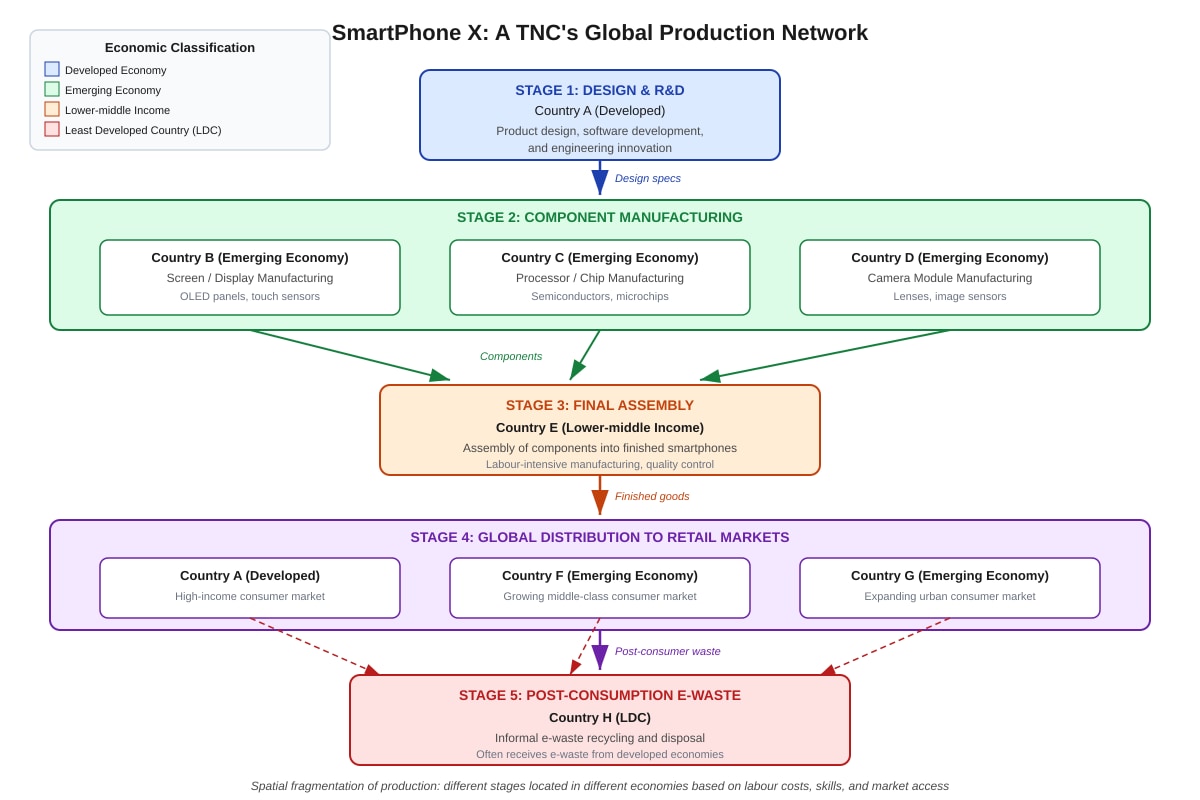
8. Using Resource 2, identify two different roles played by the host economies (Countries B, C, D, and E) in the TNC's global production network. [2]
Answer:
- Roles from Resource 2:
- Component manufacturers (Countries B, C, D): These are the source of specific, high-value parts for the product.
- Final assembler (Country E): This country's role is to bring all the components together to create the finished product for export.
- (or Reception of e-waste (Country H): An LDC's role is as a destination for post-consumer waste.)
Marking Notes:
- 1 mark per role identified. Must be clearly different roles. Accept 'sourcing', 'transformation/manufacturing', or 'consumption/disposal' based on the diagram.
9. Suggest two potential negative social impacts of the SmartPhone X's GPN on the labour force in the assembly country (Country E). [2]
Answer:
- Exploitation of labour: Workers may face low wages, long hours, and poor health and safety conditions if the local government's regulations are weak or unenforced. The desire for the lowest cost assembly often leads to a 'race to the bottom' in labour standards.
- Job insecurity: Assembly work can be insecure, with workers on short-term contracts. The TNC's ability to relocate to an even cheaper country (e.g., Country F) creates constant job precarity.
Marking Notes:
- 1 mark per valid suggestion. Accept other valid impacts. Must be a social impact (on people/community), not an economic one.
10. From Resource 2, explain how this type of GPN connects different places through the processes of sourcing, transformation, and consumption. [3]
Answer:
- Sourcing: Place A (developed) sources intellectual property/design; Places B, C, D (emerging) source components. This connects the TNC's home and host economies.
- Transformation: The components from B, C, D are transformed into a final product in Place E (lower-middle income).
- Consumption: The final product is connected to global markets (Places F, G) for consumption. The link continues as the e-waste is disposed of in Place H (LDC).
Marking Notes:
- 1 mark per part. Student must explicitly link each stage to a 'place' from the diagram to show spatial connection.
11. Using Resource 3, describe one way a multilateral institution can influence a TNC's decision to invest in a particular country. [3]
Answer: The World Bank: It can influence TNCs through the conditions of its loans to developing countries. By funding large infrastructure projects (ports, roads, power grids), the World Bank can make a country more attractive and viable for TNC operations. Its policy advice may also encourage a country to liberalise its economy, making it easier for TNCs to invest. [3 marks for a full explanation linking a specific institution to a clear mechanism of influence.]
Marking Notes:
- 3 marks: Full description of how a specific institution (WB, WTO, or ASEAN) can influence TNC investment, showing a direct link.
- 2 marks: Clear mechanism but lacking detail or specific link to an institution's action.
- 1 mark: Vague or partial description.
12. Explain one challenge faced by the state in regulating a TNC whose operations are spread across multiple countries. [3]
Answer: Regulatory Arbitrage: A major challenge is that TNCs can 'play off' one country against another. If a host government imposes strict regulations (e.g., high taxes or strong environmental laws), the TNC can threaten to move its operations to a different country with weaker rules. This 'race to the bottom' limits the power of any single state to regulate effectively, as it fears losing the economic benefits (jobs, investment) that the TNC brings.
Marking Notes:
- 3 marks: Full explanation of a clear challenge linked to the TNC's multi-country structure.
- 2 marks: Good explanation but missing the link to the multi-jurisdictional nature (e.g., only says 'high costs' without mentioning relocation threat).
- 1 mark: Vague or partial.
13. Using Resources 2 and 3, analyse the relative influence of states and multilateral institutions in shaping the global economy. [3]
Answer:
- States (from Resource 2): States have significant influence by setting the rules (labour, environment, tax) within their borders, which directly impacts the costs and viability of a TNC's operation in that place (e.g., Country E). However, as Resource 2 shows, TNCs can fragment production across multiple states, reducing any single state's power.
- Multilateral Institutions (from Resource 3): Multilateral institutions like the WTO and World Bank can influence the environment in which all states operate. The WTO sets global trade rules, and the World Bank's policy advice can shape a state's own policies, thus creating a framework that influences TNC behaviour. Their influence is broader but often less direct. [3 marks for comparing the influence of states and multilateral institutions, showing an understanding of their different roles and scales.]
Marking Notes:
- 3 marks: A balanced analysis comparing the direct but fragmented influence of states vs. the broader, more structural influence of institutions, using resources.
- 2 marks: Good analysis of one actor but not a clear comparison.
- 1 mark: Describes one actor's role without analysis.
Section C: Essay Question
14. 'The positive impacts of Transnational Corporations (TNCs) on host economies far outweigh the negative impacts.' Discuss. [20]
Examiner's Guidance: This is a high-level discussion question that requires evaluation, not just description. To achieve high marks, a candidate must present a balanced argument and arrive at a reasoned conclusion.
Structure and Content Points:
Introduction (2-3 marks)
- Define TNCs and state their global importance.
- Define 'host economy' and clarify that this varies by level of development.
- State that you will argue that the statement is overly simplistic. The net impact is highly dependent on the type of TNC, the host country's regulatory capacity, and the power of other actors (labour, state, MNIs).
Arguments for the Statement (Positive Impacts Outweigh) (8-10 marks)
- Economic Benefits (AO2/AO3):
- Capital and Jobs: Bring significant FDI and create direct and indirect employment, reducing poverty. Example: Garment factories in Bangladesh.
- Technology Transfer: Introduce new tech and skills to local workforce, boosting overall national productivity. Example: Toyota's manufacturing plants in Thailand.
- Infrastructure: Build ports, roads, and power grids that benefit the wider economy.
- Export Growth: Increase host country's exports and foreign exchange earnings, improving the balance of payments.
- Environmental Benefits (AO2/AO3):
- Some TNCs may bring higher environmental standards than local firms.
- They have the capital for cleaner, more efficient technology.
- Social Benefits (AO2/AO3):
- Often pay higher wages than local firms.
- May provide better social benefits (healthcare, training).
Arguments Against the Statement (Negative Impacts are Significant) (8-10 marks)
- Economic Costs (AO2/AO3):
- Profit Repatriation: Most profits go back to the TNC's home country, not invested locally.
- Crowding out: TNCs can outcompete and destroy local businesses.
- Race to the bottom: Competition between states to attract TNCs can lead to a 'race to the bottom' in tax rates, wages, and standards.
- Environmental Costs (AO2/AO3):
- Pollution Halo/Haven: TNCs may move polluting operations to countries with weak environmental regulations. Example: the Bhopal disaster linked to Union Carbide (a TNC).
- Resource Depletion: Unsustainable extraction of non-renewable resources (minerals, oil).
- Social Costs (AO2/AO3):
- Labour Exploitation: Poor working conditions, low safety standards, suppression of labour rights (e.g., Rana Plaza in Bangladesh).
- Cultural Erosion: Imposition of global brands and consumer culture.
- Role of Other Actors (AO2/AO3):
- States: The effectiveness of state regulation varies. Strong states can mitigate negatives; weak states cannot.
- Labour: Unions can protect workers, but are often weak in export processing zones (EPZs).
- Multilateral Institutions: The WTO's rules on IP can limit technology diffusion. IMF/World Bank's conditions for loans may force countries to deregulate to attract TNCs.
Conclusion (2-3 marks)
- It is unwise to make a universal claim.
- The outcome is contingent on: the nature of the TNC (resource extractor vs light manufacturing), the sector (oil is more destructive than software), the strength of the host government and its institutions, and the engagement of civil society and labour.
- A more accurate statement is: TNCs can be a powerful force for development, but their negative impacts can be severe and require robust governance and the active involvement of multiple actors (states, labour, civil society, MNIs) to mitigate. The 'weight' of impacts is not inherent but is managed by the context.
Marking Descriptors:
| Level | Marks | Descriptor |
|---|---|---|
| 1 | 1-6 | Descriptive answer; lists positives or negatives with little evaluation; limited use of evidence or examples. |
| 2 | 7-12 | Balanced description but weak evaluation; offers both sides but does not 'discuss' the extent; simple conclusion. |
| 3 | 13-17 | Good discussion; clear analysis of both sides with some attempt to compare their significance; uses relevant examples; has a clear, justified conclusion. |
| 4 | 18-20 | Excellent discussion; nuanced and sophisticated analysis; shows understanding of contingency (it depends on...) and the role of different actors; well-structured with a strong, evidence-based conclusion that directly addresses the 'far outweigh' part of the statement. |
Section D: Structured Response
15. State one key distinction between 'proven reserves' and 'conditional reserves' of a non-renewable resource. [1]
Answer: Proven reserves are those that have a high degree of certainty of being economically extractable under current conditions. Conditional (or probable) reserves are those that are less certain or require more favourable economic/technological conditions to be extracted.
Marking Notes:
- 1 mark: Correct distinction based on certainty and/or economic/technical feasibility.
- 0 marks: Vague or incorrect answer.
16. How does the concept of 'regenerative capacity' relate to the definition of a renewable resource? [1]
Answer: A renewable resource is defined by its ability to be replenished or regenerated by natural processes at a rate equal to or greater than its rate of consumption (human use). The regenerative capacity sets the maximum sustainable yield.
Marking Notes:
- 1 mark: Correctly links regeneration to replenishment and sustainability. Accept 'if used faster than regeneration, it becomes non-renewable'.
17. Explain one role of labour unions in regulating the working conditions of labour employed by TNCs. [2]
Answer: Labour unions act as a collective voice for workers. This allows them to negotiate with TNC management from a stronger position. They can push for better wages, safer working conditions (e.g., fire exits, protective equipment), limits on working hours, and job security, reducing the risk of exploitation. [2 marks for full explanation linking union action to impact on TNC conditions.]
Marking Notes:
- 2 marks: Clear explanation of how unions use collective bargaining to influence conditions.
- 1 mark: States union role but does not explain how it works.
18. Suggest one reason why a TNC might choose to locate its manufacturing operations in a country with weak environmental regulations. [1]
Answer: To reduce operational costs. Strict environmental regulations require investment in expensive pollution control technology, waste treatment, and ongoing monitoring. By locating in a country with weak regulations, the TNC can externalise these environmental costs, increasing its profit margins.
Marking Notes:
- 1 mark: Correctly identifies cost reduction/profit maximisation. Accept 'pollution haven' hypothesis.
19. Explain one limitation of using GDP per capita as a measure of development for comparing the impact of a TNC on different host economies. [2]
Answer: GDP per capita is an average income figure. It does not show how the wealth generated by the TNC is distributed within the host economy. The TNC's profits may be repatriated to its home country, so the increase in GDP may be modest. The GDP increase might not benefit the local population if it is concentrated among foreign shareholders or a small urban elite, failing to measure the quality of life or inequality. [2 marks for a clear explanation of how TNC profits can distort the measure.]
Marking Notes:
- 2 marks: Full explanation linking TNC activity to a flaw of GDP per capita (distribution, repatriation, inequality).
- 1 mark: Identifies the correct flaw but does not link it to TNCs.
20. Describe one possible trade-off a host developing country might face when deciding whether to attract a large TNC for resource extraction. [3]
Answer: Economic vs. Environmental Trade-off:
- Economic Gain (Pros): The TNC brings significant foreign investment, creates jobs (especially for low-skilled workers), pays taxes and royalties to the government, and builds local infrastructure (e.g., roads, ports). This provides a major short-term boost to the national economy.
- Environmental Loss (Cons): Resource extraction (e.g., mining, oil drilling) can cause irreversible environmental damage: deforestation, water and soil pollution from tailings/spills, loss of biodiversity, and long-term health problems for local communities. The country may be left with a 'resource curse' where the economy is dependent on this one industry, and the environmental cleanup costs are enormous.
- The Trade-off: The government must decide if the immediate and tangible benefits of economic growth and poverty reduction justify the potentially long-lasting and difficult-to-reverse environmental harm. [3 marks for a clear description of both sides of the trade-off, showing the conflict.]
Marking Notes:
- 3 marks: Clearly describes a trade-off between two conflicting goals (e.g., economic gain vs environmental cost; short-term development vs long-term sustainability).
- 2 marks: Describes both the benefit and the cost but does not frame it as a trade-off.
- 1 mark: Only mentions one side of the issue.