AI Generated Quiz
A Level H2 Geography Human Geography Quiz
Free A Level H2 Geography Human Geography quiz, AI version, with questions, answers, and A Level-style practice for Singapore students.
These static practice materials are generated from the site's syllabus and paper-generation workflow, with source and model context shown so students and parents can evaluate the material before use.
Questions
Free quiz and exam paper access
Enter your details to view this paper
Your access is remembered on this device.
Answers
Answer Key
Section A: Short-Answer Questions (15 marks)
1. Define the term 'Global Production Network' (GPN) as used in economic geography. [3]
Answer: A Global Production Network (GPN) is a complex, interconnected web of firms, suppliers, subcontractors, distributors, and other actors (such as governments, labour unions, and NGOs) that are involved in the production of a good or service across multiple countries. It encompasses the entire value chain—from raw material extraction, through design, manufacturing, and assembly, to distribution and after-sales services—and highlights the power relations and governance structures that shape how value is created, captured, and distributed across different places.
Marking Notes:
- 1 mark for identifying the interconnected nature of firms/actors.
- 1 mark for mentioning the cross-border/multi-country aspect.
- 1 mark for referring to the value chain or production process (including governance/power relations).
2. State two characteristics of Transnational Corporations (TNCs) that distinguish them from domestic firms. [2]
Answer:
- TNCs own or control production facilities (or other value-adding activities) in more than one country.
- TNCs coordinate and integrate operations across national borders, often through foreign direct investment (FDI) and intra-firm trade.
Marking Notes:
- 1 mark for each correct characteristic (any two of the following): multi-country presence, cross-border coordination, FDI, global sourcing, intra-firm trade, global brand/strategy.
3. Explain one way in which labour characteristics influence the locational decisions of TNCs. [3]
Answer: Labour cost is a key factor. TNCs often locate labour-intensive manufacturing in countries with low wages (e.g., Bangladesh, Vietnam) to reduce production costs and remain competitive. For example, a garment TNC may shift production from China to Vietnam because average monthly manufacturing wages are significantly lower (US850), allowing the firm to achieve higher profit margins. However, TNCs also consider labour skills, productivity, and labour regulations; high-skilled activities (e.g., R&D) may be located in countries with a well-educated workforce even if wages are higher.
Marking Notes:
- 1 mark for identifying a labour characteristic (cost, skills, productivity, flexibility, unionisation).
- 1 mark for explaining how it influences location (e.g., cost-cutting, access to skills).
- 1 mark for a concrete example or elaboration.
4. Identify two types of capital flows that connect countries in the global economy. [2]
Answer:
- Foreign Direct Investment (FDI) – investment by a firm in production or business operations in another country (e.g., building a factory).
- Portfolio investment – purchase of financial assets (stocks, bonds) in another country without direct control.
Marking Notes:
- 1 mark for each correct type. Accept also: remittances, official development assistance, trade credit, etc.
5. Describe the concept of 'uneven development' as it applies to different places within a single country. [3]
Answer: Uneven development refers to the unequal distribution of economic activity, wealth, infrastructure, and opportunities across different regions within a country. For example, in China, coastal provinces (e.g., Guangdong, Shanghai) have attracted far more FDI and experienced rapid industrialisation, while inland provinces (e.g., Gansu, Guizhou) remain poorer and less developed. This is often due to historical factors, government policies (e.g., SEZs on the coast), access to ports, and agglomeration economies.
Marking Notes:
- 1 mark for defining uneven development as spatial inequality.
- 1 mark for providing a clear example within a country.
- 1 mark for explaining a cause (policy, geography, agglomeration).
Section B: Data-Response Questions (25 marks)
6. Using Resource A, describe the trend in FDI inflows to Developing Asia between 2020 and 2024. [2]
Answer: FDI inflows to Developing Asia increased steadily from US701 billion in 2024, representing a rise of approximately 31% over the five-year period. The growth was consistent year-on-year, with the largest absolute increase occurring between 2020 and 2021 (US$84 billion).
Marking Notes:
- 1 mark for identifying the overall upward trend.
- 1 mark for providing specific figures or percentage change.
7. Using Resources A and B, explain why TNCs might choose to locate manufacturing operations in Vietnam rather than Singapore. [4]
Answer: TNCs would likely choose Vietnam over Singapore for manufacturing due to significantly lower labour costs. Resource B shows that the average monthly manufacturing wage in Vietnam is US4,500 in Singapore – a difference of over 14 times. For labour-intensive industries (e.g., textiles, electronics assembly), this cost advantage is crucial for maintaining competitiveness. Additionally, Resource A shows that Developing Asia (which includes Vietnam) has been attracting increasing FDI inflows, indicating a favourable investment climate. While Singapore offers better infrastructure, political stability, and a skilled workforce, these advantages may not outweigh the cost savings for mass production. Vietnam also benefits from proximity to regional supply chains and trade agreements.
Marking Notes:
- 1 mark for citing the wage differential (Vietnam US4,500).
- 1 mark for explaining the importance of labour costs for manufacturing.
- 1 mark for using Resource A (increasing FDI to Developing Asia).
- 1 mark for a balanced consideration (e.g., acknowledging Singapore's advantages but explaining why cost dominates).
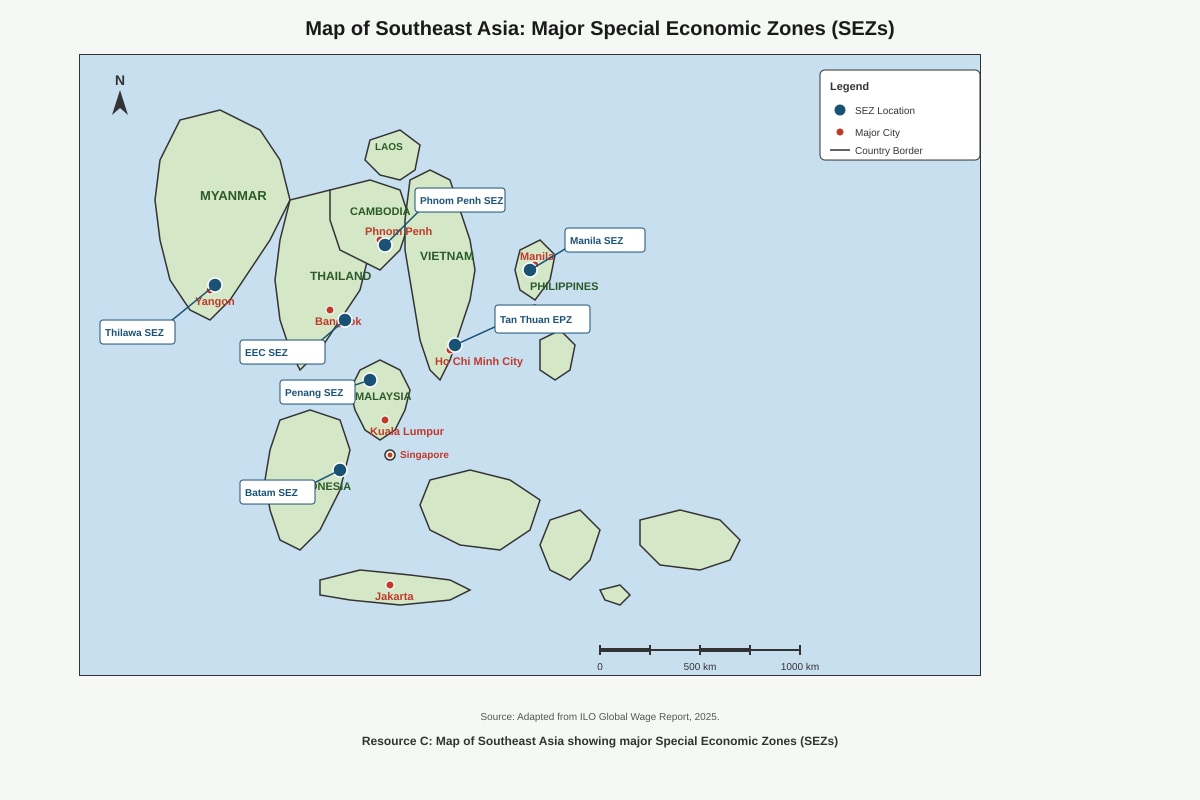
8. With reference to Resource C, suggest two reasons why governments establish Special Economic Zones (SEZs) to attract TNC investment. [4]
Answer:
-
To provide infrastructure and incentives: SEZs offer purpose-built infrastructure (roads, power, ports, telecommunications) and fiscal incentives (tax holidays, duty-free imports) that reduce the cost and risk for TNCs. For example, the Tan Thuan Export Processing Zone in Vietnam provides reliable utilities and streamlined customs procedures, making it attractive for foreign investors.
-
To promote industrialisation and job creation: By concentrating investment in specific locations, SEZs create employment opportunities, transfer technology and skills, and stimulate local supplier networks. The Phnom Penh SEZ in Cambodia, for instance, has attracted garment factories that employ thousands of workers, contributing to export earnings and poverty reduction.
Marking Notes:
- 1 mark for each valid reason (infrastructure/incentives, job creation, export promotion, technology transfer, regional development).
- 1 mark for each reason supported by reference to Resource C (e.g., naming a specific SEZ or location).
9. Explain how improvements in transport and communication technologies have facilitated the growth of Global Production Networks. [5]
Answer: Improvements in transport technologies (e.g., containerisation, larger cargo ships, air freight) have drastically reduced the cost and time of moving goods across borders. This allows TNCs to break production into stages and locate each stage in the most cost-effective country. For example, components may be made in China, assembled in Vietnam, and shipped to global markets.
Improvements in communication technologies (e.g., the internet, satellite communications, enterprise software) enable real-time coordination and monitoring of production across multiple sites. TNCs can manage complex supply chains, share design specifications instantly, and respond quickly to changes in demand. This reduces the need for geographical proximity and allows firms to exploit differences in labour costs, skills, and regulations worldwide.
Together, these technologies have lowered the "friction of distance" and made it feasible to coordinate fragmented production networks, thereby accelerating the growth of GPNs.
Marking Notes:
- 1 mark for transport improvements (containerisation, speed, cost reduction).
- 1 mark for communication improvements (internet, real-time coordination).
- 1 mark for explaining how this enables fragmentation of production.
- 1 mark for explaining how this enables global coordination.
- 1 mark for a concrete example or synthesis.
10. Evaluate the role of multilateral institutions (e.g., WTO, World Bank) in shaping the operations of TNCs in developing countries. [5]
Answer: Multilateral institutions play a significant but contested role in shaping TNC operations.
Positive roles:
- The WTO establishes rules for international trade (e.g., reducing tariffs, protecting intellectual property), creating a predictable environment for TNC investment. This encourages FDI in developing countries that comply with WTO standards.
- The World Bank provides loans and technical assistance for infrastructure projects (e.g., ports, power plants) that TNCs rely on. It also promotes good governance and legal reforms, reducing investment risk.
Negative/limiting roles:
- Critics argue that WTO rules often favour TNC interests (e.g., TRIPS agreements) at the expense of local industries and public health in developing countries.
- World Bank structural adjustment programmes have sometimes forced developing countries to liberalise markets, privatise state enterprises, and cut social spending, which can increase inequality and make countries more dependent on TNCs.
Evaluation: Overall, these institutions have facilitated TNC expansion by creating a more open and stable global economy, but their policies have also been criticised for prioritising corporate interests over developmental needs. The extent of their influence varies by country and context.
Marking Notes:
- 1 mark for identifying at least one positive role.
- 1 mark for identifying at least one negative role.
- 1 mark for using specific examples (WTO, World Bank, IMF).
- 1 mark for explaining how these roles shape TNC operations.
- 1 mark for a balanced evaluation/conclusion.
Section C: Essay Questions (20 marks)
11. Discuss the extent to which TNCs contribute to the economic development of their home countries. [5]
Answer: TNCs contribute to their home countries' economic development in several ways:
Positive contributions:
- Repatriation of profits: TNCs bring back profits from overseas operations, boosting national income and the balance of payments.
- High-value jobs: TNCs maintain headquarters, R&D, and high-skilled functions in their home country, providing well-paid employment.
- Tax revenue: Corporate taxes on overseas profits (where applicable) contribute to government revenue.
- Innovation and competitiveness: TNCs invest heavily in R&D at home, driving technological progress and productivity spillovers to domestic firms.
- Soft power and trade: TNCs promote the home country's brand and expand export markets.
Negative/limiting factors:
- Offshoring of jobs: TNCs may move manufacturing abroad, leading to job losses in the home country, particularly in lower-skilled sectors.
- Tax avoidance: Many TNCs use transfer pricing and offshore tax havens to minimise tax payments, reducing home-country revenue.
- Loss of industrial base: Over time, the home country may become hollowed out as production shifts overseas, weakening domestic manufacturing.
Evaluation: The net contribution depends on the type of TNC, the sector, and government policies. For example, the US benefits from Apple's innovation and profits, but has lost millions of manufacturing jobs. In contrast, Germany's Mittelstand TNCs have maintained strong domestic production. Overall, TNCs generally contribute positively to home-country development, but the benefits are unevenly distributed and require active government management.
Marking Notes:
- 1 mark for identifying at least two positive contributions.
- 1 mark for identifying at least one negative impact.
- 1 mark for using a specific example (e.g., Apple, Toyota, Samsung).
- 1 mark for explaining the conditions under which contributions are maximised.
- 1 mark for a balanced conclusion.
12. 'The influence of states over Transnational Corporations has declined in the era of globalisation.' To what extent do you agree with this statement? [20]
Answer: Introduction: Globalisation has increased the mobility of capital and the power of TNCs, leading some to argue that states have lost control over corporate behaviour. However, states retain significant influence through regulation, incentives, and bargaining power. This essay will evaluate the extent to which state influence has declined.
Arguments that state influence has declined:
- Capital mobility: TNCs can relocate production easily, forcing states to compete for investment by lowering taxes, relaxing labour laws, and reducing environmental standards (the "race to the bottom").
- Regulatory arbitrage: TNCs can shift profits to low-tax jurisdictions, eroding the tax base of states.
- Trade agreements: WTO rules and bilateral investment treaties limit the ability of states to impose tariffs, local content requirements, or performance standards on TNCs.
- Supranational power: Institutions like the WTO and IMF can pressure states to liberalise markets, reducing state autonomy.
Arguments that state influence remains strong:
- Regulatory power: States still set the legal framework within which TNCs operate, including labour laws, environmental standards, and competition policy. For example, the EU's GDPR has forced TNCs like Google and Facebook to change their data practices.
- Incentives and bargaining: States can attract or deter TNCs through subsidies, tax breaks, infrastructure provision, and access to markets. Large economies like China and India have significant bargaining power.
- Strategic industries: States can protect or control key sectors (e.g., defence, energy, telecommunications) through ownership, licensing, or restrictions on foreign ownership.
- Crisis intervention: During economic crises, states have intervened to bail out or regulate TNCs (e.g., the 2008 financial crisis).
- Geopolitical power: States can use sanctions, export controls, and security reviews to shape TNC behaviour (e.g., US restrictions on Huawei).
Evaluation: The extent of state influence varies by country and sector. Developing countries with weak institutions and high dependence on FDI may have less influence, while developed countries with large markets and strong legal systems retain considerable power. Also, states have adapted by cooperating regionally (e.g., EU) to regulate TNCs collectively.
Conclusion: While globalisation has reduced some traditional levers of state control (e.g., tariffs, capital controls), states have not become powerless. They have developed new tools and continue to shape TNC behaviour through regulation, incentives, and strategic bargaining. Therefore, the statement is only partially true; state influence has changed rather than simply declined.
Marking Notes:
- 2-3 marks for a clear introduction and thesis.
- 4-5 marks for well-developed arguments supporting the statement (with examples).
- 4-5 marks for well-developed arguments against the statement (with examples).
- 2-3 marks for evaluation of the extent (e.g., variation by country/sector).
- 2-3 marks for a balanced conclusion.
- 1-2 marks for structure, clarity, and use of geographical terminology.
13. Explain how the spatial organisation of TNCs affects the distribution of economic activities across different regions. [5]
Answer: TNCs organise their operations across multiple locations, creating a spatial division of labour that shapes regional economic development.
Key effects:
- Concentration in core regions: TNCs often locate headquarters, R&D, and high-value functions in major cities or developed regions (e.g., Silicon Valley, London), leading to agglomeration of high-skilled jobs and innovation.
- Peripheral production sites: Manufacturing and assembly are often located in developing regions with low labour costs (e.g., Southeast Asia, Mexico), creating industrial clusters but often with lower wages and weaker labour protections.
- Uneven development: This spatial organisation can reinforce existing inequalities, as core regions capture more value while peripheral regions remain dependent on low-cost production.
- Spillover effects: In some cases, TNCs stimulate local supplier networks and skill development in host regions (e.g., Penang, Malaysia), leading to industrial upgrading.
- Footloose industries: Some TNCs are highly mobile and may relocate quickly, causing boom-and-bust cycles in regions that become overly dependent on a single firm.
Marking Notes:
- 1 mark for explaining the core-periphery pattern.
- 1 mark for explaining the spatial division of labour.
- 1 mark for a concrete example (e.g., Apple in China, Toyota in Thailand).
- 1 mark for discussing positive spillovers or upgrading.
- 1 mark for discussing negative effects (uneven development, footloose industries).
14. With reference to a named developing country, evaluate the effectiveness of government policies in attracting FDI. [5]
Answer: Example: Vietnam
Policies:
- Special Economic Zones (SEZs): Vietnam has established SEZs (e.g., Tan Thuan, Dinh Vu) offering tax incentives, streamlined customs, and infrastructure.
- Trade liberalisation: Vietnam joined the WTO (2007) and signed numerous FTAs (e.g., CPTPP, EVFTA), reducing tariffs and opening markets.
- Investment law reforms: The 2020 Investment Law simplified licensing and allowed 100% foreign ownership in most sectors.
- Infrastructure investment: Government spending on ports, highways, and power generation has improved logistics.
Effectiveness:
- FDI inflows to Vietnam have increased dramatically, from ~US30 billion in 2024, making it a top FDI destination in Southeast Asia.
- SEZs have created jobs and boosted exports, particularly in electronics (Samsung) and textiles.
- However, challenges remain: bureaucratic red tape, corruption, and inadequate infrastructure in some regions. Also, FDI has been concentrated in a few provinces, exacerbating regional inequality.
Evaluation: Overall, Vietnam's policies have been highly effective in attracting FDI, but the benefits are unevenly distributed, and the country remains vulnerable to global economic shifts.
Marking Notes:
- 1 mark for naming a specific country.
- 1 mark for identifying at least two policies.
- 1 mark for providing evidence of success (FDI figures, examples).
- 1 mark for identifying limitations/challenges.
- 1 mark for a balanced evaluation.
15. Discuss the role of labour migration in shaping Global Production Networks. [5]
Answer: Labour migration is both a cause and consequence of GPN development.
Role:
- Supply of labour: GPNs require large numbers of workers, especially in labour-intensive industries. Migration from rural areas to industrial zones (e.g., from inland China to coastal factories) provides the necessary workforce.
- Cost differentials: International migration (e.g., from Bangladesh to Malaysia, or from Mexico to the US) can fill labour shortages in host countries while maintaining lower wage costs.
- Skill transfer: Migrant workers may acquire skills abroad and return home, contributing to local industrial development (e.g., Taiwanese engineers returning to China).
- Remittances: Migrant workers send remittances to their home countries, which can fund local consumption and investment, indirectly supporting GPN-related activities.
- Diaspora networks: Migrant communities often facilitate trade and investment between their home and host countries, helping TNCs navigate new markets.
Challenges:
- Labour migration can create social tensions, exploitation, and precarious working conditions.
- Over-reliance on migrant labour can make regions vulnerable to sudden shifts in migration policy or demand.
Marking Notes:
- 1 mark for identifying labour migration as a source of labour supply.
- 1 mark for explaining cost differentials.
- 1 mark for discussing skill transfer or remittances.
- 1 mark for a concrete example.
- 1 mark for discussing challenges or a balanced view.
Section D: Extended Essay Questions (20 marks)
16. 'Globalisation has led to a convergence of economic practices across countries.' To what extent do you agree? [20]
Answer: Introduction: Globalisation has increased interconnectedness, leading some to argue that economic practices are becoming more similar worldwide. However, significant differences persist due to local institutions, culture, and state policies. This essay will evaluate the extent of convergence.
Arguments for convergence:
- Adoption of market-based systems: Most countries have embraced capitalism, privatisation, and trade liberalisation, reducing the role of the state in the economy.
- Standardisation of production: TNCs spread uniform production methods, quality standards (e.g., ISO), and management practices (e.g., lean production) across countries.
- Harmonisation of regulations: International bodies (WTO, IMF) and trade agreements push countries to adopt similar legal and regulatory frameworks (e.g., intellectual property laws).
- Technology diffusion: The spread of digital technologies and the internet has led to similar business models (e.g., e-commerce, fintech) worldwide.
Arguments against convergence:
- Varieties of capitalism: Countries maintain distinct economic models (e.g., Anglo-American liberal market economies vs. German/Japanese coordinated market economies) with different labour relations, corporate governance, and welfare systems.
- State intervention: Countries like China and Singapore use state-led development strategies, including state-owned enterprises and industrial policy, which differ from Western free-market approaches.
- Cultural and institutional differences: Local norms, trust, and informal institutions shape how economic practices are implemented (e.g., guanxi in China, keiretsu in Japan).
- Uneven integration: Many developing countries remain marginalised from global value chains, and their economic practices differ significantly from advanced economies.
Evaluation: Convergence is partial and uneven. While there is a broad trend towards market-oriented policies and standardised production, deep institutional and cultural differences persist. Moreover, even where practices converge, they may be adapted to local contexts, resulting in hybrid forms.
Conclusion: Globalisation has promoted convergence in some areas (trade, technology, corporate governance), but it has not eliminated diversity. The extent of convergence varies by sector, country, and level of development. Therefore, the statement is only partially true.
Marking Notes:
- 2-3 marks for a clear introduction and thesis.
- 4-5 marks for well-developed arguments supporting convergence (with examples).
- 4-5 marks for well-developed arguments against convergence (with examples).
- 2-3 marks for evaluation of the extent (e.g., partial, uneven).
- 2-3 marks for a balanced conclusion.
- 1-2 marks for structure, clarity, and use of geographical terminology.
17. Evaluate the impact of TNCs on the environment in developing countries. [20]
Answer: Introduction: TNCs have significant environmental impacts in developing countries, both positive and negative. This essay will evaluate these impacts, considering the trade-offs between economic development and environmental sustainability.
Negative impacts:
- Pollution and resource depletion: TNCs in extractive industries (oil, mining) and manufacturing often cause air, water, and soil pollution. For example, oil spills in the Niger Delta (Shell) have devastated local ecosystems.
- Carbon emissions: TNCs' global supply chains contribute significantly to greenhouse gas emissions, with production often shifted to countries with weaker environmental regulations.
- Deforestation and habitat loss: Agricultural TNCs (e.g., palm oil in Indonesia) have cleared vast areas of rainforest, threatening biodiversity.
- Waste and e-waste: TNCs generate large amounts of waste, and developing countries often become dumping grounds for hazardous waste.
Positive impacts:
- Technology transfer: TNCs may bring cleaner technologies and environmental management practices to host countries.
- Environmental standards: Some TNCs adopt global environmental standards (e.g., ISO 14001) that exceed local regulations, raising the bar for domestic firms.
- Green investment: TNCs are increasingly investing in renewable energy and sustainable practices in developing countries (e.g., solar projects in India).
- Corporate social responsibility (CSR): Many TNCs fund environmental conservation projects and community initiatives.
Evaluation: The net environmental impact of TNCs is generally negative, especially in developing countries with weak regulatory frameworks. However, the impact varies by sector, firm, and host country. TNCs can be part of the solution if they adopt sustainable practices and if host governments enforce strong environmental regulations. International pressure and consumer activism are also pushing TNCs to improve their environmental record.
Conclusion: While TNCs have contributed to environmental degradation in developing countries, they also have the potential to promote sustainable development. The key is effective regulation, both at the national and international levels, and greater corporate accountability.
Marking Notes:
- 2-3 marks for a clear introduction and thesis.
- 4-5 marks for well-developed negative impacts (with examples).
- 4-5 marks for well-developed positive impacts (with examples).
- 2-3 marks for evaluation of the balance and context-dependence.
- 2-3 marks for a balanced conclusion.
- 1-2 marks for structure, clarity, and use of geographical terminology.
18. Discuss the extent to which Special Economic Zones (SEZs) have been successful in promoting economic development in Southeast Asia. [20]
Answer: Introduction: Special Economic Zones (SEZs) have been widely used in Southeast Asia to attract FDI, promote exports, and create jobs. Their success varies across countries and zones, and this essay will evaluate their overall contribution to economic development.
Successes:
- FDI attraction: SEZs have been highly effective in attracting FDI. For example, Vietnam's SEZs have drawn major electronics manufacturers like Samsung, contributing to the country's export boom.
- Export growth: SEZs have boosted exports, particularly in manufacturing (e.g., garments in Cambodia, electronics in Malaysia's Penang).
- Job creation: SEZs have created millions of jobs, providing income and skills for local workers.
- Infrastructure development: SEZs often include improved roads, ports, and power supply, which benefit the wider region.
- Industrial upgrading: Some SEZs have evolved from simple assembly to higher-value activities (e.g., Penang's shift from assembly to R&D).
Failures/limitations:
- Uneven development: SEZs are often concentrated in coastal areas, exacerbating regional inequality.
- Low wages and poor working conditions: Many SEZ workers face low pay, long hours, and limited labour rights (e.g., garment factories in Cambodia).
- Limited linkages: SEZs often operate as enclaves, with few links to local suppliers, limiting technology transfer and spillover effects.
- Fiscal costs: Tax incentives and subsidies can be costly for governments, with benefits not always outweighing the costs.
- Environmental degradation: SEZs can cause pollution and resource depletion.
Evaluation: SEZs have been broadly successful in promoting export-led growth and attracting FDI, but their contribution to broader, inclusive development is more mixed. Success depends on factors such as governance, infrastructure, labour policies, and the ability to create linkages with the local economy. Some countries (e.g., Singapore) have used SEZs effectively as part of a broader development strategy, while others have seen more limited benefits.
Conclusion: SEZs have been a useful tool for economic development in Southeast Asia, but their success is conditional and uneven. To maximise benefits, governments need to invest in human capital, enforce labour and environmental standards, and promote linkages between SEZs and the domestic economy.
Marking Notes:
- 2-3 marks for a clear introduction and thesis.
- 4-5 marks for well-developed successes (with examples).
- 4-5 marks for well-developed limitations (with examples).
- 2-3 marks for evaluation of the conditions for success.
- 2-3 marks for a balanced conclusion.
- 1-2 marks for structure, clarity, and use of geographical terminology.
19. 'The role of the state in economic development has been weakened by globalisation.' To what extent do you agree? [20]
Answer: Introduction: Globalisation has increased the power of markets and TNCs, leading some to argue that the state's role in economic development has diminished. However, states remain central actors, albeit with changed roles. This essay will evaluate the extent of this weakening.
Arguments that the state's role has weakened:
- Trade liberalisation: WTO rules and free trade agreements limit the use of tariffs, subsidies, and other protectionist measures, reducing state control over domestic industries.
- Capital mobility: TNCs can relocate easily, making it harder for states to regulate or tax them. States compete for FDI by lowering standards, reducing their policy autonomy.
- Supranational institutions: The IMF, World Bank, and WTO impose conditions on developing countries (e.g., structural adjustment programmes) that limit state intervention.
- Privatisation: Globalisation has encouraged the privatisation of state-owned enterprises, reducing the state's direct role in production.
Arguments that the state's role remains strong:
- Industrial policy: Many states, especially in East Asia (e.g., China, South Korea), have used active industrial policy to promote specific sectors, despite globalisation.
- Regulation: States still set the rules for markets, including labour, environmental, and competition laws. They can also regulate TNCs (e.g., data localisation in China, antitrust actions in the US and EU).
- Provision of public goods: States remain responsible for infrastructure, education, and healthcare, which are essential for development.
- Crisis management: The 2008 financial crisis and COVID-19 pandemic showed that states can and do intervene massively in the economy.
- Geopolitics: States use trade policy, sanctions, and export controls to shape economic outcomes (e.g., US-China trade war).
Evaluation: The state's role has changed rather than simply weakened. In some areas (e.g., trade barriers, capital controls), state power has declined. In others (e.g., regulation, crisis management), it has remained strong or even increased. The extent of weakening varies by country: developing countries with weak institutions may be more constrained, while powerful states like China and the US retain significant autonomy.
Conclusion: Globalisation has constrained certain traditional state functions, but states have adapted and continue to play a crucial role in economic development. The statement is therefore only partially true.
Marking Notes:
- 2-3 marks for a clear introduction and thesis.
- 4-5 marks for well-developed arguments supporting the statement (with examples).
- 4-5 marks for well-developed arguments against the statement (with examples).
- 2-3 marks for evaluation of the extent (e.g., variation by country/policy area).
- 2-3 marks for a balanced conclusion.
- 1-2 marks for structure, clarity, and use of geographical terminology.
20. Evaluate the extent to which TNCs have contributed to the reduction of global inequality. [20]
Answer: Introduction: Global inequality remains high, but there have been significant changes in its distribution. TNCs have played a complex role, both reducing and exacerbating inequality. This essay will evaluate the extent of their contribution.
Arguments that TNCs have reduced inequality:
- Economic growth in developing countries: TNC investment has contributed to rapid growth in countries like China, India, and Vietnam, lifting hundreds of millions out of poverty. For example, FDI in China's manufacturing sector has been a key driver of its economic rise.
- Job creation: TNCs create employment, often with higher wages than local firms, improving living standards for workers.
- Technology and skill transfer: TNCs bring technology, management practices, and training, which can enhance productivity and human capital in host countries.
- Integration into global markets: TNCs help developing countries integrate into global value chains, increasing exports and income.
Arguments that TNCs have increased inequality:
- Within-country inequality: TNCs often concentrate benefits in certain regions and among skilled workers, while low-skilled workers may face exploitation and low wages. This can widen the gap between rich and poor within countries.
- Profit repatriation: TNCs repatriate profits to their home countries, reducing the retained wealth in developing countries.
- Tax avoidance: TNCs use transfer pricing and tax havens to minimise taxes, depriving developing countries of revenue needed for public services.
- Market power: TNCs can dominate local markets, squeezing out domestic firms and reinforcing dependency.
- Uneven development: TNC investment is often concentrated in a few countries or regions,
<stage5_quiz_answers_md>
A-Level Geography H2 Quiz - Human Geography: ANSWER KEY
Total Marks: 60
Section A: Short-Answer Questions (15 marks)
1. Define the term 'Global Production Network' (GPN) as used in economic geography. [3]
Model Answer: A Global Production Network (GPN) is a conceptual framework that describes the interconnected web of firms, institutions, and labour involved in the production of a good or service across multiple countries. It goes beyond a simple linear chain to include the complex, multi-directional flows of capital, knowledge, and value, as well as the power relationships between different actors (e.g., lead firms, suppliers, governments). GPN analysis focuses on how these networks are organised spatially and how value is created, enhanced, and captured at different nodes.
Marking Scheme:
- 1 mark for identifying that it involves production across multiple countries.
- 1 mark for mentioning the interconnectedness of firms/actors.
- 1 mark for a clear definition that includes the concept of value creation/capture or power relations.
2. State two characteristics of Transnational Corporations (TNCs) that distinguish them from domestic firms. [2]
Model Answer:
- TNCs own or control value-adding activities (e.g., production, R&D, distribution) in two or more countries.
- TNCs coordinate operations across national borders, often through a centralised headquarters, but with significant operational autonomy for subsidiaries.
Marking Scheme:
- 1 mark for each correct characteristic (e.g., multi-national operations, cross-border coordination, global sourcing, significant FDI).
3. Explain one way in which labour characteristics influence the locational decisions of TNCs. [3]
Model Answer: Labour costs are a primary influence. TNCs, particularly in labour-intensive industries like garment manufacturing, are attracted to locations with low wages to minimise production costs. For example, a TNC might locate a factory in Bangladesh (average wage ~4,500/month). However, TNCs also consider labour productivity, skill levels, and labour laws. A location with slightly higher wages but a more productive, skilled workforce and stable labour relations may be more attractive for higher-value manufacturing.
Marking Scheme:
- 1 mark for identifying a specific labour characteristic (e.g., cost, skill, productivity, flexibility).
- 1 mark for explaining how it influences the decision (e.g., reduces costs, provides necessary skills).
- 1 mark for providing a clear example or further elaboration.
4. Identify two types of capital flows that connect countries in the global economy. [2]
Model Answer:
- Foreign Direct Investment (FDI) – long-term investment by a firm in a foreign country, involving management control.
- Portfolio Investment – purchase of foreign stocks, bonds, or other financial assets without seeking management control.
Marking Scheme:
- 1 mark for each correct type (e.g., FDI, portfolio investment, remittances, aid, loans).
5. Describe the concept of 'uneven development' as it applies to different places within a single country. [3]
Model Answer: Uneven development refers to the spatial variation in economic prosperity and social well-being across different regions within a country. This can manifest as a core-periphery pattern, where a core region (e.g., a capital city or coastal area) concentrates wealth, infrastructure, and high-value economic activities, while peripheral regions (e.g., rural or deindustrialised areas) experience lower incomes, higher unemployment, and poorer public services. This disparity is often self-reinforcing, as investment and talent flow towards the core.
Marking Scheme:
- 1 mark for defining the concept as spatial economic/social inequality.
- 1 mark for providing a clear example of a core-periphery dynamic.
- 1 mark for explaining a cause or consequence of this unevenness.
Section B: Data-Response Questions (25 marks)
6. Using Resource A, describe the trend in FDI inflows to Developing Asia between 2020 and 2024. [2]
Model Answer: FDI inflows to Developing Asia showed a consistent and significant upward trend over the period. They increased from 701 billion in 2024, representing a rise of over 30%.
Marking Scheme:
- 1 mark for identifying the overall upward/increasing trend.
- 1 mark for providing specific data points or a calculation to support the description.
7. Using Resources A and B, explain why TNCs might choose to locate manufacturing operations in Vietnam rather than Singapore. [4]
Model Answer: TNCs would choose Vietnam over Singapore primarily due to significantly lower labour costs. Resource B shows the average manufacturing wage in Vietnam is 4,500/month in Singapore. For labour-intensive manufacturing, this cost differential is a major advantage. While Resource A shows that Developing Asia (including Vietnam) is a major and growing destination for FDI, Singapore's high costs make it more suitable for high-value, capital-intensive activities like R&D or headquarters functions. The lower wage in Vietnam allows TNCs to achieve higher profit margins on mass-produced goods.
Marking Scheme:
- 1 mark for identifying the key factor: lower labour costs in Vietnam.
- 1 mark for using data from Resource B to support the comparison.
- 1 mark for explaining the implication for TNC profitability/strategy.
- 1 mark for contrasting with Singapore's role or using Resource A to contextualise the attractiveness of the region.
8. With reference to Resource C, suggest two reasons why governments establish Special Economic Zones (SEZs) to attract TNC investment. [4]
Model Answer:
- To provide superior infrastructure: SEZs are often located near major transport hubs (e.g., ports, airports) as shown on the map (e.g., Tan Thuan near Ho Chi Minh City, Batam near Singapore). Governments invest in dedicated infrastructure within the zone (e.g., reliable power, roads, logistics) to overcome national infrastructure deficits, making the location more attractive to TNCs.
- To offer a favourable regulatory environment: SEZs allow governments to create a 'business-friendly' enclave with incentives like tax holidays, simplified customs procedures, and relaxed labour or environmental regulations. This reduces the cost and risk for TNCs, encouraging them to invest in a country they might otherwise avoid.
Marking Scheme:
- 1 mark for each valid reason (e.g., infrastructure, tax breaks, regulatory ease, access to markets/labour).
- 1 mark for each reason that is explicitly linked to the map (e.g., mentioning a specific SEZ location from the map).
9. Explain how improvements in transport and communication technologies have facilitated the growth of Global Production Networks. [5]
Model Answer: Improvements in transport and communication technologies have been fundamental to GPN growth.
- Transport: The development of containerisation and larger, faster ships has dramatically reduced the cost and time of moving goods globally. This makes it economically viable to fragment production across multiple countries, shipping components between them for final assembly. Air freight allows for the rapid movement of high-value, time-sensitive goods.
- Communication: The internet, satellite communications, and enterprise software (e.g., ERP systems) allow for real-time coordination and management of far-flung operations. TNCs can monitor production in one country, manage inventory in another, and design products in a third, all from a central headquarters. This reduces the 'friction of distance' and enables complex, just-in-time production systems that are the hallmark of modern GPNs.
Marking Scheme:
- 1 mark for identifying a specific transport improvement (e.g., containerisation, air freight).
- 1 mark for explaining how it reduces costs or time.
- 1 mark for identifying a specific communication improvement (e.g., internet, ERP).
- 1 mark for explaining how it enables coordination/control.
- 1 mark for a concluding statement linking these to the fragmentation and growth of GPNs.
10. Evaluate the role of multilateral institutions (e.g., WTO, World Bank) in shaping the operations of TNCs in developing countries. [5]
Model Answer: Multilateral institutions play a significant but contested role.
- WTO: The WTO sets global rules on trade and investment (e.g., TRIPS, GATS). By reducing tariffs and promoting non-discrimination, it creates a more predictable environment for TNCs to operate globally. However, critics argue that WTO rules often favour TNC interests (e.g., strong intellectual property protection) at the expense of developing countries' ability to develop their own industries.
- World Bank: The World Bank provides loans and policy advice to developing countries. Its structural adjustment programmes in the past often required countries to liberalise trade, privatise state-owned enterprises, and deregulate their economies. This created a more open environment for TNCs to enter and operate, but could also lead to the decline of local industries and increased inequality. More recently, the Bank has focused on improving the 'investment climate', which can directly benefit TNCs.
- Evaluation: Overall, these institutions have been powerful forces in promoting the neoliberal policies that have facilitated the expansion of TNCs. However, their effectiveness is debated, and they have faced criticism for creating a 'race to the bottom' in labour and environmental standards. Their role is not simply to help TNCs, but to create a stable global system, though the benefits of this system are often distributed unevenly.
Marking Scheme:
- 1 mark for identifying a specific role of the WTO (e.g., trade liberalisation, rule-setting).
- 1 mark for identifying a specific role of the World Bank (e.g., loans, policy advice).
- 1 mark for explaining how this role creates opportunities for TNCs.
- 1 mark for providing a critical perspective or limitation (e.g., negative impacts on developing countries).
- 1 mark for a balanced evaluation/conclusion.
Section C: Essay Questions (20 marks)
11. Discuss the extent to which TNCs contribute to the economic development of their home countries. [5]
Model Answer: TNCs can contribute significantly to their home country's economy, but the extent is debatable.
- Positive contributions: TNCs generate substantial profits, a portion of which is repatriated as corporate taxes. They create high-value jobs in headquarters, R&D, and advanced services. They also drive innovation and maintain a country's competitive edge in global markets. For example, Apple's success benefits the US economy through high-skilled employment and tax revenue.
- Negative impacts: TNCs may shift production and jobs abroad, leading to deindustrialisation and job losses in the home country (e.g., US manufacturing decline). They can also use tax avoidance strategies (e.g., profit shifting to low-tax jurisdictions) to minimise their tax contribution. Furthermore, the benefits of TNC activity are often concentrated in specific regions and among high-skilled workers, exacerbating inequality.
- Conclusion: While TNCs can be powerful engines for innovation and wealth creation, their net contribution to the home country's development is complex. The extent of the benefit depends on government policies regarding taxation, investment in education, and support for industries that are displaced. The contribution is significant but not without significant costs and trade-offs.
Marking Scheme:
- 1-2 marks: A basic answer that lists one or two contributions without discussion.
- 3-4 marks: A developed answer that discusses both positive and negative contributions with some examples.
- 5 marks: A well-structured, evaluative answer that reaches a clear, balanced conclusion on the extent of the contribution.
12. 'The influence of states over Transnational Corporations has declined in the era of globalisation.' To what extent do you agree with this statement? [20]
Model Answer: The statement is partially true, but the relationship is more complex than a simple decline in state power.
- Arguments for decline: Globalisation has increased the mobility of capital. TNCs can 'shop around' for the most favourable regulatory and tax environments, creating a 'race to the bottom' and weakening the bargaining power of individual states. The sheer size of some TNCs (their revenues exceeding the GDP of many countries) gives them immense leverage. International trade agreements and institutions (e.g., WTO) can also constrain state policy, preventing them from protecting domestic industries or imposing strict regulations.
- Arguments against decline (states remain influential): States are not passive victims. They actively shape the global economy by creating the conditions for TNCs to thrive (e.g., through SEZs, infrastructure investment, and education). States also retain significant power to regulate TNCs in areas like labour law, environmental protection, and competition policy. The rise of state-led capitalism (e.g., in China) shows that states can use TNCs for their own strategic goals. Furthermore, states can cooperate internationally to regulate TNCs (e.g., on tax avoidance or data privacy).
- Conclusion: The influence of states has been transformed, not simply declined. They have lost some power to set independent economic policy, but they have gained new roles as facilitators and regulators of global capital. The most successful states are those that have adapted to globalisation, using their power strategically to attract and manage TNC investment for national benefit. The statement is an oversimplification; the relationship is one of constant negotiation and power struggle.
Marking Scheme:
- 1-5 marks: A basic answer that agrees or disagrees without much development.
- 6-10 marks: An answer that presents arguments for one side of the debate with some examples.
- 11-15 marks: A well-structured answer that presents a balanced discussion of both sides, using specific examples of TNCs and states.
- 16-20 marks: A sophisticated, evaluative essay that reaches a nuanced conclusion, demonstrating a deep understanding of the dynamic and contested nature of state-TNC relations.
13. Explain how the spatial organisation of TNCs affects the distribution of economic activities across different regions. [5]
Model Answer: The spatial organisation of TNCs directly creates and reinforces uneven development.
- Concentration of high-value activities: TNCs typically concentrate their headquarters, R&D, and advanced service functions in a few 'global cities' or core regions in developed countries (e.g., New York, London, Tokyo). This creates a spatial division of labour where high-skilled, high-wage jobs are clustered in these areas.
- Dispersion of low-value activities: Manufacturing and assembly, which are lower-value and more labour-intensive, are dispersed to peripheral regions or developing countries with lower costs (e.g., factories in Bangladesh, Mexico). This creates a global 'branch plant economy' where these regions are dependent on decisions made in distant headquarters.
- Creation of new hubs: TNCs can also create new centres of economic activity by establishing major production clusters or SEZs in new locations (e.g., Shenzhen in China). This can lead to rapid development in those specific areas, but often at the expense of other regions within the same country.
- Conclusion: The TNC's internal spatial logic, driven by the search for efficiency and profit, directly shapes the global economic landscape. It concentrates power and wealth in some regions while creating dependency and vulnerability in others, thereby reinforcing and creating new patterns of uneven development.
Marking Scheme:
- 1-2 marks: A basic description of TNCs operating in different places.
- 3-4 marks: An explanation of how different functions are located in different types of regions.
- 5 marks: A clear explanation that links the TNC's spatial strategy to the creation of core-periphery patterns and uneven development.
14. With reference to a named developing country, evaluate the effectiveness of government policies in attracting FDI. [5]
Model Answer: Country: Vietnam Vietnam has been highly effective in attracting FDI through a range of policies.
- Effective policies: The government has established numerous SEZs and industrial parks with tax incentives (e.g., tax holidays, reduced corporate tax rates). It has invested heavily in infrastructure (ports, roads, power) and joined free trade agreements (e.g., CPTPP, EVFTA) to provide market access. It has also invested in education to create a semi-skilled workforce. These policies have been very successful, making Vietnam a top destination for FDI in Southeast Asia, particularly in electronics and manufacturing.
- Limitations: The effectiveness is not uniform. There are concerns about corruption, bureaucratic red tape, and inadequate environmental regulations. The FDI has also created a dual economy, with a modern, foreign-invested sector coexisting with a less developed domestic sector. Vietnam has struggled to move up the value chain, with many TNCs still focusing on low-cost assembly rather than higher-value activities.
- Evaluation: Overall, Vietnam's policies have been highly effective in attracting large volumes of FDI, which has been a key driver of its rapid economic growth. However, the long-term effectiveness in terms of sustainable and equitable development is more questionable. The challenge is to move from attracting any FDI to attracting the 'right' kind of FDI that fosters technology transfer and domestic linkages.
Marking Scheme:
- 1 mark for naming a specific developing country.
- 1-2 marks for identifying specific policies used.
- 1-2 marks for evaluating the success/limitations of these policies with evidence.
- 1 mark for a concluding evaluation of overall effectiveness.
15. Discuss the role of labour migration in shaping Global Production Networks. [5]
Model Answer: Labour migration is a critical, but often overlooked, component of GPNs.
- Providing flexible labour: GPNs require a flexible and often low-cost labour force. International labour migration, both documented and undocumented, provides this. For example, migrant workers from Myanmar, Cambodia, and Laos are essential to the labour-intensive manufacturing and construction sectors in Thailand, a key node in many GPNs. Similarly, migrant workers from Central America are crucial to agriculture and construction in the US.
- Creating a 'global labour arbitrage': The movement of workers from low-wage to higher-wage economies within a GPN allows firms to access labour at a lower cost than local workers would accept. This depresses wages in the destination country and creates a vulnerable workforce that is less likely to unionise or demand better conditions.
- Shaping the geography of production: The availability of a migrant labour force can influence where TNCs choose to locate. A country with a history of immigration may have a more diverse and flexible labour pool. Conversely, remittances sent home by migrant workers can fuel consumption and investment in their home countries, creating new markets and potential production sites.
- Conclusion: Labour migration is not a separate process but is deeply embedded within the logic of GPNs. It provides the flexible, low-cost labour that is essential for the efficient operation of these networks, while also creating new social and economic dynamics in both sending and receiving regions.
Marking Scheme:
- 1-2 marks: A basic statement that migrant workers are employed by TNCs.
- 3-4 marks: A developed answer that explains how migration provides flexibility and lowers costs for GPNs.
- 5 marks: A sophisticated answer that discusses the dual role of migration in both enabling GPNs and creating new geographies of production and consumption.
Section D: Extended Essay Questions (20 marks)
16. 'Globalisation has led to a convergence of economic practices across countries.' To what extent do you agree? [20]
Model Answer: The statement is a core tenet of the hyperglobalist thesis, but it is heavily contested by sceptics and transformationalists.
- Arguments for convergence: The spread of TNCs, global brands, and international institutions has promoted a set of standardised business practices (e.g., just-in-time production, shareholder value orientation). The adoption of neoliberal policies (trade liberalisation, deregulation, privatisation) by many countries has created a more uniform global economic environment. The rise of global value chains means firms in different countries often follow similar production standards and quality control procedures.
- Arguments against convergence: There is strong evidence of persistent divergence. 'Varieties of capitalism' literature shows that different countries maintain distinct institutional frameworks (e.g., liberal market economies like the US vs. coordinated market economies like Germany). The state continues to play a powerful role in shaping economic outcomes, as seen in the 'state-led capitalism' of China and Singapore. Furthermore, globalisation has often reinforced existing inequalities and created new ones, leading to a 'dual economy' within countries rather than convergence. The informal economy remains huge in many developing countries, operating by very different rules.
- Conclusion: The idea of complete convergence is a myth. While there has been a degree of convergence in certain areas (e.g., accounting standards, technology use), deep-seated institutional, political, and social differences persist and are often reinforced by globalisation. The outcome is not a single, uniform global economy, but a more complex and interconnected system characterised by both convergence and divergence, integration and fragmentation. The statement is an oversimplification.
Marking Scheme:
- 1-5 marks: A basic answer that agrees or disagrees without much development.
- 6-10 marks: An answer that presents arguments for one side of the debate with some examples.
- 11-15 marks: A well-structured answer that presents a balanced discussion of both convergence and divergence, using specific examples of countries or industries.
- 16-20 marks: A sophisticated, evaluative essay that reaches a nuanced conclusion, demonstrating a deep understanding of the 'varieties of capitalism' debate and the complex, multi-faceted nature of globalisation.