AI Generated Exam Paper
A Level H2 Geography Practice Paper 5
Free A Level H2 Geography Practice Paper 5, HY3 AI version, with questions, answers, and A Level-style practice for Singapore students.
These static practice materials are generated from the site's syllabus and paper-generation workflow, with source and model context shown so students and parents can evaluate the material before use.
Questions
TuitionGoWhere Practice Paper - Geography H2 A-Level
TuitionGoWhere Practice Paper (AI) — Version 5
Subject: Geography H2
Level: A-Level (Pre-University)
Paper: Practice Paper (Resources Sustainability Focus)
Duration: 1 hour 30 minutes
Total Marks: 60
Name: ________________________
Class: ________________________
Date: ________________________
Instructions:
- This practice paper contains 20 questions across three sections.
- Answer all questions.
- Use the provided resources, tables, and extracts to support your answers.
- Marks for each question are shown in brackets [ ].
- Section totals and question marks add up to 60.
Section A: Resource Concepts and Classification (Questions 1–7) — Total 18 marks
1. Define the term ecosystem services and name the four categories as used in the 2026 H2 Geography syllabus. [4]
2. Distinguish between proven reserves and speculative reserves of a non-renewable resource. [2]
3. Using the table below, calculate the reserve-to-production (R/P) ratio for Country X's bauxite in years, and state what this indicates about future supply security.
| Country X Bauxite | Quantity |
|---|---|
| Proven reserves | 1,200 million tonnes |
| Annual production | 40 million tonnes |
[3]
4. Explain ONE limitation of Malthus' view on environmental limits to population growth. [2]
5. Explain ONE way in which Boserup's view differs from Malthus' regarding technology and resource supply. [2]
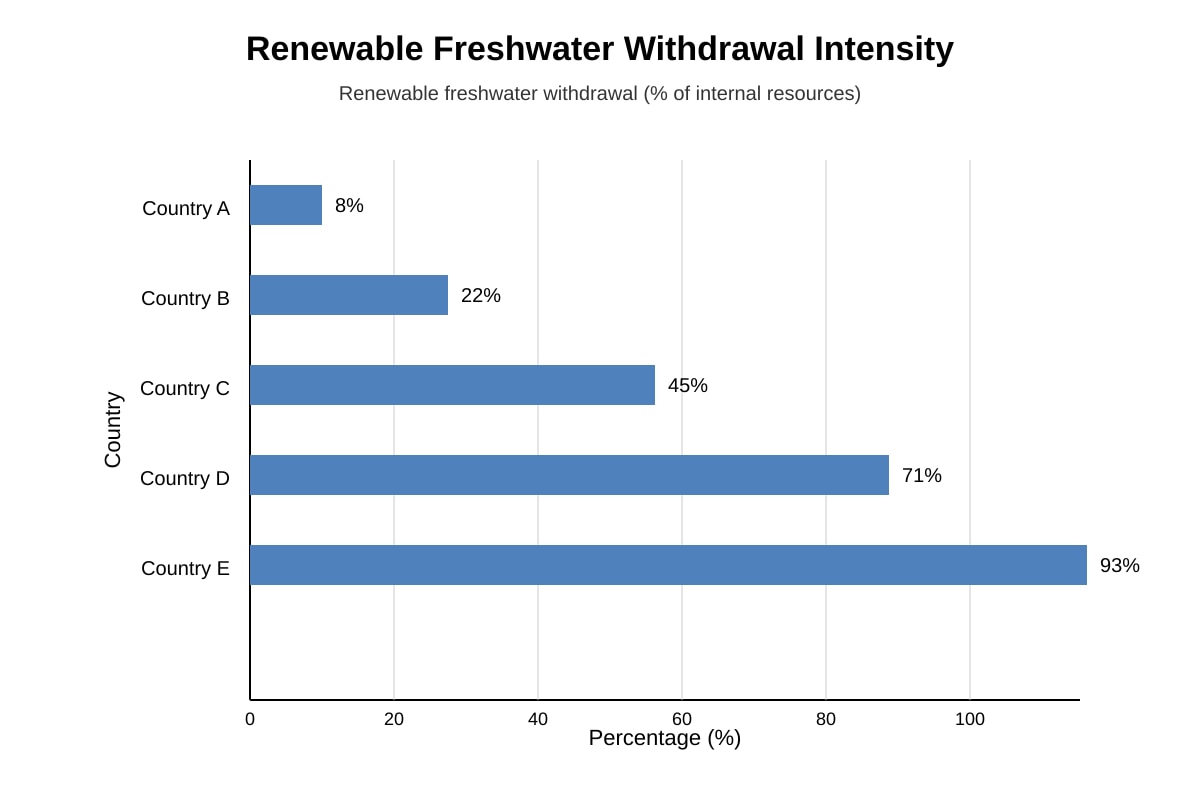
6. The bar chart in the resource shows renewable freshwater withdrawal as a percentage of total internal resources for five countries.
Image pending generation: chart for 6.
Describe the variation in renewable freshwater withdrawal intensity among the five countries shown. [3]
7. State ONE environmental trade-off of large-scale hydropower development in tropical river basins. [2]
Section B: Source-Based Analysis on Sustainability Indicators (Questions 8–14) — Total 24 marks
The table below shows the 2025 Sustainable Development Goal (SDG) progress scores (0–100, higher = better) for four Southeast Asian cities across three dimensions.
| City | Economic (E) | Environmental (Env) | Social (S) | Overall |
|---|---|---|---|---|
| City P | 74 | 58 | 81 | 71 |
| City Q | 69 | 83 | 64 | 72 |
| City R | 52 | 47 | 70 | 56 |
| City S | 88 | 61 | 77 | 75 |
8. Compare the overall SDG progress scores for the four Southeast Asian cities shown in the table. [5]
9. With reference to the table, identify the city with the largest gap between its highest and lowest dimension scores, and calculate that gap. [3]
10. Explain how quantitative targets and indicators such as those in the table help measure progress towards sustainable development. [4]
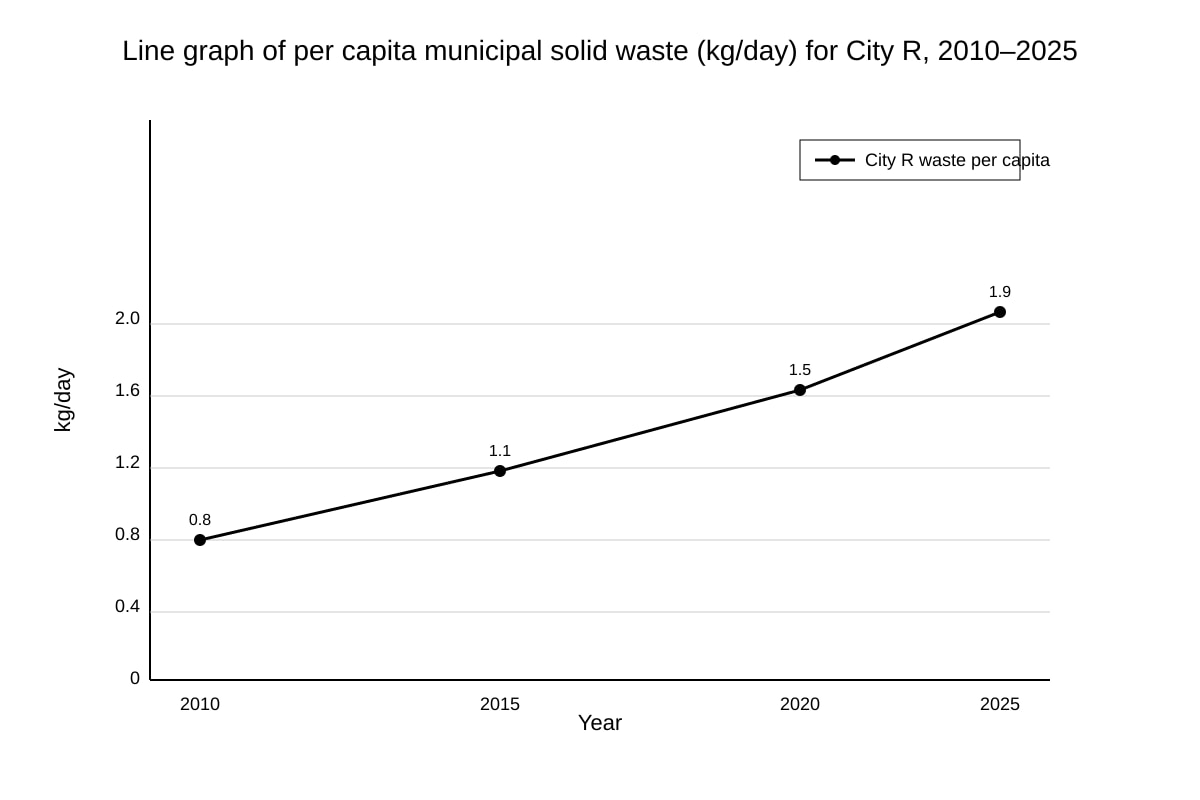
11. The line graph shows per capita municipal solid waste generation (kg/day) from 2010 to 2025 for City R.
Image pending generation: graph for 11.
Describe the trend in per capita municipal solid waste generation in City R between 2010 and 2025. [2]
12. Suggest TWO reasons for the trend identified in Question 11. [4]
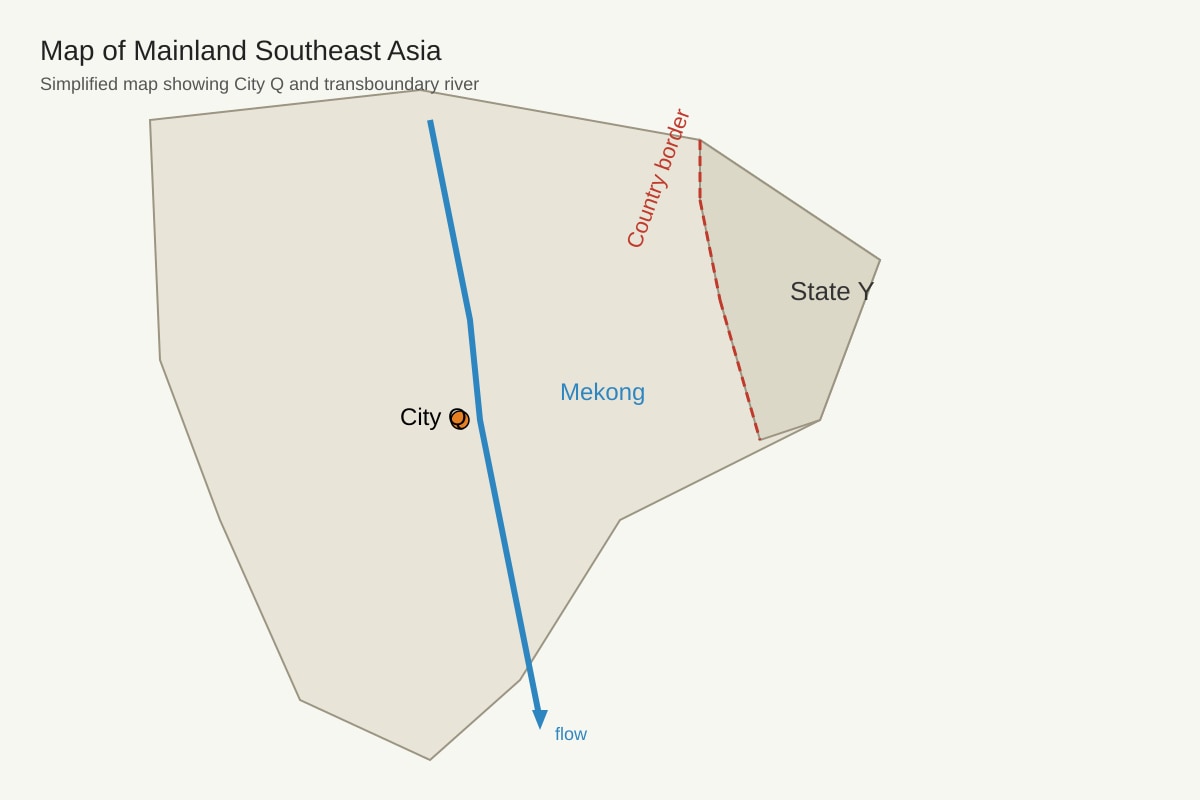
13. Using the map below, identify the transboundary river basin shared by City Q and a neighbouring country, and state one potential conflict over water resources.
Image pending generation: map for 13.
[3]
14. Evaluate the usefulness of SDG quantitative indicators for assessing trade-offs between economic growth and environmental protection. [3]
Section C: Structured Response and Synthesis (Questions 15–20) — Total 18 marks
15. Explain the processes by which chemical weathering contributes to the formation of karst landscapes in limestone regions. [7]
16. A solar farm proposal in a rural district estimates the following:
- Land area required: 500 ha
- Households powered: 60,000
- Construction cost: $120 million
- Annual CO₂ reduction: 45,000 tonnes
Calculate the CO₂ reduction per $1 million invested, and explain one social limitation of this renewable energy project. [5]
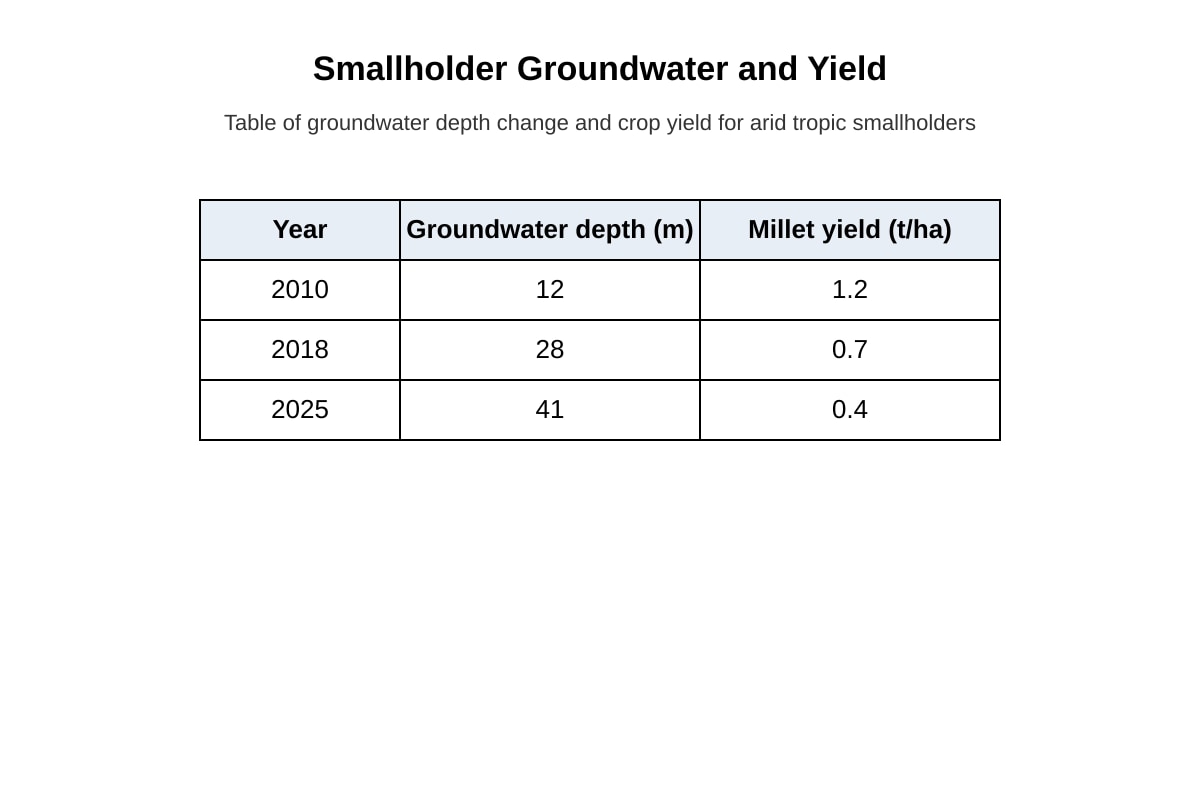
17. Using Resources below, assess the impacts of groundwater depletion on smallholder farmers in arid tropics, and suggest one sustainable management strategy.
Image pending generation: table for 17.
[4]
18. State TWO characteristics of extractive industries that make them capital- and technology-intensive. [2]
19. "The circular economy is essential for resource sustainability in rapidly industrialising countries." To what extent do you agree with this statement? Provide two supporting points and one counter-point. [4]
20. Using the extract below, explain how ecosystem provisioning services have varied over time due to demand and technology.
In the 19th century, guano (bird droppings) from Pacific islands was a key provisioning service as a natural fertiliser. Today, synthetic nitrogen fertilisers produced via the Haber-Bosch process have largely replaced guano, shifting the provisioning service base from ecological to industrial.
[2]
Answers
TuitionGoWhere Practice Paper — Geography H2 A-Level (Version 5) Answer Key
Total Marks: 60 — Section A 18, Section B 24, Section C 18.
Section A Answers (18 marks)
Q1 [4 marks]
- Ecosystem services = benefits that humans obtain from ecosystems (1 mark).
- Four categories (1 mark each): provisioning (food, water, timber), regulating (climate, flood control), cultural (recreation, spiritual), supporting (nutrient cycling, soil formation).
- Teaching note: From syllabus 1.1; students must name all four, not just define. Common mistake: listing examples but not category names.
Q2 [2 marks]
- Proven reserves: resources confirmed by exploration and economically extractable with current tech (1 mark).
- Speculative reserves: hypothesised resources in unexplored areas, uncertain existence and extractability (1 mark).
- Marking: 1 each for contrast in certainty and accessibility.
Q3 [3 marks]
- R/P = 1,200 / 40 = 30 years (2 marks for calculation, 1 mark for indication).
- Indicates: at current rate, supply lasts 30 years; moderate security but finite (1 mark).
- Working: R/P=401200=30. Unit: years.
Q4 [2 marks]
- Limitation: Malthus ignored technological innovation that can raise resource limits (e.g., Boserup effect) (2 marks). Or: uneven access means scarcity is distributional not absolute.
- Accept any one clear limitation with explanation.
Q5 [2 marks]
- Boserup: population pressure stimulates technological change that expands resource base (1 mark); differs from Malthus who saw fixed limits (1 mark).
Q6 [3 marks]
- Variation: Country A lowest (8%), E highest (93%) (1); upward gradient A<B<C<D<E (1); E near full withdrawal signals stress (1).
- Must reference chart values from placeholder.
Q7 [2 marks]
- Trade-off: floodplain habitat loss / methane from reservoirs / displaced communities (1 mark + 1 for environmental/social link).
Section B Answers (24 marks)
Q8 [5 marks]
- City S highest overall (75), City R lowest (56) (1).
- Q (72) and P (71) similar mid-high (1).
- P strong social (81) weak env (58); Q strong env (83) weak social (64) (1).
- R lags all dimensions (1).
- Pattern: no city leads all; trade-offs visible (1).
- Marking: comparative language required, not raw list.
Q9 [3 marks]
- City P: 81−58 = 23 (1 identify, 2 calc). Or Q: 83−64=19. Largest = P gap 23.
- Mark: 1 id, 2 arithmetic.
Q10 [4 marks]
- Targets quantify aims (1); indicators track change over time (1); allow comparison across space (1); reveal trade-offs (1).
- Teaching: links to SDG syllabus point on measurement challenges.
Q11 [2 marks]
- Steady rise from 0.8 to 1.9 kg/day (1); ~138% increase (1).
Q12 [4 marks]
- Reasons: urban consumption growth (2); inadequate recycling (2). Or: income rise, packaging use.
- 2 marks each, explained.
Q13 [3 marks]
- Mekong shared with State Y (1); conflict: upstream withdrawal reduces downstream flow (2).
Q14 [3 marks]
- Useful: reveals trade-offs numerically (1); but narrow indicators miss qualitative loss (1); needs context (1).
- Descriptor: balanced judgement.
Section C Answers (18 marks)
Q15 [7 marks]
- Limestone soluble CaCO₃ (1)
- Rain + CO₂ → H₂CO₃ (1)
- Dissolves rock along joints (1)
- Infiltration/percolation (1)
- Cavity enlargement (1)
- Sinkholes from collapse (1)
- Long-term, climate-dependent (1)
Q16 [5 marks]
- CO₂ per $1m = 45,000 / 120 = 375 tonnes (3 marks: 2 calc, 1 unit).
- Social limit: land contest with farmers / visual impact (2 marks).
Q17 [4 marks]
- Depth 12→41m, yield 1.2→0.4 t/ha: depletion cuts yield (2).
- Strategy: rainwater harvesting / regulated pumping (2).
Q18 [2 marks]
- High capital cost (1); advanced tech for extraction (1).
Q19 [4 marks]
- Agree: reduces waste, resource efficiency (2).
- Counter: infra cost, behaviour change hard (2).
Q20 [2 marks]
- Guano as ecological provisioning (1); Haber-Bosch shifted to industrial base via tech/demand (1).
Free quiz and exam paper access
Enter your details to view this paper
Your access is remembered on this device.