AI Generated Exam Paper
A Level H2 Geography Practice Paper 3
Free A Level H2 Geography Practice Paper 3, HY3 AI version, with questions, answers, and A Level-style practice for Singapore students.
These static practice materials are generated from the site's syllabus and paper-generation workflow, with source and model context shown so students and parents can evaluate the material before use.
Questions
TuitionGoWhere Practice Paper - Geography H2 A-Level
TuitionGoWhere Practice Paper (AI) — Version 3
Subject: Geography H2
Level: A-Level (Pre-University)
Paper: Practice Paper (Resources Sustainability Focus)
Duration: 1 hour 30 minutes
Total Marks: 60
Name: ________________________
Class: ________________________
Date: ________________________
Instructions:
- This practice paper contains 3 sections.
- Answer all questions.
- Section A: 10 short structured questions (1 mark each, total 10 marks)
- Section B: 5 data-based questions (total 30 marks)
- Section C: 2 extended response questions (total 20 marks)
- Use a black/blue pen. Write clearly.
- Marks for each question are shown in brackets [ ].
Section A: Short Structured Questions (10 marks)
1. State one difference between a renewable and a non-renewable resource. [1]
2. According to the Brundtland definition in Our Common Future, what is sustainable development? [1]
3. Name one of the four categories of ecosystem services. [1]
4. What term describes reserves that are economically and technically extractable at current prices? [1]
5. Identify the economist who argued that technology can expand the resource base. [1]
6. State one environmental impact of extractive industries. [1]
7. Name one Sustainable Development Goal (SDG) number and title (e.g., SDG 6). [1]
8. What is the term for water resources that cross national boundaries? [1]
9. Give one example of a provisioning ecosystem service. [1]
10. State one limitation of Malthus' view on population and resources. [1]
Section B: Data-Based Questions (30 marks)
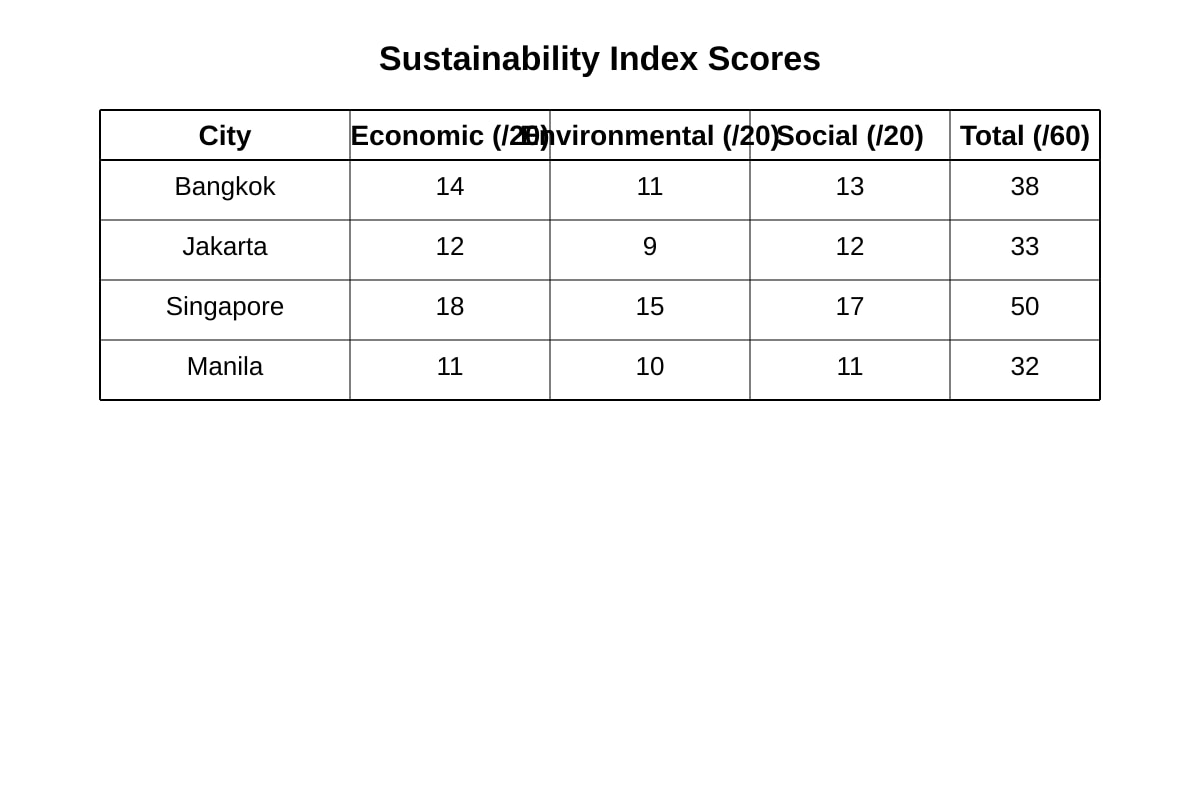
Resource 1: Table of Sustainability Index Scores for four Southeast Asian cities (2025 est.).
| City | Economic (20) | Environmental (20) | Social (20) | Total (/60) |
|---|---|---|---|---|
| Bangkok | 14 | 11 | 13 | 38 |
| Jakarta | 12 | 9 | 12 | 33 |
| Singapore | 18 | 15 | 17 | 50 |
| Manila | 11 | 10 | 11 | 32 |
11. Compare the total sustainability scores for the four cities shown in Resource 1. [5]
Image pending generation: table for Q11.
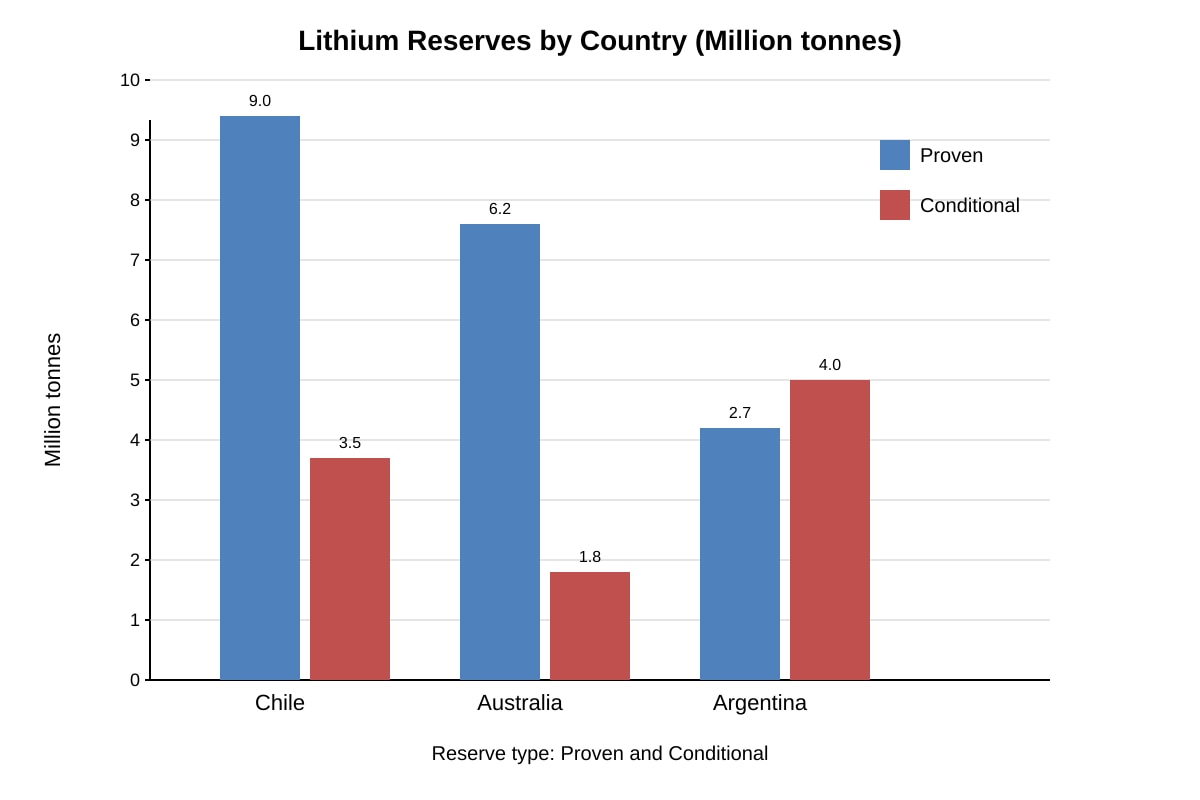
Resource 2: Bar chart of proven and conditional reserves of lithium (million tonnes) in three countries.
12. Using Resource 2, describe the pattern of lithium reserves across the three countries. [4]
Image pending generation: chart for Q12.
Resource 3: Extract from a report on transboundary water management of the Mekong River.
"The Mekong River Commission (MRC) was established in 1995 by Cambodia, Laos, Thailand, and Vietnam to promote cooperation. However, upstream dam construction by China (not a member) has reduced dry-season flow by 30% in downstream states, causing tension."
13. Explain one challenge in managing transboundary water resources using Resource 3. [3]
14. Suggest two strategies that could improve transboundary water management in the Mekong. [4]
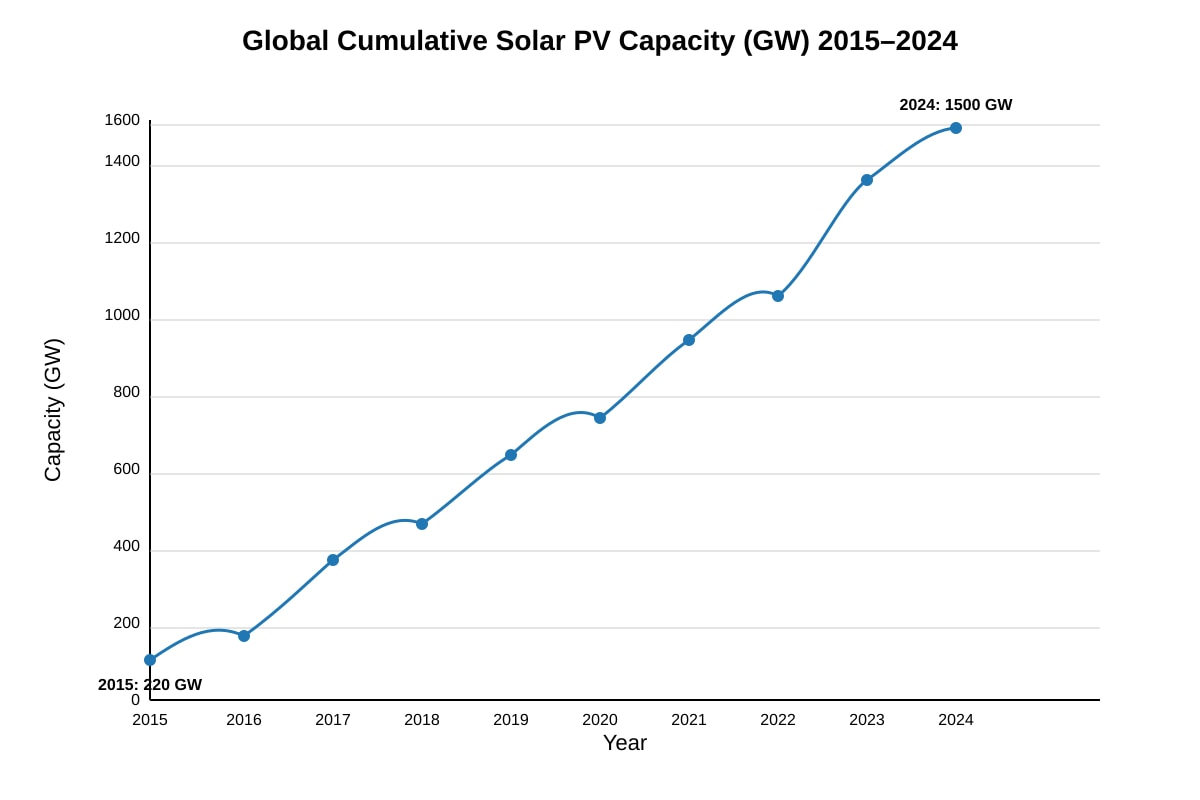
Resource 4: Line graph of global solar PV capacity (GW) 2015–2024.
15. Using Resource 4, calculate the percentage increase in global solar PV capacity from 2015 (220 GW) to 2024 (1500 GW). Show your working. [3]
Image pending generation: graph for Q15.
16. Using Resource 4 and your knowledge, explain two limitations of solar power for energy security. [6]
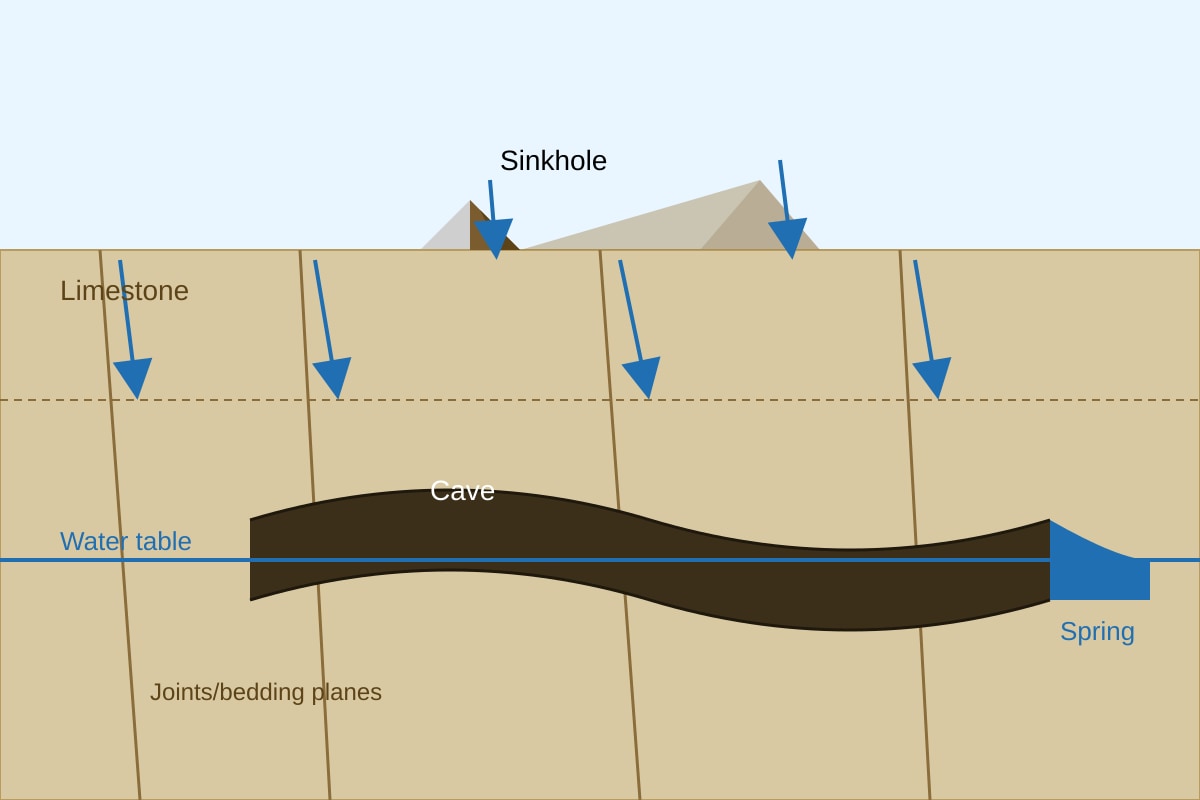
17. Resource 5 shows a karst landscape with limestone cliffs and a sinkhole. Explain the processes that formed this landscape. [5]
Image pending generation: diagram for Q17.
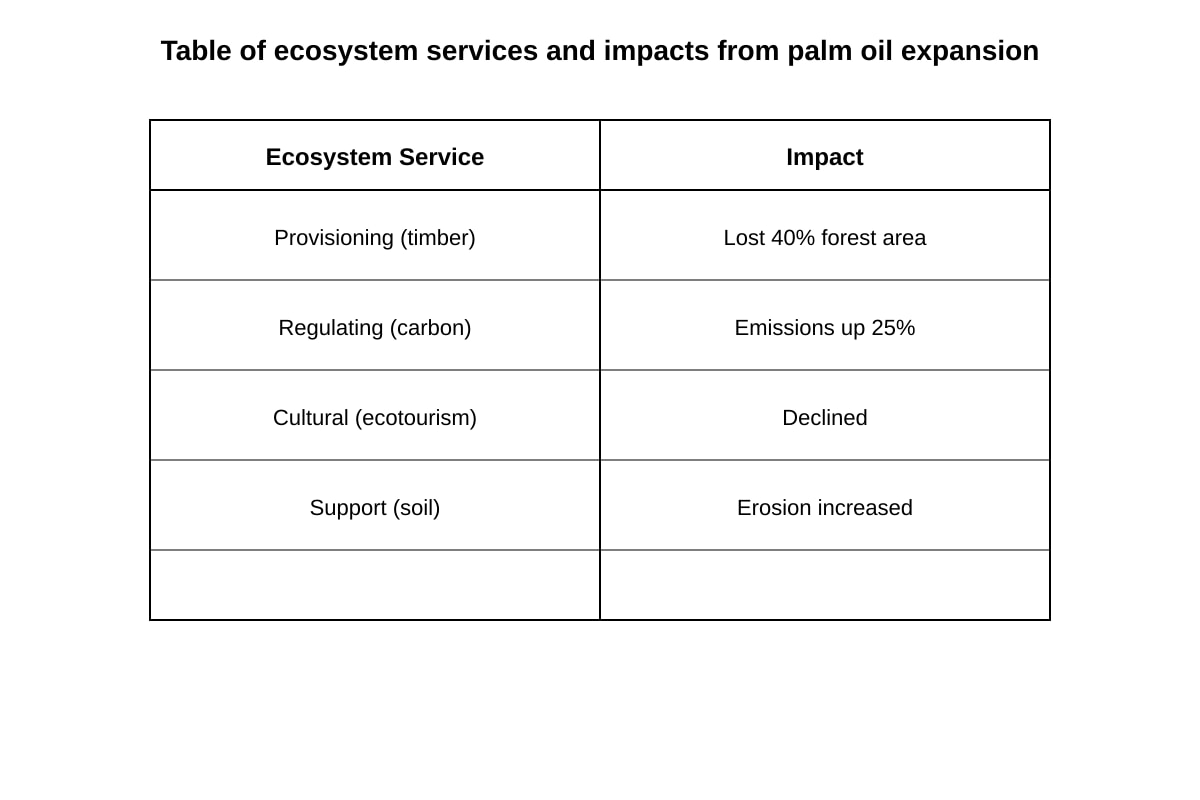
Resource 6: Table of ecosystem services compromised by palm oil expansion in Borneo.
| Ecosystem Service | Impact |
|---|---|
| Provisioning (timber) | Lost 40% forest area |
| Regulating (carbon) | Emissions up 25% |
| Cultural (ecotourism) | Declined |
| Support (soil) | Erosion increased |
18. Using Resource 6, describe how human activity has compromised ecosystem services. [5]
Image pending generation: table for Q18.
Section C: Extended Response (20 marks)
19. "Resource depletion is inevitable given population growth and industrialization." To what extent do you agree with this statement? [10]
20. Evaluate the view that circular economy principles are sufficient to achieve resource sustainability in ASEAN countries. [10]
End of Paper
Answers
TuitionGoWhere Practice Paper — Answer Key (Version 3)
Subject: Geography H2 A-Level
Total Marks: 60
Paper: Practice Paper (Resources Sustainability)
Section A: Short Structured (10 marks)
1. [1] Renewable resources regenerate within human timescales (e.g., solar, wind); non-renewable do not (e.g., coal, oil).
Mark: 1 for clear difference. Common mistake: saying "renewable is clean" – not sufficient alone.
2. [1] Development that meets the needs of the present without compromising the ability of future generations to meet their own needs.
Mark: 1 for Brundtland definition essence.
3. [1] Provisioning / Regulating / Cultural / Support (any one).
Mark: 1.
4. [1] Proven reserves.
Mark: 1. Conditional = extractable at higher price; hypothetical/speculative = unknown.
5. [1] Ester Boserup.
Mark: 1. Malthus argued limits; Boserup argued tech expands.
6. [1] Habitat destruction / pollution / soil erosion (any one).
Mark: 1.
7. [1] e.g., SDG 6 Clean Water and Sanitation / SDG 7 Affordable and Clean Energy.
Mark: 1 for number + title.
8. [1] Transboundary water resources.
Mark: 1.
9. [1] Food, water, timber, fibre (any one).
Mark: 1.
10. [1] Ignores tech innovation / uneven access / population control (any one).
Mark: 1.
Section B: Data-Based (30 marks)
11. [5] Compare total scores: Singapore highest (50), Bangkok (38), Jakarta (33), Manila lowest (32). Singapore exceeds Manila by 18 pts. Bangkok > Jakarta by 5. All SEA cities below max 60.
Marking: 1 for each city relative position, 1 synth = 5. Use comparative language.
12. [4] Chile has highest proven (9.0 Mt) + conditional (3.5); Australia proven 6.2, conditional 1.8; Argentina low proven (2.7) but high conditional (4.0). Pattern: Chile leads total, Argentina speculative potential.
Marking: 1 per country description + 1 pattern = 4.
13. [3] Challenge: upstream non-member (China) dams reduce flow 30%, MRC has no authority over China → cooperation limited by membership scope.
Marking: 1 identify actor, 1 impact, 1 explain gap = 3.
14. [4] (a) Include China in MRC / bilateral treaties [2]; (b) Joint environmental impact assessments [2].
Marking: 2 each, must be feasible.
15. [3] % increase = (1500 − 220) / 220 × 100 = 1280 / 220 × 100 = 581.8% ≈ 582%.
Working shown = 2, final = 1.
16. [6] Limitation 1: Intermittent (no sun at night/clouds) → needs storage [3]. Limitation 2: Land use conflict / material mining impact [3].
Marking: 3 per limitation with explanation.
17. [5] Rainwater + CO₂ → H₂CO₃; dissolves CaCO₃ along joints; percolation forms caves; roof collapse → sinkhole; spring at water table.
Marking: chem weathering 2, mass movement 1, subsurface 1, linkage 1.
18. [5] Provisioning lost 40% forest; regulating emissions +25%; cultural declined; support erosion up. Human activity (palm oil) compromised all four.
Marking: 1 per service described = 4, 1 synthesis = 5.
Section C: Extended (20 marks)
19. [10] Agree: Malthusian pressure, finite reserves. Disagree: Boserup tech, recycling, substitution. Conclusion: not inevitable with management.
Descriptors: L1 (1–3) simple; L2 (4–7) balanced; L3 (8–10) evaluated with examples.
20. [10] For: reduce waste, reuse. Against: needs infra, behavior change, global trade. Verdict: necessary not sufficient.
Descriptors as above; evidence from ASEAN context required for top marks.
Free quiz and exam paper access
Enter your details to view this paper
Your access is remembered on this device.