AI Generated Exam Paper
A Level H2 Geography Practice Paper 1
Free A Level H2 Geography Practice Paper 1, HY3 AI version, with questions, answers, and A Level-style practice for Singapore students.
These static practice materials are generated from the site's syllabus and paper-generation workflow, with source and model context shown so students and parents can evaluate the material before use.
Questions


Free quiz and exam paper access
Enter your details to view this paper
Your access is remembered on this device.
Answers
TuitionGoWhere Practice Paper — Answer Key (Version 1 of 5)
Subject: Geography H2 A-Level
Topic: Resources Sustainability
Total Marks: 60
Section A Answers (18 marks)
Q1 [2]
Answer: Sustainable development is development that meets the needs of the present without compromising the ability of future generations to meet their own needs (Brundtland, 1987).
Marking: 1 mark for present-needs idea; 1 mark for future-generations / intergenerational equity idea.
Teaching note: This definition is the cornerstone of the syllabus. Do not confuse with "environmental protection only" — it includes economic and social dimensions.
Q2 [2]
Answer: Renewable resources regenerate naturally within human timescales (e.g., solar energy); non-renewable resources do not regenerate or form over geological timescales (e.g., coal).
Marking: 1 mark for correct distinction; 1 mark for one valid example each (or clear pair).
Common mistake: Saying renewable = "infinite" (wrong; can be exhausted if regenerative capacity exceeded).
Q3 [1]
Answer: 120 + 80 + 50 + 30 = 280 million tonnes.
Method: Sum all four categories from table.
Marking: 1 mark for correct total.
Teaching note: Proven + conditional + hypothetical + speculative = total resource potential per syllabus reserve classification.
Q4 [3]
Answer: Ecosystem services are benefits people obtain from ecosystems. Four types: provisioning (e.g., food, water), regulating (e.g., climate control), cultural (e.g., recreation), supporting (e.g., nutrient cycling).
Marking: 1 mark for definition; 2 marks for naming all four types (½ each acceptable if listed correctly, but full 2 for all four).
Teaching note: Supporting services underpin the other three; often missed by students.
Q5 [2]
Answer: Limitation: Malthus ignored technological advancement and unequal access — resources distributed unevenly, so scarcity is often access-based not absolute.
Marking: 2 marks for one clear limitation with brief explanation (1+1).
Accept: ignored tech, ignored distribution, predicted famine not universally realised.
Q6 [3]
Answer: Boserup argued that population pressure stimulates technological innovation (e.g., intensive farming, irrigation) that expands the resource base, so limits are not fixed.
Marking: 3 marks — 1 for population pressure stimulus, 1 for tech innovation, 1 for expanded resource base / anti-Malthus conclusion.
Teaching note: She is optimistic; contrasts Malthus' pessimistic fixed-limit view.
Q7 [5]
Answer: Region A shows a steep decline from 12,000 to 4,000 m³/person/yr (–67%) over 1960–2020, while Region B remains stable near 9,000 (small drop to 8,900). Region A therefore lost far more per-capita availability; gap widened from 2,500 to 4,900 m³.
Marking: 1 for A decline described with values; 1 for B stable with values; 1 for comparison of direction; 1 for magnitude/ gap; 1 for conclusion on widening inequality.
Image need: Lines as placeholder described; student must read trends correctly.
Section B Answers (24 marks)
Q8 [2]
Answer: (i) Pollution from factories reducing air purification; (ii) Deforestation reducing flood regulation.
Marking: 1 mark each for activity + linked regulating service.
Teaching note: Regulating = climate, flood, disease control etc.
Q9 [1]
Answer: Land-use change / habitat loss for panel construction; or toxic materials in manufacturing.
Marking: 1 mark for any valid environmental limitation.
Q10 [4]
Answer: Upstream countries may divert or dam water, reducing quantity/quality for downstream neighbours → conflict. Example: Mekong River (China, Laos, Thailand, Cambodia, Vietnam) where dams affect flow.
Marking: 2 for explanation of mechanism; 2 for Asian example with brief relevance.
Teaching note: Transboundary = >1 country; syllabus stresses varying management success.
Q11 [3]
Answer: Higher hydropower share associates with higher security index: C (45%, 6.2) > E (30%, 4.8) > D (12%, 3.1). Fossil dependence inverse.
Marking: 1 compare direction; 1 reference C vs D; 1 link to security index values.
Teaching note: Correlation not causation; but pattern clear in data.
Q12 [3]
Answer: Social impact: displacement of communities for mine site; loss of livelihoods; or health issues from dust/water contamination.
Marking: 3 marks — state impact (1), explain mechanism (1), consequence for community (1).
Q13 [2]
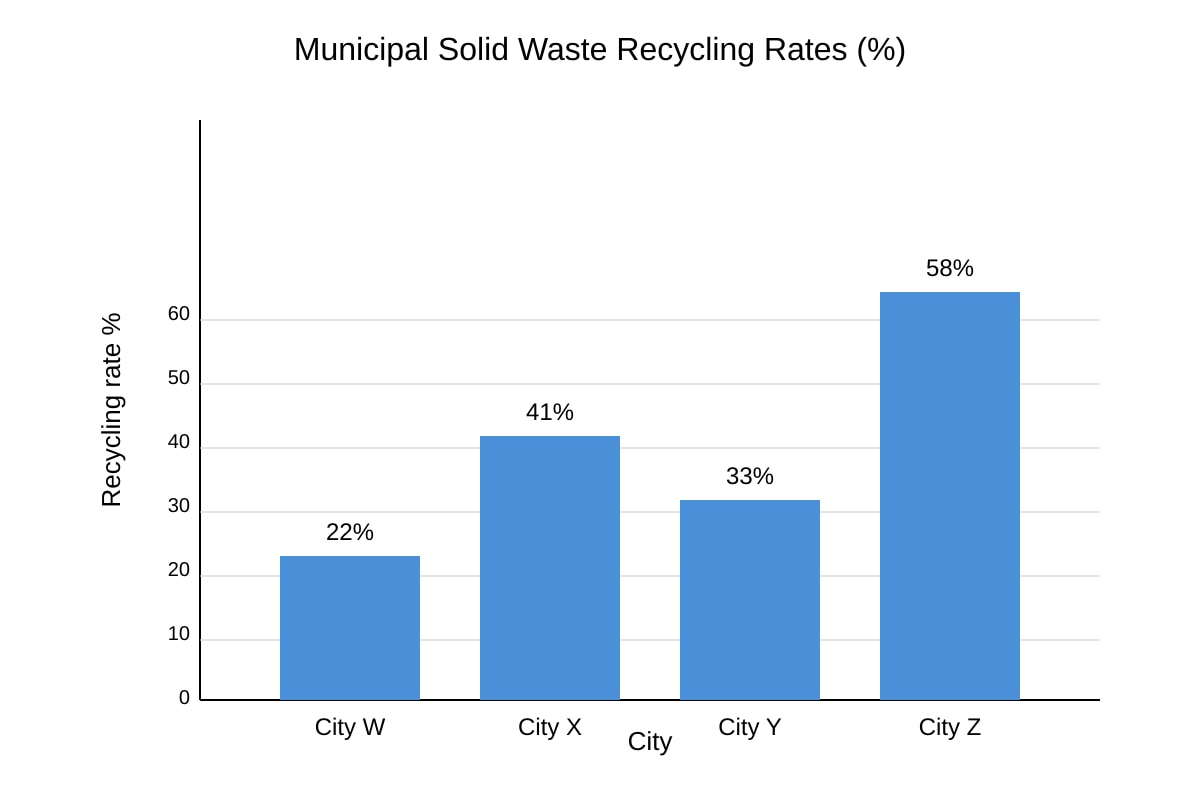
Answer: Highest = City Z (58%). Difference = 58 – 22 = 36 percentage points.
Marking: 1 for Z; 1 for correct difference.
Image need: Bars as described; read values.
Q14 [5]
Answer: Strategy: Feed-in tariffs for solar. Eval: reduces fossil use (env benefit), but high cost (economic trade-off), needs grid (social access). Success varies by state capacity.
Marking: 1 identify; 2 for advantages; 2 for limitations / evaluative judgement.
Teaching note: Use trade-off concept from syllabus.
Section C Answers (18 marks)
Q15 [2]
Answer: Challenge: lack of data infrastructure in rural areas → under-reporting; or unequal access not captured by national average.
Marking: 2 for challenge + why it hinders measurement.
Q16 [3]
Answer: Country F/G/H may use more water for agriculture → less for others; nutrient runoff causes eutrophication; conflict over outflow rights.
Marking: 1 per valid suggestion up to 3, linked to map.
Image need: Map shows shared lake; use positions.
Q17 [3]
Answer: Habitat destruction (e.g., mangrove clearing) removes fish nursery (provisioning service = seafood). Less food supply.
Marking: 1 habitat; 1 service link; 1 example.
Q18 [3]
Answer: Regenerative capacity = natural recharge rate. If extraction > recharge, stock declines → depletion; not sustainable for future.
Marking: 1 define; 1 apply > recharge; 1 conclude unsustainable.
Q19 [4]
Answer: Malthus: environment fixed limit, population outstrips. Boserup: environment limit expandable via tech. Contrast = pessimistic vs optimistic.
Marking: 2 each for accurate contrast of both views.
Q20 [3]
Answer: Agree: e.g., protected areas reduce logging (growth loss) but save ecosystems. Extent: partial — green tech may align both.
Marking: 1 stance; 1 trade-off example; 1 extent/nuance.
Teaching note: Syllabus emphasises trade-offs and limits.