From Real Exams Exam Paper
A Level H2 Geography Practice Paper 1
Free A Level H2 Geography Practice Paper 1, HY3 Exam version, with questions, answers, and A Level-style practice for Singapore students.
These static practice materials are generated from the site's syllabus and paper-generation workflow, with source and model context shown so students and parents can evaluate the material before use.
Questions
Free quiz and exam paper access
Enter your details to view this paper
Your access is remembered on this device.
Answers
TuitionGoWhere Practice Paper - Geography H2 A-Level (Version 1) Answer Key
Subject: Geography H2
Level: A-Level
Paper: Practice Paper (Resources Sustainability Focus)
Total Marks: 60
Section A Answers (30 marks)
Q1. [5 marks] Compare the four SEA cities (Resource 1).
- Singapore scores highest in all dimensions: Air 88, Green 47%, Waste 92, Water 99. [1]
- Jakarta, Bangkok, Manila lag; Manila lowest in air (49), green (19%), waste (58), water (81). [1]
- Bangkok performs best among the three lower cities (air 61, waste 70, water 90). [1]
- Jakarta exceeds Manila in air (54 vs 49) and waste (61 vs 58) but both below Bangkok. [1]
- Pattern: city-state (Singapore) outperforms large developing metros; water access uniformly high (>80) but air/green/waste vary widely. [1] Teaching note: Use comparative language (higher/lower than). Reference all 4 cities and all 4 indicators. Common mistake: listing numbers without comparing.
Q2. [3 marks] Vegetation structure & biomass (Resource 2).
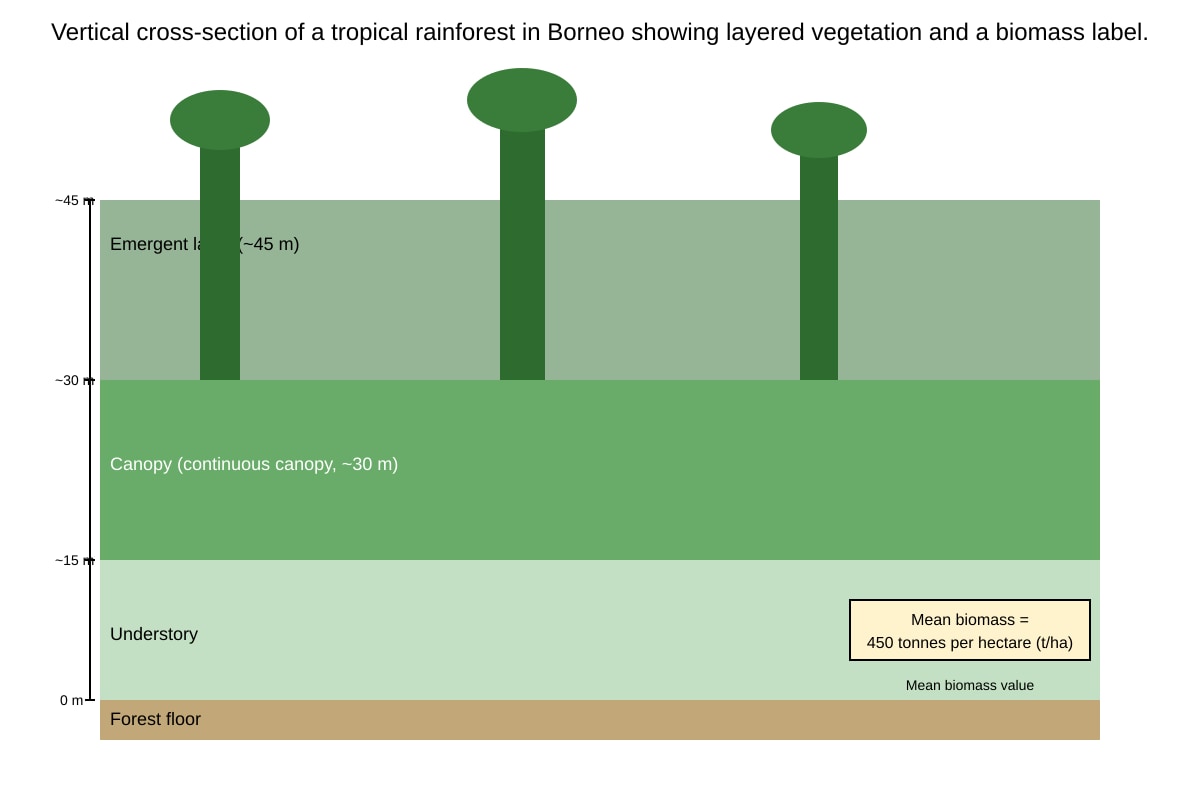
- Four layers: emergent (~45 m, sparse tall trees), continuous canopy (~30 m, dense), understory (sparse shrubs), forest floor. [1]
- Structure: tall, dense continuous canopy intercepts light; emergent breaks canopy. [1]
- Mean biomass = 450 tonnes per hectare. [1] Teaching note: Describe vertical structure not species. State biomass with unit t/ha.
Q3. [7 marks] Karst formation (Resource 3).
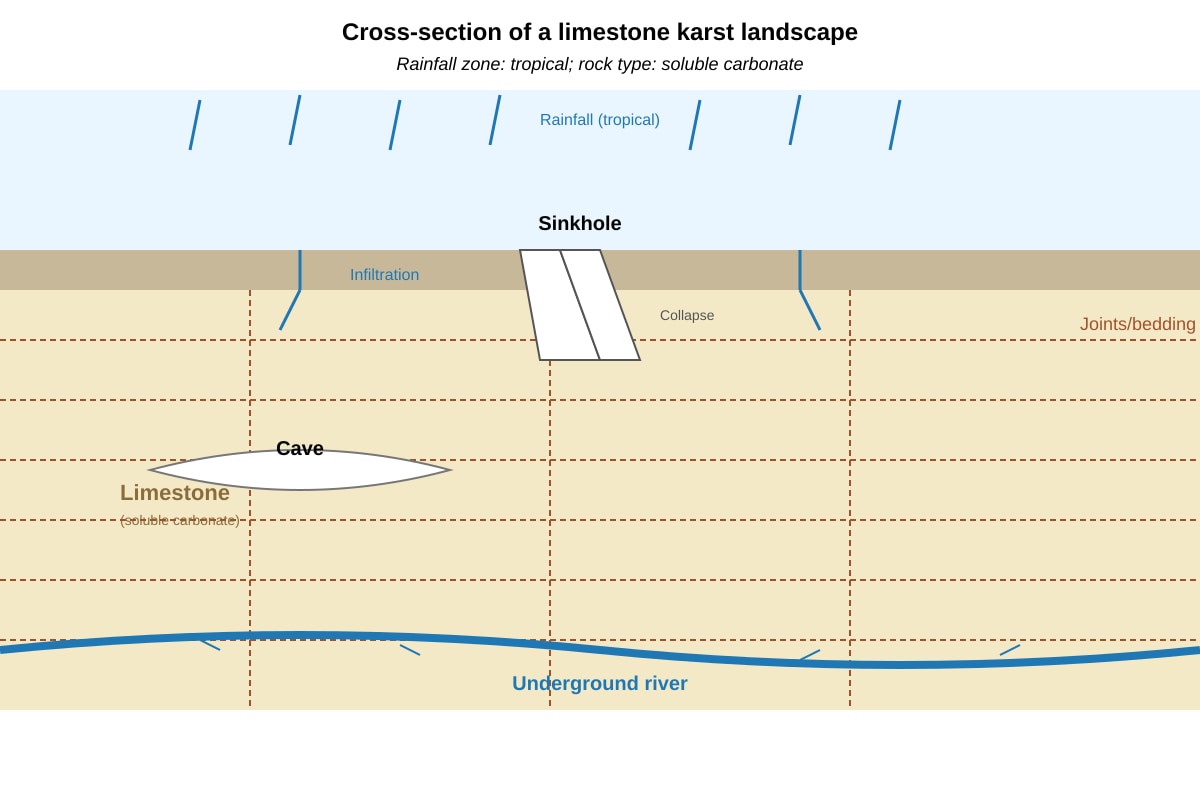
- Limestone = soluble carbonate rock vulnerable to dissolution. [1]
- Rain + CO₂ → weak carbonic acid (H₂CO₃) infiltrates via joints/bedding. [1]
- Chemical weathering: CaCO₃ + H₂CO₃ → Ca(HCO₃)₂ (dissolved). [1]
- Percolation enlarges joints → cavities/caves over long timescale. [1]
- Subsurface erosion by underground river deepens system. [1]
- Surface sinkhole forms when cave roof collapses. [1]
- Tropical rainfall accelerates rate. [1] Teaching note: Must link water + chemistry + time. Avoid generic weathering.
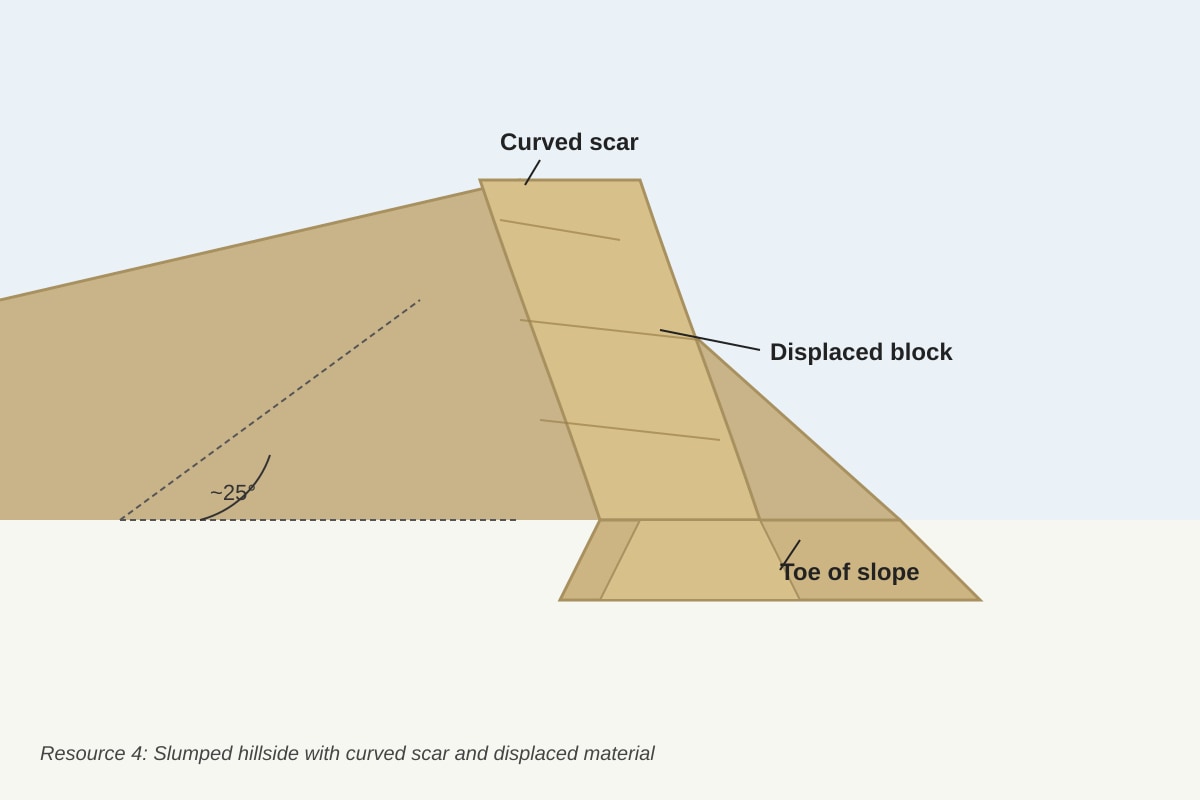
Q4. [2 marks] Mass movement = slump (rotational slide).
- Curved failure surface, rotated block, toe accumulation. [1]
- Type: slump. [1]
Q5. [3 marks] Reserves.
- Proven: scientifically measured, economically extractable at current tech. [1]
- Speculative: undiscovered, uncertain existence/quantity. [1]
- Difference: proven = known & viable; speculative = inferred only. [1]
Q6. [5 marks] E-waste recycling (Resource 6).
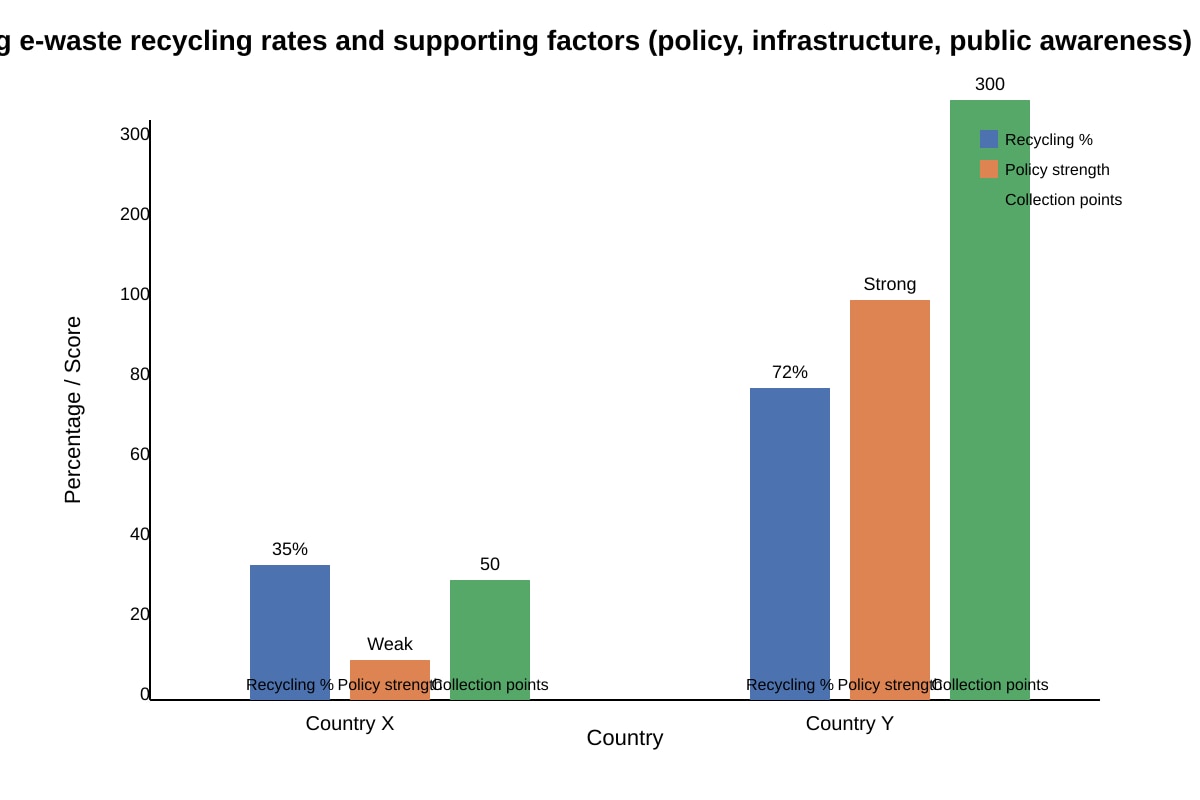
- Country X low (35%) due to weak policy, few collection points (50). [2]
- Country Y high (72%) due to strong policy, 300 points infrastructure. [2]
- Conclusion: institutional capacity drives rate gap. [1]
Q7. [4 marks] Solar power.
- Reduces fossil use by generating clean electricity during day. [1]
- Limitations: intermittent (no sun at night), needs storage. [1]
- Land use conflict, grid integration cost. [1]
- Thus energy security not fully assured without mix. [1]
Q8. [2 marks] Nation B vulnerability.
- Downstream (12% withdrawal) so reliant on A's release. [1]
- High scarcity index 0.81 = physical water stress. [1]
Q9. [3 marks] Challenges.
- Economic: short-term growth prioritised over green investment. [1.5]
- Political: conflicting national interests, weak enforcement. [1.5]
Q10. [3 marks] Habitat destruction.
- Provisioning = food, water, raw materials. [1]
- Destruction removes habitats → less fish, timber, crops. [1]
- Reduces supply of provisioning outputs. [1]
Section A Total: 30
Section B Answers (15 marks)
Q11. [1] Malthus: limits from nature; Boserup: tech expands base. (any one difference)
Q12. [2] Provisioning, regulating, cultural, support. (0.5 each)
Q13. [2] Years = 1200 / 120 = 10 years. [1 for working, 1 for answer]
Q14. [3] Invasive species.
- Outcompete natives → fewer pollinators/predators. [1]
- Disrupt nutrient cycles. [1]
- Reduce flood/erosion control (regulating). [1]
Q15. [2] Strategies: local employment, community consultation, resettlement compensation. (1 each)
Section B Total: 15
Section C Answers (15 marks)
Q16. [3] Extent agree.
- Boserup: tech expands (e.g., fertiliser). [1]
- Malthus: finite limits, uneven access. [1]
- Verdict: partially true, not always (access gap). [1]
Q17. [3] Trade-offs.
- Hydropower = low-carbon energy. [1]
- But blocks fish, floods forest (loss regulating/provisioning). [1]
- Trade-off: energy vs ecology; mitigate by run-of-river. [1]
Q18. [3] Strategies.
- Treaty (Mekong commission) partial success. [1.5]
- Joint authority better but politics limit. [1.5]
Q19. [3] Provisioning variation.
- Demand: palm oil now provisioning due to demand. [1]
- Tech: fracking made shale gas provisioning. [1]
- Space: arid areas value groundwater more. [1]
Q20. [3] SDG measurement.
- Quantitative targets (poverty %) allow tracking. [1]
- But social inclusion hard to quantify. [1]
- Mixed indicators needed. [1]
Section C Total: 15 Total: 60