AI Generated Quiz
A Level H1 Geography Resources Sustainability Quiz
Free A Level H1 Geography Resources Sustainability quiz, AI version, with questions, answers, and A Level-style practice for Singapore students.
These static practice materials are generated from the site's syllabus and paper-generation workflow, with source and model context shown so students and parents can evaluate the material before use.
Questions
Free quiz and exam paper access
Enter your details to view this paper
Your access is remembered on this device.
Answers
Answer Key: A-Level Geography H1 Quiz - Resources Sustainability
Total Marks: 50
Section A: Short-Answer Questions (20 marks)
1. Define the term 'sustainable development' as it applies to urban areas. [2]
Answer: Sustainable development in urban areas refers to development that meets the needs of the present without compromising the ability of future generations to meet their own needs. It involves balancing economic growth, social equity, and environmental protection within a city.
Marking Notes:
- 1 mark for the core idea of meeting present needs without compromising future generations.
- 1 mark for mentioning the balance of economic, social, and environmental dimensions.
Common Mistake: Students may only define sustainable development in general terms without applying it to urban areas. Ensure the definition is contextualised.
2. State two problems associated with non-hazardous solid waste management in cities in developing countries. [2]
Answer:
- Inadequate collection services: Many areas, especially low-income neighbourhoods, lack regular waste collection, leading to illegal dumping and accumulation of waste in streets and waterways.
- Limited disposal infrastructure: There is often a shortage of properly engineered landfills or treatment facilities, resulting in open dumping or burning of waste, which causes air and water pollution.
Marking Notes:
- 1 mark for each valid problem (max 2).
- Accept other valid problems such as: lack of financial resources, lack of public awareness, rapid urbanisation outpacing infrastructure development.
3. Explain what is meant by the term 'urban reimaging'. [2]
Answer: Urban reimaging is the process of changing the image and perception of a city or a specific area within a city to attract investment, tourism, and residents. It often involves physical redevelopment, marketing campaigns, and cultural initiatives to create a new, positive identity for a place that may have been associated with decline or problems.
Marking Notes:
- 1 mark for the idea of changing the image/perception of a place.
- 1 mark for mentioning the purpose (attracting investment, tourism, residents) or methods (redevelopment, marketing).
4. Identify two factors that influence the liveability of a city. [2]
Answer:
- Economic factors: Availability of jobs, income levels, cost of living.
- Environmental factors: Air and water quality, green spaces, climate.
- Social factors: Access to healthcare, education, safety, community networks.
Marking Notes:
- 1 mark for each valid factor (max 2).
- Accept any two from economic, environmental, or social factors, or specific examples like 'access to public transport' or 'crime rates'.
5. Give two reasons why the proportion of elderly people in urban areas is increasing in many countries. [2]
Answer:
- Increased life expectancy: Advances in healthcare, nutrition, and sanitation have led to people living longer.
- Declining fertility rates: Fewer children are being born, leading to an ageing population structure.
- Migration of younger people: In some countries, younger people migrate to cities for work, leaving older populations behind in rural areas, but also contributing to an ageing urban population as they themselves age in place.
Marking Notes:
- 1 mark for each valid reason (max 2).
- Accept any two of the above or other valid reasons.
Section B: Data-Response Questions (20 marks)
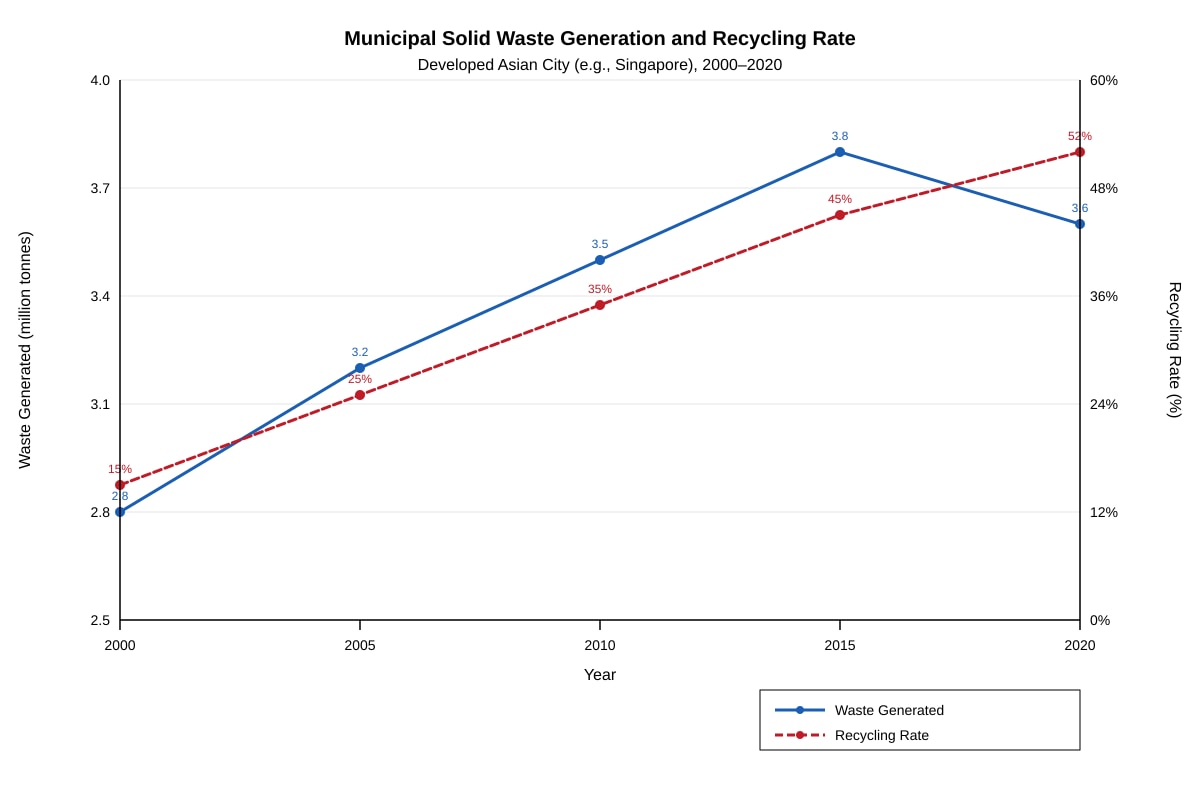
6. Using Resource 1, describe the trend in the recycling rate from 2000 to 2020. [2]
Answer: The recycling rate showed a consistent and significant increase from 2000 to 2020. It rose from 15% in 2000 to 52% in 2020, representing a more than threefold increase over the two-decade period.
Marking Notes:
- 1 mark for identifying the overall upward trend.
- 1 mark for providing specific data points (e.g., from 15% to 52%).
Common Mistake: Describing the trend without using data from the graph.
7. With reference to Resource 1, explain the relationship between the amount of waste generated and the recycling rate over the period shown. [3]
Answer: The relationship is one of decoupling. While the amount of waste generated increased from 2.8 million tonnes in 2000 to a peak of 3.8 million tonnes in 2015, the recycling rate also increased substantially from 15% to 45% over the same period. This suggests that waste generation and recycling are not directly linked; even as more waste was produced, a greater proportion was being recycled. After 2015, waste generation decreased slightly to 3.6 million tonnes in 2020, while the recycling rate continued to rise to 52%, indicating that waste reduction and recycling efforts were both contributing to more sustainable waste management.
Marking Notes:
- 1 mark for identifying the relationship (decoupling or inverse relationship).
- 1 mark for using data from the graph to support the explanation.
- 1 mark for explaining the implication (more effective waste management).
Common Mistake: Simply stating that both increased without explaining the nature of the relationship.
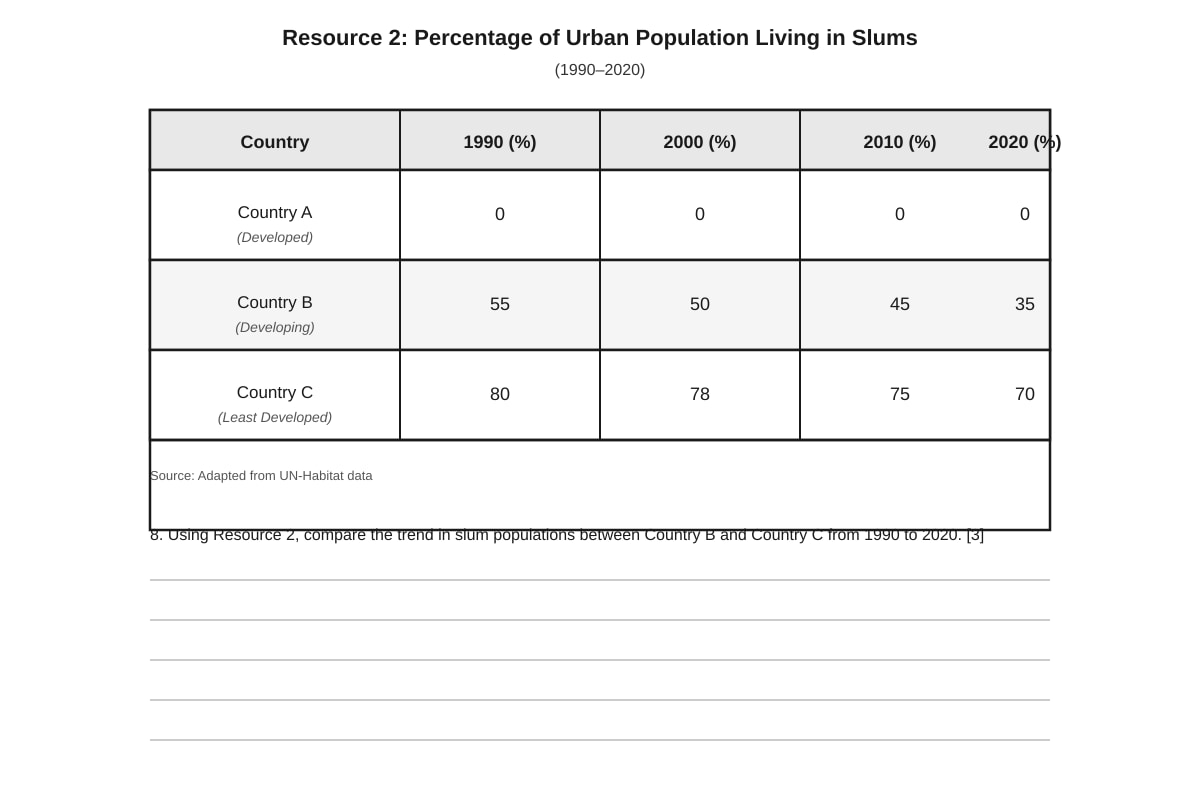
8. Using Resource 2, compare the trend in slum populations between Country B and Country C from 1990 to 2020. [3]
Answer: Both Country B and Country C experienced a decrease in the percentage of their urban populations living in slums from 1990 to 2020. However, the rate and extent of the decrease differed significantly. Country B saw a substantial reduction from 55% in 1990 to 35% in 2020, a decrease of 20 percentage points. In contrast, Country C's slum population decreased only marginally from 80% in 1990 to 70% in 2020, a decrease of just 10 percentage points. This means that while Country B made significant progress, Country C still has a very high proportion (70%) of its urban population living in slums.
Marking Notes:
- 1 mark for identifying that both decreased.
- 1 mark for quantifying the difference in the rate of decrease (e.g., Country B decreased by 20%, Country C by 10%).
- 1 mark for a concluding comparative statement.
Common Mistake: Describing each trend separately without making a direct comparison.
9. Suggest two reasons why the proportion of the urban population living in slums has decreased in Country B but remained high in Country C. [4]
Answer: Reason 1: Economic Growth and Investment (Country B): Country B likely experienced stronger and more sustained economic growth, which provided the government with greater financial resources to invest in affordable housing, infrastructure, and slum upgrading programmes. This allowed for the formalisation of informal settlements and the provision of basic services.
Reason 2: Different Levels of Development and Urbanisation Rates (Country C): Country C, being a least developed country, may have a much lower GDP and a rapidly urbanising population. The rate of rural-to-urban migration often outpaces the government's capacity to build adequate housing and infrastructure, leading to the persistent growth of slums. Furthermore, it may lack the institutional capacity and financial resources to implement large-scale slum improvement strategies.
Marking Notes:
- 1 mark for each valid reason (max 2).
- 1 mark for each reason's explanation (max 2).
- Accept other valid reasons such as: political stability, land tenure policies, international aid, or specific examples of strategies.
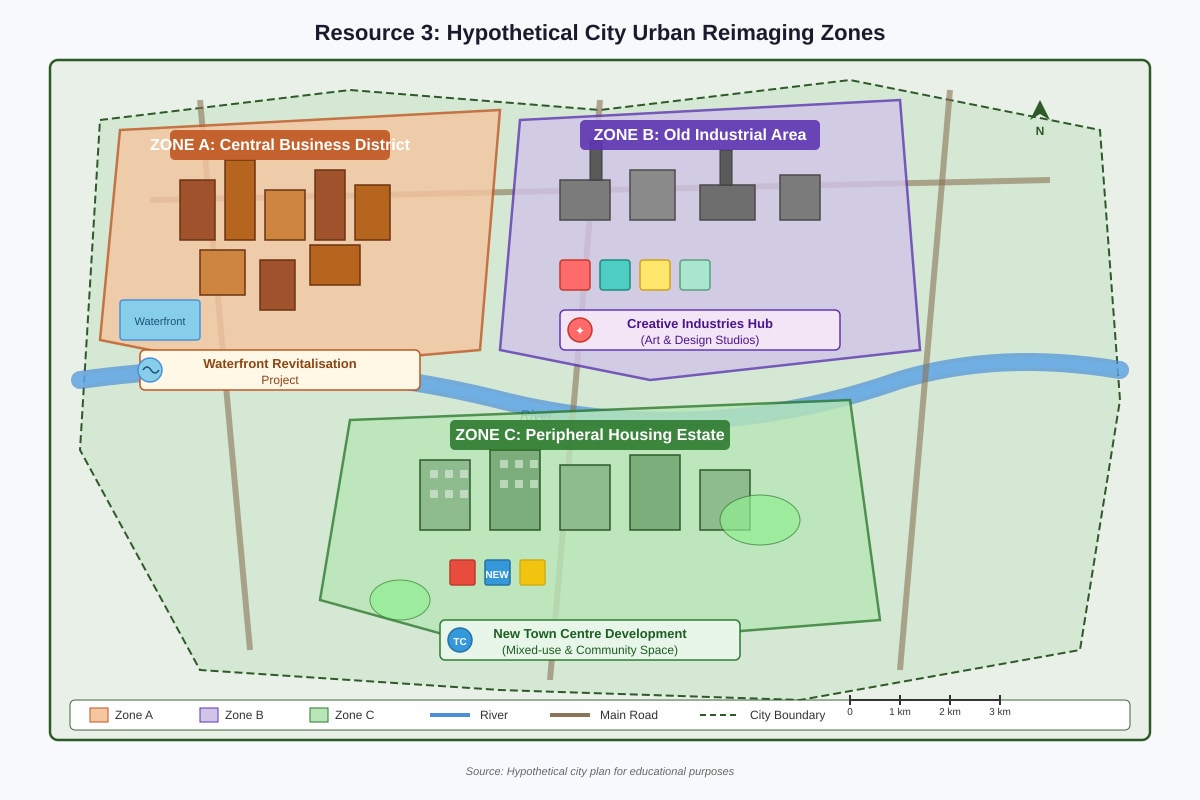
10. Using Resource 3, explain how urban reimaging strategies in the three zones might contribute to sustainable urban development. [8]
Answer: Urban reimaging can contribute to sustainable urban development by addressing economic, social, and environmental dimensions.
-
Zone A (Waterfront Revitalisation Project): This can contribute to environmental sustainability by cleaning up and restoring a previously degraded waterfront area, improving water quality and creating green spaces. It can also contribute to economic sustainability by attracting tourism, businesses, and investment, creating jobs and generating revenue for the city. Socially, it can provide new public spaces for recreation and community activities, enhancing social sustainability.
-
Zone B (Creative Industries Hub): This strategy primarily contributes to economic sustainability by transforming a declining industrial area into a hub for creative industries (e.g., arts, design, technology). This can attract a skilled workforce, foster innovation, and diversify the local economy, making it more resilient. It can also have social benefits by creating new job opportunities and revitalising a neglected area, potentially reducing crime and improving community pride.
-
Zone C (New Town Centre Development): This can contribute to sustainable urban development by creating a more compact, mixed-use centre in a peripheral housing estate. This reduces the need for long commutes to the main city centre, lowering carbon emissions (environmental sustainability). It can also improve liveability by providing residents with better access to shops, services, and employment (social and economic sustainability).
Overall: These reimaging strategies, when implemented effectively, can create a more balanced, economically vibrant, and environmentally responsible city, contributing to its long-term sustainability.
Marking Notes:
- 1 mark for each zone explained with reference to at least one dimension of sustainability (max 3 marks).
- 2 marks for explaining how the strategies contribute to specific dimensions (economic, social, environmental).
- 2 marks for using specific details from Resource 3.
- 1 mark for a concluding statement linking the strategies to overall sustainable urban development.
- Level-based marking:
- Level 3 (7-8 marks): Detailed explanation of all three zones, clearly linking each to multiple dimensions of sustainability with specific reference to the resource.
- Level 2 (4-6 marks): Explanation of two or three zones, with some links to sustainability but less detailed.
- Level 1 (1-3 marks): General description of the zones without clear links to sustainability.
Common Mistake: Describing the reimaging projects without explaining how they contribute to sustainability.
Section C: Essay Questions (10 marks)
11. 'Economic factors are the most important influence on the liveability of a city.' To what extent do you agree with this statement? [10]
Answer: Introduction: Liveability is a subjective concept that refers to the quality of life experienced by residents of a city. While economic factors such as employment, income, and cost of living are undeniably important, they are not the sole determinants. A balanced assessment must consider the interplay of economic, social, and environmental factors.
Arguments agreeing that economic factors are most important:
- Foundation for other aspects: A strong economy provides the tax revenue needed for governments to invest in social services (healthcare, education) and environmental infrastructure (parks, public transport). Without a healthy economy, a city cannot afford to be liveable.
- Employment and income: Access to well-paying jobs is a primary concern for most residents. High unemployment and low wages directly reduce liveability by causing financial stress and limiting access to housing, healthcare, and leisure activities.
- Example: Cities like Singapore and Zurich, which rank highly in liveability indices, also have very strong economies and high GDP per capita.
Arguments disagreeing that economic factors are the most important:
- Environmental factors are critical: A city with a strong economy but severe air pollution (e.g., some industrial cities in China) or a lack of green spaces can be highly unliveable. Environmental quality directly impacts physical and mental health.
- Social factors are essential: A city with high crime rates, social inequality, or poor community networks can be unliveable even for wealthy residents. Safety, social inclusion, and a sense of belonging are crucial for well-being.
- The subjective nature of liveability: What makes a city liveable varies from person to person. For a young professional, economic opportunities might be paramount. For a retiree, a clean, safe, and quiet environment with good healthcare might be more important.
- Example: Some cities with moderate economies but excellent social cohesion and environmental quality (e.g., certain cities in Scandinavia) are consistently ranked as highly liveable.
Conclusion: Economic factors are a necessary but not sufficient condition for a liveable city. They provide the resources for investment in other areas, but liveability is ultimately determined by a complex interplay of economic, social, and environmental factors. The relative importance of each factor is subjective and depends on the individual and the context. Therefore, I disagree that economic factors are the most important, as a city cannot be truly liveable if it fails on social or environmental fronts, regardless of its economic strength.
Marking Notes:
- Level 4 (9-10 marks): A well-structured, evaluative essay that presents a balanced argument with specific examples. The conclusion is clear and justified.
- Level 3 (6-8 marks): A good essay that presents arguments on both sides but may lack depth in evaluation or specific examples.
- Level 2 (3-5 marks): A descriptive essay that focuses on one side of the argument or lacks a clear structure.
- Level 1 (1-2 marks): A basic answer with limited understanding of the concept.
Common Mistake: Only listing factors without evaluating their relative importance.
12. Evaluate the success of strategies to improve the lives of slum dwellers in cities at different levels of development. [10]
Answer: Introduction: Strategies to improve the lives of slum dwellers vary in their approach and success, depending on the level of development of the country. Key strategies include in-situ upgrading, resettlement, and self-help approaches.
Strategies and their success in developing countries (e.g., India, Brazil):
- In-situ upgrading: This strategy involves improving existing slums by providing basic services (water, sanitation, electricity) and securing land tenure. It has been relatively successful in places like Medellín, Colombia, where cable cars and public libraries were integrated into hillside slums, improving connectivity and social inclusion. However, success is limited by the cost and the challenge of retrofitting infrastructure in densely built-up areas.
- Resettlement: This involves moving slum dwellers to new, formal housing estates. While it provides better quality housing, it has often been criticised for disrupting social networks, being located far from employment opportunities, and being unaffordable for residents. In Mumbai, India, resettlement projects have sometimes led to new slums forming near the relocation sites.
Strategies and their success in least developed countries (e.g., Kenya, Bangladesh):
- Self-help and community-based approaches: In countries with limited government capacity, NGOs and community organisations play a key role. The work of BRAC in Bangladesh or Shack/Slum Dwellers International (SDI) in Kenya has shown some success in helping communities build their own sanitation facilities or negotiate for land rights. However, these projects are often small-scale and struggle to achieve city-wide impact.
- Challenges: In LDCs, the sheer scale of slum growth, driven by rapid urbanisation and poverty, often overwhelms any intervention. Lack of funding, weak institutions, and insecure land tenure are major barriers to success.
Overall Evaluation: The success of slum improvement strategies is highly variable. In-situ upgrading is generally considered more sustainable than resettlement as it preserves communities and is more cost-effective. However, its success depends on strong political will, adequate funding, and community participation. In LDCs, the challenge is much greater, and even the most well-intentioned strategies often have limited impact due to the scale of the problem. A multi-pronged approach that combines upgrading with broader economic development and poverty reduction is essential for lasting success.
Marking Notes:
- Level 4 (9-10 marks): A well-evaluated essay that compares the success of different strategies across different levels of development with specific, named examples.
- Level 3 (6-8 marks): A good essay that discusses strategies and their success but may lack a clear comparative element or specific examples.
- Level 2 (3-5 marks): A descriptive essay that lists strategies without evaluating their success.
- Level 1 (1-2 marks): A basic answer with limited understanding.
Common Mistake: Describing strategies without evaluating their success or failure.
Section D: Short-Answer Questions (10 marks)
13. Explain one reason why effective waste management is important for sustainable urban development. [2]
Answer: Effective waste management is important because it reduces environmental pollution. Improper disposal of waste can contaminate soil and water sources, harm ecosystems, and contribute to air pollution through open burning. By managing waste effectively through recycling, treatment, and proper disposal, cities can protect their natural environment, which is a key pillar of sustainable development.
Marking Notes:
- 1 mark for identifying a valid reason (e.g., reduces pollution, conserves resources, protects public health).
- 1 mark for a brief explanation.
14. State two economic reasons for urban reimaging efforts. [2]
Answer:
- To attract foreign direct investment (FDI) and businesses.
- To boost tourism and the local economy.
Marking Notes:
- 1 mark for each valid reason (max 2).
- Accept other valid reasons such as: to increase property values, to create jobs, to diversify the economic base.
15. Describe one issue faced by elderly people in urban areas related to their social well-being. [2]
Answer: One issue is social isolation. As people age, they may lose contact with friends and family due to death or relocation. In a large, anonymous city, this can lead to loneliness and a lack of social support networks, which negatively impacts their mental and emotional well-being.
Marking Notes:
- 1 mark for identifying a valid issue (e.g., social isolation, lack of community spaces, ageism).
- 1 mark for a brief description.
16. Suggest one strategy that can be used to make cities more liveable for women. [2]
Answer: Improving lighting and surveillance in public spaces (e.g., streets, parks, transport hubs) can enhance women's safety and reduce the fear of crime, allowing them to move around the city more freely and participate in public life.
Marking Notes:
- 1 mark for a valid strategy.
- 1 mark for a brief explanation of how it improves liveability.
- Accept other valid strategies such as: providing affordable childcare, ensuring equal access to public transport, designing inclusive public toilets.
17. Explain why liveability is considered a subjective concept. [2]
Answer: Liveability is subjective because what makes a place liveable varies from person to person depending on their individual needs, preferences, and life stage. For example, a young professional might value nightlife and job opportunities, while a family with young children might prioritise good schools and safe parks. Therefore, there is no single, objective measure of liveability.
Marking Notes:
- 1 mark for explaining that it depends on individual perspectives.
- 1 mark for providing an example to illustrate the point.
18. Give one example of a tension between sustainable urban development and liveability. [2]
Answer: A tension can arise when implementing congestion charging to reduce traffic and air pollution (sustainable development). While this is good for the environment, it can reduce liveability for car-dependent residents who face higher costs and reduced mobility, potentially making it harder for them to access jobs and services.
Marking Notes:
- 1 mark for identifying a valid example of tension.
- 1 mark for explaining the conflict between the two concepts.
- Accept other valid examples such as: building high-density housing (sustainable) vs. residents' desire for space and privacy (liveability); restricting car use (sustainable) vs. convenience (liveability).
19. Identify one strategy for managing non-hazardous solid waste in a city and explain how it contributes to sustainability. [2]
Answer: Strategy: Recycling programmes. Contribution to sustainability: Recycling reduces the amount of waste sent to landfills, conserving land resources. It also reduces the need to extract and process raw materials, saving energy and reducing pollution, which contributes to environmental sustainability.
Marking Notes:
- 1 mark for identifying a valid strategy (e.g., recycling, composting, waste-to-energy incineration).
- 1 mark for explaining its contribution to sustainability (e.g., reduces land use, conserves resources, generates energy).
20. Explain one reason why slums develop in urban areas of developing countries. [2]
Answer: One reason is rapid rural-to-urban migration. People move to cities in search of better economic opportunities, but the city's formal housing market cannot keep up with the influx of new residents. As a result, migrants are forced to find shelter in informal settlements (slums) on marginal land, where housing is unregulated and often lacks basic services.
Marking Notes:
- 1 mark for identifying a valid reason (e.g., rapid urbanisation, lack of affordable housing, poverty).
- 1 mark for a brief explanation.