AI Generated Quiz
A Level H1 Geography Resources Sustainability Quiz
Free A Level H1 Geography Resources Sustainability quiz, AI version, with questions, answers, and A Level-style practice for Singapore students.
These static practice materials are generated from the site's syllabus and paper-generation workflow, with source and model context shown so students and parents can evaluate the material before use.
Questions

Free quiz and exam paper access
Enter your details to view this paper
Your access is remembered on this device.
Answers
A-Level Geography H1 Quiz - Resources Sustainability: Answer Key
Total Marks: 50
Section A: Data-Response Questions (20 marks)
Question 1 (2 marks)
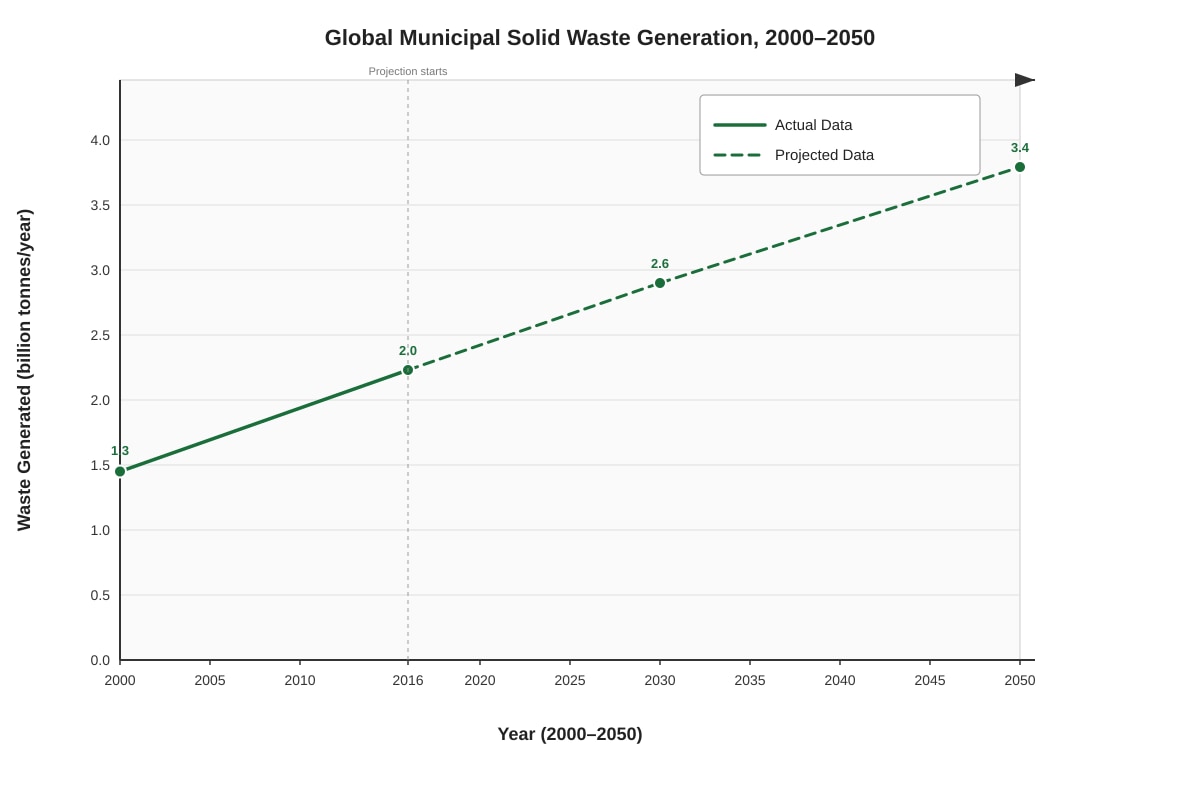
Answer: Global municipal solid waste generation has shown a consistent upward trend from 2000 to 2050. The actual data shows an increase from 1.3 billion tonnes in 2000 to 2.0 billion tonnes in 2016. Projected data indicates continued growth, reaching 3.4 billion tonnes by 2050, representing more than a doubling of waste generation over the 50-year period.
Marking Scheme:
- 1 mark: Identifies the upward/increasing trend
- 1 mark: Provides specific data points (e.g., from 1.3 to 3.4 billion tonnes) or describes the rate of increase
Teaching Note: When describing trends from a graph, always state the overall direction (upward, downward, stable) and support with specific data points. Use the start and end values to show the magnitude of change. The key concept here is that waste generation is increasing globally, which creates challenges for sustainable urban development.
Question 2 (3 marks)
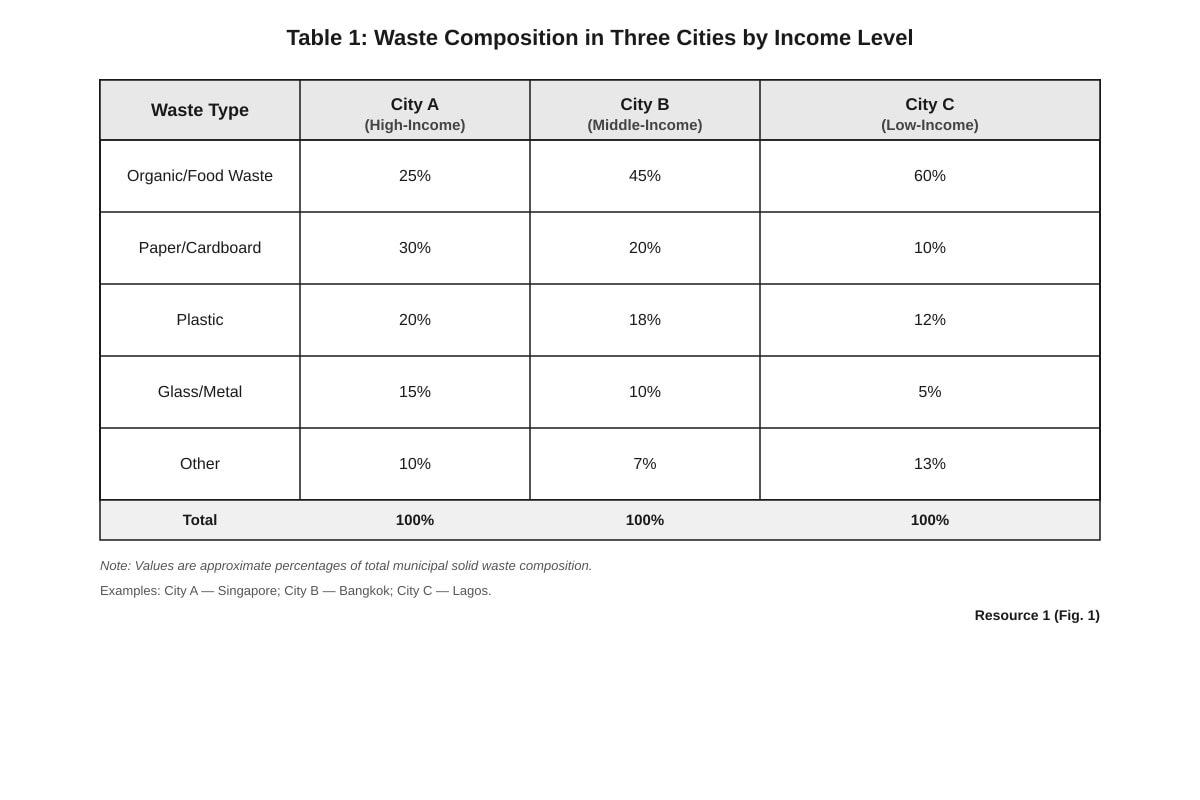
Answer: City A (high-income) has a significantly lower proportion of organic/food waste (25%) compared to City C (low-income) at 60%. Conversely, City A has higher proportions of paper/cardboard (30% vs 10%) and plastic (20% vs 12%) waste. City A also has more glass/metal waste (15% vs 5%). The 'Other' category is similar (10% vs 13%).
Marking Scheme:
- 1 mark: Identifies the difference in organic/food waste (City C higher)
- 1 mark: Identifies differences in paper/cardboard and/or plastic (City A higher)
- 1 mark: Provides specific percentage values from the table
Teaching Note: Comparison questions require you to identify similarities AND differences. Use comparative language (higher/lower, more/less, greater/smaller). Always support your comparison with specific data from the resource. The pattern here reflects different consumption patterns and economic development levels.
Question 3 (3 marks)
Answer: The proportion of organic/food waste is highest in City C (low-income) for several reasons:
- Less processed food consumption: Low-income households tend to buy fresh, unprocessed food which has higher organic content and spoils faster.
- Limited food preservation technology: Lower access to refrigeration and food storage leads to more food spoilage.
- Less packaging: In low-income cities, food is often sold without packaging, so the waste is primarily organic rather than packaging materials.
- Lower recycling infrastructure: Organic waste is less likely to be separated for composting or recycling, so it remains in the general waste stream.
Marking Scheme:
- 1 mark: Each valid explanation point (max 3 marks)
- Award marks for clear causal links between income level and waste composition
Teaching Note: This question tests your understanding of how economic development affects waste composition. The key concept is that waste composition reflects consumption patterns, which are influenced by income levels. Low-income cities have more organic waste because of less processed food consumption, less packaging, and limited preservation technology.
Question 4 (4 marks)
Answer: The higher proportion of paper/cardboard waste in City A (high-income) compared to City C (low-income) can be accounted for by:
- Higher consumption of packaged goods: High-income cities have greater consumption of processed and packaged foods, resulting in more paper/cardboard packaging waste.
- Greater use of paper products: Higher literacy rates, more office work, and greater use of paper for printing, packaging, and advertising in high-income economies.
- E-commerce and delivery services: High-income cities have more developed e-commerce sectors, generating significant cardboard packaging waste from online deliveries.
- Different food retail systems: Supermarkets and large retail chains in high-income cities use more packaging compared to wet markets and street vendors common in low-income cities.
- Recycling systems: High-income cities often have better paper recycling systems, but the total paper waste generated is still higher due to consumption levels.
Marking Scheme:
- 1 mark: Each valid explanation point (max 4 marks)
- Must establish a clear causal link between income level and paper waste generation
Teaching Note: This question requires you to 'account for' a pattern, meaning you need to explain WHY it exists. The key is linking consumption patterns to economic development. High-income economies are characterized by more packaging, more processed goods, and more paper-intensive activities, all of which contribute to higher paper waste.
Question 5 (8 marks)
Answer:
Usefulness of Resource 1 (Fig. 1 - Global waste generation trend):
- Strengths: Shows the long-term trend (2000-2050), demonstrating the scale of the waste challenge globally. The projection data highlights the urgency of addressing waste management. The graph provides a clear overview of the growing problem.
- Limitations: Only shows global aggregate data, not variations between countries or cities at different development levels. The projection is based on assumptions that may not account for policy changes or technological innovations.
Usefulness of Resource 2 (Fig. 2 - Waste composition comparison):
- Strengths: Provides direct comparison between cities at different income levels, allowing analysis of how development affects waste composition. The specific percentage data enables quantitative analysis.
- Limitations: Only shows three cities, which may not be representative of all cities at those income levels. Does not show changes over time or include data on waste management infrastructure.
Overall evaluation: Both resources are useful for understanding waste management challenges, but they address different aspects. Resource 1 shows the scale of the problem (quantity), while Resource 2 shows the nature of the problem (composition). Together, they provide a more complete picture. However, neither resource addresses waste management capacity, policy responses, or environmental impacts, which are also crucial for understanding the full challenge.
Marking Scheme (Levels-based):
- Level 3 (7-8 marks): Comprehensive evaluation of both resources, identifying strengths and limitations of each, with a clear overall judgment. Uses specific evidence from the resources.
- Level 2 (4-6 marks): Good evaluation of both resources but may be unbalanced or lack specific evidence. Some judgment present.
- Level 1 (1-3 marks): Describes resource content without evaluating usefulness. Limited or no judgment.
- Level 0 (0 marks): No relevant content.
Teaching Note: 'Evaluate the usefulness' questions require you to assess how helpful a resource is for a specific purpose. You must identify BOTH strengths and limitations. A strong answer will:
- State what the resource shows
- Explain why this is useful for understanding the topic
- Identify what the resource does NOT show (limitations)
- Make an overall judgment about its usefulness
- Compare resources if multiple are provided
Section B: Structured Questions (15 marks)
Question 6 (2 marks)
Answer: Sustainable development is development that meets the needs of the present without compromising the ability of future generations to meet their own needs. In the context of urban resource management, it involves managing resources (such as waste, water, and energy) in a way that balances economic growth, social equity, and environmental protection.
Marking Scheme:
- 1 mark: Correct definition of sustainable development (Brundtland definition)
- 1 mark: Application to urban resource management context
Teaching Note: The Brundtland Commission definition is the most widely accepted definition of sustainable development. For H1 Geography, you need to apply this concept to specific urban contexts. Remember the three pillars: economic, social, and environmental sustainability.
Question 7 (4 marks)
Answer: Reason 1: Environmental protection - Ineffective waste management leads to pollution of land, water, and air. Landfills can contaminate groundwater through leachate, while open burning releases toxic gases. Proper waste management prevents environmental degradation and protects ecosystems, which is essential for sustainable development.
Reason 2: Public health and social well-being - Accumulated waste attracts disease vectors (rats, insects) and creates unsanitary conditions that spread diseases. Effective waste management improves quality of life, reduces health risks, and contributes to social sustainability by creating cleaner, healthier urban environments.
Reason 3: Resource conservation - Waste contains valuable materials that can be recovered through recycling and composting. Effective waste management reduces the need for virgin resource extraction, conserves energy, and supports a circular economy, which is central to sustainable development.
Marking Scheme:
- 2 marks: Each valid reason with clear explanation (max 4 marks)
- 1 mark: Reason stated without explanation
Teaching Note: When asked to 'explain', you need to provide the causal mechanism - not just state the reason but show HOW it contributes to sustainable urban development. Connect each point to one or more of the three pillars of sustainability (economic, social, environmental).
Question 8 (3 marks)
Answer: Strategy: Community-based composting programs A city in a developing country could implement community composting programs to reduce organic waste sent to landfills. This involves:
- Providing households with composting bins or establishing community composting sites
- Training residents to separate organic waste (food scraps, garden waste)
- Using the compost produced for urban agriculture or community gardens
This strategy is appropriate because organic waste makes up a large proportion (often 50-60%) of waste in low-income cities, and composting requires minimal technology and investment. It also produces a useful product (compost) that can improve soil fertility and support local food production.
Alternative acceptable strategies:
- Informal sector integration (supporting waste pickers/recyclers)
- Source separation programs
- Pay-as-you-throw schemes
- Deposit-refund systems for recyclables
Marking Scheme:
- 1 mark: Identifies a specific strategy
- 1 mark: Explains how the strategy works
- 1 mark: Explains why it is suitable for a developing country context
Teaching Note: When suggesting strategies, always consider the context. A strategy suitable for a developing country should be:
- Low-cost and low-technology
- Appropriate for the waste composition (high organic content)
- Able to utilize existing informal systems
- Culturally and socially acceptable
Question 9 (3 marks)
Answer: The waste hierarchy (reduce, reuse, recycle) contributes to sustainable urban development by:
-
Reduce: Minimizing waste generation at source reduces the demand for raw materials, energy, and landfill space. This directly addresses the root cause of waste problems rather than managing symptoms.
-
Reuse: Extending the life of products reduces the need for new production, conserving resources and energy. It also creates economic opportunities (e.g., second-hand markets, repair services).
-
Recycle: Converting waste materials into new products reduces the need for virgin resource extraction, saves energy (e.g., recycling aluminum saves 95% of energy compared to producing new aluminum), and reduces landfill burden.
Together, these three principles promote a circular economy where resources are kept in use for as long as possible, minimizing environmental impact and supporting long-term sustainability.
Marking Scheme:
- 1 mark: Explanation of 'reduce' and its contribution
- 1 mark: Explanation of 'reuse' and its contribution
- 1 mark: Explanation of 'recycle' and its contribution
Teaching Note: The waste hierarchy is a fundamental concept in waste management. The order is important: reduce is preferred over reuse, which is preferred over recycling. This is because reducing waste at source has the greatest environmental benefit. Always explain the mechanism - HOW each level contributes to sustainability.
Question 10 (3 marks)
Answer: Reason: Differences in financial resources and infrastructure Waste management strategies successful in high-income cities often require significant capital investment, advanced technology, and established infrastructure that may not be available in low-income cities. For example, Singapore's waste-to-energy incineration plants cost hundreds of millions of dollars to build and require specialized technical expertise to operate and maintain. A low-income city may lack the financial resources, technical capacity, and reliable electricity grid needed to support such technology.
Additionally, the waste composition differs (higher organic content in low-income cities), which affects the suitability of certain technologies. Incineration works best with waste that has high calorific value (paper, plastic), which is more common in high-income cities.
Alternative acceptable reasons:
- Different waste composition affecting technology suitability
- Different institutional capacity and governance structures
- Different informal sector involvement
- Different cultural attitudes and social norms
- Different regulatory environments
Marking Scheme:
- 1 mark: Identifies a valid reason
- 2 marks: Explains the reason with specific reference to differences between high-income and low-income cities
Teaching Note: This question tests your understanding of context-specific solutions. The key concept is that 'one size does not fit all' in waste management. Strategies must be adapted to local conditions including economic resources, waste composition, technical capacity, and social/cultural factors.
Section C: Essay Questions (15 marks)
Question 11 (15 marks)
Answer: 'Incineration is the most effective solution for managing municipal solid waste in densely populated cities.' To what extent do you agree?
Structure and Key Points:
Introduction:
- Define incineration (waste-to-energy combustion)
- Acknowledge the challenge of waste management in densely populated cities (limited land, high waste volumes)
- State your position: Incineration is effective but not the most effective solution; it should be part of an integrated approach
Arguments FOR incineration (agree):
- Volume reduction: Incineration reduces waste volume by 80-90%, crucial for cities with limited landfill space (e.g., Singapore, Tokyo)
- Energy recovery: Generates electricity from waste, contributing to energy security and reducing fossil fuel dependence
- Reduced methane emissions: Prevents methane generation from landfills (methane is 25x more potent than CO2 as a greenhouse gas)
- Sanitary disposal: Destroys pathogens and reduces health risks compared to open dumping
- Land efficiency: Requires much less land than landfills, making it suitable for densely populated cities
Arguments AGAINST incineration (disagree):
- High cost: Capital and operational costs are very high, making it unaffordable for many cities
- Air pollution: Releases pollutants including dioxins, furans, and heavy metals if not properly controlled
- Ash disposal: Produces toxic fly ash that requires special disposal
- Discourages waste reduction: May reduce incentives for waste reduction and recycling
- Carbon emissions: Releases fossil carbon (from plastics) as CO2, contributing to climate change
- Not suitable for all waste types: High organic content waste (common in developing countries) has low calorific value
Alternative/more effective solutions:
- Waste reduction at source: Most effective but requires behavioral change
- Recycling and composting: Creates jobs, conserves resources, lower environmental impact
- Circular economy approaches: Redesign products to eliminate waste
- Integrated waste management: Combining multiple strategies for optimal results
Conclusion:
- Incineration is a useful tool but not the most effective solution on its own
- The most effective approach is an integrated waste management system that prioritizes waste reduction and recycling, with incineration used for residual waste
- Effectiveness depends on local context: incineration may be appropriate for high-income, land-scarce cities but not for low-income cities
Marking Scheme (Levels-based):
| Level | Marks | Description |
|---|---|---|
| Level 4 | 13-15 | Comprehensive evaluation with clear argument, balanced analysis, specific examples, and well-supported conclusion |
| Level 3 | 9-12 | Good evaluation with clear argument, some examples, balanced but may lack depth in one area |
| Level 2 | 5-8 | Some evaluation but may be one-sided or lack specific examples |
| Level 1 | 1-4 | Limited evaluation, mainly descriptive, few or no examples |
| Level 0 | 0 | No relevant content |
Teaching Note: 'To what extent do you agree' questions require you to take a position and support it with evidence. A strong essay will:
- Define key terms
- Present arguments for and against
- Use specific examples/case studies
- Evaluate the strength of different arguments
- Reach a clear, well-supported conclusion
- Consider alternative perspectives
Question 12 (15 marks)
Answer: 'Evaluate the view that reducing waste generation is more important than improving waste disposal methods for achieving sustainable urban development.'
Structure and Key Points:
Introduction:
- Define the two approaches: waste reduction (prevention) vs. improved disposal (end-of-pipe solutions)
- Explain the concept of sustainable urban development (balancing economic, social, environmental goals)
- State your position: Waste reduction is more important in principle, but both are necessary
Arguments supporting the view (waste reduction is more important):
- Addresses root cause: Prevention is better than cure - reducing waste at source eliminates the problem rather than managing symptoms
- Environmental benefits: Avoids resource extraction, energy use, and pollution associated with both production and disposal
- Circular economy: Waste reduction is fundamental to circular economy principles, keeping resources in use longer
- Cost-effective: Reducing waste saves costs throughout the system (collection, processing, disposal)
- Long-term sustainability: Addresses the growing waste challenge at its source rather than creating ever-larger disposal infrastructure
Arguments against the view (improved disposal is equally/more important):
- Immediate impact: Improved disposal methods can reduce environmental harm more quickly than behavioral change needed for waste reduction
- Practicality: Waste reduction requires significant behavioral and economic changes that are difficult to achieve
- Technological solutions: Modern disposal technologies (WTE incineration, advanced recycling) can recover value from waste
- Existing waste: Improved disposal is needed to manage the waste already being generated
- Economic reality: In growing economies, waste generation may increase despite reduction efforts
Synthesis and evaluation:
- The waste hierarchy prioritizes reduction, but in practice, all levels are needed
- Different contexts require different priorities: high-income cities may focus more on reduction, while rapidly urbanizing cities may need improved disposal first
- True sustainability requires both: reducing waste generation AND improving disposal methods for residual waste
- The most effective approach is integrated waste management
Conclusion:
- Waste reduction is more important in principle because it addresses the root cause
- However, improved disposal methods are essential in practice, especially for managing existing waste and residual waste
- Both approaches are necessary for sustainable urban development
- The key is to prioritize reduction while continuously improving disposal methods
Marking Scheme: Same levels-based scheme as Question 11.
Teaching Note: 'Evaluate the view' questions require you to critically assess a statement. A strong essay will:
- Explain what the statement means
- Present evidence supporting the view
- Present evidence challenging the view
- Synthesize different perspectives
- Reach a balanced, well-supported conclusion
- Use specific examples and case studies
Section D: Case Study Application (Bonus marks not counted in total)
Question 13 (1 mark)
Answer: The main challenge Singapore faces in managing its solid waste is limited land area for landfill disposal. With only 728 km² of land, Semakau Landfill is expected to be full by 2035.
Teaching Note: This is a direct recall question from the case study. The key challenge is land scarcity, which drives Singapore's approach to waste management.
Question 14 (2 marks)
Answer: Singapore's waste-to-energy (WTE) incineration plants reduce the volume of waste requiring landfill disposal by approximately 90%. This means that for every 100 tonnes of waste incinerated, only about 10 tonnes of ash remain, which is then sent to Semakau Landfill. This significantly extends the lifespan of the limited landfill space available.
Marking Scheme:
- 1 mark: Identifies the volume reduction (90%)
- 1 mark: Explains the mechanism (burning reduces waste to ash)
Teaching Note: The key statistic here is the 90% volume reduction. This is why incineration is particularly attractive for land-scarce cities like Singapore. The ash is much more compact and stable than raw waste.
Question 15 (2 marks)
Answer: One environmental benefit of Singapore's waste-to-energy approach is that it generates electricity from waste, which is fed into the national power grid. This reduces the need for fossil fuel-based electricity generation, thereby lowering greenhouse gas emissions. Additionally, incineration prevents methane generation that would occur if the waste were sent to a landfill (methane is a potent greenhouse gas).
Marking Scheme:
- 1 mark: Identifies a valid environmental benefit
- 1 mark: Explains the benefit with specific reference to Singapore
Teaching Note: Environmental benefits of WTE include: energy recovery (reducing fossil fuel use), methane avoidance (compared to landfills), and reduced land use. The energy recovery aspect is particularly important as it turns a waste problem into an energy solution.
Question 16 (2 marks)
Answer: One limitation of relying on incineration as a waste management strategy is air pollution. Incineration releases pollutants including dioxins, furans, heavy metals, and particulate matter, which can have negative health impacts on nearby populations. Even with modern pollution control technology, some emissions are unavoidable. Additionally, incineration produces toxic fly ash that requires special handling and disposal.
Alternative acceptable limitations:
- High capital and operational costs
- Discourages waste reduction and recycling
- Releases fossil carbon (from plastics) as CO2
- Not suitable for waste with high moisture content
Marking Scheme:
- 1 mark: Identifies a valid limitation
- 1 mark: Explains the limitation
Teaching Note: While incineration has benefits, it also has significant limitations. A balanced understanding is important for evaluation questions. The key limitations relate to pollution, cost, and the fact that it doesn't address the root cause of waste generation.
Question 17 (3 marks)
Answer: Singapore's 'Zero Waste Masterplan' aims to address the challenge of limited landfill space by targeting a 30% reduction in waste sent to Semakau Landfill by 2030. It does this through:
- Promoting waste reduction: Encouraging households and businesses to reduce waste generation
- Increasing recycling rates: Improving recycling infrastructure and public education
- Extended Producer Responsibility (EPR): Making producers responsible for the end-of-life management of their products
By reducing the amount of waste that needs to be disposed of, the Masterplan extends the lifespan of Semakau Landfill and reduces the need for new landfill capacity.
Marking Scheme:
- 1 mark: Identifies the target (30% reduction by 2030)
- 1 mark: Explains one strategy from the Masterplan
- 1 mark: Explains how this addresses the landfill challenge
Teaching Note: The 'Zero Waste Masterplan' represents Singapore's shift from a 'treatment and disposal' approach to a 'reduce and recycle' approach. This is significant because it addresses the root cause of waste problems rather than just managing the symptoms.
Question 18 (4 marks)
Answer: Singapore's integrated waste management system is effective in several ways:
- Environmental effectiveness: The system significantly reduces waste volume (90% through incineration), generates clean energy, and prevents methane emissions from landfills
- Land efficiency: The system maximizes the use of limited land, extending the lifespan of Semakau Landfill
- Resource recovery: The 60% recycling rate (including industrial waste) recovers valuable materials
However, there are limitations:
- High cost: The system requires significant investment in infrastructure and technology
- Carbon emissions: Incineration releases CO2 from fossil-based materials (plastics)
- Recycling rate: The domestic recycling rate (excluding industrial waste) is much lower, around 20%
- Dependency on technology: The system is highly dependent on advanced technology, which may not be transferable to other contexts
Overall, Singapore's system is effective for its specific context (high-income, land-scarce) but has limitations in terms of cost and environmental impact.
Marking Scheme:
- 1-2 marks: Identifies strengths of the system
- 1-2 marks: Identifies limitations/weaknesses
- 1 mark: Overall evaluation/judgment
Teaching Note: 'Evaluate the effectiveness' requires you to assess how well something achieves its goals. You need to identify both successes and limitations, and reach a balanced judgment. Use specific evidence from the case study.
Question 19 (3 marks)
Answer: Comparison: Singapore's approach relies heavily on high-technology solutions (WTE incineration, advanced recycling) and significant government investment. A more suitable strategy for a low-income city might be community-based composting and informal sector integration.
Reason for difference: The difference is primarily due to economic resources and waste composition. Low-income cities typically have:
- Limited financial resources for capital-intensive technology
- Higher proportion of organic waste (60%+), which is more suitable for composting than incineration
- Existing informal waste sector (waste pickers) that can be integrated into formal systems
- Lower technical capacity to operate and maintain advanced technology
Marking Scheme:
- 1 mark: Identifies a difference in approach
- 1 mark: Explains the difference
- 1 mark: Provides a reason for the difference
Teaching Note: This question tests your understanding of context-appropriate solutions. The key concept is that waste management strategies must be adapted to local conditions including economic resources, waste composition, technical capacity, and social/cultural factors.
Question 20 (3 marks)
Answer: I disagree that technological solutions alone are sufficient to address waste management challenges. While technology (such as Singapore's WTE incineration) can help manage waste, it does not address the root cause of increasing waste generation.
Arguments against technological sufficiency:
- Growing waste volumes: Technology cannot keep pace with rapidly increasing waste generation, especially in developing countries
- Environmental impacts: Even advanced technology has environmental costs (emissions, energy use, ash disposal)
- Cost barriers: High technology costs make it inaccessible to many cities
- Behavioral change needed: Ultimately, reducing waste requires changes in consumption patterns and production systems
Alternative approaches needed:
- Waste reduction at source
- Circular economy principles
- Extended Producer Responsibility
- Public education and behavioral change
Example: Singapore's approach, while technologically advanced, still faces the challenge of Semakau Landfill filling up by 2035. This shows that technology alone is not enough - waste reduction and recycling are also essential.
Marking Scheme:
- 1 mark: States a clear position
- 1 mark: Provides reasoning with reference to Singapore
- 1 mark: References at least one other example or provides additional reasoning
Teaching Note: 'To what extent do you agree' questions require a balanced but clear position. The key insight here is that technology is a tool, not a solution. True sustainability requires addressing the root causes of waste generation through behavioral, economic, and systemic changes.
End of Answer Key