AI Generated Quiz
A Level H1 Geography Physical Geography Quiz
Free A Level H1 Geography Physical Geography quiz, AI version, with questions, answers, and A Level-style practice for Singapore students.
These static practice materials are generated from the site's syllabus and paper-generation workflow, with source and model context shown so students and parents can evaluate the material before use.
Questions


Free quiz and exam paper access
Enter your details to view this paper
Your access is remembered on this device.
Answers
A-Level Geography H1 Quiz - Physical Geography: Answer Key
Total Marks: 50
Section A: Climate Science and Variability (Questions 1–5)
Question 1 [2 marks]
Answer: Two proxy indicators used to reconstruct past climate variability are:
- Ice cores (from ice sheets/glaciers) – containing trapped air bubbles that reveal past atmospheric composition and temperature.
- Ocean cores (sediment cores from the ocean floor) – containing fossilized marine organisms (e.g., foraminifera) whose shell chemistry indicates past ocean temperatures.
Marking Notes:
- Award 1 mark for each correct proxy indicator.
- Accept other valid proxies such as tree rings (dendrochronology), pollen records (palynology), or coral cores.
- Do not accept "temperature records" or "thermometers" as these are direct measurements, not proxies.
Teaching Note: Proxy indicators are preserved physical characteristics of the past that stand in for direct measurements. They allow scientists to reconstruct climate before the era of instrumental records (pre-1850s). Ice cores provide data on temperature (through oxygen isotope ratios), atmospheric CO2, and methane levels. Ocean cores provide data on sea surface temperatures and ocean chemistry.
Question 2 [3 marks]
Answer: Changes in solar output (the amount of energy emitted by the Sun) can influence Earth's temperature variability through the following mechanisms:
- Direct radiative forcing: When solar output increases, more solar radiation reaches Earth's surface, causing warming. When solar output decreases, less radiation reaches Earth, causing cooling.
- Amplification through feedbacks: Small changes in solar output can be amplified by feedback mechanisms. For example, increased solar radiation can cause ice sheets to melt, reducing Earth's albedo (reflectivity), which leads to further warming.
- Orbital forcing (Milankovitch cycles): Variations in Earth's orbit (eccentricity, obliquity, precession) affect the distribution and amount of solar radiation received at different latitudes and seasons, driving glacial-interglacial cycles.
Marking Notes:
- Award 1 mark for explaining direct radiative forcing.
- Award 1 mark for explaining amplification through feedbacks.
- Award 1 mark for explaining orbital forcing (Milankovitch cycles) or another valid mechanism.
Teaching Note: Solar output variations are a natural factor influencing climate. However, the IPCC concludes that changes in solar output alone cannot account for the rapid warming observed since the mid-20th century, as solar output has been relatively stable while global temperatures have risen sharply. The Milankovitch cycles operate on timescales of tens of thousands of years and are responsible for glacial-interglacial cycles, not the recent rapid warming.
Question 3 [3 marks]
Answer: Thermohaline circulation (THC) is a global ocean circulation system driven by differences in water density (temperature and salinity). Its role in regulating global climate includes:
- Heat transport: THC transports warm surface waters from the equator towards the poles, and cold deep waters from the poles towards the equator. This redistributes heat around the globe, moderating temperatures in high-latitude regions (e.g., Western Europe is kept warmer than its latitude would suggest by the North Atlantic Drift).
- Carbon storage: THC drives the downwelling of cold, dense water in the North Atlantic and Southern Ocean, which carries dissolved CO2 into the deep ocean. This acts as a carbon sink, removing CO2 from the atmosphere.
- Climate stability: THC helps maintain stable climate conditions by regulating the distribution of heat and carbon. Disruption of THC (e.g., by freshwater input from melting ice sheets) can lead to abrupt climate change.
Marking Notes:
- Award 1 mark for explaining heat transport.
- Award 1 mark for explaining carbon storage.
- Award 1 mark for explaining climate stability or another valid role.
Teaching Note: The THC is sometimes called the "global ocean conveyor belt." It is a critical component of the climate system. A key concern is that melting Greenland ice could inject freshwater into the North Atlantic, reducing surface water density and potentially slowing or shutting down the THC, which could lead to cooling in Western Europe and other disruptions.
Question 4 [4 marks]
Answer: Changes in ice sheets influence temperature through feedback mechanisms:
Positive feedback (amplifying warming):
- Albedo feedback: Ice sheets have a high albedo (reflectivity), meaning they reflect most incoming solar radiation back into space. When temperatures rise, ice sheets melt, exposing darker surfaces (land or ocean) that absorb more solar radiation. This causes further warming, which leads to more ice melt – a self-reinforcing cycle.
- Temperature-albedo feedback: As ice sheets shrink, the region's overall albedo decreases, leading to more absorbed solar energy and higher local temperatures, accelerating further ice loss.
Negative feedback (moderating cooling): 3. Ice sheet growth feedback: During cooling periods, ice sheets expand, increasing Earth's albedo. This reflects more solar radiation, leading to further cooling and more ice growth. However, this is a self-reinforcing (positive) feedback for cooling, not a moderating one.
Marking Notes:
- Award 1 mark for explaining the albedo feedback mechanism.
- Award 1 mark for explaining how ice melt amplifies warming.
- Award 1 mark for explaining how ice sheet growth amplifies cooling.
- Award 1 mark for clearly distinguishing between positive and negative feedbacks.
Teaching Note: A positive feedback amplifies the initial change (warming causes more warming), while a negative feedback dampens the initial change (warming causes cooling). In the context of ice sheets, the albedo feedback is a powerful positive feedback that can accelerate climate change. Understanding feedbacks is crucial for predicting future climate change because they can cause non-linear responses (sudden, rapid changes).
Question 5 [3 marks]
Answer: The graph shows a clear pattern of glacial-interglacial cycles during the Quaternary period:
- Cyclical pattern: Temperature has fluctuated between cold glacial periods (troughs at approximately -8°C to -10°C anomaly) and warm interglacial periods (peaks at approximately 0°C anomaly).
- Approximately 100,000-year cycles: The cycles have a period of roughly 100,000 years, with long, gradual cooling phases followed by relatively rapid warming into interglacials.
- Current interglacial: The most recent interglacial (the Holocene, starting ~11,700 years ago) is the warm period we are currently in, shown at the far right of the graph.
Marking Notes:
- Award 1 mark for identifying the cyclical pattern of glacial-interglacial cycles.
- Award 1 mark for describing the approximate 100,000-year cycle length.
- Award 1 mark for identifying the current interglacial (Holocene) or describing the sawtooth pattern.
Teaching Note: This graph is based on data from the EPICA Dome C ice core in Antarctica. The sawtooth pattern (slow cooling, rapid warming) is characteristic of Quaternary climate. The cycles are driven by Milankovitch orbital forcing, but the actual temperature changes are amplified by feedback mechanisms (CO2, albedo). The current interglacial (Holocene) has been unusually stable compared to previous interglacials, which may have facilitated the development of human civilization.
Section B: The Enhanced Greenhouse Effect and Human Activities (Questions 6–10)
Question 6 [1 mark]
Answer: The IPCC consensus is that climate change observed since the mid-20th century is unequivocal and very likely (more than 95% probability) caused by human activities, primarily the emission of greenhouse gases.
Marking Notes:
- Award 1 mark for stating that human activities are the primary cause.
- Accept: "very likely caused by human activities" or "anthropogenic activities are the dominant cause."
Teaching Note: The IPCC (Intergovernmental Panel on Climate Change) is the UN body for assessing climate science. Their reports represent the consensus of thousands of scientists worldwide. The phrase "very likely" corresponds to a probability of >95%. This is a key point in the H1 Geography syllabus.
Question 7 [3 marks]
Answer: The burning of fossil fuels (coal, oil, and natural gas) contributes to the enhanced greenhouse effect through the following process:
- CO2 emission: Combustion of fossil fuels releases carbon dioxide (CO2) that was stored underground for millions of years. This adds a large volume of CO2 to the atmosphere that was not part of the active carbon cycle.
- Enhanced absorption of infrared radiation: CO2 is a greenhouse gas that absorbs outgoing longwave (infrared) radiation emitted by Earth's surface. The additional CO2 from fossil fuel combustion increases the atmosphere's capacity to trap heat.
- Radiative forcing: The increased concentration of CO2 creates a positive radiative forcing (an imbalance in Earth's energy budget), causing more energy to be retained in the Earth system, leading to global warming.
Marking Notes:
- Award 1 mark for identifying that fossil fuel combustion releases stored CO2.
- Award 1 mark for explaining that CO2 absorbs outgoing infrared radiation.
- Award 1 mark for explaining the concept of radiative forcing or the enhanced greenhouse effect.
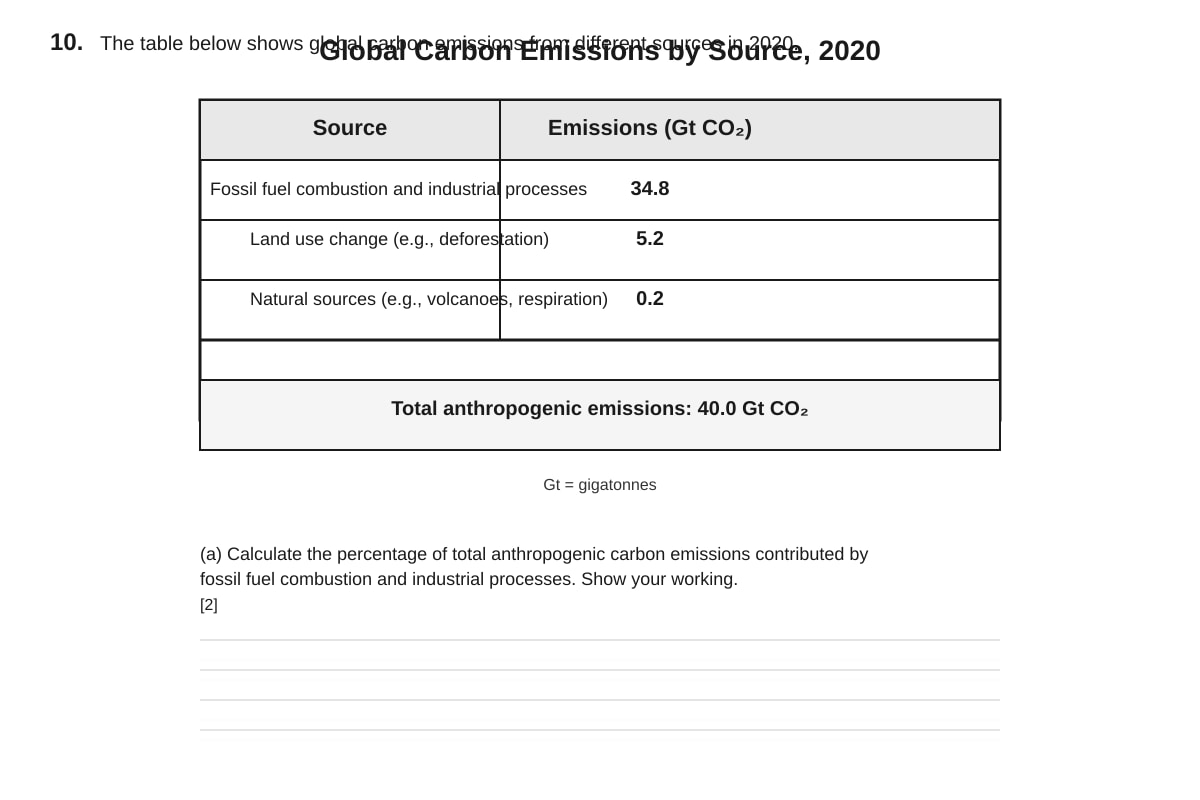
Teaching Note: The "enhanced" greenhouse effect refers to the additional warming caused by human activities, beyond the natural greenhouse effect that keeps Earth habitable. Fossil fuel combustion is the largest source of anthropogenic CO2 emissions (about 87% of total anthropogenic CO2 in 2020). The natural greenhouse effect is essential for life; the problem is the enhancement of this effect by human activities.
Question 8 [4 marks]
Answer: Two human activities that reduce carbon sinks:
-
Deforestation: Forests are major carbon sinks, absorbing CO2 through photosynthesis. When forests are cleared (for agriculture, logging, or urban development), this carbon sink is reduced or eliminated. Additionally, if the cleared biomass is burned, the stored carbon is released back into the atmosphere as CO2, further increasing atmospheric carbon.
-
Ocean acidification and pollution: Human activities that increase ocean acidification (through CO2 absorption) and pollution can damage marine ecosystems like coral reefs and phytoplankton, which are important carbon sinks. When these ecosystems are degraded, their capacity to absorb CO2 from the atmosphere is reduced.
Alternative acceptable answer: 3. Urbanization/land use change: Converting natural ecosystems (forests, wetlands, grasslands) into urban areas reduces the area available for carbon sequestration. Wetlands, in particular, are important carbon sinks, and their drainage releases stored carbon.
Marking Notes:
- Award 1 mark for each correctly identified activity (2 marks total).
- Award 1 mark for each explanation of how it affects the carbon cycle (2 marks total).
Teaching Note: Carbon sinks are natural or artificial reservoirs that absorb and store carbon from the atmosphere. The main natural carbon sinks are forests, oceans, and soil. Human activities that reduce these sinks are a major concern because they not only reduce the Earth's capacity to absorb CO2 but often also release additional stored carbon.
Question 9 [3 marks]
Answer: Deforestation can create a positive feedback loop that accelerates global warming:
- Initial warming: Global warming causes temperatures to rise, which can increase the frequency and intensity of droughts and wildfires in forested areas.
- Forest dieback/deforestation: Droughts and wildfires kill trees, leading to deforestation. Additionally, higher temperatures can stress trees, making them more susceptible to pests and diseases, further reducing forest cover.
- Feedback loop: The loss of forests reduces the Earth's capacity to absorb CO2 (since trees are carbon sinks). Furthermore, the decomposition or burning of dead trees releases stored carbon into the atmosphere as CO2. The increased atmospheric CO2 enhances the greenhouse effect, causing further warming, which leads to more forest dieback – a self-reinforcing cycle.
Marking Notes:
- Award 1 mark for explaining the initial trigger (warming leading to forest stress/dieback).
- Award 1 mark for explaining the reduction in carbon sink capacity.
- Award 1 mark for explaining the release of stored carbon and the self-reinforcing nature of the loop.
Teaching Note: Positive feedback loops are dangerous because they can lead to "tipping points" – thresholds beyond which the system changes rapidly and irreversibly. The Amazon rainforest is a key example: deforestation and climate change are pushing it towards a tipping point where it could transition from a rainforest to a savanna ecosystem, releasing billions of tonnes of carbon in the process.
Question 10 [4 marks]
(a) [2 marks]
Answer: Percentage = (Emissions from fossil fuel combustion and industrial processes / Total anthropogenic emissions) × 100 Percentage = (34.8 Gt / 40.0 Gt) × 100 Percentage = 0.87 × 100 Percentage = 87%
Marking Notes:
- Award 1 mark for correct working (showing the formula and substitution).
- Award 1 mark for the correct final answer (87%).
- Accept 87% or 87.0%. Do not accept answers without working.
(b) [2 marks]
Answer: Natural sources of carbon emissions (such as volcanoes, respiration, and decomposition) are not considered a major contributor to contemporary climate change because:
- They are part of the natural carbon cycle: Natural emissions are balanced by natural carbon sinks (e.g., photosynthesis, ocean absorption). Over long timescales, the natural carbon cycle is in equilibrium – emissions are roughly equal to absorptions.
- The current imbalance is anthropogenic: The rapid increase in atmospheric CO2 since the Industrial Revolution is due to human activities (fossil fuel burning, deforestation) that add carbon to the atmosphere faster than natural sinks can absorb it. This anthropogenic addition is what is causing the enhanced greenhouse effect.
Marking Notes:
- Award 1 mark for explaining that natural emissions are balanced by natural sinks.
- Award 1 mark for explaining that the current imbalance is caused by human activities.
Teaching Note: This is a crucial distinction. The natural greenhouse effect is a stable, balanced system. Human activities have disrupted this balance by adding extra greenhouse gases to the atmosphere. The IPCC's conclusion that recent warming is "very likely" caused by human activities is based on this fundamental understanding of the carbon cycle.
Section C: Impacts of Climate Change (Questions 11–15)
Question 11 [2 marks]
Answer: Two possible impacts of climate change on aquatic ecosystems:
- Ocean acidification: Increased atmospheric CO2 is absorbed by the oceans, forming carbonic acid. This lowers the pH of seawater, making it more difficult for calcifying organisms (e.g., corals, shellfish, plankton) to build their shells and skeletons. This can lead to coral bleaching and the collapse of marine food webs.
- Warming of water bodies: Rising temperatures can cause thermal stress in aquatic organisms, leading to shifts in species distribution (e.g., fish moving to cooler waters), changes in breeding cycles, and increased mortality. Warmer water also holds less dissolved oxygen, leading to "dead zones."
Marking Notes:
- Award 1 mark for each correctly described impact.
- Accept other valid impacts such as sea-level rise affecting coastal ecosystems, changes in freshwater availability, or increased frequency of algal blooms.
Teaching Note: Aquatic ecosystems are particularly vulnerable to climate change because water temperature and chemistry are critical to the survival of aquatic organisms. Coral reefs are often described as the "canaries in the coal mine" for climate change impacts.
Question 12 [4 marks]
Answer: Changes in temperature and precipitation patterns could affect agricultural productivity in tropical regions in several ways:
- Increased temperatures: Higher temperatures can exceed the optimal growing range for many tropical crops (e.g., rice, maize, coffee). Heat stress can reduce yields, damage crops, and increase water demand for irrigation. Higher temperatures also increase evapotranspiration, leading to soil moisture loss.
- Changes in precipitation: Some tropical regions may experience increased rainfall, leading to flooding and waterlogging of crops. Other regions may experience decreased rainfall and more frequent droughts, leading to crop failure and reduced agricultural output.
- Shifts in growing seasons: Changes in the timing and reliability of monsoon rains can disrupt planting and harvesting cycles, leading to reduced yields.
- Increased pest and disease pressure: Warmer temperatures can allow pests and diseases to expand their range and survive through more of the year, increasing crop losses.
Marking Notes:
- Award 1 mark for each well-explained impact (up to 4 marks).
- Accept other valid impacts such as changes in crop suitability zones or impacts on livestock.
Teaching Note: Tropical regions are particularly vulnerable to climate change impacts on agriculture because many developing countries in the tropics rely heavily on agriculture for food security and livelihoods. The impacts are complex and vary by region, but overall, climate change is expected to reduce agricultural productivity in many tropical areas, exacerbating food insecurity.
Question 13 [2 marks]
Answer: Two regions projected to experience a decrease in annual precipitation by 2080 under a high-emissions scenario are:
- The Mediterranean region (including Southern Europe, North Africa, and the Middle East).
- Southern Africa (including countries like South Africa, Botswana, and Namibia).
Alternative acceptable answers:
- Southwestern Australia
- Parts of Central America (e.g., Mexico, Central American isthmus)
- The Amazon region
Marking Notes:
- Award 1 mark for each correctly identified region.
- Accept any region shown in red/orange on the map.
Teaching Note: The map shows projected precipitation changes under the RCP 8.5 scenario (a high-emissions, "business-as-usual" scenario). The drying pattern in subtropical regions is consistent with climate model projections, which show a poleward expansion of the subtropical dry zones. This has significant implications for water resources, agriculture, and wildfire risk in these regions.
Question 14 [4 marks]
Answer: The impacts of climate change are expected to be unevenly distributed across the world due to several factors:
- Geographic vulnerability: Some regions are inherently more vulnerable to climate impacts. For example, low-lying coastal areas and small island states are more vulnerable to sea-level rise. Arid and semi-arid regions are more vulnerable to drought and desertification.
- Differences in adaptive capacity: Developed countries have greater financial resources, technology, and infrastructure to adapt to climate change (e.g., building sea walls, developing drought-resistant crops). Developing countries have limited resources and may lack the capacity to implement adaptation measures, making them more vulnerable to impacts.
- Exposure to extreme events: Some regions are projected to experience more frequent and intense extreme weather events (e.g., tropical cyclones, heatwaves, floods). The distribution of these events is uneven, with some regions facing greater risks.
- Economic dependence on climate-sensitive sectors: Countries whose economies are heavily dependent on agriculture, fisheries, or tourism are more vulnerable to climate impacts than those with diversified economies.
Marking Notes:
- Award 1 mark for each well-explained factor (up to 4 marks).
- Accept other valid factors such as population density, governance, or health system capacity.
Teaching Note: The concept of "uneven impacts" is a key theme in the H1 Geography syllabus. It highlights the issue of climate justice: those who have contributed the least to climate change (developing countries) are often the most vulnerable to its impacts. This is a central argument in international climate negotiations.
Question 15 [5 marks]
Answer: Sea-level rise poses significant consequences for coastal populations in Southeast Asia:
Level 3 (5 marks): Comprehensive evaluation with specific examples and balanced judgement.
Potential consequences:
- Displacement and loss of land: Many major cities in Southeast Asia are located on low-lying coasts (e.g., Jakarta, Bangkok, Ho Chi Minh City, Manila). Sea-level rise could inundate large areas, displacing millions of people. For example, Jakarta is already experiencing severe flooding and land subsidence, and parts of the city are expected to be submerged by 2050.
- Saltwater intrusion: Rising sea levels push saltwater further inland into rivers and groundwater aquifers. This contaminates freshwater supplies for drinking and irrigation, threatening food security and water availability.
- Damage to infrastructure and economy: Coastal infrastructure (ports, roads, buildings) is at risk of damage from flooding and storm surges. This could disrupt economic activities, particularly in trade-dependent economies like Singapore.
- Loss of coastal ecosystems: Mangroves, wetlands, and coral reefs are threatened by sea-level rise. These ecosystems provide important services (coastal protection, fisheries, biodiversity) and their loss would have cascading effects.
Evaluation: The consequences are severe but vary across the region. Countries with higher adaptive capacity (e.g., Singapore, with its coastal protection measures and financial resources) may be better able to manage the impacts. However, lower-income countries (e.g., Myanmar, Cambodia, parts of Indonesia) face greater risks due to limited resources. The overall impact depends on the rate of sea-level rise and the effectiveness of adaptation measures.
Marking Notes:
- Level 1 (1-2 marks): Simple description of one or two consequences without evaluation.
- Level 2 (3-4 marks): Good description of multiple consequences with some specific examples, but limited evaluation.
- Level 3 (5 marks): Comprehensive answer with specific examples, clear evaluation of severity and variation across the region, and a balanced judgement.
Teaching Note: Southeast Asia is one of the most vulnerable regions to sea-level rise due to its long coastlines, large coastal populations, and the presence of many megacities on low-lying land. The region also has significant variations in adaptive capacity, making the impacts uneven.
Section D: Responses to Climate Change (Questions 16–20)
Question 16 [2 marks]
Answer:
- Mitigation refers to actions taken to reduce the sources of greenhouse gas emissions or enhance carbon sinks, with the aim of limiting the magnitude of future climate change (e.g., switching to renewable energy, afforestation).
- Adaptation refers to actions taken to adjust to the actual or expected effects of climate change, with the aim of reducing vulnerability and building resilience (e.g., building sea walls, developing drought-resistant crops).
Marking Notes:
- Award 1 mark for a correct definition of mitigation.
- Award 1 mark for a correct definition of adaptation.
Teaching Note: This is a fundamental distinction in climate policy. Mitigation addresses the causes of climate change, while adaptation addresses the impacts. Both are necessary, but the balance between them depends on the rate and magnitude of climate change and the capacity to implement each type of response.
Question 17 [3 marks]
Answer: Afforestation (planting trees on land that was not previously forested) can contribute to climate change mitigation through:
- Carbon sequestration: Trees absorb CO2 from the atmosphere through photosynthesis and store it in their biomass (trunks, branches, leaves, roots) and in the soil. This removes CO2 from the atmosphere, reducing the greenhouse effect.
- Creation of a carbon sink: A new forest acts as a long-term carbon sink, continuing to absorb CO2 as the trees grow. Mature forests can store large amounts of carbon.
- Additional benefits: Afforestation can also provide co-benefits such as reducing soil erosion, improving water quality, and providing habitat for biodiversity, which can enhance ecosystem resilience to climate change.
Marking Notes:
- Award 1 mark for explaining carbon sequestration through photosynthesis.
- Award 1 mark for explaining the creation of a long-term carbon sink.
- Award 1 mark for mentioning additional benefits or explaining the scale of impact.
Teaching Note: Afforestation is a nature-based solution to climate change. However, it is not a substitute for reducing emissions. Trees take time to grow and sequester carbon, and the carbon stored can be released if the forest is later cleared or burned. The effectiveness of afforestation also depends on the type of trees planted, the location, and the long-term management of the forest.
Question 18 [2 marks]
Answer: Two examples of adaptation strategies that coastal cities can implement to address sea-level rise:
- Construction of hard engineering defences: Building sea walls, flood barriers, and dykes to physically prevent seawater from inundating coastal areas. For example, the Thames Barrier in London and the Delta Works in the Netherlands.
- Managed retreat or land use planning: Relocating vulnerable populations and infrastructure away from high-risk coastal areas, and restricting new development in flood-prone zones. This can be combined with restoring natural coastal buffers like mangroves and wetlands.
Alternative acceptable answers:
- Elevating buildings and infrastructure (e.g., building on stilts).
- Improving drainage and pumping systems to manage floodwater.
- Implementing early warning systems for storm surges and coastal flooding.
Marking Notes:
- Award 1 mark for each correctly described adaptation strategy.
- Accept any valid adaptation strategy specific to coastal cities.
Teaching Note: Adaptation strategies can be categorized as "hard" (engineering-based) or "soft" (nature-based or policy-based). The choice of strategy depends on factors such as cost, effectiveness, environmental impact, and social acceptability. Many cities are adopting a combination of strategies.
Question 19 [4 marks]
Answer: Developing countries face several challenges in implementing climate change adaptation measures:
- Financial constraints: Adaptation measures (e.g., building sea walls, developing drought-resistant crops, improving water infrastructure) are expensive. Developing countries often lack the financial resources to invest in large-scale adaptation projects and may rely on international funding, which is often insufficient or slow to arrive.
- Limited technical capacity: Developing countries may lack the technical expertise, technology, and institutional capacity to design and implement effective adaptation strategies. For example, they may not have the meteorological data or climate modeling capabilities needed to assess future risks.
- Competing development priorities: Developing countries often face pressing immediate needs (e.g., poverty reduction, healthcare, education, infrastructure development) that compete for limited resources. Adaptation to future climate risks may be deprioritized in favor of more urgent current needs.
- Weak governance and institutions: Corruption, political instability, and weak institutional frameworks can hinder the effective planning and implementation of adaptation measures. Lack of coordination between government agencies and limited community participation can also reduce effectiveness.
Marking Notes:
- Award 1 mark for each well-explained challenge (up to 4 marks).
- Accept other valid challenges such as lack of data, limited access to insurance, or social/cultural barriers.
Teaching Note: The challenges faced by developing countries in adapting to climate change are a key aspect of climate justice. These countries are often the most vulnerable to climate impacts but have the least capacity to adapt. International climate finance (e.g., the Green Climate Fund) is intended to help address this imbalance, but has been criticized for being insufficient and difficult to access.
Question 20 [5 marks]
Answer: 'International cooperation is essential for effective climate change mitigation.' To what extent do you agree with this statement? Justify your answer.
Level 3 (5 marks): Comprehensive evaluation with balanced argument and specific examples.
Arguments supporting the statement (agree):
- Global commons problem: Climate change is a global problem – greenhouse gas emissions mix uniformly in the atmosphere, and emissions from any country affect the entire planet. No single country can solve the problem alone. International cooperation is needed to ensure collective action.
- Free-rider problem: Without international agreements, countries have an incentive to free-ride on others' mitigation efforts. International cooperation (e.g., the Paris Agreement) creates a framework for shared responsibility and accountability.
- Technology and knowledge sharing: International cooperation facilitates the transfer of clean technologies from developed to developing countries, accelerating the global transition to low-carbon economies.
- Economies of scale: Coordinated international action can drive down the costs of clean technologies through larger markets and shared research and development (e.g., the rapid cost reduction of solar panels).
Arguments against (disagree – to some extent):
- National sovereignty and self-interest: Countries may prioritize their own economic interests over international commitments. The US withdrawal from the Paris Agreement (2017-2021) and the difficulty of reaching binding emissions targets demonstrate the limitations of international cooperation.
- Subnational and non-state action: Effective mitigation can also occur at the national, subnational (e.g., city, state), and non-state (e.g., corporate) levels. For example, the EU's emissions trading system and corporate renewable energy commitments have driven significant emissions reductions without requiring global consensus.
- Implementation challenges: International agreements are often non-binding or lack enforcement mechanisms. The Paris Agreement relies on voluntary nationally determined contributions (NDCs), which are currently insufficient to meet the 1.5°C target.
Balanced judgement: International cooperation is essential for setting global goals, establishing frameworks for accountability, and facilitating technology transfer. However, it is not sufficient on its own. Effective mitigation also requires strong national policies, subnational action, and private sector engagement. The most effective approach combines international cooperation with robust domestic action.
Marking Notes:
- Level 1 (1-2 marks): Simple statement of agreement or disagreement with limited justification.
- Level 2 (3-4 marks): Good discussion of arguments on both sides with some specific examples, but limited evaluation.
- Level 3 (5 marks): Comprehensive evaluation with balanced argument, specific examples (e.g., Paris Agreement, EU ETS, corporate action), and a clear, justified judgement.
Teaching Note: This is an evaluative question that requires students to demonstrate AO3 (Evaluation) skills. The key is to show an understanding of both the necessity and the limitations of international cooperation. The Paris Agreement is the key example of international cooperation, but students should also be aware of its limitations (e.g., non-binding NDCs, lack of enforcement).
End of Answer Key