AI Generated Quiz
A Level H1 Geography Human Geography Quiz
Free A Level H1 Geography Human Geography quiz, AI version, with questions, answers, and A Level-style practice for Singapore students.
These static practice materials are generated from the site's syllabus and paper-generation workflow, with source and model context shown so students and parents can evaluate the material before use.
Questions
Free quiz and exam paper access
Enter your details to view this paper
Your access is remembered on this device.
Answers
A-Level Geography H1 Quiz - Human Geography: Answer Key
Total Marks: 50
Section A: Data-Based Questions (Questions 1–5)
Q1. [2 marks]
Answer: Resource 1 shows that more developed countries (Japan) have a higher proportion of elderly people living in urban areas (29.1%) compared to less developed countries (Brazil at 8.7%, Nigeria at 3.1%). There is a positive correlation between a country's level of development and the proportion of elderly in urban areas.
Marking Notes:
- 1 mark for identifying the positive relationship (higher development = higher elderly urban population)
- 1 mark for using specific data from the resource to support the observation (e.g., Japan 29.1% vs Nigeria 3.1%)
Teaching Note: This question tests the ability to read and interpret a data table. The key concept is the demographic transition: more developed countries have aging populations due to lower fertility rates and higher life expectancy, and these elderly populations are more likely to live in urban areas where services and family support are concentrated. In less developed countries, elderly populations are smaller overall and more likely to remain in rural areas where traditional family structures are stronger.
Q2. [2 marks]
Answer: One reason is that Brazil and Nigeria are experiencing rapid urbanization driven by young migrants seeking economic opportunities in cities. This influx of younger people reduces the proportion of elderly in urban areas, even as the absolute number of elderly may be growing. In contrast, Japan's urbanization occurred earlier, and its current urban population includes a larger cohort that has aged in place.
Marking Notes:
- 1 mark for identifying the role of rural-urban migration by younger age groups
- 1 mark for explaining how this demographic process affects the proportion of elderly
Common Mistake: Students may say "elderly don't move to cities" without explaining the demographic mechanism. The key is that young migrants dilute the elderly proportion, not that elderly don't exist in cities.
Q3. [2 marks]
Answer: Two issues related to social well-being are:
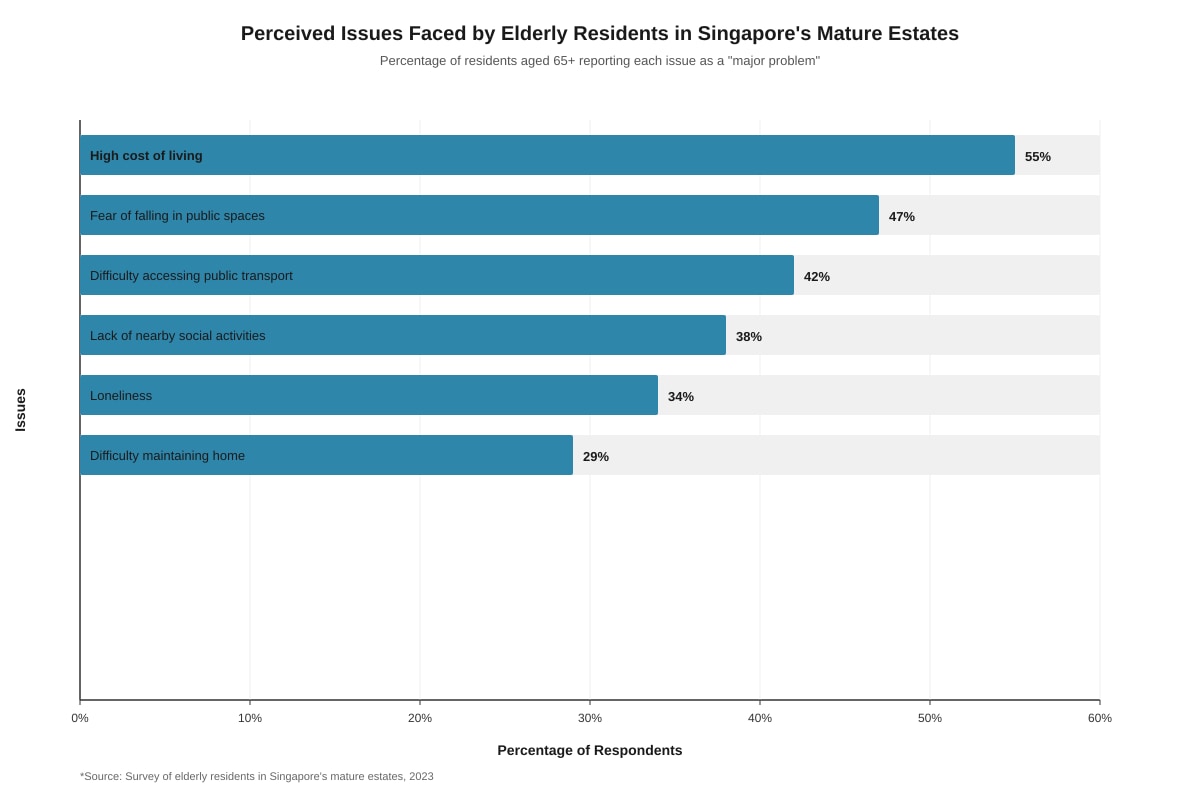
- Lack of nearby social activities (38%)
- Loneliness (34%)
Marking Notes:
- 1 mark for each correctly identified issue (must be from the chart)
- Accept: "Lack of nearby social activities" and "Loneliness"
- Do not accept: issues related to physical safety (fear of falling), economic concerns (cost of living), or mobility (accessing transport) as these are not primarily social well-being issues
Teaching Note: Social well-being refers to an individual's ability to interact with others, participate in community life, and maintain meaningful relationships. Loneliness and lack of social activities directly affect this dimension, while other issues in the chart relate more to physical, economic, or environmental well-being.
Q4. [3 marks]
Answer: Fear of falling in public spaces can affect the economic well-being of elderly residents in several ways:
- It may limit their mobility and willingness to travel to work or engage in part-time employment, reducing their income.
- It can increase healthcare costs due to potential injuries from falls, straining their financial resources.
- It may lead to increased dependence on paid services (e.g., delivery services, taxis) instead of walking or using public transport, increasing living expenses.
Marking Notes:
- 1 mark for each valid explanation linking fear of falling to an economic consequence (max 3)
- Award marks for clear causal reasoning: fear → reduced mobility → economic impact
Teaching Note: This question requires connecting a physical safety concern to economic outcomes. The key is to show understanding that well-being is multi-dimensional and that issues in one dimension (physical safety) can have cascading effects on another (economic). Students should avoid simply restating the fear without explaining the economic mechanism.
Q5. [3 marks]
Answer: One strategy is to establish community-based senior activity centres within walking distance of mature estates. These centres could offer regular social activities, hobby classes, and volunteer opportunities. This strategy addresses loneliness by:
- Providing structured opportunities for social interaction
- Creating a sense of purpose and belonging through activities
- Reducing social isolation by making it easy for elderly residents to form new friendships
This improves psychological well-being by combating depression and anxiety associated with loneliness, and by fostering a sense of community belonging and self-worth.
Marking Notes:
- 1 mark for a specific, feasible strategy
- 1 mark for explaining how it addresses loneliness
- 1 mark for explaining the link to psychological well-being
Teaching Note: The strategy must be specific and actionable. Vague suggestions like "help them make friends" are insufficient. The explanation should show understanding that psychological well-being includes emotional health, sense of purpose, and belonging, not just the absence of loneliness.
Section B: Structured Questions (Questions 6–15)
Q6. [2 marks]
Answer: Liveability refers to the quality of life experienced by residents in a particular place, based on the extent to which the urban environment meets their needs and expectations. It encompasses economic, social, and environmental factors that contribute to residents' overall well-being and satisfaction with their living environment.
Marking Notes:
- 1 mark for defining liveability as quality of life or well-being in a place
- 1 mark for mentioning that it involves multiple factors (economic, social, environmental) or meeting residents' needs
Teaching Note: Liveability is a central concept in urban geography. It is distinct from sustainability (which focuses on long-term resource use) and is inherently subjective because different people have different needs and priorities.
Q7. [4 marks]
Answer: Liveability is subjective because:
-
Place-dependence: What makes a city liveable varies by location. For example, a city with cold winters might be considered less liveable by someone who prefers warm climates, while another person might value seasonal changes. A coastal city might be highly liveable for someone who enjoys water sports but less so for someone afraid of flooding.
-
Time-dependence: Perceptions of liveability change over time. A neighbourhood that was considered highly liveable in the 1990s might be seen as less liveable today due to increased traffic congestion or changing social demographics. Similarly, what a person values at age 25 (nightlife, career opportunities) differs from what they value at age 70 (healthcare access, quiet environment).
Marking Notes:
- 1 mark for each valid reason (2 reasons × 2 marks = 4 marks)
- For each reason: 1 mark for identifying the factor (place/time/purpose), 1 mark for explanation with example
Teaching Note: The syllabus specifically identifies three factors: place, time, and purpose of assessment. Students should be able to explain all three. The question asks for two, so students should choose the two they can explain most clearly with examples.
Q8. [4 marks]
Answer: Two ways sustainable urban development and liveability can be complementary:
-
Green spaces: Creating parks and green corridors within cities enhances liveability by providing recreational space, improving air quality, and reducing urban heat island effects. This also contributes to sustainability by supporting biodiversity, managing stormwater, and sequestering carbon. Example: Singapore's Park Connector Network.
-
Efficient public transport: Investing in high-quality public transport reduces traffic congestion and air pollution (sustainability benefits) while improving residents' mobility, reducing commute times, and lowering transport costs (liveability benefits). Example: London's public transport system.
Marking Notes:
- 1 mark for each valid example of complementarity
- 1 mark for explaining the sustainability benefit
- 1 mark for explaining the liveability benefit
Teaching Note: The key word is "complementary" – students must show how the same strategy benefits BOTH sustainability AND liveability. A common mistake is to describe a strategy that only benefits one dimension.
Q9. [2 marks]
Answer: One example of tension between sustainable urban development and liveability is the implementation of congestion charging. While this reduces traffic emissions and promotes sustainable transport use (sustainability benefit), it can be seen as reducing liveability for residents who rely on cars for their daily commute, particularly those with limited public transport options or mobility issues. The additional cost can also be regressive, disproportionately affecting lower-income residents.
Marking Notes:
- 1 mark for identifying a specific example of tension
- 1 mark for explaining how it creates a trade-off between sustainability and liveability
Teaching Note: Tension exists when a policy or development that is good for sustainability negatively affects some aspect of liveability for certain groups. Students should show understanding that trade-offs are common in urban planning.
Q10. [4 marks]
Answer: Two social issues faced by women in cities that affect their access to economic opportunities:
-
Safety concerns and fear of harassment: Women may avoid certain areas or travel during certain times due to fear of sexual harassment or assault. This limits their ability to access jobs, particularly those requiring evening or night shifts, or jobs located in poorly lit or isolated areas. This restricts their employment options and earning potential.
-
Lack of affordable childcare: In many cities, the shortage of affordable, accessible childcare facilities forces women to reduce their working hours, take lower-paying jobs closer to home, or leave the workforce entirely. This directly limits their economic participation and career advancement.
Marking Notes:
- 1 mark for each valid social issue (2 issues)
- 1 mark for each explanation linking the issue to economic opportunity (2 explanations)
Teaching Note: The question specifically asks for "social issues" – students should not discuss economic issues like wage gaps or discrimination in hiring, though these are related. The focus should be on social barriers that have economic consequences.
Q11. [3 marks]
Answer: One strategy is to implement women-only carriages or compartments on trains and buses during peak hours. This addresses the issue of sexual harassment and groping that women frequently experience in crowded public transport. By providing a safe space, women are more likely to use public transport for commuting to work, accessing education, or engaging in economic activities, thereby improving their mobility and economic participation.
Marking Notes:
- 1 mark for a specific, feasible strategy
- 1 mark for identifying the specific issue it addresses
- 1 mark for explaining how it improves economic access
Teaching Note: The strategy must be directly linked to a specific issue women face. Generic strategies like "improve public transport" are insufficient. Examples from real cities (e.g., Tokyo, Mumbai, Cairo) can strengthen the response.
Q12. [4 marks]
Answer: Two reasons why slums develop in urban areas of developing countries:
-
Rapid rural-urban migration: Large numbers of people move from rural areas to cities seeking better economic opportunities. However, the rate of migration often exceeds the city's capacity to provide adequate housing, infrastructure, and services. New arrivals, unable to afford formal housing, settle in informal settlements on vacant or marginal land.
-
Lack of affordable housing: The formal housing market in many developing cities fails to provide sufficient low-cost housing for the urban poor. High land prices, building costs, and restrictive regulations make formal housing unaffordable. As a result, low-income households have no choice but to build their own shelter in informal settlements.
Marking Notes:
- 1 mark for each valid reason
- 1 mark for each explanation showing the causal mechanism
Teaching Note: Students should understand that slums are not simply caused by poverty, but by the interaction between migration patterns, housing market failures, and inadequate urban planning. The "push-pull" model of migration is relevant here.
Q13. [2 marks]
Answer: One impact of multiple deprivations experienced by slum dwellers on sustainable urban development is the perpetuation of a cycle of poverty. Poor health due to lack of clean water and sanitation reduces productivity and earning capacity, limiting residents' ability to improve their living conditions. This creates a long-term drain on urban resources as future generations are also trapped in poverty, undermining the social and economic dimensions of sustainable development.
Marking Notes:
- 1 mark for identifying a specific impact
- 1 mark for explaining the link to sustainable urban development
Teaching Note: "Multiple deprivations" refers to the interconnected nature of problems in slums – poor housing, lack of services, poor health, low income – which reinforce each other. Students should show understanding that sustainable development has economic, social, and environmental dimensions.
Q14. [3 marks]
Answer: One strategy is slum upgrading, which involves improving existing informal settlements by providing basic infrastructure (water, sanitation, electricity) and services rather than demolishing them.
Limitation: Upgrading can lead to gentrification and displacement. As infrastructure improves and the area becomes more desirable, property values rise, potentially making it unaffordable for original residents. This can force them to move to other slum areas, simply relocating the problem rather than solving it.
Marking Notes:
- 1 mark for identifying a specific strategy
- 1 mark for explaining how the strategy works
- 1 mark for identifying and explaining a limitation
Teaching Note: Students should be familiar with both upgrading and relocation as strategies. The limitation should be specific to the strategy chosen, not a generic criticism. Examples from real cities (e.g., Mumbai's Dharavi, Rio's favelas) strengthen the response.
Q15. [4 marks]
Answer: Two economic reasons why cities undertake urban reimaging projects:
-
Attracting investment and tourism: Cities reimage themselves to attract foreign direct investment, businesses, and tourists. By creating a positive image through iconic architecture, cultural districts, or waterfront redevelopment, cities can boost their economic base. Example: Bilbao's Guggenheim Museum transformed the city's image from declining industrial centre to cultural tourism destination.
-
Stimulating property values and economic growth: Reimaging projects often involve regenerating derelict areas, which increases land values and attracts private sector investment. This creates construction jobs, increases tax revenues, and stimulates local economic activity. Example: London's Docklands redevelopment.
Marking Notes:
- 1 mark for each valid economic reason
- 1 mark for each explanation with example
Teaching Note: The question specifically asks for "economic reasons" – students should not discuss social or environmental reasons. The distinction between attracting external investment (tourism, FDI) and stimulating internal economic growth (property values, local jobs) is important.
Section C: Essay (Questions 16–20)
Answer one question. Marking uses Generic Level Descriptors for Section C.
Q16. [13 marks]
Answer Structure:
Introduction (1-2 marks):
- Define liveability as quality of life in a city, influenced by economic, social, and environmental factors
- Acknowledge that economic factors are important but not the sole determinant
Arguments that economic factors are most important (4-5 marks):
- Income levels determine access to housing, healthcare, education, and other services
- Employment opportunities are a primary reason people choose to live in cities
- Economic growth funds public services and infrastructure that improve liveability
- Example: Singapore's economic success has funded world-class housing (HDB), transport, and healthcare
Counter-arguments showing other factors matter (4-5 marks):
- Social factors: Community cohesion, safety, and social networks can compensate for lower income (e.g., high liveability in some low-income neighbourhoods with strong community bonds)
- Environmental factors: Air quality, green spaces, and climate affect liveability regardless of income (e.g., cities with high pollution but high income may have low liveability)
- Subjective nature: What matters varies by individual – a wealthy person may still find a city unliveable due to crime or lack of cultural amenities
Evaluation and conclusion (2-3 marks):
- Economic factors are a necessary foundation but not sufficient for high liveability
- The relative importance varies by context (developing vs developed cities, individual circumstances)
- Best approach: integrated view where economic, social, and environmental factors interact
Marking Descriptors:
| Level | Marks | Description |
|---|---|---|
| 4 | 11-13 | Excellent: Analytical, evaluative, well-structured, specific examples, clear judgment |
| 3 | 7-10 | Good: Clear argument, some evaluation, relevant examples |
| 2 | 4-6 | Adequate: Descriptive, limited evaluation, few examples |
| 1 | 1-3 | Weak: Basic points, no evaluation, no examples |
| 0 | 0 | No relevant content |
Q17. [13 marks]
Answer Structure:
Introduction (1-2 marks):
- Define slum upgrading (in-situ improvement) and slum relocation (moving residents to new housing)
- State that effectiveness depends on context, implementation, and sustainability criteria
Arguments for slum upgrading (4-5 marks):
- Preserves existing social networks and community structures
- More cost-effective than relocation (uses existing infrastructure)
- Minimizes disruption to livelihoods (residents remain near jobs)
- Example: Medellín, Colombia – cable cars and library parks integrated informal settlements into the city
Arguments for slum relocation (3-4 marks):
- Can provide better quality housing with proper infrastructure
- Allows for planned urban development on vacated land
- May be necessary in hazardous locations (floodplains, unstable slopes)
- Example: Mumbai's relocation of slum dwellers to high-rise apartments
Limitations of each approach (3-4 marks):
- Upgrading: May not address structural issues; can lead to gentrification
- Relocation: Disrupts communities; often located far from jobs; residents may sell units and return to slums
Evaluation and conclusion (2-3 marks):
- Upgrading is generally more sustainable for social and economic reasons
- Relocation may be necessary in specific circumstances (hazardous locations)
- Most effective approach combines upgrading with broader urban planning
Marking Descriptors: Same as Q16.
Q18. [13 marks]
Answer Structure:
Introduction (1-2 marks):
- Define urban reimaging as deliberate efforts to change a city's image and attract investment
- Post-industrial cities face economic decline (job losses, factory closures) and social inequality (unemployment, poverty)
How reimaging addresses economic decline (4-5 marks):
- Creates new economic sectors (culture, tourism, services)
- Attracts investment and creates jobs
- Increases property values and tax revenues
- Examples: Manchester's media and tech hub; Bilbao's Guggenheim effect
How reimaging addresses social inequality (3-4 marks):
- Can create jobs for local residents
- May include affordable housing in redevelopment plans
- Public spaces and cultural amenities benefit all residents
- Example: Barcelona's Olympic redevelopment included new public housing
Limitations and failures (3-4 marks):
- Often benefits wealthy investors more than local residents
- Can lead to gentrification and displacement of low-income communities
- May create "dual city" – prosperous centre surrounded by deprived areas
- Example: London's Docklands created jobs but also widened inequality
Evaluation and conclusion (2-3 marks):
- Reimaging can successfully address economic decline but often fails to reduce social inequality
- Success depends on inclusive planning, affordable housing policies, and community engagement
- Need for complementary policies (education, social services) to address inequality
Marking Descriptors: Same as Q16.
Q19. [13 marks]
Answer Structure:
Introduction (1-2 marks):
- Define liveability for the elderly: access to services, safety, social inclusion, mobility
- Distinguish between social infrastructure (community centres, healthcare, social services) and physical infrastructure (transport, housing, pavements)
Arguments for social infrastructure being more important (4-5 marks):
- Loneliness and social isolation are major issues for elderly (as shown in Resource 2)
- Healthcare access and social support are critical for well-being
- Community centres provide opportunities for social interaction and mental stimulation
- Example: Japan's "Community General Support Centres" provide integrated social care
Arguments for physical infrastructure being equally important (3-4 marks):
- Mobility is essential for accessing social services and maintaining independence
- Age-friendly housing (grab bars, no stairs) prevents accidents
- Safe pavements and accessible transport enable social participation
- Example: Singapore's "Ageing-in-Place" programme includes both home modifications and transport improvements
Evaluation and conclusion (2-3 marks):
- Both types of infrastructure are essential and interdependent
- Physical infrastructure enables access to social infrastructure
- The balance depends on local context: cities with good physical infrastructure may need more social investment, and vice versa
- Best approach: integrated planning that addresses both dimensions
Marking Descriptors: Same as Q16.
Q20. [13 marks]
Answer Structure:
Introduction (1-2 marks):
- Define gender-sensitive urban planning: designing cities that consider the different needs, experiences, and safety concerns of women
- Link to liveability: cities that fail to address women's needs are not truly liveable for half the population
Arguments supporting the statement (4-5 marks):
- Safety: Well-lit streets, CCTV, and women-only spaces enable women's mobility and participation
- Transport: Reliable, safe public transport with women's safety features enables economic participation
- Housing: Affordable housing near jobs and services reduces burden on women who often have caregiving responsibilities
- Examples: Vienna's gender-sensitive planning (wider pavements for prams, better lighting); Tokyo's women-only carriages
Limitations and counter-arguments (3-4 marks):
- Gender-sensitive planning alone cannot address deep-rooted social norms and discrimination
- May be expensive and face political opposition
- Risk of tokenism if not implemented comprehensively
- Other factors (income, class, ethnicity) also affect liveability and intersect with gender
- Example: Women-only spaces may not address root causes of harassment
Evaluation and conclusion (2-3 marks):
- Gender-sensitive planning is essential but not sufficient
- Must be part of broader efforts to address gender equality
- Most effective when combined with legal protections, education, and economic empowerment
- Cities that ignore gender dimensions cannot claim to be truly liveable
Marking Descriptors: Same as Q16.
End of Answer Key