From Real Exams Quiz
A Level H1 Geography Human Geography Quiz
Free A Level H1 Geography Human Geography quiz, HY3 Exam version, with questions, answers, and A Level-style practice for Singapore students.
These static practice materials are generated from the site's syllabus and paper-generation workflow, with source and model context shown so students and parents can evaluate the material before use.
Questions
Free quiz and exam paper access
Enter your details to view this paper
Your access is remembered on this device.
Answers
A-Level Geography H1 Quiz - Human Geography (Answer Key)
Total Marks: 40
Topic: Human Geography (Cities in a Sustainable Future)
Section A: Short Answer (1 mark each)
1. Sustainable development = development that meets the needs of the present without compromising the ability of future generations to meet their own needs (Brundtland definition applied to cities).
Teaching note: Key idea is intergenerational equity; in urban context it means balancing resource use, waste, and liveability.
2. Example: open dumping leading to water contamination / disease / river pollution. (Any one valid problem)
Mark: 1 for any specific problem.
3. Example: rural-to-urban migration exceeding formal housing supply.
Mark: 1 for any valid reason (push-pull, poverty, lack of planning).
4. Urban reimaging.
Mark: 1 for term.
5. Example: environmental – air quality; economic – job access; social – community ties. (Any one)
Mark: 1.
6. Example: loneliness / social isolation.
Mark: 1.
7. Example: wage gap / limited job opportunities.
Mark: 1.
8. Because it depends on place, time, and purpose of assessment (different people value different factors).
Mark: 1 for subjectivity reason.
Section B: Structured Response
9. (a) [2] Effective waste management prevents pollution, protects health, and conserves resources enabling long-term urban sustainability.
Mark breakdown: 1 for reducing environmental harm, 1 for supporting resource continuity.
(b) [1] Example: waste-to-energy incineration (e.g., Tuas Nexus).
Mark: 1.
10. [4] Account for slum development in Lagos:
- Rapid rural-urban migration due to push factors (poverty, conflict) and pull (jobs). [1]
- Insufficient formal housing → informal occupation of marginal land. [1]
- Weak governance / planning unable to keep pace. [1]
- Population growth outstripping infrastructure. [1]
Teaching: Must explain causation not just describe.
11. [3] Urban reimaging may attract investment and improve liveability (e.g., new amenities) but can raise costs, displace poor, and increase resource use conflicting with sustainability. [1+1+1 for tension explanation]
12. [2] Characteristics: (1) High density / overcrowding; (2) Makeshift construction from scrap. 1 mark each.
13. [3] Strategy: community centre with social activities. Success: reduces isolation, leverages existing spaces, meets social need. [1 strategy, 2 explanation]
14. [2] Gender inequality limits women's access to jobs / safety, reducing overall city liveability for half population. 1 for issue, 1 for link.
Section C: Data / Source-Based & Extended
15. (a) [2] Recycling rate increases with level of development (LDC 10% → HIC 60%). 2 for clear description.
(b) [3] HICs have more waste due to consumption but better tech, policy, and funds for sorting/processing. [1 dev gap, 1 infrastructure, 1 management]
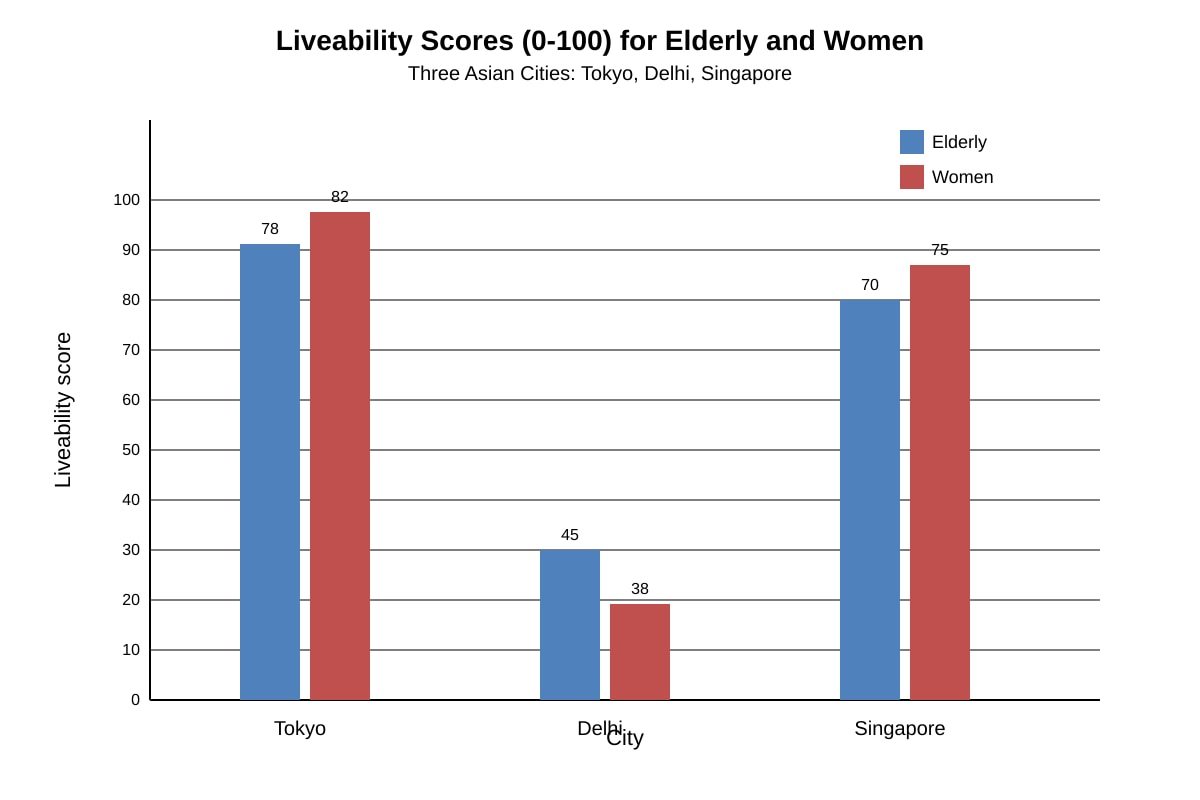
16. [4] Using Q16-fig1: Tokyo and Singapore show higher scores for both groups than Delhi. Women slightly higher than elderly in Tokyo/SG; Delhi low for both, women lower. 1 per comparison point (3 cities + gender gap).
17. [7] Evaluate face-to-face questionnaire for elderly needs:
Strengths: direct voice, nuanced responses, high response from non-digital elderly. [2]
Limitations: small sample, bias if only accessible areas, time-consuming. [2]
Judgment: useful for depth but limited generalizability; combine with stats. [3 overall eval]
Marking: L3 (6-7) balanced with clear judgment.
18. [3] Dense layout → land scarcity; makeshift → low cost, no regulations; both indicate poverty and informality. 1 each.
19. [5] Agree: green spaces, public transport achieve both. Disagree: consumption tensions. Conclusion: possible with planning.
Marking: 2 for for, 2 against, 1 synthesis.
20. [2] Risk: safety during door-to-door (e.g., late hours). Mitigate: pair work, daylight, inform community. 1+1.