From Real Exams Quiz
A Level H1 Geography Human Geography Quiz
Free A Level H1 Geography Human Geography quiz, Exam version, with questions, answers, and A Level-style practice for Singapore students.
These static practice materials are generated from the site's syllabus and paper-generation workflow, with source and model context shown so students and parents can evaluate the material before use.
Questions
Free quiz and exam paper access
Enter your details to view this paper
Your access is remembered on this device.
Answers
A-Level Geography H1 Quiz - Human Geography: ANSWER KEY
Total Marks: 50
Section A: Short-Answer Questions (15 marks)
1. Define the term 'urban liveability'. [2]
Answer: Urban liveability refers to the quality of life experienced by residents in a city, encompassing the social, economic, and environmental conditions that make a place desirable to live in. (2 marks)
Marking Notes:
- Award 1 mark for a basic definition (e.g., "how good a city is to live in").
- Award 2 marks for a more complete definition that includes reference to quality of life or multiple dimensions (social, economic, environmental).
Teaching Note: Liveability is a subjective concept—what makes a city liveable for one person may not be the same for another. It is often measured using indicators like safety, access to services, environmental quality, and economic opportunity.
2. State two factors that influence the liveability of a city. [2]
Answer: Any two of the following (1 mark each):
- Economic factors (e.g., employment opportunities, cost of living)
- Environmental factors (e.g., air quality, green spaces, cleanliness)
- Social factors (e.g., safety, community cohesion, access to healthcare and education)
- Infrastructure (e.g., transport, housing, utilities)
Marking Notes:
- Award 1 mark for each correctly identified factor.
- Do not award marks for simply naming a city or a vague answer like "money" or "weather".
Teaching Note: The syllabus identifies three main categories of factors influencing liveability: economic, environmental, and social. Students should be able to explain how each factor contributes to or detracts from liveability.
3. Explain why the concept of liveability is considered subjective. [2]
Answer: Liveability is subjective because it depends on an individual's personal preferences, needs, and circumstances, which vary according to place, time, and purpose of assessment. (1 mark) For example, a young professional may value nightlife and job opportunities, while an elderly person may prioritise access to healthcare and quiet, safe streets. (1 mark)
Marking Notes:
- Award 1 mark for identifying that liveability depends on personal perspective.
- Award 1 mark for providing a clear example or explanation of how perspectives differ.
Teaching Note: This is a key concept in the syllabus. The subjectivity of liveability means that there is no single "best" city to live in—different people will have different rankings based on their own criteria.
4. Identify one economic issue faced by the elderly in urban areas. [1]
Answer: Any one of the following:
- Inadequate retirement savings/pensions
- Difficulty finding employment due to age discrimination
- High cost of living (e.g., housing, healthcare, utilities)
- Poverty or financial insecurity
Marking Notes:
- Award 1 mark for a clearly stated economic issue.
Teaching Note: The elderly face a range of economic issues that can affect their well-being and liveability. These are often linked to reduced income after retirement and rising costs in urban areas.
5. State one strategy that can be used to improve the liveability of cities for women. [1]
Answer: Any one of the following:
- Improving street lighting and public transport safety
- Designing public spaces with women's needs in mind (e.g., wider pavements for prams)
- Providing affordable and accessible childcare facilities
- Implementing policies to promote gender equality in the workplace
- Creating women-only transport options (e.g., women-only train carriages)
Marking Notes:
- Award 1 mark for a clearly stated strategy.
Teaching Note: Strategies to improve liveability for women often focus on safety, accessibility, and economic participation. The syllabus emphasises the importance of gender equality for progress towards liveable cities.
6. Explain how the proportion of elderly in urban areas is changing in countries at different levels of development. [3]
Answer: In developed countries, the proportion of elderly in urban areas is already high and is increasing due to low birth rates and increased life expectancy. (1 mark) In developing countries, the proportion of elderly in urban areas is also increasing, but at a faster rate, driven by rural-to-urban migration of younger people (leaving older populations behind in rural areas) and improvements in healthcare that are extending lifespans. (1 mark) However, the absolute number of elderly in developing countries is much larger, and many urban areas in these countries are less prepared to meet their needs. (1 mark)
Marking Notes:
- Award 1 mark for each well-explained point that demonstrates understanding of the different trends in developed and developing countries.
- Award full marks for a clear comparative explanation.
Teaching Note: This is a key trend in the syllabus. Students should understand that population ageing is a global phenomenon, but the pace and scale differ between developed and developing countries, with significant implications for urban planning and policy.
7. Distinguish between 'sustainable urban development' and 'liveability'. [2]
Answer: Sustainable urban development focuses on meeting the needs of the present without compromising the ability of future generations to meet their own needs, balancing economic, social, and environmental goals. (1 mark) Liveability, on the other hand, refers to the quality of life for current residents, which may sometimes be achieved at the expense of long-term sustainability. (1 mark)
Marking Notes:
- Award 1 mark for a clear definition of each term.
- Award 2 marks for a clear distinction that highlights the temporal difference (future vs. present focus).
Teaching Note: This distinction is central to the syllabus. Students should understand that while sustainable development and liveability are related, they can also be in tension—for example, building a new highway may improve liveability (shorter commutes) but harm sustainability (increased carbon emissions).
8. Give one reason why effective waste management is important for sustainable urban development. [2]
Answer: Effective waste management is important because it reduces environmental pollution (e.g., air, water, and soil contamination from landfills and incineration), which protects ecosystems and human health. (1 mark) It also allows for resource recovery through recycling and composting, reducing the demand for raw materials and contributing to a circular economy, which is essential for long-term sustainability. (1 mark)
Marking Notes:
- Award 1 mark for a basic reason (e.g., "it reduces pollution").
- Award 2 marks for a more developed explanation that links waste management to a specific aspect of sustainability (environmental, economic, or social).
Teaching Note: Waste management is a key component of sustainable urban development. The syllabus covers the problems of non-hazardous solid waste in cities at different levels of development and the varying success of different waste management strategies.
Section B: Data-Response and Structured Questions (20 marks)
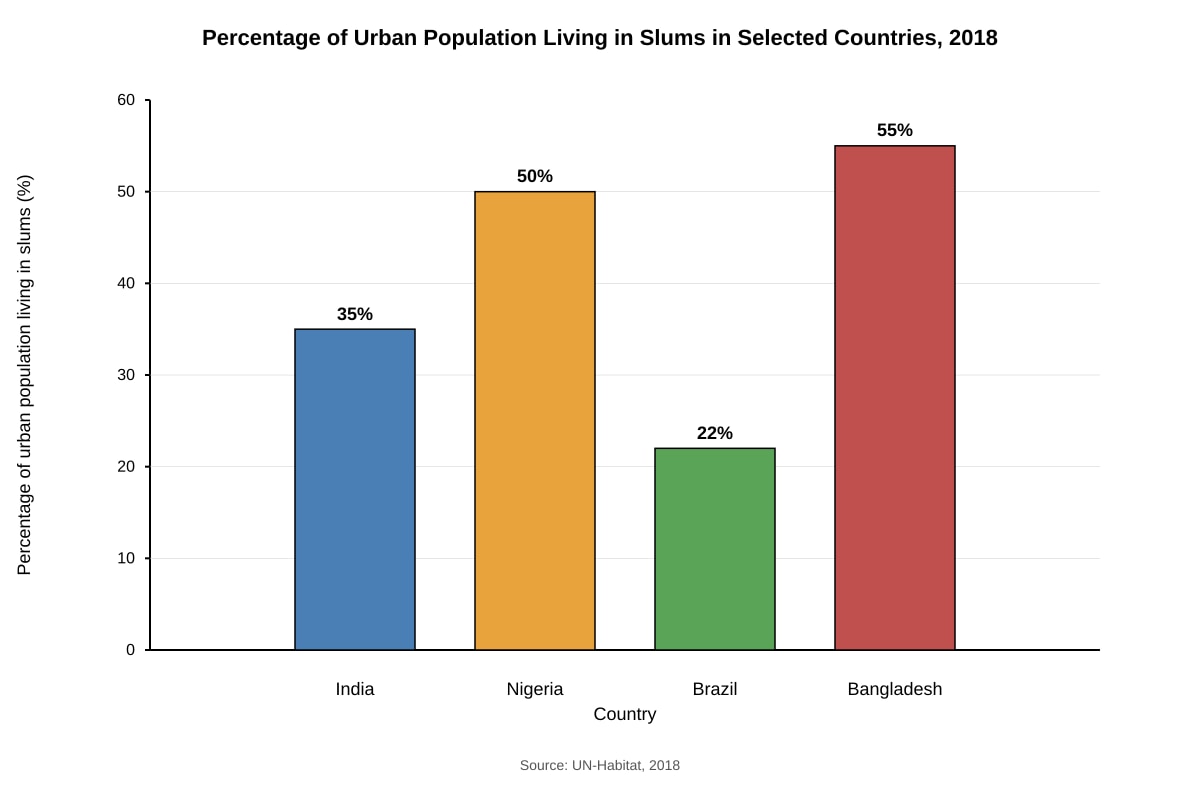
9. Describe the pattern of slum populations shown in Fig. 1. [2]
Answer: The percentage of the urban population living in slums varies significantly between the selected countries. (1 mark) Bangladesh has the highest proportion (55%), followed by Nigeria (50%), while Brazil has the lowest proportion (22%) among the four countries shown. (1 mark)
Marking Notes:
- Award 1 mark for identifying that there is variation between countries.
- Award 1 mark for providing specific data from the chart (e.g., naming the highest and lowest values).
Common Mistakes:
- Simply listing the values without describing the pattern.
- Making generalisations not supported by the data (e.g., "all developing countries have high slum populations").
Teaching Note: This question tests basic data description skills. Students should be able to read a bar chart and identify overall patterns (e.g., variation, highest/lowest values) before moving to more detailed analysis.
10. Explain two reasons for the development of slums in urban areas of developing countries. [4]
Answer: Reason 1: Rapid rural-to-urban migration driven by push factors (e.g., lack of employment, poverty, and poor services in rural areas) and pull factors (e.g., perceived better job opportunities, education, and healthcare in cities). This influx of people exceeds the capacity of the city to provide adequate housing, leading to the growth of informal settlements or slums. (2 marks)
Reason 2: Inability of the government to provide affordable housing due to limited financial resources, poor urban planning, and corruption. As a result, low-income migrants are forced to build their own shelters on vacant or marginal land, often without legal tenure or basic services. (2 marks)
Marking Notes:
- Award 2 marks for each well-explained reason (1 mark for identifying the reason, 1 mark for explanation).
- Accept other valid reasons such as: natural population increase, land speculation, lack of enforcement of building regulations.
Teaching Note: The syllabus requires students to understand the reasons for slum development in countries at different levels of development. The key is to link the growth of slums to the gap between housing supply and demand, which is exacerbated by rapid urbanisation and weak governance.
11. With reference to a specific example, evaluate the success of one strategy used to improve the lives of slum dwellers. [4]
Answer: Example: The Baan Mankong programme in Thailand. (1 mark)
Evaluation:
- Successes: The programme has been successful in improving the lives of slum dwellers by providing secure land tenure, upgrading infrastructure (e.g., water, sanitation, electricity), and improving housing quality. It is a community-driven approach, meaning residents are involved in planning and implementation, which increases ownership and sustainability. Over 1,500 communities have benefited. (2 marks)
- Limitations: However, the programme has not reached all slum dwellers, and some communities have faced challenges in accessing funding or negotiating with landowners. The scale of the problem means that even successful programmes can only address a fraction of the need. (1 mark)
Overall: The Baan Mankong programme is considered a relatively successful example of slum upgrading because of its participatory approach and focus on security of tenure, but its impact is limited by scale and funding constraints.
Marking Notes:
- Award 1 mark for naming a specific example.
- Award up to 2 marks for evidence of success.
- Award 1 mark for a limitation or critical evaluation.
- Accept other valid examples such as: the Favela-Bairro project in Rio de Janeiro, Brazil; the Kampung Improvement Programme in Indonesia; or the Slum Networking Project in Ahmedabad, India.
Teaching Note: The syllabus requires students to evaluate the varying success of strategies to improve the lives of slum dwellers across places. A good answer will use a specific example and provide a balanced assessment, noting both achievements and limitations.
12. (a) Identify two economic reasons for Manchester's urban reimaging efforts. [2]
Answer:
- To attract investment (e.g., from media and cultural industries). (1 mark)
- To boost tourism and create jobs. (1 mark)
Marking Notes:
- Award 1 mark for each correctly identified economic reason.
- Accept other valid reasons from the extract: to reverse economic decline, to attract new residents, to rebrand the city.
Teaching Note: Urban reimaging is often driven by economic motivations—cities that have lost their traditional industrial base need to find new sources of revenue and employment.
12. (b) Explain how urban reimaging can have both positive and negative impacts on sustainable urban development. [4]
Answer: Positive impacts:
- Economic sustainability: Urban reimaging attracts investment, creates jobs, and generates tax revenue, which can be reinvested in public services and infrastructure. (1 mark)
- Social sustainability: It can improve the image of a city, attract new residents, and create cultural and leisure facilities that enhance quality of life. (1 mark)
Negative impacts:
- Social sustainability: Gentrification can lead to the displacement of lower-income communities, increasing social inequality and reducing affordability. (1 mark)
- Environmental sustainability: Large-scale redevelopment projects can consume resources, generate waste, and increase carbon emissions during construction. (1 mark)
Marking Notes:
- Award 1 mark for each well-explained point (2 positive, 2 negative).
- Accept other valid points such as: improved transport infrastructure (positive environmental), loss of community identity (negative social).
Teaching Note: This question tests the ability to analyse a concept from multiple perspectives. The syllabus requires students to understand the impact of urban reimaging on sustainable urban development, which includes economic, social, and environmental dimensions.
13. Explain how the issue of safety can affect the liveability of cities for women. [4]
Answer: Safety is a critical factor affecting liveability for women because fear of harassment, assault, or violence can restrict their mobility and access to public spaces. (1 mark)
Explanation:
- Restricted mobility: Women may avoid using public transport or walking alone at certain times of day, limiting their access to employment, education, and social activities. This reduces their economic opportunities and social well-being. (1 mark)
- Unequal access to public spaces: Parks, streets, and other public spaces may be perceived as unsafe, meaning women cannot fully benefit from the amenities a city offers. (1 mark)
- Psychological impact: Constant fear of crime can cause stress and anxiety, reducing overall quality of life. (1 mark)
Marking Notes:
- Award 1 mark for identifying that safety is a key factor.
- Award up to 3 marks for a well-developed explanation of how safety affects liveability, with specific reference to women's experiences.
- Accept other valid points such as: inadequate lighting, lack of CCTV, poorly designed public spaces, lack of women-only transport options.
Teaching Note: The syllabus requires students to understand the issues faced by women in urban areas related to economic, social, and psychological well-being. Safety is a cross-cutting issue that affects all three dimensions.
Section C: Essay Questions (15 marks)
14. 'Sustainable urban development and liveability are always in conflict.' Discuss this statement with reference to specific examples. [15]
Answer:
Level Descriptors:
| Level | Marks | Descriptor |
|---|---|---|
| 4 | 13–15 | Excellent: Comprehensive, well-structured, analytical, and evaluative. Uses specific examples effectively. Clear judgement. |
| 3 | 9–12 | Good: Well-developed argument with good examples. Some analysis and evaluation. |
| 2 | 5–8 | Adequate: Some relevant points but limited analysis or evaluation. Examples may be vague. |
| 1 | 1–4 | Limited: Basic points with little or no development. No clear argument or examples. |
| 0 | 0 | No relevant content. |
Suggested Answer Structure:
Introduction:
- Define sustainable urban development (meeting present needs without compromising future generations) and liveability (quality of life for current residents).
- State the essay's argument: While there are tensions between the two concepts, they are not always in conflict, and in many cases, they can be complementary.
Body Paragraph 1: Areas of Conflict (Tension)
- Example 1: Transport. Building more roads and car parks may improve liveability (convenience, shorter commutes) but harms sustainability (increased carbon emissions, air pollution, urban sprawl). (e.g., Los Angeles' car-centric development).
- Example 2: Housing. High-density housing can be more sustainable (efficient land use, lower energy consumption per capita) but may reduce liveability for some (lack of private space, noise, overcrowding). (e.g., Hong Kong's high-density living).
- Example 3: Economic development. Attracting heavy industry may create jobs (improving economic liveability) but can cause environmental degradation (harming sustainability). (e.g., industrial cities in China).
Body Paragraph 2: Areas of Complementarity (Synergy)
- Example 1: Green spaces. Parks and green corridors improve liveability (recreation, mental health, aesthetics) and also enhance sustainability (carbon sequestration, biodiversity, stormwater management). (e.g., Singapore's Park Connector Network).
- Example 2: Public transport. Efficient, affordable public transport improves liveability (mobility, reduced congestion) and sustainability (lower emissions per passenger). (e.g., London's public transport system).
- Example 3: Waste management. Recycling and waste-to-energy programmes improve liveability (cleaner streets, reduced pollution) and sustainability (resource recovery, reduced landfill). (e.g., Sweden's waste-to-energy system).
Body Paragraph 3: The Role of Planning and Policy
- The relationship between sustainability and liveability is not fixed—it depends on how cities are planned and managed.
- Good urban design can create win-win solutions (e.g., mixed-use developments that reduce car dependency while creating vibrant, walkable neighbourhoods).
- The concept of "sustainable liveability" recognises that both goals can be pursued simultaneously.
Conclusion:
- The statement is an oversimplification. While there are genuine tensions, sustainable urban development and liveability are not always in conflict.
- The key is integrated planning that seeks to balance both objectives, recognising that in the long term, sustainability is a prerequisite for sustained liveability.
Marking Notes:
- Award marks based on the level descriptors above.
- A strong answer will: (1) define key terms, (2) present a balanced argument with specific examples, (3) evaluate the statement critically, and (4) reach a clear, well-supported judgement.
- Examples should be specific (named cities, programmes, or policies) rather than generic.
Teaching Note: This is a classic "discuss" question that requires evaluation. The best answers will avoid taking an extreme position and instead explore the nuances of the relationship between sustainability and liveability. The syllabus explicitly mentions the "complementarity and tension" between these two concepts.
15. Evaluate the effectiveness of strategies used to create liveable cities for the elderly. [15]
Answer:
Level Descriptors:
| Level | Marks | Descriptor |
|---|---|---|
| 4 | 13–15 | Excellent: Comprehensive, well-structured, analytical, and evaluative. Uses specific examples effectively. Clear judgement. |
| 3 | 9–12 | Good: Well-developed argument with good examples. Some analysis and evaluation. |
| 2 | 5–8 | Adequate: Some relevant points but limited analysis or evaluation. Examples may be vague. |
| 1 | 1–4 | Limited: Basic points with little or no development. No clear argument or examples. |
| 0 | 0 | No relevant content. |
Suggested Answer Structure:
Introduction:
- Define liveability for the elderly (quality of life that meets their specific economic, social, and psychological needs).
- State the essay's argument: Strategies have been effective in some areas but face significant limitations, and their success varies across places.
Body Paragraph 1: Economic Strategies
- Strategy: Providing financial support (e.g., pensions, subsidies for healthcare and housing).
- Example: Singapore's Central Provident Fund (CPF) and Silver Support Scheme provide financial security for many elderly.
- Evaluation: Effective in reducing poverty, but may not be sufficient to cover rising costs of living. Not all elderly are eligible.
Body Paragraph 2: Social Strategies
- Strategy: Creating age-friendly community centres, social clubs, and intergenerational programmes.
- Example: Japan's "Silver Human Resource Centres" provide employment and social engagement opportunities for the elderly.
- Evaluation: Effective in reducing social isolation and promoting active ageing, but may not reach the most isolated or frail elderly.
Body Paragraph 3: Environmental/Infrastructure Strategies
- Strategy: Age-friendly urban design (e.g., barrier-free access, covered walkways, priority seating on public transport, accessible toilets).
- Example: Singapore's "Ageing in Place" programme, which includes retrofitting HDB flats with senior-friendly features and creating "Silver Zones" with safer road crossings.
- Evaluation: Highly effective in improving mobility and safety, but implementation is costly and may not be uniform across all neighbourhoods.
Body Paragraph 4: Healthcare Strategies
- Strategy: Providing accessible and affordable healthcare services, including home care and community-based health centres.
- Example: The UK's National Health Service (NHS) provides free healthcare for the elderly, but faces challenges of long waiting times and funding pressures.
- Evaluation: Essential for well-being, but quality and accessibility vary significantly between countries and regions.
Body Paragraph 5: Overall Evaluation
- The most effective strategies are those that are integrated and address multiple dimensions of well-being simultaneously.
- Success depends on: government commitment, funding, community involvement, and the specific needs of the local elderly population.
- No single strategy is universally effective—what works in a developed country like Japan may not be feasible in a developing country with fewer resources.
Conclusion:
- Strategies to create liveable cities for the elderly have been effective in improving quality of life, but their success is uneven.
- The growing proportion of elderly in urban areas means that more comprehensive and innovative approaches are needed.
Marking Notes:
- Award marks based on the level descriptors above.
- A strong answer will: (1) cover multiple types of strategies (economic, social, environmental, healthcare), (2) use specific examples, (3) evaluate effectiveness with both strengths and limitations, and (4) reach a clear, well-supported overall judgement.
- Examples should be specific (named countries, cities, or programmes) rather than generic.
Teaching Note: The syllabus requires students to understand the issues faced by the elderly and the varying success of strategies to address these issues. A good answer will demonstrate awareness that strategies are context-dependent and that there is no one-size-fits-all solution.
Section D: Fieldwork Application Questions (10 marks)
16. Suggest one suitable research question for this investigation. [1]
Answer: Any one of the following:
- "How liveable is [neighbourhood name] for its elderly residents?"
- "What are the main challenges faced by elderly residents in [neighbourhood name]?"
- "To what extent does [neighbourhood name] meet the needs of its elderly population?"
Marking Notes:
- Award 1 mark for a clear, focused research question that is relevant to the investigation.
- The question should be specific enough to be investigated through fieldwork.
Teaching Note: A good research question should be clear, focused, and answerable through the proposed methods. It should guide the data collection and analysis.
17. Explain why a questionnaire survey is an appropriate method for collecting data on the needs of the elderly. [3]
Answer: A questionnaire survey is appropriate because:
- It allows the students to collect primary data directly from the elderly residents, providing first-hand information about their needs, experiences, and perceptions. (1 mark)
- It can be designed to collect both quantitative data (e.g., rating scales for satisfaction) and qualitative data (e.g., open-ended questions about specific challenges), providing a comprehensive understanding. (1 mark)
- It is relatively efficient and can be administered to a large number of respondents in a short time, allowing the students to gather a representative sample of the elderly population in the neighbourhood. (1 mark)
Marking Notes:
- Award 1 mark for each well-explained reason.
- Accept other valid reasons such as: anonymity can encourage honest responses, standardised questions allow for comparison, can be conducted face-to-face to assist elderly with visual or literacy difficulties.
Teaching Note: The syllabus requires students to understand the strengths and limitations of different fieldwork methods. A good answer will explain why the method is suitable for the specific context (elderly residents) and research aim (understanding needs).
18. Identify one potential risk the students might face when conducting this fieldwork and suggest how it could be mitigated. [2]
Answer: Risk: The students might face resistance or hostility from elderly residents who are suspicious of strangers or unwilling to participate in the survey. (1 mark)
Mitigation: The students could obtain permission from the local community centre or Residents' Committee (RC) and have a letter of introduction from their school. They could also approach elderly residents in familiar, safe settings (e.g., community centres, coffee shops) and explain the purpose of the survey clearly and respectfully. (1 mark)
Marking Notes:
- Award 1 mark for identifying a specific, realistic risk.
- Award 1 mark for a practical and appropriate mitigation strategy.
- Accept other valid risks and mitigations such as: risk of accidents (e.g., tripping) → conduct a risk assessment and have a first-aid kit; risk of getting lost → work in pairs and have a map; risk of bad weather → check weather forecast and bring umbrellas.
Teaching Note: Risk assessment is a key component of fieldwork. Students should be able to identify potential risks (physical, social, ethical) and suggest appropriate mitigation measures.
19. The students collected data on the number of elderly-friendly facilities (e.g., benches, covered walkways, ramps) in two different parts of the neighbourhood. Suggest an appropriate data representation method to compare the data from the two sites. [1]
Answer: A comparative bar chart (or side-by-side bar chart). (1 mark)
Marking Notes:
- Award 1 mark for a suitable method.
- Accept other valid methods such as: a table, a stacked bar chart, or a pictogram.
- Do not award marks for methods that are unsuitable for comparing two sites (e.g., a pie chart, a line graph).
Teaching Note: The syllabus requires students to be able to select and sketch appropriate data representation methods. The choice of method should depend on the type of data and the purpose of the representation.
20. Evaluate the usefulness of the students' investigation for understanding the liveability of the neighbourhood for the elderly. [3]
Answer: Usefulness:
- The investigation provides primary data on the specific needs and experiences of elderly residents in the neighbourhood, which is more relevant than secondary data from other locations. (1 mark)
- The combination of questionnaire surveys and environmental quality observations provides both subjective (perceptions) and objective (physical features) data, giving a more complete picture of liveability. (1 mark)
Limitations:
- The investigation is limited to one neighbourhood, so the findings may not be generalisable to other areas. The sample size may also be small, and the students may have introduced bias in their data collection (e.g., only surveying elderly people who are out and about, missing those who are housebound). (1 mark)
Marking Notes:
- Award 1 mark for identifying a strength/usefulness.
- Award 1 mark for a second strength/usefulness.
- Award 1 mark for identifying a limitation or weakness.
- Accept other valid points such as: the investigation may not capture seasonal or temporal variations; the students' inexperience may affect data quality; ethical considerations (e.g., informed consent) may not have been fully addressed.
Teaching Note: This question tests the ability to evaluate fieldwork. A good answer will provide a balanced assessment, acknowledging both what the investigation can tell us and what it cannot. The syllabus requires students to evaluate the usefulness of investigations, including their limitations.
END OF ANSWER KEY