AI Generated Exam Paper
A Level H1 Geography Practice Paper 5
Free A Level H1 Geography Practice Paper 5, HY3 AI version, with questions, answers, and A Level-style practice for Singapore students.
These static practice materials are generated from the site's syllabus and paper-generation workflow, with source and model context shown so students and parents can evaluate the material before use.
Questions
Free quiz and exam paper access
Enter your details to view this paper
Your access is remembered on this device.
Answers
TuitionGoWhere Practice Paper — Answer Key (Version 5)
Subject: Geography H1
Level: A-Level
Total Marks: 50
Section A Marking Scheme
Q1 [2 marks]
Answer: Sustainable development in urban resource management refers to meeting present urban needs (housing, waste, water) without compromising future generations' ability to meet theirs.
Marking: 1 mark for present-need focus, 1 mark for future-generation / resource continuity.
Teaching note: Core syllabus definition; links to Brundtland concept applied to cities.
Q2 [2 marks]
Answer (any two): open dumping causes soil/water contamination; open burning releases air pollutants; leachate contaminates groundwater.
Marking: 1 mark each, max 2.
Common mistake: stating "too much waste" without environmental effect.
Q3 [2 marks]
Answer: Rapid rural-to-urban migration exceeds formal housing supply, forcing informal settlement on marginal land.
Marking: 1 mark cause (migration/population pressure), 1 mark link to housing gap.
Q4 [2 marks]
Answer: To attract investment, tourism, or skilled labour by improving city image.
Marking: 1 mark economic reason, 1 mark elaboration.
Q5 [2 marks]
Answer: Liveability is subjective (place/time/purpose) and people-centred; sustainability is resource/ecological continuity objective.
Marking: 1 mark each concept contrast.
Q6 [2 marks]
Answer: Mobility limitations reduce access to transport, healthcare, or community centres.
Marking: 1 mark challenge, 1 mark example.
Q7 [2 marks]
Answer: Curbside separate collection; waste-to-energy plants; mandatory recycling laws. (any one)
Marking: 1 mark strategy, 1 mark context (high-income).
Q8 [2 marks]
Answer: Women may face unsafe transport, wage gaps, or caregiving burden that limits access to services and economic participation.
Marking: 1 mark inequality, 1 mark liveability impact.
Q9 [2 marks]
Answer: Reduced flooding, improved sanitation access, secure tenure, or service coverage. (any one)
Marking: 1 mark indicator.
Q10 [2 marks]
Answer: Reimaging may prioritise aesthetic/consumer spaces over green infrastructure, increasing resource use.
Marking: 1 mark tension, 1 mark explanation.
Section B Marking Scheme
Q11 [5 marks]
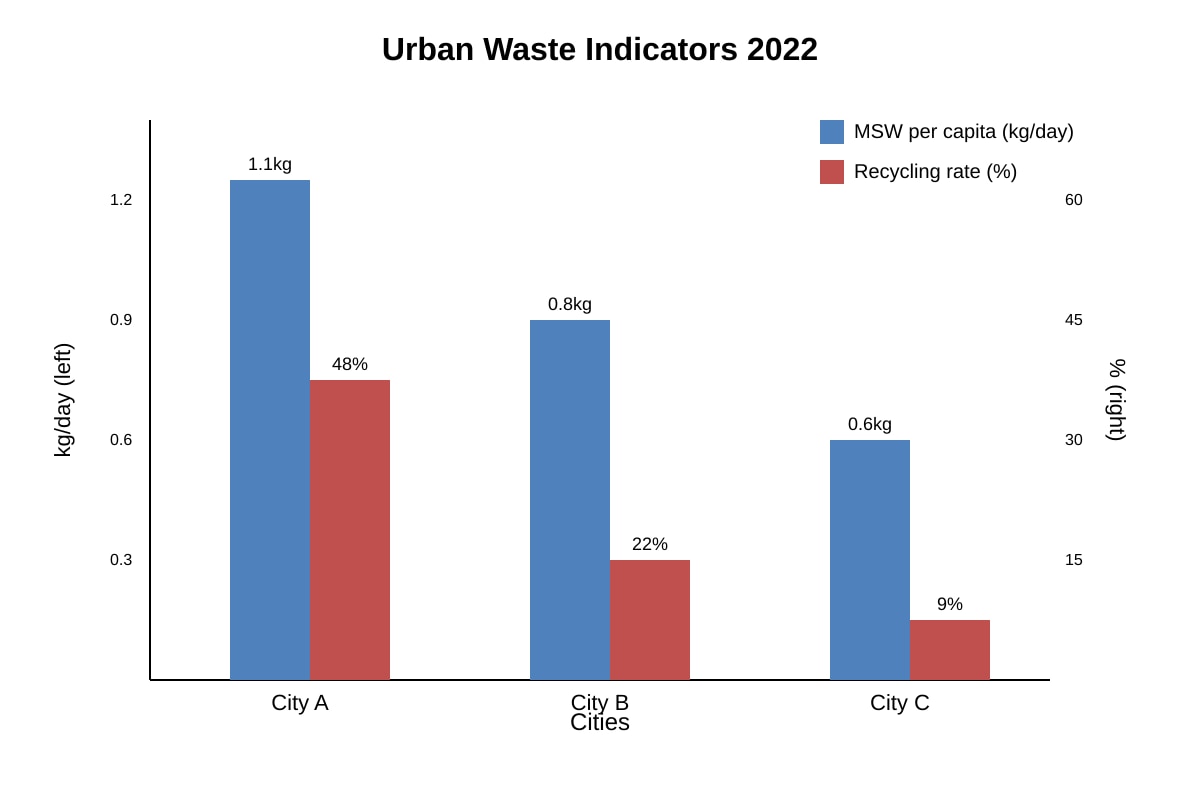
Answer: City A (high-income) has 48% recycling due to formal systems, public education, and landfill diversion policy. City B (22%) has partial infrastructure but limited enforcement. City C (9%) lacks collection services and relies on open burning due to financial constraints.
Marking: 1 mark per city explanation with link to income/context (max 3) + 2 marks for synthesising pattern (higher income → higher recycling).
Teaching note: Use Resource 1 data; show causation not just description.
Q12 [5 marks]
Answer: Useful: clear cross-income comparison, quantifies disposal method and rate. Limited: no temporal trend, no per-capita waste composition, ignores informal recycling. Overall moderately useful for broad relationship.
Marking: 2 marks strengths, 2 marks limitations, 1 mark balanced judgment.
Descriptors: L3 (4–5): analytical, weighed; L2 (2–3): descriptive with some eval; L1 (1): lists only.
Q13 [5 marks]
Answer: Characteristics: infrastructure upgrade (drainage, toilets), coverage of 3,200 households, but insecure tenure for 60%. Shows partial success with social barrier.
Marking: 1 mark each characteristic (max 3) + 2 marks explanation of mixed outcome.
Teaching note: From Resource 2 extract; link to multiple deprivations concept.
Section C Marking Scheme
Q14 [15 marks]
Level Descriptors (Generic, scaled to 15):
- L4 (11–15): Evaluative, coherent, compares levels of development, uses examples (e.g., Seoul vs Lagos), judges "most critical" with counter-arguments (slums, reimaging also vital).
- L3 (7–10): Clear analysis, some evaluation, limited contrast.
- L2 (4–6): Descriptive, weak judgment.
- L1 (1–3): Assertions only.
Content points: Waste mgmt prevents pollution, saves resources; but slum liveability and reimaging address social/economic pillars. High-income cities need circular economy; low-income need basic collection.
Structure: Intro definition → For statement (evidence) → Against (other strategies) → Judgement.
Teaching note: Must show synthesis across development contexts; not recall-only.