From Real Exams Exam Paper
A Level H1 Geography Practice Paper 3
Free A Level H1 Geography Practice Paper 3, HY3 Exam version, with questions, answers, and A Level-style practice for Singapore students.
These static practice materials are generated from the site's syllabus and paper-generation workflow, with source and model context shown so students and parents can evaluate the material before use.
Questions
TuitionGoWhere Practice Paper - Geography H1 A-Level (Version 3)
School: TuitionGoWhere Exam Practice (AI)
Subject: Geography H1
Level: A-Level
Paper: Practice Paper (Cluster 1: Resources & Sustainability)
Duration: 1 hour 30 minutes
Total Marks: 80
Name: ___________________________
Class: ___________________________
Date: ___________________________
Instructions:
- This practice paper contains 20 questions on the topic of Resources & Sustainability.
- Section A: Short Structured Questions (Q1–8). Section B: Data-Based Questions (Q9–14). Section C: Extended Response (Q15–20).
- Answer all questions.
- Use a black/blue pen. Write clearly.
- For data-based questions, refer to the resources provided.
Section A: Short Structured Questions (24 marks)
Answer all questions. Each question carries the stated marks.
1. [2] Define the term "sustainable development" using the Brundtland Commission definition.
2. [2] State two reasons why cities consume more resources per capita than rural areas.
(i) ___________________________________________________
(ii) ___________________________________________________
3. [3] Explain one environmental impact of poor non-hazardous solid waste management in a city in a less developed country.
4. [3] Account for the growth of slums in urban areas of less developed countries. Use one causal factor in your answer.
5. [2] State one economic reason why urban authorities engage in urban reimaging.
6. [4] Describe two ways in which the liveability of a city may be assessed differently by an elderly resident compared to a working-age woman.
7. [4] Explain why the concept of liveability is described as "subjective". Use an example in your answer.
8. [4] Suggest two strategies a city can use to improve waste management sustainability. For each, state one expected outcome.
Section B: Data-Based Questions (36 marks)
Study the resources below and answer questions 9 to 14.
Resource 1: Table showing municipal solid waste (tonnes/day) and service coverage (%) for water, sanitation, electricity in Davao (2010) and Davao (2023).
| Service | 2010 Coverage % | 2023 Coverage % | Waste gen. 2010 (t/day) | Waste gen. 2023 (t/day) |
|---|---|---|---|---|
| Water | 71 | 94 | – | – |
| Sanitation | 58 | 89 | – | – |
| Electricity | 66 | 97 | – | – |
| Solid waste | 820 | 540 | – | – |
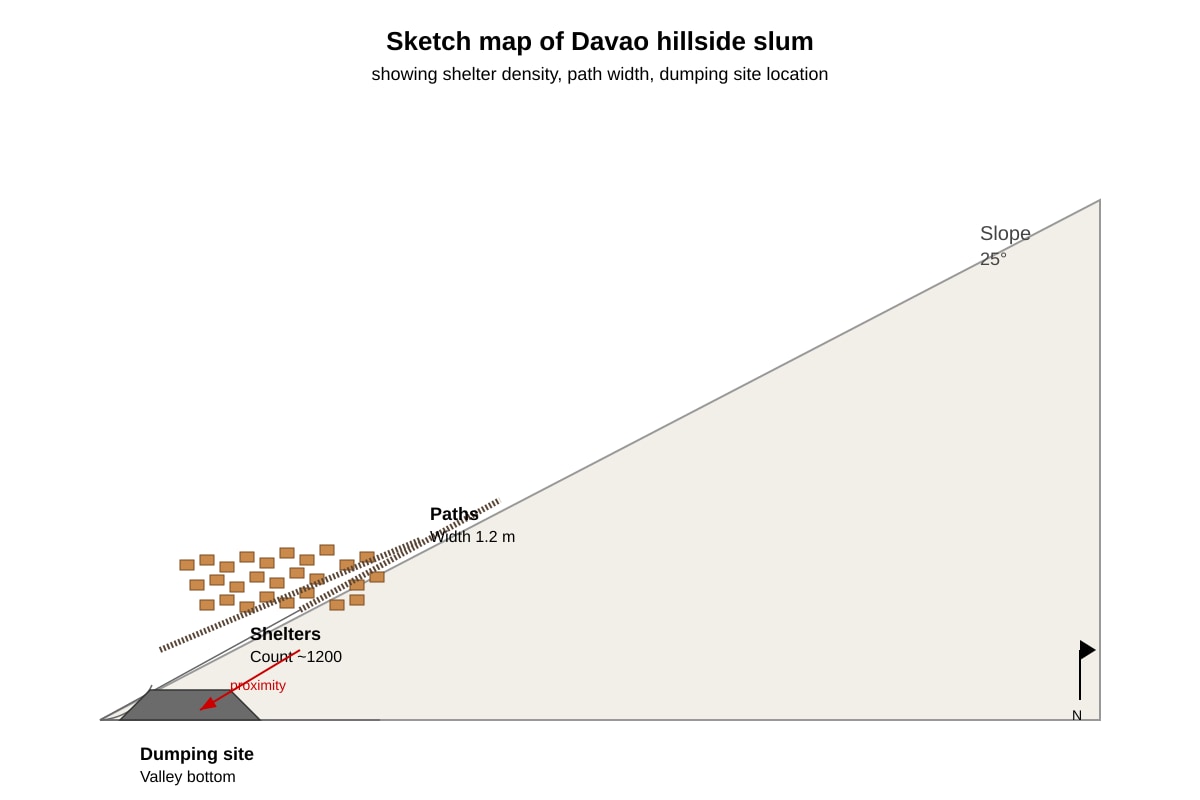
Resource 2: Photograph description: Dense cluster of makeshift shelters on steep hillside; narrow paths; open dumping site at valley bottom.
Image pending generation: diagram for Q9.
9. [5] Account for the changes in service provision in Davao as shown in Resource 1.
10. [5] Explain the characteristics of the slum area in Davao as suggested by Resource 2.
11. [7] Evaluate the usefulness of Resource 1 and Resource 2 in helping to understand the challenges of sustainable waste management in Davao.
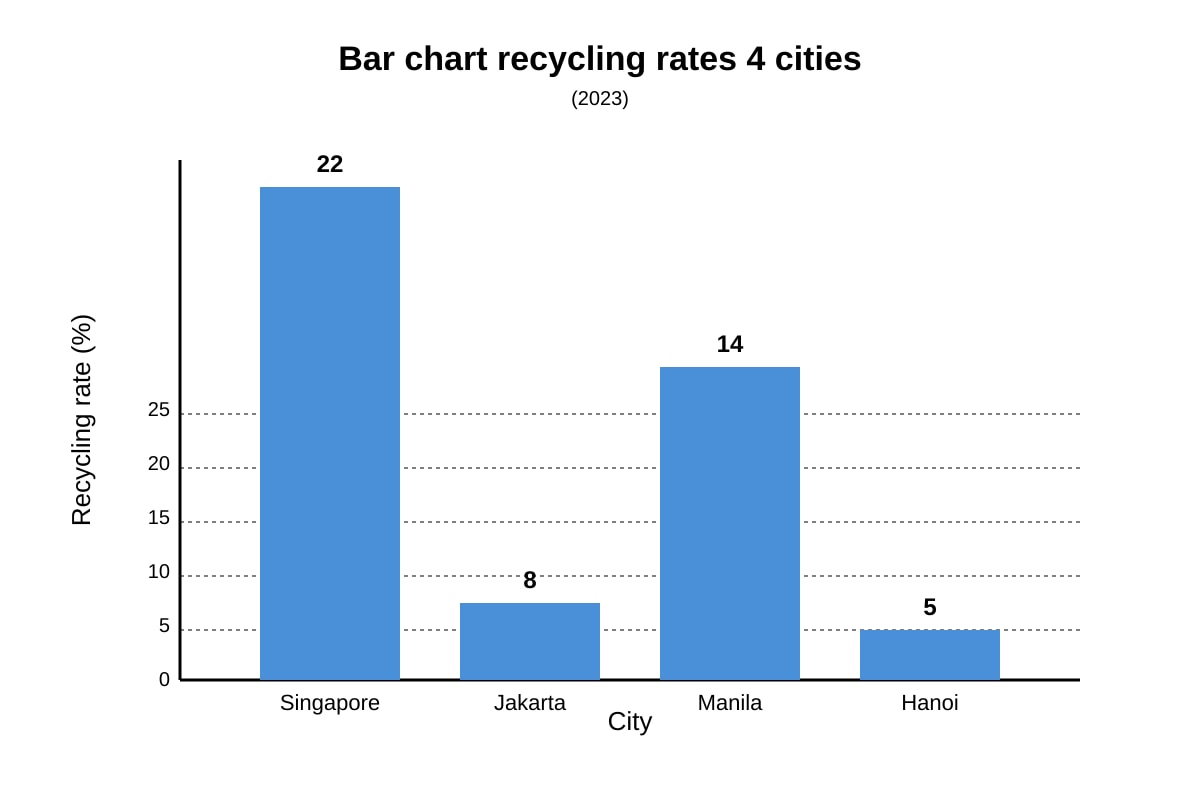
Resource 3: Bar chart of recycling rate (%) for 4 cities: Singapore 22, Jakarta 8, Manila 14, Hanoi 5 (2023).
Image pending generation: chart for Q12.
12. [5] With reference to Resource 3, compare the recycling performance of the four cities and suggest one reason for the variation.
13. [6] Explain how urban reimaging can create tension with environmental sustainability, using a named city example.
14. [8] Evaluate the effectiveness of community-based waste sorting programmes in improving sustainable urban development. Use evidence from Resources 1–3 where relevant.
Section C: Extended Response (20 marks)
Answer all questions. Each carries the stated marks.
15. [4] "Resource sustainability in cities is primarily a problem of consumption, not governance." Assess this statement with one supporting and one opposing view.
16. [4] Outline two indicators that could be used in a fieldwork study of elderly needs in a high-rise urban neighbourhood.
17. [4] Explain how gender can influence the experience of liveability in a tropical Asian city.
18. [4] Suggest how spatial scale affects the management of solid waste in a city-region.
19. [4] "Slum upgrading is always beneficial to sustainable development." Evaluate this statement.
20. [20] "Achieving resource sustainability in cities requires trade-offs between liveability and environmental protection." Evaluate this statement with reference to waste management, slum upgrading, and urban reimaging. Support your answer with examples.
Answers
Answer Key – TuitionGoWhere Practice Paper Geography H1 A-Level (Version 3)
Topic: Resources & Sustainability
Total Marks: 80
Section A: 24 marks | Section B: 36 marks | Section C: 20 marks
Section A Answers (24 marks)
Q1 [2] Sustainable development is development that meets the needs of the present without compromising the ability of future generations to meet their own needs (Brundtland, 1987).
Marking: 2 marks for definition; 1 mark partial if only "future generations" mentioned.
Q2 [2] Any two: higher concentration of economic activity; greater transport demand; denser population requiring more utilities; heat island effect raising energy use.
Marking: 1 mark each.
Q3 [3] e.g., open dumping causes groundwater contamination and disease spread. Explanation: lack of collection leads to leachate entering supplies.
Marking: 1 env impact (1m) + explanation (2m).
Q4 [3] Rural–urban migration exceeds housing supply; poverty forces informal settlement. Causal factor explained.
Marking: factor (1m) + account (2m).
Q5 [2] To attract investment/tourism; increase land value.
Marking: 1m each valid reason.
Q6 [4] Elderly: prioritise healthcare, safety, accessibility. Woman: prioritise childcare, safety at night, transport.
Marking: 2m per group, contrast clear.
Q7 [4] Liveability depends on individual values/needs; e.g., a young professional may value nightlife, elderly value quiet.
Marking: subjective defined (2m) + example (2m).
Q8 [4] e.g., (1) Recycling – less landfill (2m). (2) Waste-to-energy – energy recovery (2m).
Marking: 2m each strategy+outcome.
Section B Answers (36 marks)
Q9 [5] Account for changes: Water +23% due to gov pipeline expansion; Sanitation +31% due to sewer programme; Electricity +31% due to grid extension; Waste fell 34% due to collection fleet.
Marking: 1m per service explained with cause from Resource 1 (max 5m).
Q10 [5] Characteristics: high density, steep slope risk, poor access, near dump. Explanation links to poverty.
Marking: 1m per char + explain (max 5m).
Q11 [7] Useful: R1 shows quantitative gap closure; R2 shows spatial reality. Limited: R1 no qualitative; R2 no time series. Judgment balanced.
Marking: strengths (3m) + limits (3m) + judgment (1m).
Q12 [5] SIN highest (22%), HAN lowest (5%); reason: policy/infrastructure.
Marking: compare (3m) + reason (2m).
Q13 [6] e.g., Singapore Marina reimaging raised energy use; tension via embodied carbon.
Marking: example (2m) + tension explained (4m).
Q14 [8] Community sorting cuts landfill (R1), but needs enforcement (R3). Eval: partial success.
Marking: use evidence (4m) + eval (4m).
Section C Answers (20 marks)
Q15 [4] Support: overconsumption. Oppose: poor governance worsens.
Marking: 2m each view.
Q16 [4] Indicators: lift access %, community centre distance.
Marking: 2m each.
Q17 [4] Women face harassment, care burden limiting mobility.
Marking: 2m per point.
Q18 [4] Scale: household vs regional plant; coordination difficulty.
Marking: 2m each.
Q19 [4] Eval: upgrading helps services but may displace.
Marking: 2m per side.
Q20 [20] Essay. Level 4 (17–20): clear eval of trade-offs in waste (e.g., incineration vs liveability), slum (services vs gentrification), reimaging (economy vs ecology). Examples: Jakarta, Singapore.
Marking Descriptors: L4 11–13 style adapted to 20m scale. Structure: intro, 3 themes, conclusion.
Free quiz and exam paper access
Enter your details to view this paper
Your access is remembered on this device.