AI Generated Quiz
A Level Economics H3 Market Failure Quiz
Free A Level Economics H3 Market Failure quiz, AI version, with questions, answers, and A Level-style practice for Singapore students.
These static practice materials are generated from the site's syllabus and paper-generation workflow, with source and model context shown so students and parents can evaluate the material before use.
Questions
Free quiz and exam paper access
Enter your details to view this paper
Your access is remembered on this device.
Answers
Answer Key: A-Level Economics H3 Quiz - Market Failure
Total Marks: 50
Section A: Multiple Choice Questions (Questions 1–5) [10 marks]
1. Answer: C (A good that is non-rivalrous but excludable)
- Explanation: A quasi-public good (or club good) is non-rivalrous in consumption (one person's use does not reduce availability for others) but excludable (people can be prevented from using it if they do not pay). Examples include satellite TV, private parks, and toll roads. Option A describes a pure public good. Option B describes a private good. Option D describes a common-pool resource.
- Marking: 2 marks for correct answer. 0 marks otherwise.
2. Answer: B (A common-pool resource is over-consumed due to a lack of clearly defined property rights)
- Explanation: The tragedy of the commons describes a situation where individuals, acting independently and rationally according to their own self-interest, deplete a shared resource (common-pool resource) because they do not bear the full cost of their actions. This occurs because property rights are not clearly defined, so no one has an incentive to conserve. Option A describes under-provision of public goods. Option C describes negative externalities. Option D is unrelated.
- Marking: 2 marks for correct answer. 0 marks otherwise.
3. Answer: B (Transaction costs are low and property rights are clearly defined)
- Explanation: The Coase Theorem states that if property rights are clearly defined and transaction costs are low, private parties can bargain to reach an efficient outcome regardless of the initial allocation of rights. High transaction costs (option A) would prevent bargaining. Ambiguous property rights (option C) would make bargaining impossible. A price ceiling (option D) is a government intervention, not private bargaining.
- Marking: 2 marks for correct answer. 0 marks otherwise.
4. Answer: B (High-risk individuals are more likely to purchase insurance, while low-risk individuals opt out)
- Explanation: Adverse selection occurs before a transaction takes place. In insurance markets, asymmetric information means the insurer cannot perfectly distinguish between high-risk and low-risk individuals. If the insurer charges a pooled premium based on average risk, low-risk individuals may find it too expensive and drop out, leaving a pool of predominantly high-risk individuals. This can lead to market failure or even market collapse. Option A describes moral hazard (post-contractual behaviour change).
- Marking: 2 marks for correct answer. 0 marks otherwise.
5. Answer: B (A satellite television subscription)
- Explanation: A club good is non-rivalrous (one person watching does not reduce the signal for others) but excludable (only subscribers can access it). A public park (A) is non-excludable and non-rivalrous (pure public good). Fish in the ocean (C) are rivalrous but non-excludable (common-pool resource). National defence (D) is non-rivalrous and non-excludable (pure public good).
- Marking: 2 marks for correct answer. 0 marks otherwise.
Section B: Short Answer Questions (Questions 6–10) [20 marks]
6. Answer:
- Definition: Moral hazard is a post-contractual problem that arises when one party (the agent) takes on more risk or exerts less effort because they do not bear the full consequences of their actions, knowing that another party (the principal) bears the cost. In the principal-agent problem, the agent's actions are unobservable to the principal, leading to a divergence of incentives.
- Real-world example: After purchasing comprehensive car insurance, a driver may drive less carefully because they know the insurance company will cover most of the repair costs. This increases the probability of an accident, which the insurer cannot perfectly monitor.
- Marking:
- 2 marks for clear definition of moral hazard in the principal-agent context.
- 2 marks for a relevant and well-explained real-world example.
- Partial credit (1 mark) for a partially correct definition or example.
7. Answer:
- Analysis: International waters are a common-pool resource — rivalrous (fish caught by one fisherman are not available to others) but non-excludable (no one can be prevented from fishing). Each fisherman has an incentive to catch as many fish as possible to maximise their own profit, because if they do not, another fisherman will. However, the individual fisherman does not consider the negative externality their fishing imposes on others (reduced fish stock for everyone). This leads to overfishing, depletion of the fish stock, and eventually a collapse of the fishery — the tragedy of the commons.
- Policy measure: One measure is the establishment of individual transferable quotas (ITQs) — a form of tradeable permit. Each fisherman is allocated a share of the total allowable catch, which they can buy or sell. This creates a property right over the resource and aligns private incentives with social efficiency.
- Marking:
- 2 marks for clear explanation of the tragedy of the commons applied to overfishing (rivalry, non-excludability, individual vs. collective interest).
- 2 marks for a relevant policy measure with brief explanation.
- Partial credit for incomplete analysis.
8. Answer:
- Market failure explanation: In the used car market (the "lemons problem"), sellers know the true quality of their car, but buyers do not. Buyers therefore assume the worst and are only willing to pay a price reflecting average quality. This price is too low for sellers of high-quality cars, who withdraw from the market. As the average quality of cars on the market falls, buyers lower their willingness to pay further, leading to a "race to the bottom" where only low-quality cars ("lemons") remain. This is a market failure because mutually beneficial transactions (high-quality cars sold at a fair price) do not occur.
- Strategy to overcome: Sellers can use signalling to convey information about quality. For example, a seller could offer a warranty or a money-back guarantee. A warranty is a credible signal because it is costly for a seller of a low-quality car to offer (they would have to pay out frequently), but less costly for a seller of a high-quality car. This allows buyers to distinguish between high and low quality, restoring efficient trade.
- Marking:
- 2 marks for explaining how asymmetric information leads to market failure (adverse selection, lemons problem).
- 2 marks for describing a relevant strategy (signalling, screening, or warranty) with explanation of how it works.
- Partial credit for incomplete answers.
9. Answer:
- Adverse selection in the labour market: Occurs before hiring. Employers cannot perfectly observe a worker's productivity. If the employer offers a wage based on average productivity, high-productivity workers may find the wage too low and not apply, leaving a pool of low-productivity applicants. Example: A firm advertises a job at a fixed salary. Highly skilled workers do not apply because they can earn more elsewhere, so the firm only receives applications from less skilled workers.
- Moral hazard in the labour market: Occurs after hiring. Once employed, a worker may shirk (exert less effort) because their effort is costly and difficult for the employer to monitor. The worker receives the same wage regardless of effort, so they have an incentive to free-ride. Example: A salesperson paid a fixed salary may not work as hard to close sales because their pay does not depend on performance.
- Marking:
- 2 marks for distinguishing adverse selection (pre-contractual) from moral hazard (post-contractual) in the labour market context.
- 1 mark for a clear example of each.
- Partial credit for correct definitions but weak examples.
10. Answer:
- Effectiveness of tradeable permits: Tradeable permits (e.g., carbon credits) create a market for pollution rights. The government sets a cap on total emissions and issues permits equal to that cap. Firms can buy and sell permits. This ensures that emissions are reduced at the lowest possible cost because firms with low abatement costs will reduce emissions and sell permits, while firms with high abatement costs will buy permits. This is efficient because it equates marginal abatement costs across firms. Tradeable permits also provide a dynamic incentive for innovation: firms that develop cleaner technology can sell more permits.
- Limitations: However, tradeable permits may not be effective if the initial allocation of permits is not well-designed (e.g., grandfathering may reward polluters). Monitoring and enforcement can be costly. If the cap is set too high, the policy will not reduce emissions sufficiently. Additionally, tradeable permits may be regressive, as the cost of permits can be passed on to consumers. In international contexts, free-riding by countries that do not participate can undermine the scheme.
- Marking:
- 2 marks for explaining how tradeable permits work (cap-and-trade, cost-effectiveness).
- 2 marks for evaluating effectiveness with reference to the tragedy of the commons and carbon emissions.
- Partial credit for incomplete analysis.
Section C: Data Response Questions (Questions 11–15) [30 marks]
11. Answer:
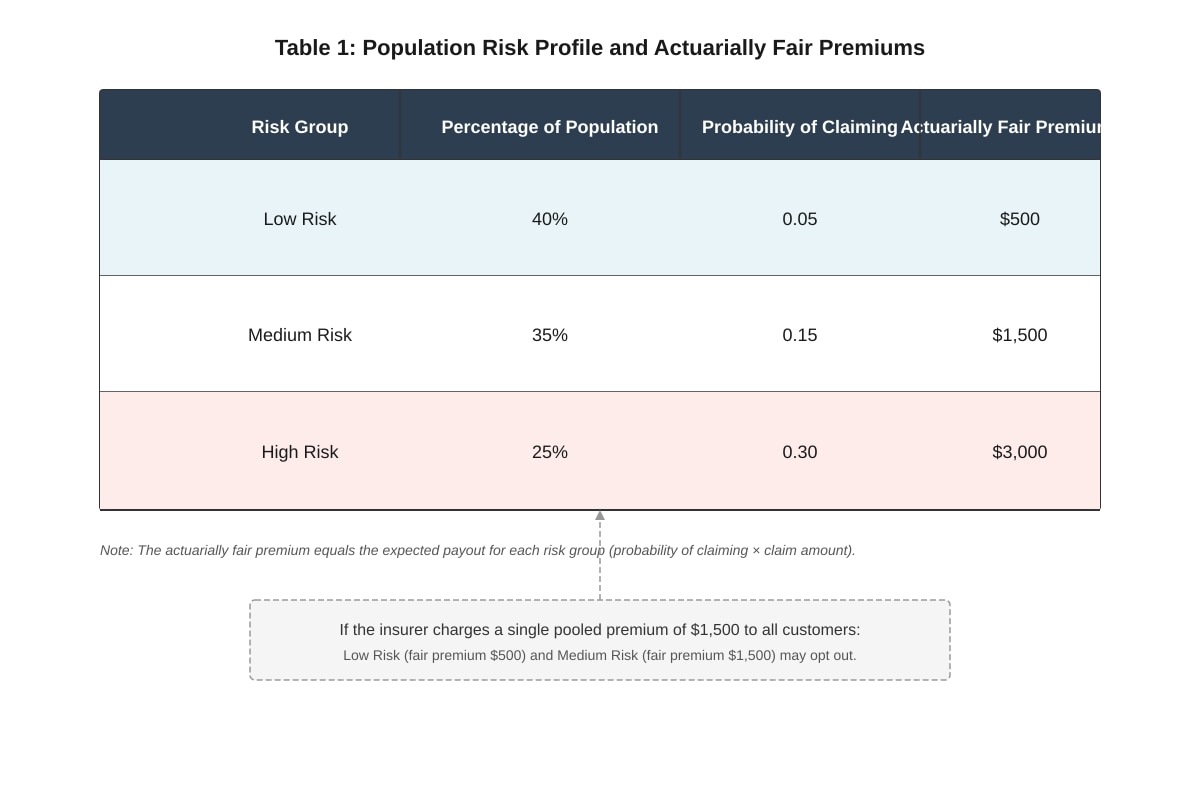
- Which groups purchase: Low-risk individuals (40% of population) face a premium of 500. They are likely to find insurance too expensive and may opt out. Medium-risk individuals (35%) face a premium equal to their actuarially fair premium of 1,500, which is lower than their actuarially fair premium of $3,000, so they are very likely to purchase insurance.
- Problem illustrated: This illustrates adverse selection. The insurance pool becomes skewed towards higher-risk individuals because low-risk individuals drop out. This increases the average risk of the insured pool, which may force the insurer to raise premiums further, causing even more low-risk individuals to drop out. In extreme cases, the market may collapse.
- Marking:
- 2 marks for correctly identifying which groups purchase (low-risk likely opt out, high-risk likely purchase).
- 2 marks for explaining why (comparison of pooled premium to actuarially fair premium).
- 2 marks for identifying and explaining adverse selection.
- Partial credit for incomplete analysis.
12. Answer:
- Policy measure: The government could implement mandatory insurance (an individual mandate). This requires everyone to purchase insurance, regardless of risk level. This ensures that the risk pool includes low-risk individuals, keeping the average premium lower and preventing adverse selection. Alternatively, the government could provide subsidies to low-risk individuals to make insurance affordable, or implement risk-adjusted payments to insurers to compensate them for covering high-risk individuals.
- Potential drawback: A mandatory insurance requirement may be regressive, as it forces low-income individuals to purchase insurance they may not be able to afford. It may also be politically unpopular, as it restricts individual choice. Additionally, if the mandate is not enforced effectively, it may not solve the adverse selection problem.
- Marking:
- 2 marks for proposing a relevant policy measure (mandate, subsidy, risk adjustment, or public option).
- 2 marks for explaining how it mitigates adverse selection.
- 2 marks for evaluating one potential drawback (cost, regressivity, enforcement, political feasibility).
- Partial credit for incomplete answers.
13. Answer:
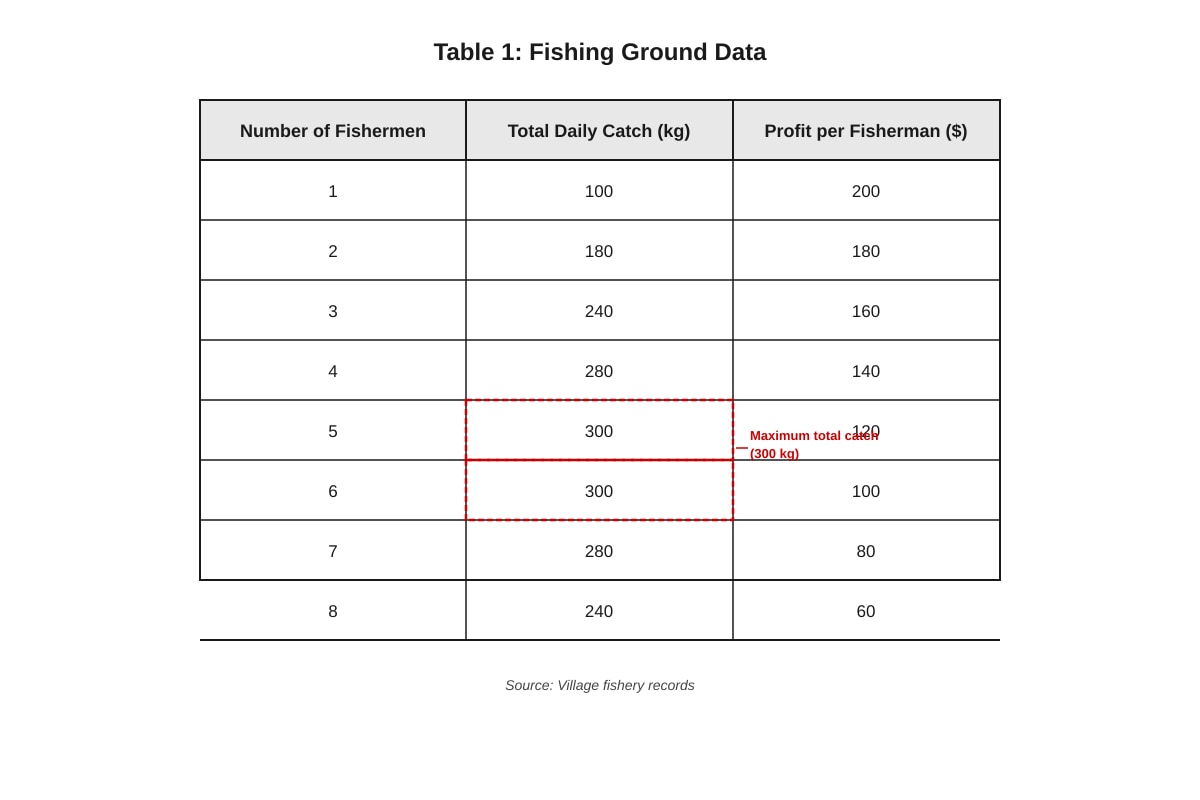
- Why common-pool resource: The fishing ground is rivalrous (fish caught by one fisherman are not available to others) but non-excludable (any fisherman can access it). This combination of rivalry and non-excludability defines a common-pool resource.
- Total catch stops increasing: The total daily catch stops increasing at 5 or 6 fishermen. At 5 fishermen, total catch is 300 kg; at 6 fishermen, total catch is still 300 kg. After that, total catch declines (280 kg at 7, 240 kg at 8).
- Sustainable yield: The sustainable yield is the maximum catch that can be taken without depleting the fish stock. The data suggests that the sustainable yield is around 300 kg per day, as this is the maximum total catch that can be maintained. Beyond this point, adding more fishermen reduces the total catch, indicating overfishing and depletion of the stock.
- Marking:
- 2 marks for explaining rivalry and non-excludability.
- 2 marks for identifying the point where total catch stops increasing (5-6 fishermen, 300 kg).
- 2 marks for explaining sustainable yield and the implication of declining catch beyond that point.
- Partial credit for incomplete analysis.
14. Answer:
- Overuse explanation: Each fisherman, acting in their own self-interest, will continue to fish as long as their individual profit is positive. From the data, profit per fisherman is positive even at 8 fishermen ($60). However, the total catch declines after 6 fishermen, meaning that the marginal fisherman imposes a negative externality on others (reducing the catch for everyone). Because no fisherman has property rights over the resource, they do not consider this externality. The result is that too many fishermen enter the fishery, and the total catch (and profit) is lower than the socially optimal level.
- Coasean solution: A Coasean solution would involve assigning property rights to the fishing ground, for example, by giving the village a collective ownership or by auctioning fishing licenses. Then, the owners can negotiate to limit the number of fishermen to the socially optimal level (e.g., 5 or 6 fishermen) to maximise total profit. They could also charge a fee for access.
- Condition necessary: For the Coasean solution to work, transaction costs must be low and property rights must be clearly defined. In this case, the village must be able to negotiate and enforce agreements among themselves at low cost. If there are many fishermen or if bargaining is difficult, the solution may not be feasible.
- Marking:
- 2 marks for explaining overuse (individual profit motive, negative externality, divergence from social optimum).
- 2 marks for suggesting a Coasean solution (assigning property rights, bargaining, licenses).
- 2 marks for identifying a necessary condition (low transaction costs, clear property rights, enforceability).
- Partial credit for incomplete analysis.
15. Answer:
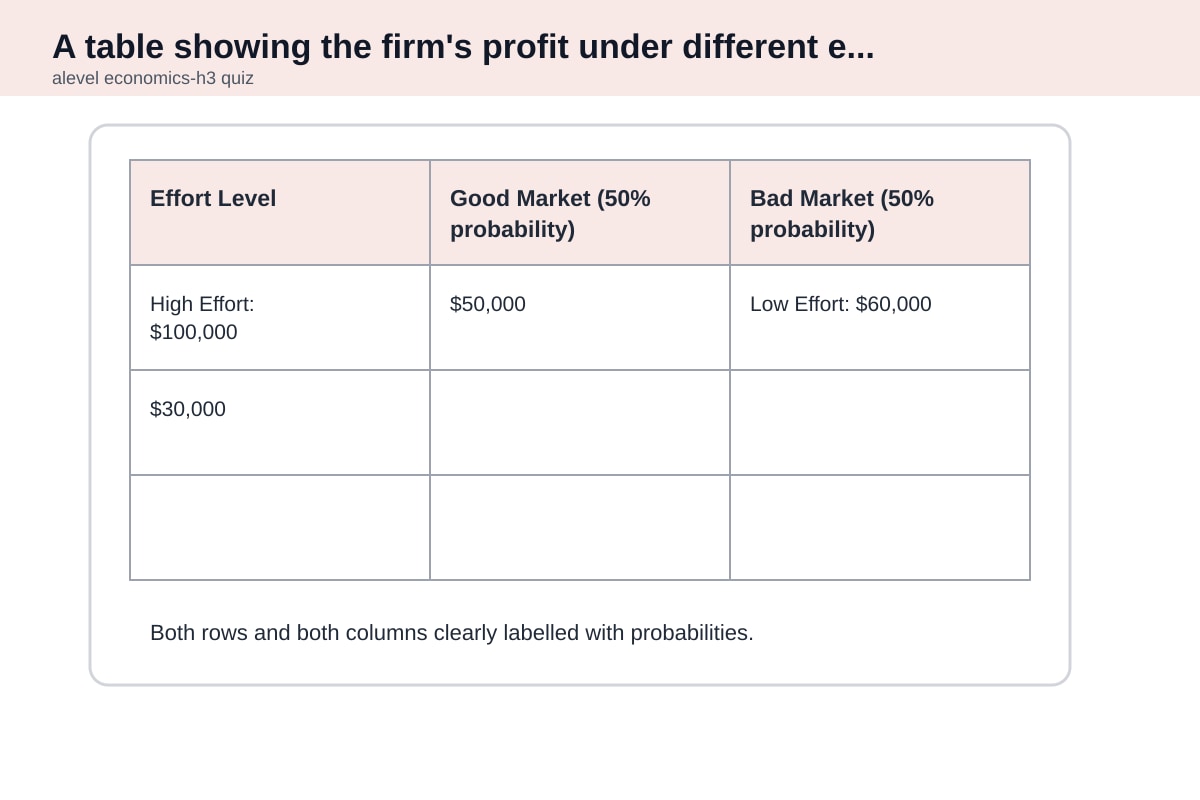
- Principal-agent problem: This is a principal-agent problem because the firm (principal) hires the manager (agent) to act on its behalf, but the manager's effort is unobservable. The manager has different incentives (to minimise personal cost) than the firm (to maximise profit). This creates a conflict of interest and a moral hazard problem.
- Effort with fixed salary: If the firm pays a fixed salary of 0) compared to high effort (60,000) + (0.5 × 45,000, which is less than the salary paid, so the firm makes a loss.
- Alternative compensation scheme: The firm could use a performance-based pay scheme, such as a bonus tied to profit. For example, the firm could pay the manager a base salary of 100,000) + (0.5 × 75,000, so the manager's expected pay would be 75,000 = 45,000 - 35,000. Under low effort, expected profit is 30,000 + 0.2 × 39,000, and net benefit is 0 = 30,000 + 0.3 × 52,500 under high effort (net 30,000 + 0.3 × 43,500 under low effort (net 30,000 + 0.4 × 60,000 (net 30,000 + 0.4 × 48,000 (net $48,000) under low effort, so high effort is now preferred. Alternatively, the firm could offer a profit-sharing plan or stock options.
- Marking:
- 2 marks for explaining the principal-agent problem (unobservable effort, divergent incentives).
- 2 marks for correctly identifying that the manager chooses low effort under fixed salary (with reasoning).
- 2 marks for proposing an alternative compensation scheme that aligns incentives (performance-based pay, bonus, profit-sharing) with explanation of how it works.
- Partial credit for incomplete analysis.
Section D: Essay Questions (Questions 16–20) [50 marks]
16. Answer:
- Introduction: Asymmetric information in healthcare markets leads to market failures such as adverse selection and moral hazard. Government intervention can correct these failures through regulation, public provision, and subsidies.
- Adverse selection: In voluntary insurance markets, high-risk individuals are more likely to purchase insurance, while low-risk individuals opt out. This can lead to market collapse. Government can mandate insurance (individual mandate) or provide a public option to ensure universal coverage.
- Moral hazard: After purchasing insurance, individuals may overuse healthcare services because they do not bear the full cost. Government can impose co-payments, deductibles, or usage limits to reduce moral hazard.
- Other interventions: The government can regulate insurance companies to prevent discrimination (e.g., community rating) and ensure coverage for pre-existing conditions. It can also provide information (e.g., quality ratings of hospitals) to reduce information asymmetry.
- Evaluation: Government intervention can improve efficiency and equity, but may also lead to government failure (e.g., bureaucratic inefficiency, crowding out of private insurance). The optimal level of intervention depends on the specific context.
- Conclusion: Government intervention is necessary to correct market failures from asymmetric information in healthcare, but must be carefully designed to avoid unintended consequences.
- Marking:
- 2 marks for clear introduction and identification of asymmetric information in healthcare.
- 4 marks for analysis of adverse selection and moral hazard with examples.
- 2 marks for discussion of government interventions (mandate, regulation, public provision).
- 2 marks for evaluation (effectiveness, limitations, government failure).
- Partial credit for incomplete essays.
17. Answer:
- Introduction: The Coase Theorem suggests that if property rights are clearly defined and transaction costs are low, private bargaining can resolve the tragedy of the commons. However, in practice, these conditions are often not met.
- Application to shared grazing land: If property rights to the grazing land are assigned to a single owner or to a collective, the owner can charge a fee for grazing or limit the number of animals. This internalises the externality and prevents overgrazing. The owner has an incentive to manage the resource sustainably to maximise long-term profit.
- Limitations: (1) High transaction costs: Bargaining among many users can be costly and time-consuming. (2) Free-riding: Some users may refuse to participate in the bargain. (3) Information problems: It may be difficult to determine the optimal level of use. (4) Enforcement: Property rights must be enforceable, which may require a legal system. (5) Distributional concerns: The initial allocation of rights may be unfair.
- Evaluation: The Coase Theorem provides a useful theoretical framework, but its practical applicability is limited. In many cases, government regulation or collective management (e.g., community-based resource management) may be more effective.
- Conclusion: While the Coase Theorem offers a market-based solution, its limitations mean that it is not always the most effective approach to the tragedy of the commons.
- Marking:
- 2 marks for clear explanation of the Coase Theorem.
- 4 marks for application to shared grazing land (property rights, bargaining, internalising externality).
- 2 marks for discussion of limitations (transaction costs, free-riding, enforcement).
- 2 marks for evaluation and conclusion.
- Partial credit for incomplete essays.
18. Answer:
- Introduction: Public goods and common-pool resources are both types of market failure, but they differ in their characteristics and the policy remedies required.
- Public goods: Non-rivalrous and non-excludable. Market failure occurs because of free-riding: individuals have no incentive to pay for the good, leading to under-provision. Policy remedies include government provision (e.g., national defence) or subsidies to encourage private provision.
- Common-pool resources: Rivalrous but non-excludable. Market failure occurs because of overuse (tragedy of the commons): individuals have an incentive to consume as much as possible, leading to depletion. Policy remedies include property rights (e.g., tradeable permits), regulation (e.g., quotas), or collective management.
- Comparison: Both involve externalities and free-riding, but the nature of the failure is different (under-provision vs. overuse). This affects the choice of policy: for public goods, the focus is on ensuring provision; for common-pool resources, the focus is on limiting use.
- Evaluation: The choice of policy depends on the specific context. For public goods, government provision is often necessary. For common-pool resources, a combination of property rights and regulation may be more effective.
- Conclusion: Understanding the differences between public goods and common-pool resources is essential for designing effective policy remedies.
- Marking:
- 2 marks for clear definitions of public goods and common-pool resources.
- 4 marks for analysis of market failures (free-riding vs. overuse).
- 2 marks for comparison of policy remedies.
- 2 marks for evaluation and conclusion.
- Partial credit for incomplete essays.
19. Answer:
- Introduction: Moral hazard and adverse selection are two types of asymmetric information that can lead to inefficiencies in the banking sector.
- Adverse selection: Before a loan is made, banks cannot perfectly assess the risk of borrowers. High-risk borrowers are more likely to seek loans, while low-risk borrowers may be discouraged by high interest rates. This can lead to a pool of risky borrowers and potential loan defaults. Regulatory measures include credit checks, collateral requirements, and risk-based pricing.
- Moral hazard: After a loan is made, borrowers may take on more risk because they do not bear the full cost of default (e.g., limited liability). This can lead to excessive risk-taking and financial instability. Regulatory measures include capital adequacy requirements (e.g., Basel III), loan-to-value ratios, and monitoring.
- Systemic risk: Moral hazard can also affect banks themselves, as they may take on excessive risk if they expect a government bailout (too-big-to-fail). Regulation can include higher capital requirements for systemically important banks and resolution mechanisms.
- Evaluation: Regulation can mitigate moral hazard and adverse selection, but may also impose costs on banks and reduce lending. The optimal level of regulation balances financial stability with economic growth.
- Conclusion: Moral hazard and adverse selection are significant sources of inefficiency in banking, but can be addressed through a combination of regulation and market discipline.
- Marking:
- 2 marks for clear introduction and identification of asymmetric information in banking.
- 4 marks for analysis of adverse selection and moral hazard with examples.
- 2 marks for discussion of regulatory measures (capital requirements, credit checks, etc.).
- 2 marks for evaluation (effectiveness, costs, trade-offs).
- Partial credit for incomplete essays.
20. Answer:
- Introduction: Tradeable permits (e.g., carbon credits) are a market-based policy to address negative externalities like pollution. They are often considered efficient because they achieve emission reductions at the lowest cost.
- Efficiency argument: Tradeable permits create a market for pollution rights. The government sets a cap on total emissions and issues permits equal to that cap. Firms can buy and sell permits. This ensures that emissions are reduced where it is cheapest to do so, equating marginal abatement costs across firms. This is more efficient than command-and-control regulation, which may impose uniform standards regardless of cost.
- Examples: The European Union Emissions Trading System (EU ETS) and the Kyoto Protocol's Clean Development Mechanism are examples of tradeable permit systems.
- Criticisms: (1) Initial allocation: If permits are grandfathered (given free to existing polluters), this may be unfair and reward past pollution. Auctioning permits is more efficient and equitable. (2) Cap setting: If the cap is set too high, the policy will not reduce emissions sufficiently. (3) Monitoring and enforcement: Requires a robust regulatory framework. (4) Market power: Large firms may manipulate the permit market. (5) Leakage: Emissions may shift to unregulated regions.
- Comparison with other policies: Tradeable permits are generally more efficient than taxes in the presence of uncertainty about abatement costs, but taxes are simpler to implement. Command-and-control regulation may be more appropriate for local pollutants.
- Conclusion: Tradeable permits are an efficient solution to negative externalities, but their effectiveness depends on careful design and implementation. They are not a panacea and may need to be combined with other policies.
- Marking:
- 2 marks for clear introduction and explanation of tradeable permits.
- 4 marks for analysis of efficiency (cost-effectiveness, cap-and-trade).
- 2 marks for evaluation of criticisms and limitations.
- 2 marks for comparison with other policies and conclusion.
- Partial credit for incomplete essays.