AI Generated Quiz
A Level Economics H3 Market Failure Quiz
Free A Level Economics H3 Market Failure quiz, AI version, with questions, answers, and A Level-style practice for Singapore students.
These static practice materials are generated from the site's syllabus and paper-generation workflow, with source and model context shown so students and parents can evaluate the material before use.
Questions
Free quiz and exam paper access
Enter your details to view this paper
Your access is remembered on this device.
Answers
Answer Key: A-Level Economics H3 Quiz - Market Failure
Total Marks: 50
Section A: Short-Answer Questions (Questions 1–5)
1. Define the term "quasi-public good" and provide one example. [2]
- Answer: A quasi-public good is a good that is non-rivalrous in consumption (one person's use does not reduce availability for others) but is excludable (it is possible to prevent people from using it). [1]
- Example: A toll road, a private park, or a satellite TV signal. [1]
- Explanation: Unlike pure public goods (e.g., national defence), quasi-public goods can be provided by the private sector because exclusion is possible. However, they may still be underprovided if the good has positive externalities.
- Marking Notes: Award 1 mark for a correct definition that includes both non-rivalry and excludability. Award 1 mark for a valid example.
2. Explain the concept of the "tragedy of the commons" and state one real-world example. [3]
- Answer: The tragedy of the commons occurs when a shared, rivalrous, and non-excludable resource (a common-pool resource) is overused and depleted because each individual user acts in their own self-interest, ignoring the negative impact on others. [2]
- Example: Overfishing in international waters, overgrazing on common land, or pollution of a shared aquifer. [1]
- Explanation: The key idea is that the marginal private benefit of using the resource exceeds the marginal private cost, but the marginal social cost (depletion) is not borne by the individual user. This leads to overuse.
- Marking Notes: Award 2 marks for a clear explanation that includes the concepts of self-interest, shared resource, and depletion. Award 1 mark for a valid example.
3. State the Coase Theorem. Under what condition is it most likely to lead to an efficient outcome? [3]
- Answer: The Coase Theorem states that if property rights are clearly defined and transaction costs are low, private parties can bargain to reach an efficient outcome regardless of the initial allocation of property rights. [2]
- Condition: It is most likely to lead to an efficient outcome when transaction costs are very low (e.g., few parties involved, clear information, no bargaining costs). [1]
- Explanation: The theorem suggests that government intervention is not always needed to solve externalities; private bargaining can work if the conditions are right. However, in reality, transaction costs are often high.
- Marking Notes: Award 2 marks for a correct statement of the theorem. Award 1 mark for identifying low transaction costs as a key condition.
4. Distinguish between "adverse selection" and "moral hazard" in the context of insurance markets. [4]
- Answer:
- Adverse selection occurs before a transaction. It is a situation where one party has more information than the other, leading to a selection of bad risks. In insurance, high-risk individuals are more likely to buy insurance, driving up premiums and driving out low-risk individuals. [2]
- Moral hazard occurs after a transaction. It is a situation where one party changes their behaviour because they are protected from risk. In insurance, an insured person may take fewer precautions (e.g., driving more recklessly) because they know they are covered. [2]
- Explanation: The key distinction is timing: adverse selection is about hidden information before the contract, while moral hazard is about hidden actions after the contract.
- Marking Notes: Award 2 marks for a clear explanation of each concept, including the timing (before/after) and the behavioural change. Award 1 mark each for a partial explanation.
5. A local fishing community shares a lake. Each fisherman can catch up to 50 fish per day, but if all fishermen catch at maximum, the fish population will collapse. Using the concept of the tragedy of the commons, explain why this outcome is likely without intervention. [3]
- Answer: The lake is a common-pool resource (rivalrous and non-excludable). Each fisherman has an incentive to maximise their own catch (self-interest) because the private benefit of catching an extra fish is high, while the private cost is low (the cost of depletion is shared by all). [1] If one fisherman reduces their catch, others will simply catch more, so there is no individual incentive to conserve. [1] This leads to overfishing and eventual collapse of the fish population, which is the tragedy of the commons. [1]
- Explanation: This is a classic example of a negative externality: each fisherman's action imposes a cost on others (reduced future fish stocks) that they do not take into account.
- Marking Notes: Award 1 mark for identifying the resource as a common-pool resource. Award 1 mark for explaining the individual incentive to overfish. Award 1 mark for linking this to the collapse outcome.
Section B: Data-Response Questions (Questions 6–10)
6. Identify the type of market failure described in the extract. [1]
- Answer: Asymmetric information (or the "lemons problem"). [1]
- Explanation: The market failure arises because sellers have more information about the quality of the car than buyers.
- Marking Notes: Award 1 mark for the correct identification.
7. Explain how the "lemons problem" leads to a suboptimal outcome in the used car market. [4]
- Answer: The lemons problem leads to a suboptimal outcome because:
- Sellers of high-quality cars ("peaches") cannot credibly signal their quality, so they are only offered the average market price. [1]
- Since the average price is below the value of a peach, these sellers withdraw from the market. [1]
- This reduces the average quality of cars on the market, causing buyers to lower their willingness to pay further. [1]
- This cycle continues until only the lowest-quality cars ("lemons") remain, resulting in a market failure where mutually beneficial trades (for peaches) do not occur. [1]
- Explanation: This is a classic example of adverse selection driving out high-quality goods. The market equilibrium is inefficient because there are potential gains from trade that are not realised.
- Marking Notes: Award 1 mark for each of the four steps described above. Accept alternative valid explanations that capture the same logic.
8. Propose and explain one strategy that a seller of a high-quality used car could use to overcome this market failure. [3]
- Answer: The seller could offer a warranty (signalling). [1]
- Explanation: By offering a warranty, the seller signals that the car is high-quality because a low-quality seller would face high costs from honouring the warranty. [1] This allows the buyer to distinguish between lemons and peaches, restoring trust and enabling the sale of the high-quality car at a higher price. [1]
- Alternative answers: Third-party certification (e.g., a mechanic's inspection), a money-back guarantee, or a reputation mechanism (e.g., selling through a reputable dealer).
- Marking Notes: Award 1 mark for a valid strategy, 1 mark for explaining how it works, and 1 mark for linking it to overcoming the information asymmetry.
9. The extract mentions that buyers are only willing to pay a price reflecting average quality. Explain why this is a rational response for a risk-averse buyer. [2]
- Answer: A risk-averse buyer prefers a certain outcome over an uncertain one with the same expected value. [1] Since the buyer cannot distinguish between a lemon and a peach, they face a gamble. Paying the average price is a rational way to avoid the risk of overpaying for a lemon, even though it means they might miss out on a peach. [1]
- Explanation: This is a key insight from behavioural economics: risk aversion leads to conservative choices under uncertainty.
- Marking Notes: Award 1 mark for identifying risk aversion. Award 1 mark for explaining the link to the average price.
10. Evaluate the effectiveness of government regulation (e.g., mandatory inspections) in solving the lemons problem. [4]
- Answer:
- Effective aspects: Mandatory inspections can reduce information asymmetry by providing a minimum quality standard. [1] This can increase buyer confidence and prevent the worst lemons from being sold, improving market outcomes. [1]
- Limitations: Inspections are costly and may not catch all defects. [1] Sellers may still have more information than inspectors. Also, regulation may create a black market for uninspected cars. [1]
- Conclusion: While mandatory inspections can help, they are not a perfect solution and may need to be combined with other measures like warranties or consumer education.
- Marking Notes: Award 1 mark for a valid positive point, 1 mark for a valid negative point, and 2 marks for a balanced evaluation that reaches a reasoned judgement. Accept other valid points.
Section C: Essay Questions (Questions 11–15)
11. Explain how the establishment of clearly defined property rights can help resolve the tragedy of the commons. Use a relevant example to support your answer. [5]
- Answer:
- Explanation: The tragedy of the commons arises because no one owns the resource, so no one has an incentive to conserve it. [1] By assigning property rights (e.g., privatising the resource), the owner now has a long-term incentive to manage it sustainably because they bear the future costs of overuse. [1] The owner can also exclude others, preventing overexploitation. [1]
- Example: If a fishing ground is divided into individual fishing quotas (ITQs) that are tradeable, each quota owner has an incentive to fish sustainably to maintain the value of their quota. [1] This has been successful in countries like Iceland and New Zealand. [1]
- Marking Notes: Award 1 mark for explaining the link between property rights and incentives. Award 1 mark for explaining how exclusion works. Award 1 mark for a clear example. Award up to 2 marks for depth of explanation (e.g., mentioning that property rights internalise the externality).
12. Discuss the role of club goods in addressing market failure. How do they differ from pure public goods? [4]
- Answer:
- Club goods are excludable but non-rivalrous (e.g., a private park, a gym). [1] They can address market failure because the provider can charge a fee (membership) to cover costs, making private provision possible. [1] This solves the free-rider problem associated with pure public goods.
- Difference from pure public goods: Pure public goods are both non-excludable and non-rivalrous (e.g., national defence). [1] Because they are non-excludable, private firms cannot charge for them, leading to underprovision (market failure). Club goods, being excludable, avoid this problem. [1]
- Marking Notes: Award 1 mark for defining club goods, 1 mark for explaining their role in addressing market failure, 1 mark for defining pure public goods, and 1 mark for the contrast.
13. A government is considering introducing a tradeable permits system to reduce carbon emissions. Using the Coase Theorem, explain how this system could lead to an efficient outcome. What are the limitations of this approach? [6]
- Answer:
- How it works: The government sets a cap on total emissions and issues permits equal to that cap. [1] Firms can buy and sell permits. A firm that can reduce emissions cheaply will do so and sell its surplus permits, while a firm with high reduction costs will buy permits. [1] This ensures that emissions are reduced where it is cheapest, achieving the cap at the lowest possible cost (efficient outcome). [1]
- Link to Coase: The Coase Theorem suggests that if property rights (permits) are clearly defined and tradeable, private bargaining (trading) will lead to an efficient allocation of pollution rights, regardless of the initial distribution. [1]
- Limitations: Transaction costs can be high (e.g., finding buyers/sellers, legal fees). [1] The initial allocation of permits may be politically contentious. Also, the system only works if the cap is set at the socially optimal level, which is difficult to determine. [1]
- Marking Notes: Award up to 3 marks for explaining how the system works and linking it to the Coase Theorem. Award up to 3 marks for discussing limitations. Accept other valid limitations.
14. In the labour market, employers may pay "efficiency wages" to reduce moral hazard. Explain how this strategy works and evaluate its effectiveness. [5]
- Answer:
- How it works: Efficiency wages are wages set above the market-clearing level. [1] This creates a cost of job loss for workers because they earn a premium. [1] Workers are therefore less likely to shirk (moral hazard) because they risk losing the higher wage. This reduces the need for costly monitoring. [1]
- Evaluation: Effective because it aligns worker incentives with firm goals and can increase productivity. [1] However, it can be costly for the firm (higher wage bill) and may lead to involuntary unemployment (as the wage is above equilibrium). [1] It may also not work if workers are not motivated by financial incentives alone.
- Marking Notes: Award up to 3 marks for explaining the mechanism. Award up to 2 marks for balanced evaluation.
15. Compare and contrast the use of "signalling" and "screening" as solutions to asymmetric information. Which is more effective in the education market? [6]
- Answer:
- Signalling: The informed party takes action to reveal their private information. In education, a worker gets a degree to signal their high ability to employers. [1]
- Screening: The uninformed party takes action to induce the informed party to reveal their information. In education, employers may set a minimum degree requirement to screen applicants. [1]
- Comparison: Both aim to reduce information asymmetry. Signalling is initiated by the informed party, while screening is initiated by the uninformed party. [1] Both can be costly (e.g., cost of education) and may lead to a "signalling arms race" where everyone gets degrees, reducing their informational value. [1]
- Effectiveness in education: Signalling is arguably more effective because it is a direct way for high-ability individuals to distinguish themselves. [1] However, screening is also common (e.g., employers requiring degrees). The effectiveness depends on the cost of signalling: if it is cheaper for high-ability individuals, it works well. If not, it may be inefficient. [1]
- Marking Notes: Award 1 mark for defining each concept, 2 marks for comparison points, and 2 marks for a reasoned evaluation of effectiveness in education.
Section D: Case Study Application (Questions 16–20)
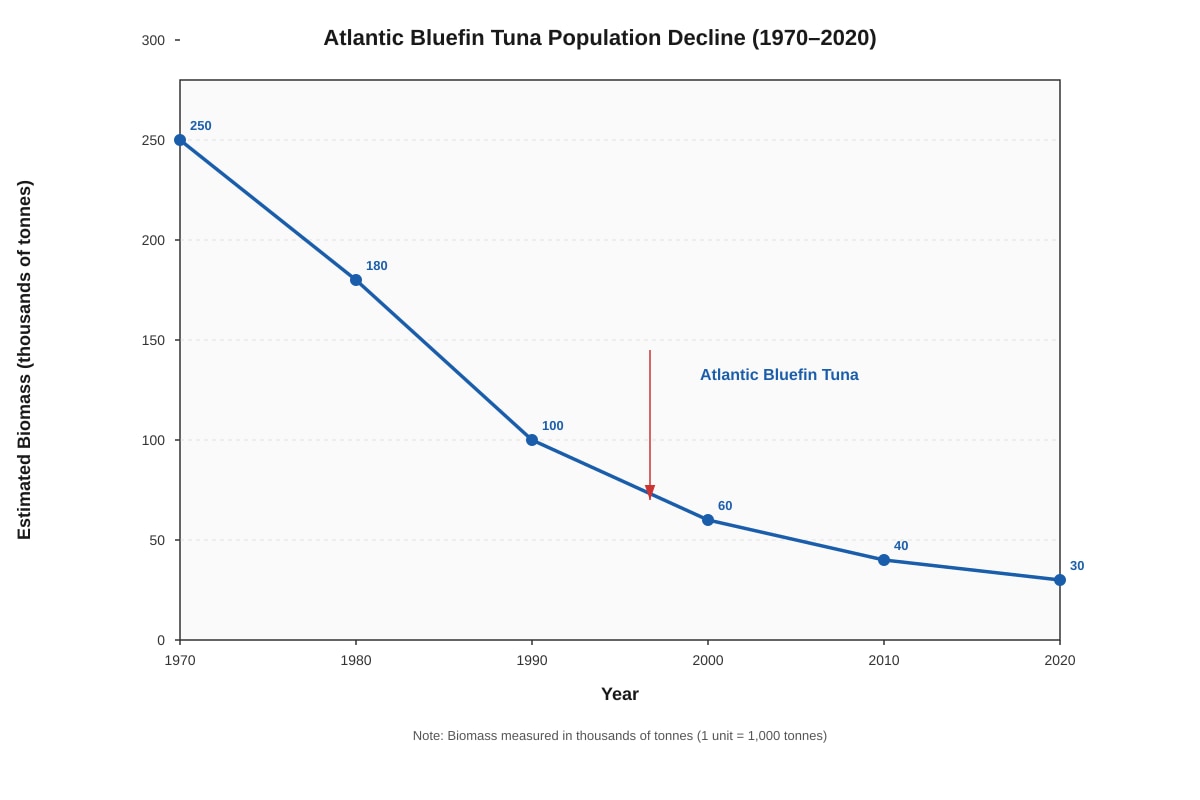
16. Using the graph above, describe the trend in the Atlantic bluefin tuna population from 1970 to 2020. [2]
- Answer: The Atlantic bluefin tuna population has declined steeply and continuously from approximately 250,000 tonnes in 1970 to less than 50,000 tonnes in 2020. [2]
- Explanation: The graph shows a clear downward trend, indicating a severe depletion of the fish stock.
- Marking Notes: Award 1 mark for identifying the downward trend. Award 1 mark for providing specific data points (e.g., starting and ending values).
17. Explain why the Atlantic bluefin tuna is a quasi-public good and how this contributes to its overfishing. [4]
- Answer:
- Quasi-public good: The Atlantic bluefin tuna is rivalrous (one fish caught reduces the stock for others) but non-excludable (it is difficult to prevent anyone from fishing in international waters). [1] This makes it a common-pool resource, a type of quasi-public good. [1]
- Contribution to overfishing: Because it is non-excludable, there is a free-rider problem: no single country or fisherman has an incentive to conserve because others will simply catch the fish they leave behind. [1] This leads to the tragedy of the commons, where each individual acts in their own self-interest, leading to overfishing and depletion. [1]
- Marking Notes: Award 1 mark for identifying rivalrous and non-excludable characteristics. Award 1 mark for classifying it as a common-pool resource. Award 2 marks for explaining the link to overfishing.
18. The case study mentions that international quotas are difficult to enforce. Identify and explain one type of market failure that arises from this enforcement problem. [3]
- Answer: Moral hazard. [1] Because enforcement is weak, fishermen have an incentive to engage in illegal fishing (catching more than their quota) because they know the probability of being caught and punished is low. [1] This changes their behaviour after the quota agreement is in place, leading to overfishing despite the agreement. [1]
- Alternative answer: Adverse selection (if countries with poor enforcement records are more likely to sign agreements they don't intend to keep).
- Marking Notes: Award 1 mark for identifying the type of market failure. Award 2 marks for explaining how it arises from the enforcement problem.
19. Propose and evaluate one policy measure (other than quotas) that could help address the overfishing of Atlantic bluefin tuna. [4]
- Answer:
- Proposal: A system of tradeable fishing permits (ITQs) for the entire Atlantic bluefin tuna fishery. [1]
- Evaluation:
- Positive: Creates a property right, giving each permit holder an incentive to conserve the stock to maintain the value of their permit. [1] It also allows for efficient allocation of fishing effort (those who value fishing most can buy permits). [1]
- Negative: Difficult to implement internationally due to sovereignty issues and enforcement challenges. [1] Initial allocation of permits would be politically contentious.
- Alternative answers: Marine protected areas, fishing bans during spawning season, consumer awareness campaigns, international trade bans.
- Marking Notes: Award 1 mark for a valid proposal. Award up to 3 marks for balanced evaluation (at least one positive and one negative point).
20. Discuss the role of asymmetric information in the context of illegal fishing. How might a lack of information about fishing activities affect the effectiveness of conservation efforts? [3]
- Answer: Asymmetric information exists because fishermen know their own catch levels, but regulators do not. [1] This allows fishermen to hide illegal catches (moral hazard). [1] Without accurate information, regulators cannot set appropriate quotas or enforce rules effectively, undermining conservation efforts. [1]
- Explanation: This is a classic principal-agent problem: the regulator (principal) cannot perfectly monitor the fisherman (agent), leading to shirking (illegal fishing).
- Marking Notes: Award 1 mark for identifying the information asymmetry. Award 1 mark for explaining how it enables illegal fishing. Award 1 mark for linking it to reduced effectiveness of conservation.