AI Generated Exam Paper
A Level Economics H3 Practice Paper 5
Free A Level Economics H3 Practice Paper 5, HY3 AI version, with questions, answers, and A Level-style practice for Singapore students.
These static practice materials are generated from the site's syllabus and paper-generation workflow, with source and model context shown so students and parents can evaluate the material before use.
Questions
Free quiz and exam paper access
Enter your details to view this paper
Your access is remembered on this device.
Answers
TuitionGoWhere Practice Paper Answers — Economics H3 A-Level (Version 5)
Total Marks: 50
Syllabus-first inferred; no past-paper evidence used.
Section A Answers (20 marks)
1. [2 marks] Loss aversion: tendency to feel losses more strongly than equivalent gains.
Teaching note: Define as pain of loss > joy of gain. Mark: 1 for definition, 1 for behavioural context.
2. [1 mark] Status quo bias.
Note: Not endowment effect (no ownership transfer).
3. [2 marks] Sunk cost fallacy: continuing due to past unrecoverable costs. Example: finishing a paid movie despite disliking it.
Marks: 1 concept, 1 example.
4. [1 mark] (marginal benefit equals marginal cost).
5. [2 marks] Nash equilibrium: no player can benefit by changing strategy unilaterally.
Marks: 1 definition, 1 pure-strategy context.
6. [1 mark] E.g., car owner drives recklessly after insuring.
7. [2 marks] Low transaction costs + defined property rights enable bargaining to efficient outcome.
Marks: 1 each.
8. [2 marks] Club good: excludable, non-rival up to capacity. E.g., cable TV.
Marks: 1 def, 1 example.
9. [1 mark] Moral hazard.
10. [1 mark] Screening (e.g., warranties).
Section B Answers (15 marks)
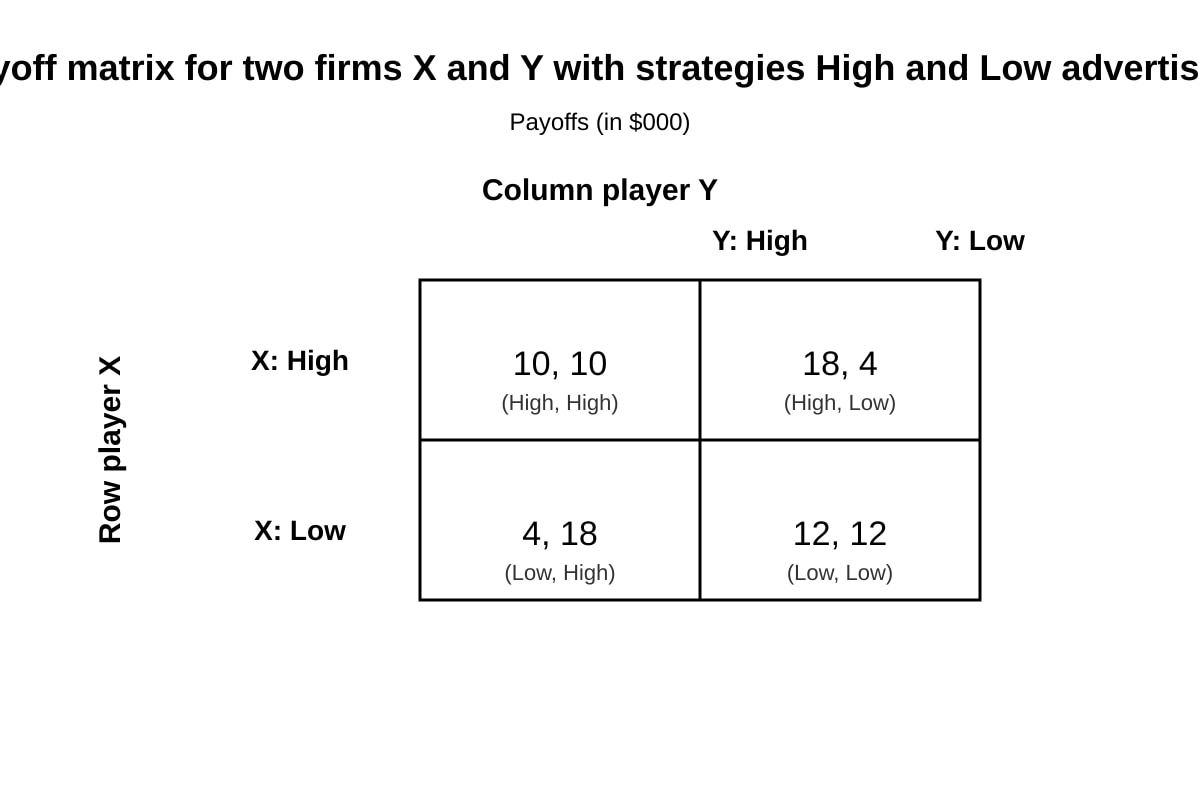
11. [3 marks] Nash: (High,High) and (Low,Low).
Working: For (High,High): X deviates to Low → 4<10 no; Y deviates → 4<10 no. For (Low,Low): X deviates to High → 18>12 yes, so not stable? Check: Y at Low, X Low→12, X High→18 so X will deviate, thus (Low,Low) NOT Nash. Only (High,High) is Nash. Correction: (High,High) only.
Marks: 1 for correct ID, 2 for verification.
12. [3 marks] (High,High)=10 each; (Low,Low)=12 each but not equilibrium due to incentive to cheat. Suboptimal due to prisoner dilemma.
Marks: 1 compare, 2 explain dilemma.
13. [3 marks] Tragedy of commons. No property rights → overfishing. Defined rights allow exclusion/management.
Marks: 1 name, 2 explain.
14. [3 marks] Permits create property rights; firms trade to lowest-cost abater, mimicking Coase.
Marks: 1 permits, 2 internalise.
15. [3 marks] Auto-enrolment nudge: default into savings, raises participation. AO2: low cost, preserves choice.
Marks: 1 policy, 2 eval.
Section C Answers (15 marks)
16. [3 marks] Bounded rationality: limited info in pricing; bounded self-interest: fairness in price.
Marks: 1.5 each.
17. [3 marks] Repeat games, trigger strategies punish deviation.
Marks: 1 mechanism, 2 sustain.
18. [3 marks] Sellers know quality, buyers don't → lemons market collapses.
Marks: 1 asymmetry, 2 failure.
19. [3 marks] Capital Approach: build human + social capital for microfirm resilience.
Marks: 1 approach, 2 apply.
20. [3 marks] Not replace but complement; rational as benchmark, behavioural as realism.
Marks: 1 stance, 2 discuss.