AI Generated Exam Paper
A Level Economics H3 Practice Paper 1
Free A Level Economics H3 Practice Paper 1, HY3 AI version, with questions, answers, and A Level-style practice for Singapore students.
These static practice materials are generated from the site's syllabus and paper-generation workflow, with source and model context shown so students and parents can evaluate the material before use.
Questions
TuitionGoWhere Practice Paper - Economics H3 A-Level
TuitionGoWhere Practice Paper (AI) — Version 1
Subject: Economics H3
Level: A-Level
Paper: Practice Paper (Microeconomics Focus)
Duration: 1 hour 30 minutes
Total Marks: 40
Name: ________________________
Class: ________________________
Date: ________________________
Instructions:
- This practice paper is generated from syllabus-first inference. No past-year exam templates were available; questions are aligned to the H3 Economics (9809) interpreted syllabus for Microeconomics (Themes 1 and 2).
- Answer all questions.
- Use a calculator if permitted by SEAB.
- Show all working and reasoning where applicable.
Section A: Multiple-Choice and Short Structured Questions (1–10) [20 marks]
1. [2 marks] According to standard rational choice theory, an economic agent maximises self-interest by:
A. Following social norms exclusively
B. Weighing marginal costs against marginal benefits
C. Avoiding all risky choices
D. Accepting the status quo
2. [2 marks] A consumer refuses to sell a coffee mug they own for 5butwouldnotpaymorethan3 to buy the same mug. This illustrates:
A. Loss aversion
B. Endowment effect
C. Sunk cost fallacy
D. Salience bias
3. [2 marks] A firm continues a failing project because it already spent $1 million. This is an example of:
A. Status quo bias
B. Sunk cost fallacy
C. Nudge theory
D. Bounded self-interest
4. [2 marks] In game theory with pure strategies, a Nash equilibrium occurs when:
A. All firms collude
B. No player can improve payoff by changing strategy unilaterally
C. The government sets prices
D. One firm dominates
5. [2 marks] The tragedy of the commons is best resolved by:
A. Increasing demand
B. Clearly defined property rights C. Banning all use
D. Subsidising consumers
6. [2 marks] A person buying insurance and then taking more risks shows:
A. Adverse selection
B. Moral hazard
C. Screening
D. Signalling
7. [2 marks] Before a contract, a high-risk driver hides their risk from insurer. This is:
A. Moral hazard
B. Adverse selection C. Principal-agent problem
D. Coase theorem
8. [2 marks] A risk-averse agent would prefer a certain 50toa50100 because they:
A. Dislike variance in outcomes
B. Are irrational
C. Seek salience
D. Have bounded will-power
9. [2 marks] A nudge that changes default enrolment to organ donation uses:
A. Loss aversion
B. Status quo bias
C. Endowment effect
D. Time-inconsistency
10. [2 marks] In Porter’s framework, the threat of new entrants is reduced by:
A. Low capital needs
B. High barriers to entry
C. Weak suppliers
D. Few substitutes
Section B: Data Response and Application (11–15) [12 marks]
11. [3 marks] Explain bounded rationality using loss aversion and endowment effect.
12. [3 marks] Define quasi-public good and give one example of a club good.
13. [2 marks] State the Coase theorem condition for efficient resolution of externalities.
14. [2 marks] A worker exerts less effort after being hired due to unobservable action. Name the problem and one policy measure.
15. [2 marks] In a prisoner’s dilemma, both firms confess and get low profit. Why is this a Nash equilibrium?
Section C: Extended Microeconomic Analysis (16–20) [8 marks]
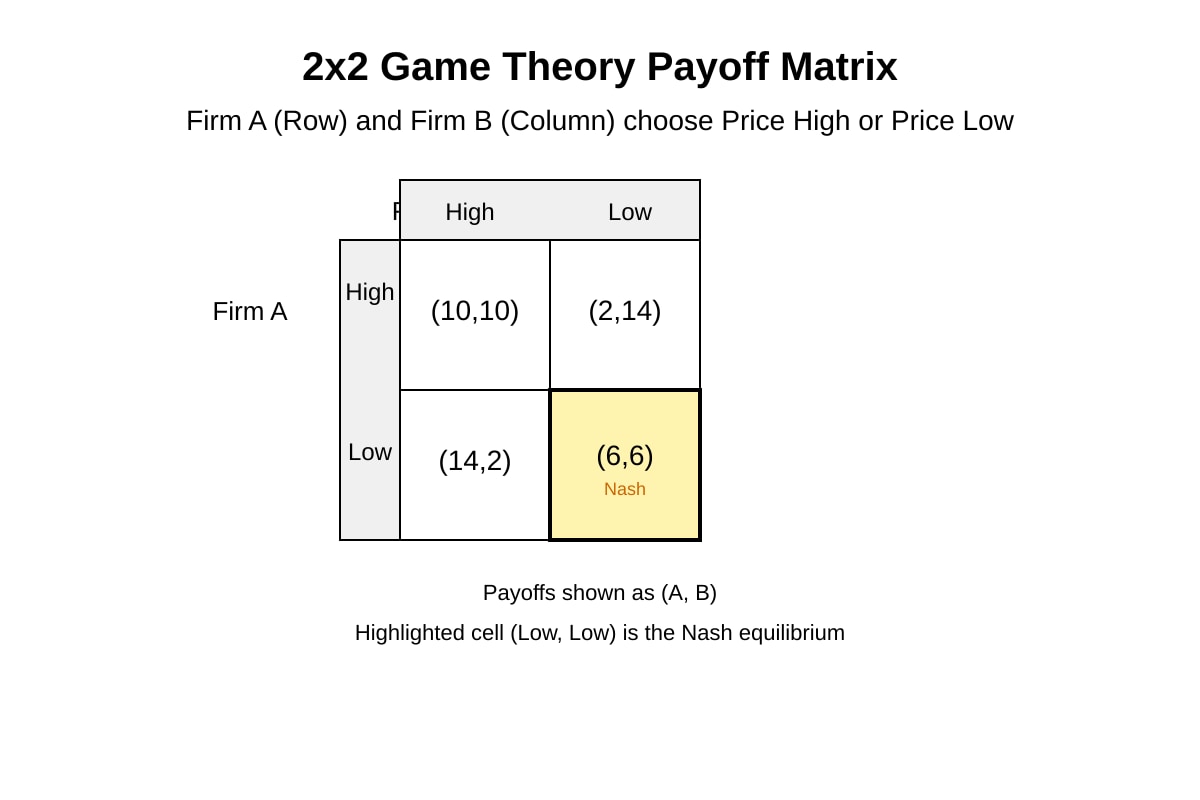
16. [2 marks] Show a 2×2 payoff matrix where two firms choose High or Low price; Nash at (Low, Low).
Image pending generation: table for Q16.
17. [2 marks] Explain how tradeable permits address tragedy of commons.
18. [2 marks] Differentiate adverse selection from moral hazard with market examples.
19. [2 marks] Suggest one nudge to increase retirement savings and the bias used.
20. [2 marks] Why might time-inconsistent preferences cause procrastination in studying?
Total Marks: 40
Answers
TuitionGoWhere Practice Paper Answers - Economics H3 A-Level (Version 1)
Section A Answers (1–10)
- B [2] Rational agent compares marginal cost and marginal benefit. A,C,D contradict standard model.
- B [2] Endowment effect: owned item valued more than same item unowned.
- B [2] Sunk cost fallacy: past cost irrelevant to forward choice.
- B [2] Nash: no unilateral profitable deviation in pure strategies.
- B [2] Defined property rights internalise commons.
- B [2] Moral hazard: behaviour change post-contract.
- B [2] Adverse selection: hidden info pre-contract.
- A [2] Risk-averse: avoid variance, prefer certainty equivalent.
- B [2] Default exploits status quo bias.
- B [2] Barriers reduce threat of entry.
Section B Answers (11–15)
11. [3] Bounded rationality: limits in cognition. Loss aversion: losses felt > gains (e.g., not selling at gain). Endowment: owned goods overvalued. (1 mark each)
12. [3] Quasi-public: non-excludable but rivalrous (e.g., fish stock). Club good: excludable non-rivalrous (e.g., Netflix). (2+1)
13. [2] Zero transaction costs and defined rights → efficient bargain (Coase).
14. [2] Principal-agent; measure: efficiency wages or monitoring.
15. [2] Unilateral switch worsens payoff (Low,Low is best response to Low).
Section C Answers (16–20)
16. [2] Matrix per placeholder: (Low,Low) = (6,6); if A deviates to High when B Low → 2<6. Same for B. Hence Nash.
17. [2] Caps total use; tradable gives efficient allocation to low-cost reducers.
18. [2] Adverse: hidden type pre (used car); Moral: action post (insured risk).
19. [2] Auto-enrol retirement; uses status quo bias.
20. [2] Present self undervalues future cost → delays (procrastination).
Total: 40 marks. All questions syllabus-aligned; no past-paper claim.
Free quiz and exam paper access
Enter your details to view this paper
Your access is remembered on this device.