A-Level Economics H2 Quiz - Policy Evaluation
Name:
Class:
Date:
Score:
Duration: 60 minutes
Total Marks: 40
Topic: Policy Evaluation (syllabus-first practice; not derived from past-year papers)
Instructions:
- Answer all 20 questions.
- Section A: 10 short structured questions (1 mark each).
- Section B: 6 medium questions (2–4 marks each).
- Section C: 4 extended evaluation questions (up to 6 marks each).
- Use economic terms, diagrams where requested, and reference policy trade-offs.
Section A: Basic Policy Evaluation Concepts (Questions 1–10, 1 mark each)
-
In policy evaluation, what does the term "opportunity cost of a policy" refer to?
-
State one criterion used to evaluate the effectiveness of a government policy.
-
What is meant by "unintended consequences" in policy evaluation?
-
Give one example of a demand-side macroeconomic policy.
-
Give one example of a supply-side policy.
-
What is a deadweight loss in the context of policy intervention?
-
State one reason why a subsidy may fail to correct a market failure completely.
-
In evaluating policy, what does "equity" refer to?
-
What is the difference between positive and normative evaluation of policy?
-
State one limitation of using GDP growth as the sole measure of policy success.
Section B: Applied Policy Analysis (Questions 11–16)
-
A government imposes a carbon tax to reduce emissions. Using a demand-supply diagram, explain one way to evaluate whether the policy is effective. [3 marks]
-
Singapore uses a managed float exchange rate policy. State two macroeconomic objectives this policy may help achieve and one trade-off involved. [3 marks]
-
A minimum wage is set above the equilibrium wage. With reference to a labour market diagram, explain one negative evaluation point. [2 marks]
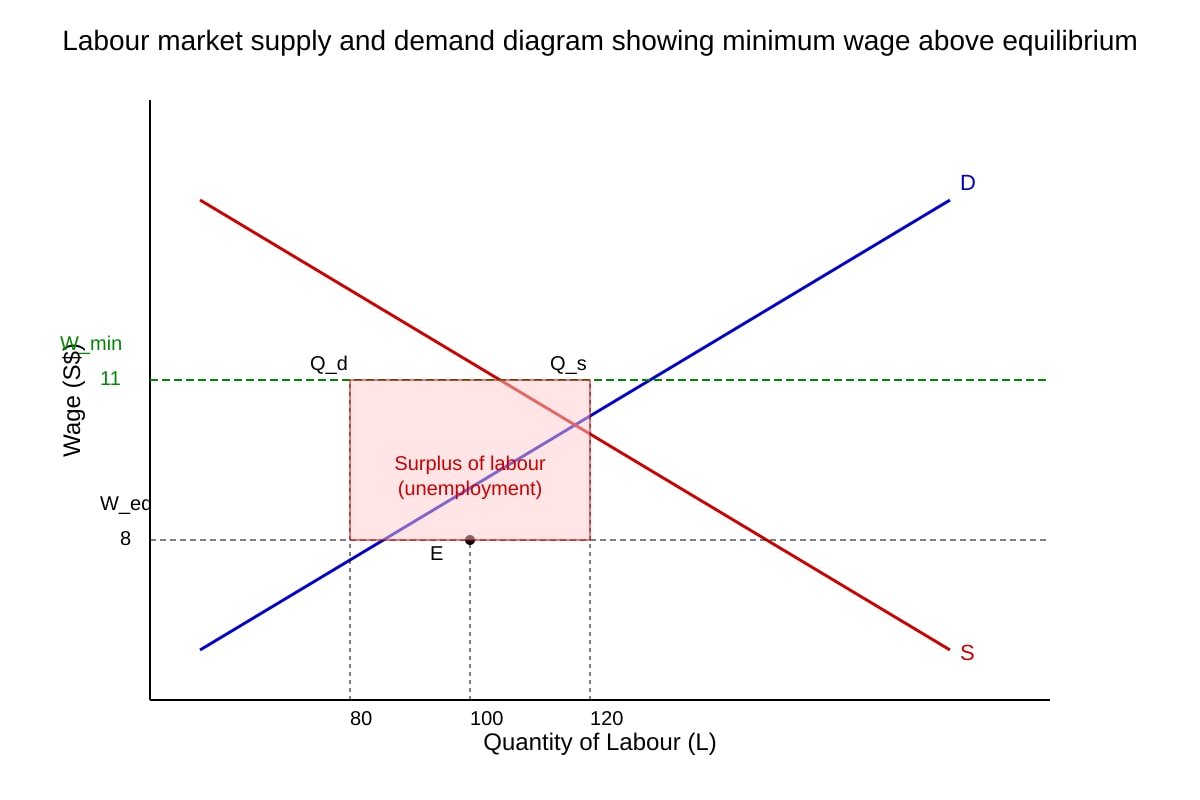
Generated diagram for Q13.
-
Calculate the fiscal multiplier if the marginal propensity to consume (MPC) is 0.8. Show your working. [2 marks]
-
Evaluate one advantage and one disadvantage of using price controls instead of taxes to correct a positive externality in consumption. [4 marks]
-
With reference to Extract A below, identify one policy evaluation criterion that the data supports. [2 marks]
Extract A: "After the 2023 subsidy on electric vehicles, registrations rose by 40% but grid carbon intensity remained unchanged due to coal reliance."
Section C: Extended Evaluation (Questions 17–20)
-
Assess whether a merger between two ride-hailing firms in a small economy should be approved on policy evaluation grounds. Use cost, consumer welfare, and competition criteria. [6 marks]
-
Evaluate the effectiveness of expansionary fiscal policy in a recession with high leakages to imports. Include the multiplier effect in your answer. [5 marks]
-
"Government intervention always improves societal welfare." Using market failure and policy evaluation concepts, evaluate this statement with reference to possible government failure. [6 marks]
-
With reference to the table below, evaluate the policy of imposing a tariff on imported steel using the criteria of domestic industry protection and consumer cost.
| Year | Domestic Output (000t) | Import Price (S$/t) | Consumer Cost Index |
|---|
| 2022 | 120 | 500 | 100 |
| 2024 | 150 | 620 | 108 |
[5 marks]
</stage5_quiz_answers_md>
<stage5_quiz_answers_md>
A-Level Economics H2 Quiz - Policy Evaluation: Answer Key
Topic: Policy Evaluation (syllabus-first practice; not past-year derived)
Section A: Basic Policy Evaluation Concepts (1 mark each)
-
Answer: The next-best alternative use of resources forgone as a result of adopting the policy.
Teaching note: Opportunity cost is central to the decision-making approach; every policy uses scarce resources that could fund other programmes.
-
Answer: Any one: efficiency, equity, sustainability, feasibility, time-lag, or achievement of stated objective.
Marking: 1 mark for a valid criterion.
-
Answer: Side-effects of a policy not intended by policymakers (e.g. black market from price ceiling).
Common mistake: Confusing with opportunity cost.
-
Answer: Any one: government spending increase, tax cut, or expansionary monetary policy.
Note: Demand-side policies affect AD directly.
-
Answer: Any one: education/training subsidies, infrastructure investment, tax incentives for R&D.
Note: Supply-side policies shift AS right.
-
Answer: Loss of total welfare (consumer + producer surplus) due to market distortion.
Link: Shown as triangle in diagram between D and S after intervention.
-
Answer: Any one: marginal external benefit not fully known, take-up incomplete, or crowd-out.
Teaching: Subsidy may under/over-correct if size mismatched.
-
Answer: Fairness in distribution of policy benefits and burdens across groups.
Contrast: Efficiency is size of pie; equity is slice division.
-
Answer: Positive = factual/measurable; normative = value-based judgment of "good/bad".
Marking: Both elements for full but 1 mark accepts short correct distinction.
-
Answer: Ignores income distribution, non-market welfare, or environmental cost.
Example: GDP up but inequality worsens.
Section B: Applied Policy Analysis
- [3 marks]
- Draw D (petrol) and S; tax shifts S left to S_tax. [1]
- Evaluate by comparing quantity fall from Q0 to Q1 vs target reduction. [1]
- Check if emission fall proportionate and if D is elastic enough; if inelastic, tax less effective. [1]
Teaching: Effectiveness = movement toward social optimum quantity.
- [3 marks]
- Objectives: price stability (appreciation curbs import inflation), export competitiveness management. [2]
- Trade-off: appreciation may reduce growth/employment in tradables. [1]
- [2 marks]
- Diagram shows W_min > equilibrium, Q_s (120) > Q_d (80). [1]
- Evaluation: unemployment (surplus 40 units) is a cost; may hurt low-skilled. [1]
Image check: Surplus region labelled between 80 and 120 at wage 11.
- [2 marks]
- Multiplier = 1 / (1 - MPC) = 1 / (1 - 0.8) = 1 / 0.2 = 5. [2]
Working: Substitute MPC = 0.8; show division.
- [4 marks]
- Advantage of price control (e.g. max price on positive externality good): direct quantity boost, simple. [2]
- Disadvantage: shortage, misallocation, no revenue for govt, may need subsidy funding. [2]
- [2 marks]
- Criterion: efficiency (registrations up = closer to social optimum) BUT sustainability not met (grid unchanged). [2]
Marking: 1 for identifying criterion from extract, 1 for using data.
Section C: Extended Evaluation
- [6 marks]
- Cost: economies of scale, lower prices possible (2).
- Consumer welfare: may rise if prices fall, but choice falls (2).
- Competition: HHI rises, barrier entry, possible monopoly power (2).
Descriptors: Balanced judgment needed for top marks.
- [5 marks]
- Multiplier = 1/(1-MPC+MPM); high MPM reduces k. [2]
- Fiscal boost ΔY = ΔG × k smaller due to leakages. [2]
- Evaluation: less effective than closed economy; suggest coordinated policy. [1]
- [6 marks]
- Agree: corrects externality, public goods (2).
- Disagree: government failure, info asymmetry, rent-seeking (3).
- Conclusion: not always; depends on design (1).
- [5 marks]
- Domestic output rose 120→150 (protection works) [2].
- Consumer cost index 100→108, import price up [2].
- Trade-off: industry gain vs consumer loss; net welfare ambiguous [1].
</stage5_quiz_answers_md>
<stage5_quiz_md>
A-Level Economics H2 Quiz - Policy Evaluation
Name:
Class:
Date:
Score:
Duration: 60 minutes
Total Marks: 40
Topic: Policy Evaluation (syllabus-first practice; not derived from past-year papers)
Instructions:
- Answer all 20 questions.
- Section A: 10 short structured questions (1 mark each).
- Section B: 6 medium questions (2–4 marks each).
- Section C: 4 extended evaluation questions (up to 6 marks each).
- Use economic terms, diagrams where requested, and reference policy trade-offs.
Section A: Basic Policy Evaluation Concepts (Questions 1–10, 1 mark each)
-
In policy evaluation, what does the term "opportunity cost of a policy" refer to?
-
State one criterion used to evaluate the effectiveness of a government policy.
-
What is meant by "unintended consequences" in policy evaluation?
-
Give one example of a demand-side macroeconomic policy.
-
Give one example of a supply-side policy.
-
What is a deadweight loss in the context of policy intervention?
-
State one reason why a subsidy may fail to correct a market failure completely.
-
In evaluating policy, what does "equity" refer to?
-
What is the difference between positive and normative evaluation of policy?
-
State one limitation of using GDP growth as the sole measure of policy success.
Section B: Applied Policy Analysis (Questions 11–16)
-
A government imposes a carbon tax to reduce emissions. Using a demand-supply diagram, explain one way to evaluate whether the policy is effective. [3 marks]
-
Singapore uses a managed float exchange rate policy. State two macroeconomic objectives this policy may help achieve and one trade-off involved. [3 marks]
-
A minimum wage is set above the equilibrium wage. With reference to a labour market diagram, explain one negative evaluation point. [2 marks]
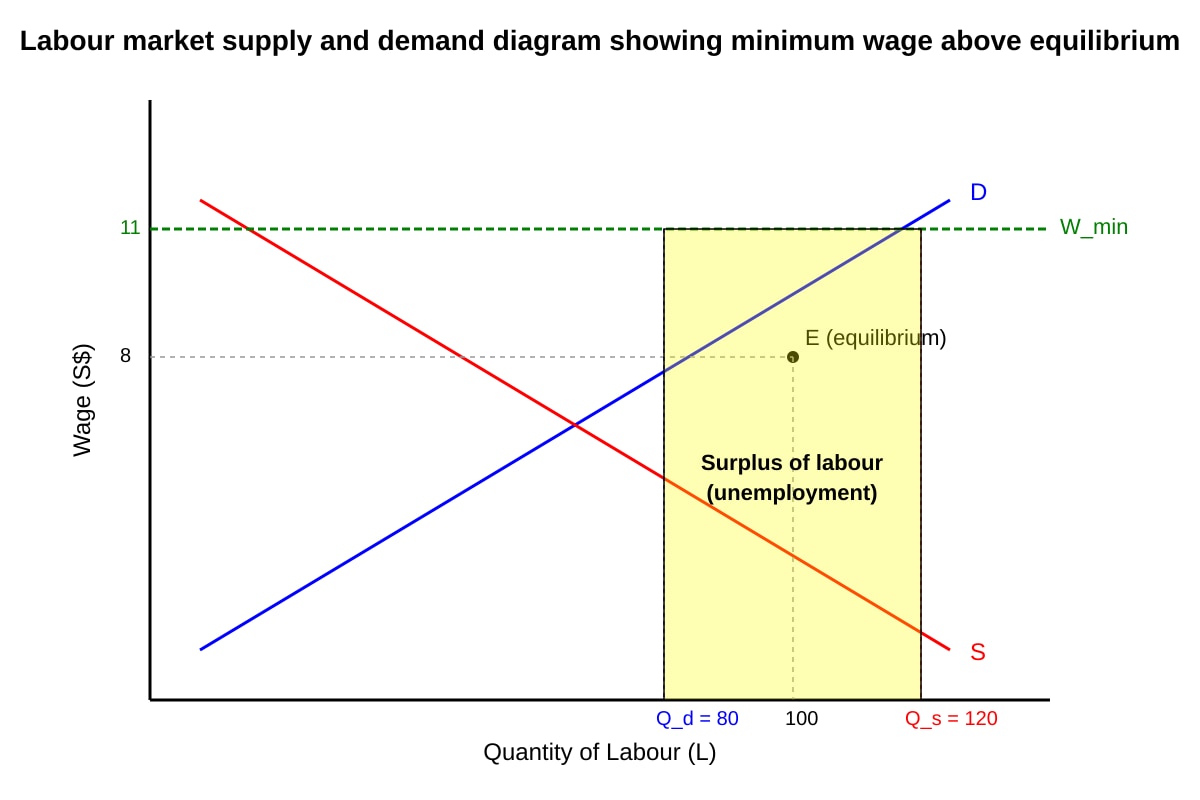
Generated diagram for Q13.
-
Calculate the fiscal multiplier if the marginal propensity to consume (MPC) is 0.8. Show your working. [2 marks]
-
Evaluate one advantage and one disadvantage of using price controls instead of taxes to correct a positive externality in consumption. [4 marks]
-
With reference to Extract A below, identify one policy evaluation criterion that the data supports. [2 marks]
Extract A: "After the 2023 subsidy on electric vehicles, registrations rose by 40% but grid carbon intensity remained unchanged due to coal reliance."
Section C: Extended Evaluation (Questions 17–20)
-
Assess whether a merger between two ride-hailing firms in a small economy should be approved on policy evaluation grounds. Use cost, consumer welfare, and competition criteria. [6 marks]
-
Evaluate the effectiveness of expansionary fiscal policy in a recession with high leakages to imports. Include the multiplier effect in your answer. [5 marks]
-
"Government intervention always improves societal welfare." Using market failure and policy evaluation concepts, evaluate this statement with reference to possible government failure. [6 marks]
-
With reference to the table below, evaluate the policy of imposing a tariff on imported steel using the criteria of domestic industry protection and consumer cost.
| Year | Domestic Output (000t) | Import Price (S$/t) | Consumer Cost Index |
|---|
| 2022 | 120 | 500 | 100 |
| 2024 | 150 | 620 | 108 |
[5 marks]