AI Generated Quiz
A Level H2 Economics Microeconomics Quiz
Free A Level H2 Econs Microeconomics quiz, DeepSeek AI version, with questions, answers, and A Level-style practice for Singapore students.
These static practice materials are generated from the site's syllabus and paper-generation workflow, with source and model context shown so students and parents can evaluate the material before use.
Questions
Free quiz and exam paper access
Enter your details to view this paper
Your access is remembered on this device.
Answers
A-Level Economics H2 Quiz - Microeconomics — Answer Key and Marking Scheme
Total Marks: 50
Section A: Short-Answer Questions (10 marks)
1. Define the term "opportunity cost" and provide one example from an economic context. [2 marks]
Answer:
- Definition (1 mark): Opportunity cost is the value of the next best alternative forgone when a choice is made.
- Example (1 mark): Award 1 mark for any valid economic example, e.g.:
- A government choosing to build a hospital instead of a school — the opportunity cost is the education benefits forgone.
- A student choosing to study Economics instead of working part-time — the opportunity cost is the income forgone.
- A firm investing in new machinery instead of expanding its workforce — the opportunity cost is the additional output from more workers.
Marking notes: Accept any clear definition that captures "next best alternative forgone." The example must be contextualised in an economic decision (individual, firm, or government).
2. State two factors that would cause the demand curve for a normal good to shift to the right. [2 marks]
Answer: Award 1 mark for each valid factor (maximum 2 marks):
- Increase in consumer income (for a normal good)
- Increase in the price of a substitute good
- Decrease in the price of a complementary good
- Favourable change in tastes/preferences
- Increase in population/number of buyers
- Expectations of future price increases
- Successful advertising campaign
Marking notes: Accept any two distinct factors. The factor must be a demand-side shifter, not a supply-side factor. Do not award marks for "decrease in price of the good itself" (this causes a movement along the curve, not a shift).
3. Distinguish between a movement along a supply curve and a shift of the supply curve. [2 marks]
Answer:
- Movement along (1 mark): A movement along the supply curve is caused by a change in the price of the good itself, resulting in a change in quantity supplied (extension or contraction of supply).
- Shift of the curve (1 mark): A shift of the supply curve is caused by a change in any other factor affecting supply (e.g., costs of production, technology, government policy, number of sellers), resulting in an increase or decrease in supply at every price.
Marking notes: Both parts must be clearly distinguished. Award 1 mark for correctly identifying the cause of each. Accept "change in own price" vs. "change in conditions of supply."
4. Identify two characteristics of a public good. [2 marks]
Answer: Award 1 mark for each characteristic (maximum 2 marks):
- Non-excludability: Once the good is provided, it is impossible or extremely costly to prevent anyone from consuming it, even if they do not pay.
- Non-rivalry: One person's consumption of the good does not reduce the amount available for others to consume.
Marking notes: Both characteristics must be present for a pure public good. Accept clear explanations of each concept. Do not award marks for "provided by the government" (this is not a defining characteristic).
5. State the formula for price elasticity of demand (PED) and explain what a PED value of -0.5 indicates about the good. [2 marks]
Answer:
- Formula (1 mark): PED = Percentage change in quantity demanded / Percentage change in price (Accept: %ΔQd / %ΔP, or the full formula using midpoints)
- Explanation (1 mark): A PED of -0.5 indicates that demand is price inelastic. A 1% increase in price leads to a 0.5% decrease in quantity demanded. The good is likely a necessity or has few close substitutes. If the firm raises price, total revenue will increase.
Marking notes: Award 1 mark for the correct formula (sign convention not strictly required). Award 1 mark for correctly interpreting the value as inelastic and explaining the implication (either the percentage relationship or the revenue effect).
Section B: Structured Questions (24 marks)
6. A government is deciding between allocating an additional $500 million to healthcare or to education.
(a) Using a production possibility curve (PPC) diagram, explain the concept of opportunity cost in the context of this decision. [4 marks]
Answer:
- Diagram (2 marks):
- Correctly labelled axes: "Healthcare" on one axis, "Education" on the other (1 mark)
- Concave PPC curve drawn, with two points labelled: Point A (initial allocation) and Point B (new allocation with more healthcare, less education) (1 mark)
- Explanation (2 marks):
- The PPC shows the maximum combinations of healthcare and education the government can provide with its given resources and technology (1 mark)
- Moving from Point A to Point B along the PPC requires sacrificing some education to obtain more healthcare — the quantity of education forgone is the opportunity cost of the additional healthcare (1 mark)
Marking notes: Diagram must be fully labelled. Explanation must link the diagram to the concept of opportunity cost. Award partial marks if the diagram is correct but explanation is weak, or vice versa.
(b) Explain why the PPC is typically drawn concave to the origin. [2 marks]
Answer:
- The concave shape reflects the principle of increasing opportunity cost (1 mark).
- As more resources are allocated to one good, resources that are less suited to its production must be used, so increasing amounts of the other good must be sacrificed for each additional unit produced. Resources are not equally efficient in all uses (1 mark).
Marking notes: Must mention increasing opportunity cost and explain why it occurs (resource specificity/heterogeneity). A simple statement that "opportunity cost increases" without explanation earns 1 mark.
7. The table below shows the weekly demand and supply schedules for organic vegetables in a local market.
(a) Determine the equilibrium price and quantity. Explain how the market would adjust if the price were initially set at $6. [3 marks]
Answer:
- Equilibrium (1 mark): Equilibrium price = $8, equilibrium quantity = 400 kg (where Qd = Qs).
- Market adjustment (2 marks):
- At P = $6, Qd = 600 kg and Qs = 400 kg, creating a shortage of 200 kg (1 mark).
- The shortage creates upward pressure on price. As price rises, quantity demanded falls and quantity supplied rises, moving the market toward equilibrium at P = $8, Q = 400 kg (1 mark).
Marking notes: Award 1 mark for correct equilibrium. Award 1 mark for identifying the shortage. Award 1 mark for explaining the adjustment mechanism (price rising to clear the market).
(b) Suppose a health report highlights the benefits of organic vegetables, increasing quantity demanded by 200 kg at every price. Calculate the new equilibrium price and quantity. [3 marks]
Answer:
- New demand schedule (1 mark):
Price ($) New Qd (kg) Qs (kg) 4 1000 200 6 800 400 8 600 600 10 400 800 - New equilibrium (2 marks): New equilibrium price = $8, new equilibrium quantity = 600 kg. (Award 1 mark for price, 1 mark for quantity.)
Marking notes: Award 1 mark for correctly adjusting the demand schedule. Award 2 marks for the correct new equilibrium. If the student identifies the correct equilibrium without showing the adjusted schedule, award full marks provided the reasoning is clear.
8. A firm operating in an oligopolistic market is considering whether to engage in a price war with its rivals.
(a) Explain why price competition is often limited in oligopolistic markets. Use the concept of interdependence in your answer. [4 marks]
Answer:
- Interdependence (2 marks): In an oligopoly, there are few dominant firms, and each firm's actions directly affect its rivals. Firms recognise their mutual dependence and must consider rivals' likely reactions when making pricing decisions.
- Limited price competition (2 marks):
- If one firm lowers its price, rivals are likely to match the price cut to avoid losing market share. The initiating firm gains little extra market share, and all firms suffer lower profits (price rigidity).
- If one firm raises its price, rivals may not follow, causing the initiating firm to lose significant market share. This asymmetry creates a strong disincentive for price competition, leading to stable or "sticky" prices.
Marking notes: Award up to 2 marks for clearly explaining interdependence. Award up to 2 marks for explaining why this leads to limited price competition (kinked demand curve theory is acceptable but not required). Must link interdependence to the outcome.
(b) Describe two forms of non-price competition that firms in an oligopoly might use instead. [2 marks]
Answer: Award 1 mark for each valid form (maximum 2 marks):
- Product differentiation: Improving quality, design, features, or performance to make the product stand out.
- Advertising and branding: Building brand loyalty through marketing campaigns, sponsorships, or celebrity endorsements.
- Loyalty schemes: Offering rewards points, discounts for repeat purchases, or membership benefits.
- After-sales service: Providing warranties, free maintenance, customer support, or extended service contracts.
- Innovation and R&D: Developing new products or improving existing ones to gain a competitive edge.
Marking notes: Accept any two distinct forms of non-price competition. Descriptions should be clear and relevant to oligopolistic markets.
9. The diagram below represents the market for petrol, where consumption generates negative externalities from carbon emissions.
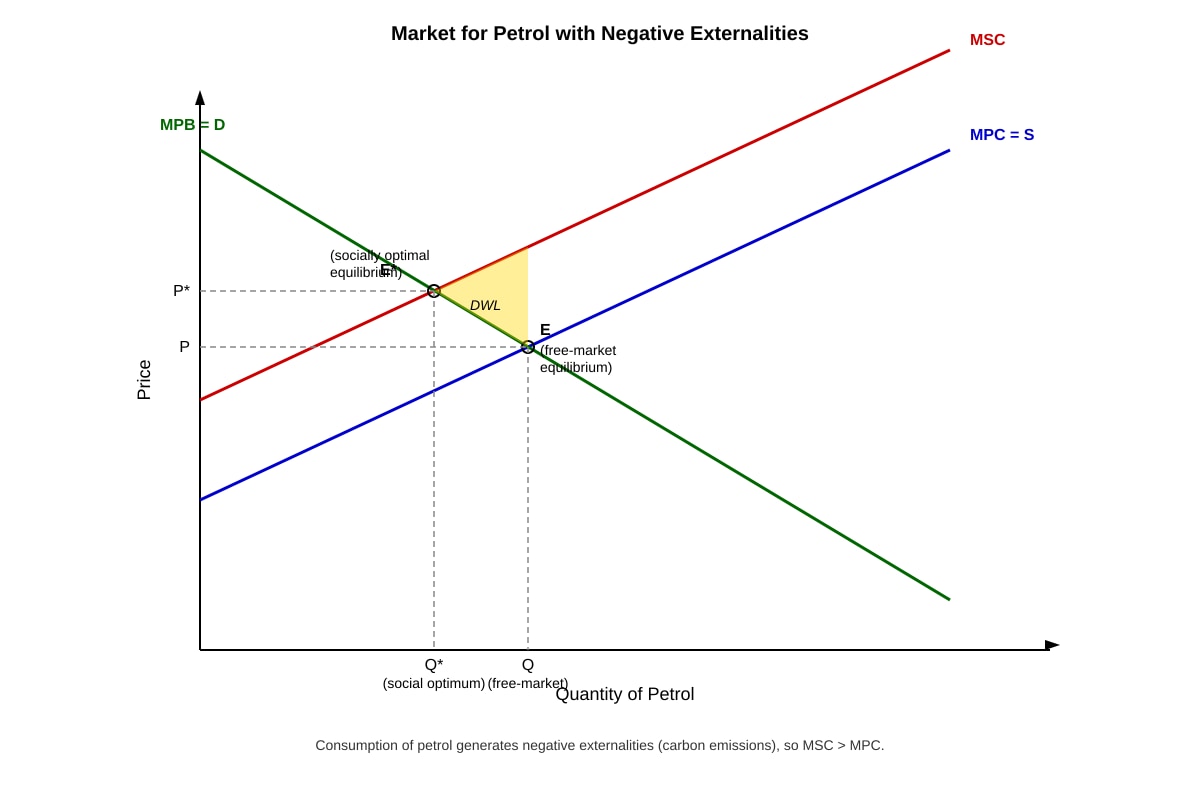
Generated diagram for this question.
(a) Draw a fully labelled diagram showing the marginal private cost (MPC), marginal social cost (MSC), and marginal private benefit (MPB) curves. Identify the free-market equilibrium and the socially optimal equilibrium. [4 marks]
Answer:
- Diagram (3 marks):
- Correctly labelled axes: "Price/Cost" on vertical axis, "Quantity of petrol" on horizontal axis (1 mark).
- Downward-sloping MPB curve and upward-sloping MPC curve drawn, with free-market equilibrium (Qm, Pm) where MPB = MPC (1 mark).
- MSC curve drawn above and to the left of the MPC curve (reflecting external costs), with socially optimal equilibrium (Qs, Ps) where MPB = MSC. Qs < Qm and Ps > Pm clearly shown (1 mark).
- Identification (1 mark): Free-market equilibrium and socially optimal equilibrium clearly labelled on the diagram.
Marking notes: Diagram must be fully labelled. The MSC curve must be above the MPC curve, and the socially optimal quantity must be less than the free-market quantity. Award partial marks if some elements are missing.
(b) Shade and label the area of deadweight loss arising from the negative externality. Explain what this deadweight loss represents. [2 marks]
Answer:
- Shading (1 mark): The deadweight loss is the triangular area between the MSC and MPB curves, from the socially optimal quantity (Qs) to the free-market quantity (Qm). It should be shaded and labelled.
- Explanation (1 mark): The deadweight loss represents the welfare loss to society from overproduction/overconsumption of petrol. For each unit produced beyond Qs, the marginal social cost exceeds the marginal private benefit, resulting in a net loss to society.
Marking notes: Award 1 mark for correct shading and labelling. Award 1 mark for explaining that it represents the excess of social cost over social benefit for the overproduced units.
10. Explain the difference between a specific tax and an ad valorem tax. Using a diagram, show how a specific tax affects the market equilibrium for a good with relatively inelastic demand. [6 marks]
Answer:
- Difference (2 marks):
- A specific tax is a fixed amount per unit of the good (e.g., $2 per litre). The supply curve shifts upward by a parallel amount equal to the tax.
- An ad valorem tax is a percentage of the price of the good (e.g., 10% VAT). The supply curve shifts upward, but the gap between the original and new supply curves widens as price increases (pivotal shift).
- Diagram (3 marks):
- Correctly labelled axes: "Price" on vertical axis, "Quantity" on horizontal axis (1 mark).
- Downward-sloping demand curve (relatively steep/inelastic) and upward-sloping supply curve drawn, with initial equilibrium (P1, Q1) (1 mark).
- New supply curve (S + tax) drawn parallel above the original supply curve, with new equilibrium (P2, Q2). The vertical distance between the two supply curves equals the tax per unit. Tax burden mainly on consumers shown by larger increase in price relative to decrease in quantity (1 mark).
- Explanation (1 mark): Because demand is relatively inelastic, consumers bear a larger share of the tax burden. The quantity traded falls by a relatively small amount, and the government collects significant tax revenue (shown by the rectangle: tax per unit × Q2).
Marking notes: Award up to 2 marks for clearly distinguishing specific and ad valorem taxes. Award up to 3 marks for a correctly drawn and labelled diagram. Award 1 mark for explaining the incidence and market outcome with inelastic demand.
Section C: Essay Questions (16 marks)
11. Discuss whether a monopoly in the pharmaceutical industry necessarily leads to market failure. In your answer, consider both the potential inefficiencies and the possible benefits of monopoly in this industry. [8 marks]
Answer:
- Introduction (1 mark): Define monopoly (single seller, high barriers to entry) and market failure (inefficient allocation of resources, loss of social welfare). State that the pharmaceutical industry has unique characteristics that make the assessment complex.
- Potential inefficiencies (3 marks):
- Higher prices and lower output: Monopolist restricts output and charges a price above marginal cost (P > MC), leading to allocative inefficiency and deadweight loss.
- Productive inefficiency: Lack of competitive pressure may lead to X-inefficiency, higher costs, and less incentive to minimise costs.
- Reduced consumer surplus: Higher prices reduce consumer welfare and may limit access to essential medicines, creating equity concerns.
- Barriers to entry: Patents and high R&D costs prevent potential competitors, perpetuating monopoly power.
- Possible benefits (3 marks):
- Innovation and R&D: High profits provide funds for research and development of new drugs. Patent protection incentivises innovation by allowing firms to recoup R&D costs.
- Economies of scale: Large-scale production and distribution can lower average costs, potentially leading to lower prices than under competition.
- Natural monopoly argument: High fixed costs of drug development and low marginal costs of production may make a single producer more efficient.
- Global competitiveness: Large pharmaceutical firms can compete internationally and invest in treatments for rare diseases (orphan drugs) that might otherwise be neglected.
- Evaluation and conclusion (1 mark): Whether monopoly leads to market failure depends on the balance between static inefficiencies (higher prices, lower output) and dynamic efficiencies (innovation, new drugs). Government regulation (price controls, compulsory licensing) can mitigate inefficiencies while preserving innovation incentives. A blanket statement that monopoly necessarily causes market failure is too simplistic for this industry.
Marking notes: Award up to 3 marks for discussing inefficiencies, up to 3 marks for discussing benefits, and up to 2 marks for overall structure, evaluation, and conclusion. Answers should demonstrate balanced analysis and use economic terminology accurately.
12. "The most effective way to reduce traffic congestion in a city is to impose a congestion charge on motorists during peak hours." Evaluate this statement, considering alternative policies a government could use to address the negative externalities associated with car usage. [8 marks]
Answer:
- Introduction (1 mark): Define traffic congestion as a negative externality (each additional car imposes time costs and pollution on others). State that a congestion charge is a market-based instrument to internalise the externality.
- Arguments for congestion charging (3 marks):
- Internalises externality: Charges motorists the marginal external cost, leading to a more socially optimal level of traffic (Pigouvian tax principle).
- Incentivises behavioural change: Encourages shift to public transport, carpooling, cycling, or off-peak travel.
- Generates revenue: Funds can be used to improve public transport or road infrastructure (double dividend).
- Practical success: Examples like London and Singapore show significant reductions in congestion and improvements in air quality.
- Diagram (optional but rewarded): MSC > MPC diagram showing tax shifting MPC to MSC, reducing quantity to socially optimal level.
- Limitations of congestion charging (2 marks):
- Regressive impact: Charges may disproportionately affect lower-income motorists who have less flexibility in travel times or modes.
- Administrative costs: Setting up and enforcing charging zones requires significant investment in technology and bureaucracy.
- Substitution effects: May shift congestion to surrounding areas or times just outside peak hours.
- Political unpopularity: Public resistance can make implementation difficult.
- Alternative policies (2 marks):
- Public transport investment: Subsidising and expanding buses, trains, and cycling infrastructure provides viable alternatives.
- Regulation: Odd-even licence plate schemes, vehicle quotas, or banning cars from certain zones.
- Road pricing: Broader pricing schemes including distance-based charges.
- Information and nudges: Real-time traffic apps, flexible work hours promotion, telecommuting incentives.
- Fuel taxes: Indirectly discourage driving but less targeted than congestion charges.
- Evaluation and conclusion (1 mark): A congestion charge is effective in targeting the specific externality at peak times and locations, but its effectiveness depends on availability of alternatives, public acceptance, and complementary policies. A comprehensive approach combining pricing, investment in alternatives, and regulation is likely most effective. No single policy is a panacea.
Marking notes: Award up to 3 marks for arguments supporting congestion charging, up to 2 marks for limitations, up to 2 marks for alternative policies, and up to 1 mark for evaluation and conclusion. Answers should demonstrate critical thinking and use economic concepts appropriately.
Section D: Data Response and Application Questions (10 marks)
13. The table below shows the price and quantity data for a firm producing handmade furniture.
(a) Calculate the marginal revenue and marginal cost for the fourth unit of output. [2 marks]
Answer:
- Marginal Revenue (1 mark): MR = Change in TR / Change in Q = (480 - 390) / (4 - 3) = 90 / 1 = $90.
- Marginal Cost (1 mark): MC = Change in TC / Change in Q = (420 - 320) / (4 - 3) = 100 / 1 = $100.
Marking notes: Award 1 mark for each correct calculation. Accept working shown even if final answer is slightly miswritten, provided the method is correct.
(b) Using the data, determine the profit-maximising level of output. Explain your reasoning. [3 marks]
Answer:
- Profit-maximising output (2 marks): The firm maximises profit where MR = MC, or the last unit where MR > MC. Calculating MR and MC for each unit:
- Unit 1: MR = 150, MC = 80 (MR > MC)
- Unit 2: MR = 130, MC = 60 (MR > MC)
- Unit 3: MR = 110, MC = 80 (MR > MC)
- Unit 4: MR = 90, MC = 100 (MR < MC)
- Unit 5: MR = 70, MC = 130 (MR < MC) The firm should produce 3 units, as this is the last unit where MR exceeds MC. Producing the 4th unit would reduce profit.
- Reasoning (1 mark): Profit is maximised where the additional revenue from the last unit produced is at least as great as the additional cost. Beyond 3 units, MC > MR, so each additional unit reduces total profit.
Marking notes: Award 2 marks for correctly identifying 3 units as the profit-maximising output. Award 1 mark for clear reasoning linking MR and MC to profit maximisation. Accept calculation of total profit at each level as an alternative method.
14. A local government is considering subsidising solar panel installations to encourage renewable energy adoption.
(a) Using a demand and supply diagram, illustrate the effect of a subsidy on the market for solar panels. Clearly show the new equilibrium and the subsidy per unit. [3 marks]
Answer:
- Diagram (3 marks):
- Correctly labelled axes: "Price of solar panels" on vertical axis, "Quantity of solar panels" on horizontal axis (1 mark).
- Downward-sloping demand curve and upward-sloping supply curve drawn, with initial equilibrium (P1, Q1) (1 mark).
- New supply curve (S - subsidy) drawn to the right of the original supply curve, with new equilibrium (P2, Q2) where P2 is the price consumers pay (lower than P1) and Q2 > Q1. The vertical distance between the two supply curves equals the subsidy per unit. The price received by producers (P2 + subsidy) should be indicated (1 mark).
Marking notes: Diagram must be fully labelled. The subsidy shifts the supply curve downward/to the right. Both the consumer price and producer price should be identifiable. Award partial marks if some elements are missing.
(b) Explain one advantage and one disadvantage of using subsidies rather than direct regulation to achieve environmental goals. [2 marks]
Answer:
- Advantage (1 mark): Subsidies work through market incentives, allowing consumers and firms flexibility in how they respond. They encourage adoption without mandating specific technologies, potentially fostering innovation and cost reductions over time. They are politically more palatable than regulations.
- Disadvantage (1 mark): Subsidies require government expenditure, which has an opportunity cost and may lead to higher taxes or government debt. They may also encourage overconsumption or dependency if not carefully designed, and can be difficult to remove once established.
Marking notes: Award 1 mark for a valid advantage and 1 mark for a valid disadvantage. Answers must compare subsidies to direct regulation specifically.
15. Define the term "price elasticity of supply" (PES) and explain how the time period under consideration affects the PES of agricultural products. [2 marks]
Answer:
- Definition (1 mark): PES measures the responsiveness of quantity supplied to a change in price. Formula: PES = % change in quantity supplied / % change in price.
- Time period effect (1 mark): In the short run, the supply of agricultural products is highly inelastic because production decisions (planting, land allocation) cannot be changed quickly. In the long run, supply becomes more elastic as farmers can adjust inputs, change crops, or bring new land into cultivation.
Marking notes: Award 1 mark for a correct definition (formula or description). Award 1 mark for explaining that PES is lower in the short run and higher in the long run for agricultural products, with a brief reason.
16. The cross-price elasticity of demand between two goods, X and Y, is +1.8. Interpret this value and explain what it reveals about the relationship between the two goods. [2 marks]
Answer:
- Interpretation (1 mark): A positive cross-price elasticity indicates that goods X and Y are substitutes. A value of +1.8 means that a 1% increase in the price of good Y leads to a 1.8% increase in the quantity demanded of good X.
- Relationship (1 mark): The goods are close substitutes because the cross-price elasticity is strongly positive and greater than 1. Consumers readily switch from Y to X when the price of Y rises.
Marking notes: Award 1 mark for identifying the goods as substitutes and interpreting the sign. Award 1 mark for explaining the magnitude and the closeness of the substitute relationship.
17. Explain the difference between absolute advantage and comparative advantage in international trade. [2 marks]
Answer:
- Absolute advantage (1 mark): A country has an absolute advantage when it can produce a good using fewer resources (or produce more output with the same resources) than another country.
- Comparative advantage (1 mark): A country has a comparative advantage when it can produce a good at a lower opportunity cost than another country. Comparative advantage is the basis for mutually beneficial trade, even if one country has an absolute advantage in all goods.
Marking notes: Award 1 mark for each correct definition. The distinction must be clear: absolute advantage focuses on resource efficiency, comparative advantage on opportunity cost.
18. State two reasons why a government might choose to provide a good directly rather than leaving it to the free market. [2 marks]
Answer: Award 1 mark for each valid reason (maximum 2 marks):
- Public goods: The good is non-excludable and non-rival, so the free market would underprovide it due to the free-rider problem (e.g., national defence, street lighting).
- Merit goods: The good generates positive externalities and is underconsumed in the free market because individuals do not fully appreciate its benefits (e.g., education, healthcare).
- Natural monopoly: High fixed costs and economies of scale mean a single provider is most efficient, and government provision avoids private monopoly abuse (e.g., water supply, rail infrastructure).
- Equity/Universal access: To ensure all citizens have access to essential services regardless of ability to pay (e.g., basic healthcare, primary education).
Marking notes: Accept any two distinct and valid economic reasons. Answers should reference economic concepts (public goods, merit goods, externalities, natural monopoly, equity).
19. Define the term "adverse selection" and provide one example from an insurance market. [2 marks]
Answer:
- Definition (1 mark): Adverse selection occurs when there is asymmetric information between buyers and sellers before a transaction, leading to a situation where the party with less information is more likely to attract undesirable trading partners. In insurance, it refers to the tendency for those most likely to claim to be the most eager to buy insurance.
- Example (1 mark): In health insurance, individuals who know they have high health risks are more likely to purchase comprehensive insurance, while healthy individuals may opt out. This can lead to a pool of insured individuals with above-average risk, driving up premiums and potentially causing market failure.
Marking notes: Award 1 mark for a clear definition that captures asymmetric information and pre-transaction timing. Award 1 mark for a valid insurance market example.
20. Explain what is meant by "government failure" and give one example where government intervention might worsen an economic outcome. [2 marks]
Answer:
- Definition (1 mark): Government failure occurs when government intervention to correct a market failure leads to a net welfare loss or a less efficient allocation of resources than the original market outcome. It arises from issues such as imperfect information, political incentives, bureaucracy, and unintended consequences.
- Example (1 mark): Award 1 mark for any valid example, e.g.:
- Price controls: Rent controls intended to make housing affordable can lead to housing shortages, reduced quality, and black markets.
- Agricultural subsidies: Subsidies to farmers can lead to overproduction, environmental damage, and trade distortions.
- Regulatory capture: Regulators may act in the interest of the industry they regulate rather than the public, leading to weaker protections.
- Unintended consequences: A tax on plastic bags may lead consumers to switch to paper bags, which have their own environmental costs.
Marking notes: Award 1 mark for a clear definition. Award 1 mark for a relevant example that explains how the intervention worsened the outcome.
END OF ANSWER KEY