AI Generated Quiz
A Level H2 Economics Market Failure Quiz
Free A Level H2 Econs Market Failure quiz, LongCat AI version, with questions, answers, and A Level-style practice for Singapore students.
These static practice materials are generated from the site's syllabus and paper-generation workflow, with source and model context shown so students and parents can evaluate the material before use.
Questions
Free quiz and exam paper access
Enter your details to view this paper
Your access is remembered on this device.
Answers
A-Level Economics H2 Quiz - Market Failure
Answer Key and Marking Scheme
Section A: Understanding Market Failure (Questions 1–5)
1. Define the term market failure in economics.
[2 marks]
Answer: Market failure occurs when the free market, operating without government intervention, fails to allocate resources efficiently. This means that the market equilibrium does not maximise total social welfare (i.e., the sum of consumer and producer surplus is not maximised). Market failure arises when the price mechanism fails to account for all costs and benefits associated with the production or consumption of a good or service.
Marking: 1 mark for identifying that resources are not allocated efficiently; 1 mark for explaining that the free market outcome does not maximise social welfare / that the price mechanism fails to reflect true costs or benefits.
Common mistakes: Students sometimes define market failure simply as "when the market does not work" without specifying the efficiency dimension. A complete definition must reference the misallocation of resources or the failure to achieve allocative efficiency.
2. State two characteristics of a pure public good.
[2 marks]
Answer: Two characteristics of a pure public good are:
- Non-excludability: It is impossible or prohibitively costly to prevent non-payers from consuming the good once it is provided.
- Non-rivalry: One person's consumption of the good does not reduce the amount available for others to consume.
Marking: 1 mark for each correct characteristic. Accept "non-excludable" and "non-rivalrous" as shorthand.
Common mistakes: Students sometimes confuse public goods with merit goods. Public goods are defined by non-excludability and non-rivalry, whereas merit goods are goods that are under-consumed in a free market due to positive externalities or information failure.
3. Explain what is meant by a negative externality of consumption. Give one example.
[2 marks]
Answer: A negative externality of consumption occurs when the consumption of a good or service imposes costs on third parties who are not involved in the transaction. The marginal social benefit (MSB) of consumption is less than the marginal private benefit (MPB) because the consumer does not take into account the harm caused to others.
Example: Smoking in public places — the smoker derives private benefit, but second-hand smoke imposes health costs on bystanders. Other acceptable examples include: loud music from a neighbour, alcohol consumption leading to anti-social behaviour, or driving a car that produces air pollution.
Marking: 1 mark for a correct explanation (must reference costs imposed on third parties / MSB < MPB); 1 mark for a valid example.
4. Distinguish between a merit good and a demerit good, providing one example of each.
[2 marks]
Answer: A merit good is a good that is under-consumed in a free market because individuals do not fully appreciate its benefits (due to information failure) or because it generates positive externalities. The marginal social benefit exceeds the marginal private benefit. Example: Education, healthcare, vaccinations.
A demerit good is a good that is over-consumed in a free market because individuals do not fully appreciate its costs (due to information failure) or because it generates negative externalities. The marginal social cost exceeds the marginal private cost. Example: Cigarettes, alcohol, illegal drugs.
Marking: 1 mark for correctly distinguishing between the two (under-consumption vs. over-consumption, or MSB > MPB vs. MSC > MPC); 1 mark for providing one valid example of each.
5. What is meant by asymmetric information? How can it lead to market failure?
[2 marks]
Answer: Asymmetric information occurs when one party in a market transaction has more or better information than the other party. This imbalance can lead to market failure because it results in inefficient outcomes — specifically, adverse selection (where the market is dominated by low-quality products because buyers cannot distinguish quality) and moral hazard (where one party takes excessive risks because they do not bear the full consequences of their actions).
Marking: 1 mark for defining asymmetric information (unequal information between buyer and seller); 1 mark for explaining how it leads to market failure (adverse selection or moral hazard, or a general explanation of inefficient allocation).
Section B: Application and Analysis (Questions 6–14)
6. Solar panel market data.
(a) Identify the type of externality present in the production of solar panels. Explain your answer.
[2 marks]
Answer: There is a positive externality in production (or more precisely, a positive externality associated with the consumption/use of solar panels, since MSB > MPB at every output level). The marginal social benefit exceeds the marginal private benefit at all levels of output, indicating that the production/consumption of solar panels generates benefits to third parties that are not reflected in the market price. These third-party benefits include reduced carbon emissions, improved air quality, and lower dependence on fossil fuels.
Marking: 1 mark for identifying positive externality; 1 mark for explaining that MSB > MPB, meaning third-party benefits exist.
(b) Calculate the socially optimal output level of solar panels. Show your working.
[2 marks]
Answer: The socially optimal output occurs where MSB = MC (marginal social benefit equals marginal cost).
From the table:
- At Q = 300: MSB = 80 → MSB > MC (under-production)
- At Q = 400: MSB = 90 → MSB = MC ✓
The socially optimal output is 400 units.
Marking: 1 mark for stating the condition MSB = MC; 1 mark for the correct answer of 400 units.
(c) If the market operates freely without government intervention, what output level would be produced? Explain why this differs from the socially optimal level.
[3 marks]
Answer: In a free market, producers and consumers base their decisions on private benefits and costs. The market equilibrium occurs where MPB = MC.
From the table:
- At Q = 200: MPB = 70 → MPB = MC ✓
The free market output is 200 units.
This differs from the socially optimal level (400 units) because the market fails to account for the positive externality — the external benefits to third parties from reduced pollution and cleaner energy. Since consumers only consider their private benefits, they demand fewer solar panels than is socially desirable. This results in under-production relative to the socially optimal level, creating a welfare loss.
Marking: 1 mark for identifying the free market output of 200 units (where MPB = MC); 1 mark for explaining that the market ignores the positive externality; 1 mark for concluding that this leads to under-production and a welfare loss.
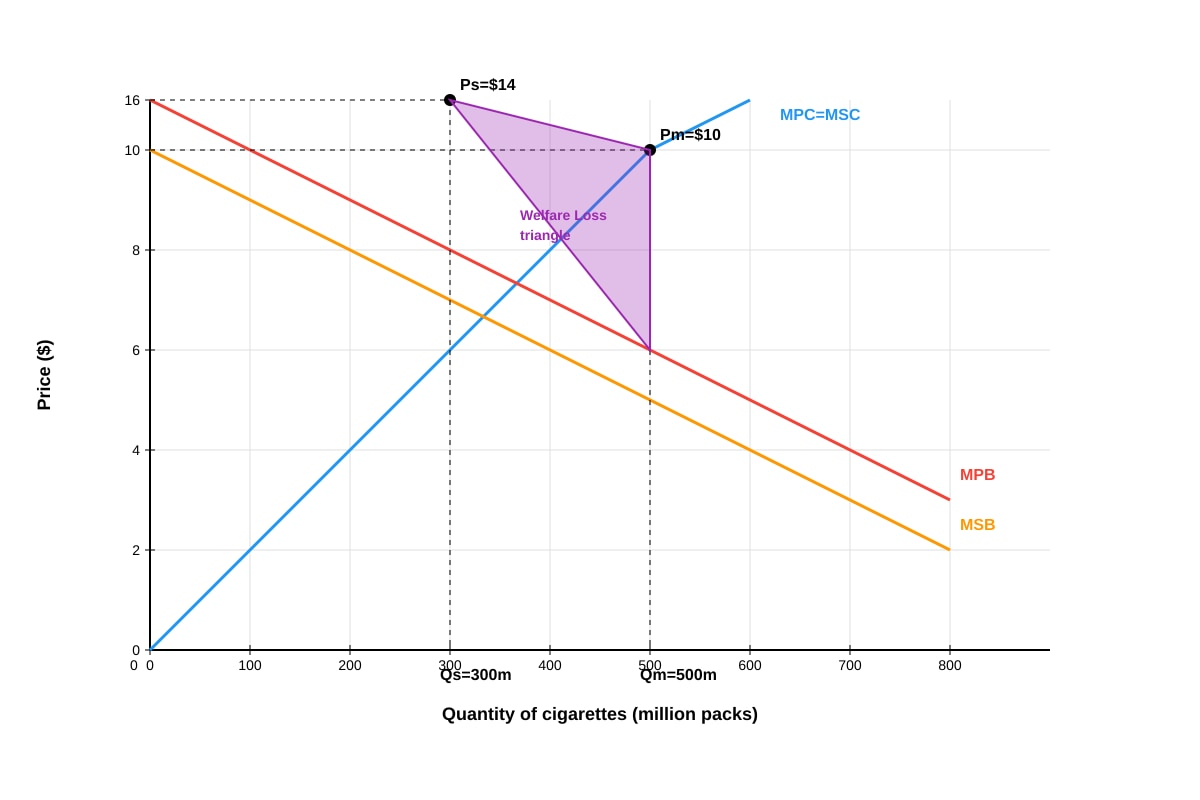
7. Cigarette market diagram.
(a) Using the diagram, explain why the free market equilibrium results in a welfare loss.
[3 marks]
Answer: In the free market, equilibrium occurs where MPB = MPC at quantity Qm (500 million packs) and price Pm (14).
Between Qs and Qm, the marginal social benefit of each additional pack of cigarettes is less than the marginal cost of producing it. This means that resources are being used to produce cigarettes that generate less social value than their cost of production. The welfare loss is represented by the shaded triangle between Qs and Qm, bounded by the MSB and MPC curves. This triangle represents the net loss to society from over-consumption of cigarettes.
Marking: 1 mark for identifying the free market equilibrium (Qm, Pm) and the socially optimal equilibrium (Qs, Ps); 1 mark for explaining that MSB < MPC between Qs and Qm; 1 mark for identifying the welfare loss triangle and explaining its meaning.
(b) The Singapore government imposes an excise tax on cigarettes. On the diagram, show the effect of this tax and explain how it reduces the welfare loss.
[3 marks]
Answer: An excise tax on cigarettes increases the cost of production, shifting the supply curve (MPC) upward by the amount of the tax. This causes the equilibrium quantity to fall from Qm toward Qs and the equilibrium price to rise from Pm toward Ps.
The tax effectively internalises the externality by making consumers pay a price that reflects the true social cost of cigarette consumption. As the quantity consumed falls from Qm toward Qs, the welfare loss triangle shrinks. If the tax is set at the correct level (equal to the marginal external cost at the socially optimal quantity), the market equilibrium will coincide with the socially optimal equilibrium, and the welfare loss will be eliminated entirely.
Marking: 1 mark for explaining that the tax shifts the supply curve upward; 1 mark for explaining that the tax internalises the externality; 1 mark for explaining that the welfare loss is reduced/eliminated as quantity falls toward Qs.
8. Electronic Road Pricing in Singapore.
(a) Explain why road congestion represents a market failure.
[3 marks]
Answer: Road congestion represents a market failure because it involves a negative externality of consumption. When an individual motorist decides to use a congested road, they consider only their own private costs (fuel, vehicle wear, time) but do not account for the additional costs they impose on other road users. Each additional vehicle on a congested road slows down all other vehicles, increasing their travel time, fuel consumption, and pollution. This means the marginal social cost (MSC) of road use exceeds the marginal private cost (MPC). As a result, the free market leads to over-consumption of road space during peak hours — more motorists use the road than is socially optimal, resulting in a welfare loss.
Marking: 1 mark for identifying the negative externality; 1 mark for explaining that MSC > MPC (motorists don't account for costs imposed on others); 1 mark for concluding that this leads to over-consumption and welfare loss.
(b) Using the concept of externalities, analyse how the ERP system addresses the market failure of road congestion.
[4 marks]
Answer: The ERP system addresses the market failure by internalising the negative externality of road congestion. By charging motorists a fee for using congested roads during peak hours, the ERP system increases the private cost of road use to bring it closer to the social cost. This is a form of Pigouvian taxation — the charge makes motorists take into account the congestion costs they impose on others.
Before ERP, motorists faced only their private costs (fuel, time), leading to over-use of roads. With ERP, the charge increases the effective price of road use during peak hours, causing some motorists to:
- Switch to public transport
- Travel at off-peak hours
- Carpool or use alternative routes
This reduces the quantity of road use toward the socially optimal level, thereby reducing the welfare loss from congestion. The data shows that after the ERP rate increase from 5.00, traffic volume fell by 12% and average speeds improved from 35 km/h to 48 km/h, demonstrating the effectiveness of the price mechanism in reducing congestion.
Marking: 1 mark for explaining that ERP internalises the externality; 1 mark for linking ERP to Pigouvian taxation / increasing private cost toward social cost; 1 mark for explaining the behavioural response (motorists reduce road use); 1 mark for using evidence from the extract to support the analysis.
(c) Evaluate the effectiveness of the ERP system as a solution to road congestion in Singapore.
[5 marks]
Answer:
Arguments that ERP is effective:
- The data shows that ERP rate increases lead to measurable reductions in traffic volume (12% fall) and improvements in traffic speeds (35→48 km/h), demonstrating that the price mechanism works.
- ERP is a market-based solution that is more efficient than command-and-control approaches (e.g., banning cars), as it allows motorists to make their own choices based on their individual valuations of time and convenience.
- The system is flexible — rates can be adjusted quarterly based on traffic conditions, allowing fine-tuning to maintain optimal traffic flow.
- The revenue generated can be used to improve public transport infrastructure, providing alternatives to driving.
Arguments that ERP has limitations:
- The extract notes that some motorists divert to alternative routes, causing congestion on residential roads not covered by ERP gantries. This is a problem of displacement rather than elimination of congestion.
- ERP may be regressive — lower-income motorists may be disproportionately affected if they cannot afford the charges and have fewer alternatives (e.g., if public transport is not available in their area).
- The social cost of congestion is estimated at $1.2 billion annually, suggesting that despite ERP, significant market failure persists. This may indicate that ERP rates are not set at the optimal level.
- ERP does not address the root cause of congestion — the high demand for road space in a land-scarce country. Complementary policies (e.g., improving public transport, promoting remote working) may also be needed.
Overall evaluation: ERP is an effective tool for managing congestion, but it is not a complete solution. Its effectiveness depends on setting the correct price, covering all relevant roads, and providing viable alternatives. It should be part of a broader transport policy framework.
Marking: Up to 2 marks for arguments supporting effectiveness; up to 2 marks for limitations/criticisms; 1 mark for an evaluative conclusion that weighs both sides.
9. National defence.
(a) Explain why national defence is considered a pure public good.
[2 marks]
Answer: National defence is a pure public good because it exhibits both non-excludability and non-rivalry:
- Non-excludability: Once national defence is provided, it is impossible to prevent any citizen from benefiting from it, regardless of whether they have paid for it.
- Non-rivalry: One person's consumption of national defence (i.e., being protected) does not reduce the amount of protection available to others. The marginal cost of providing defence to an additional person is zero.
Marking: 1 mark for each characteristic correctly explained in the context of national defence.
(b) Why will the free market under-provide national defence?
[3 marks]
Answer: The free market will under-provide (or fail to provide) national defence due to the free-rider problem. Because national defence is non-excludable, individuals have an incentive to free-ride — that is, to enjoy the benefits of national defence without paying for it, hoping that others will pay instead. Since everyone has this incentive, private firms cannot charge users for national defence and therefore cannot make a profit from providing it. As a result, the private market will not supply national defence, or will supply it at a level far below the socially optimal quantity. This is a clear case of market failure that requires government intervention.
Marking: 1 mark for identifying the free-rider problem; 1 mark for explaining that non-excludability prevents private firms from charging; 1 mark for concluding that the market will under-provide or not provide national defence.
(c) Suggest one way the government can ensure the efficient provision of national defence and explain why this method is necessary.
[2 marks]
Answer: The government can provide national defence directly through taxation. The government collects taxes from all citizens and uses the revenue to fund national defence. This method is necessary because it overcomes the free-rider problem — since taxation is compulsory, no individual can free-ride. Everyone contributes to the cost of national defence, ensuring that it is provided at the socially optimal level.
Marking: 1 mark for suggesting taxation / direct government provision; 1 mark for explaining that this overcomes the free-rider problem.
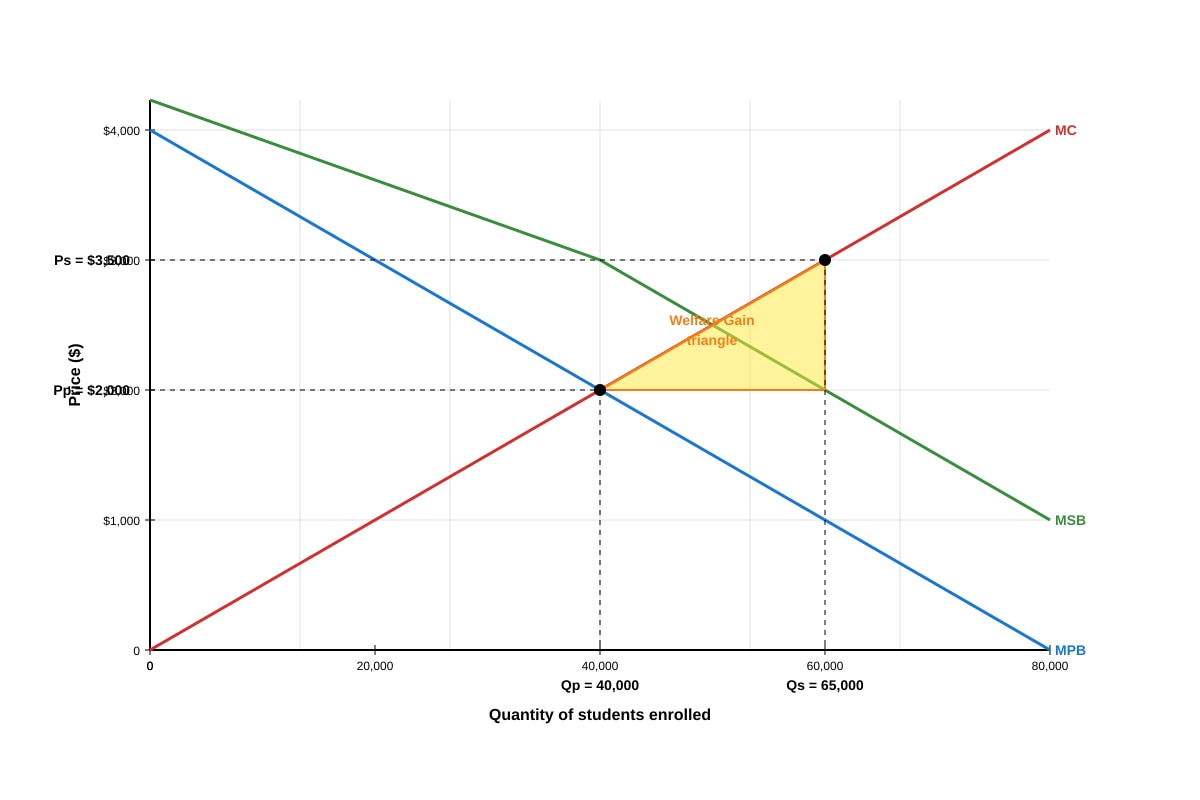
10. Education market diagram.
(a) Identify the type of market failure shown in the diagram. Explain your reasoning.
[2 marks]
Answer: The diagram shows a positive externality in consumption (or a merit good). The marginal social benefit (MSB) curve lies above the marginal private benefit (MPB) curve, indicating that the consumption of education generates benefits to third parties that are not captured by the private market. These external benefits include a more productive workforce, lower crime rates, better-informed citizens, and technological spillovers. Because consumers only consider their private benefits, the market equilibrium (Qp = 40,000) is below the socially optimal level (Qs = 65,000), resulting in under-consumption of education.
Marking: 1 mark for identifying positive externality / merit good; 1 mark for explaining that MSB > MPB, leading to under-consumption.
(b) Calculate the welfare gain if the market moves from the private equilibrium to the socially optimal equilibrium. Show your working.
[2 marks]
Answer: The welfare gain is the area of the welfare gain triangle between Qp and Qs, bounded by the MSB and MC curves.
At Qp = 40,000: The vertical distance between MSB and MC needs to be determined. From the diagram, at Qp the MSB exceeds MC, and at Qs they are equal.
Using the values from the diagram:
- At Qp (40,000): MSB > MC (the gap represents the net social benefit of additional education)
- At Qs (65,000): MSB = MC
The welfare gain = area of triangle = ½ × (Qs − Qp) × (MSB − MC at Qp)
From the diagram values: The vertical gap at Qp can be estimated. At Qp = 40,000, Pp = 3,500), the height of the triangle is approximately $1,500 (the difference between MSB and MC at Qp).
Welfare gain = ½ × (65,000 − 40,000) × 1,500 = $18,750,000
Note: The exact value depends on the precise shape of the curves in the diagram. The key is the method: ½ × base × height of the welfare gain triangle.
Marking: 1 mark for identifying the correct method (area of the welfare gain triangle); 1 mark for the correct calculation.
(c) Discuss whether government provision of free education is the most effective way to correct this market failure.
[4 marks]
Answer:
Arguments for government provision of free education:
- Free education ensures universal access, eliminating the under-consumption caused by the positive externality. If education is free, the price to consumers is zero, which should increase consumption toward the socially optimal level.
- It addresses equity concerns — without free education, low-income families may not be able to afford education, leading to both inefficiency (under-consumption) and inequity.
- The government can ensure minimum quality standards and a standardised curriculum.
Arguments against free education as the most effective solution:
- Free education does not necessarily mean efficient provision. Government provision may suffer from X-inefficiency (lack of competitive pressure leading to higher costs and lower quality) and bureaucratic inefficiency.
- A subsidy rather than free provision might be more efficient — it lowers the price to consumers (correcting the externality) while still maintaining some market discipline and consumer choice.
- Free education may lead to over-consumption beyond the socially optimal level if the subsidy is too large, wasting resources.
- The government must fund free education through taxation, which itself creates deadweight loss (excess burden of taxation).
Evaluation: Government provision of free education is one way to address the market failure, but it may not be the most efficient. A targeted subsidy combined with regulation to ensure quality, or a voucher system that maintains consumer choice while reducing the price, might achieve a better balance between efficiency and equity.
Marking: Up to 2 marks for arguments supporting free education; up to 2 marks for arguments suggesting alternative policies may be more effective. Must include evaluative judgement for full marks.
11. Explain how moral hazard arising from asymmetric information can lead to market failure in the health insurance market.
[4 marks]
Answer: Moral hazard occurs when one party in a transaction changes their behaviour after the transaction has taken place, taking greater risks because they do not bear the full consequences of their actions. In the health insurance market, moral hazard arises because the insured individual has more information about their health behaviour than the insurer (asymmetric information).
Once an individual has health insurance, they may:
- Take less care of their health (e.g., eat unhealthily, exercise less) because they know the insurance will cover medical costs.
- Over-consume healthcare services (e.g., visit the doctor for minor ailments, request unnecessary tests) because the marginal cost to them is low or zero.
This leads to market failure because:
- Over-consumption of healthcare: The insured individual consumes healthcare beyond the socially optimal level, since they do not face the true marginal cost of healthcare services.
- Rising premiums: As insurers pay out more claims, they raise premiums for all policyholders, which may cause some low-risk individuals to drop out of the market (adverse selection), further destabilising the insurance market.
- Inefficient resource allocation: Resources are diverted to healthcare services that generate less social value than their cost, reducing overall welfare.
Marking: 1 mark for defining moral hazard; 1 mark for explaining the asymmetric information context; 1 mark for explaining the behavioural change (over-consumption or riskier behaviour); 1 mark for explaining how this leads to market failure (inefficient allocation, rising premiums, welfare loss).
12. Chemical factory pollution — calculations.
(a) Derive the marginal social cost (MSC) function.
[2 marks]
Answer: MSC = MPC + MEC
MPC = 20 + 0.5Q
MEC = 0.3Q
MSC = (20 + 0.5Q) + 0.3Q = 20 + 0.8Q
Marking: 1 mark for stating MSC = MPC + MEC; 1 mark for the correct derived function.
(b) Calculate the free market equilibrium price and quantity.
[2 marks]
Answer: In the free market, equilibrium occurs where demand (MPB) equals MPC.
Demand: P = 100 − 0.4Q
MPC = 20 + 0.5Q
Setting P = MPC:
100 − 0.4Q = 20 + 0.5Q
100 − 20 = 0.5Q + 0.4Q
80 = 0.9Q
Q = 88.89 units (or 800/9 ≈ 88.89)
Substituting back into demand:
P = 100 − 0.4(88.89) = 100 − 35.56 = $64.44
Free market equilibrium: P = $64.44, Q = 88.89 units
Marking: 1 mark for setting up the equation correctly; 1 mark for the correct values.
(c) Calculate the socially optimal price and quantity.
[2 marks]
Answer: The socially optimal equilibrium occurs where demand (MPB) equals MSC.
Demand: P = 100 − 0.4Q
MSC = 20 + 0.8Q
Setting P = MSC:
100 − 0.4Q = 20 + 0.8Q
100 − 20 = 0.8Q + 0.4Q
80 = 1.2Q
Q = 66.67 units (or 200/3 ≈ 66.67)
Substituting back into demand:
P = 100 − 0.4(66.67) = 100 − 26.67 = $73.33
Socially optimal equilibrium: P = $73.33, Q = 66.67 units
Marking: 1 mark for setting up the equation correctly; 1 mark for the correct values.
(d) Calculate the total external cost at the free market equilibrium.
[2 marks]
Answer: Total external cost = MEC × Q (at free market equilibrium)
MEC = 0.3Q = 0.3 × 88.89 = 26.67 per unit
Total external cost = 26.67 × 88.89 = $2,370.37
Alternatively, using the integral approach for a linear MEC:
Total external cost = ½ × MEC at Qm × Qm = ½ × (0.3 × 88.89) × 88.89 = ½ × 26.67 × 88.89 = $1,185.19
Note: The correct approach depends on whether MEC is interpreted as the marginal external cost at the final unit (in which case total external cost = MEC × Q) or as a linear function starting from zero (in which case total external cost = ½ × MEC at Qm × Qm). The latter is the standard economic approach for a linear MEC curve starting from the origin.
Using the standard approach: Total external cost = ½ × 0.3 × (88.89)² = ½ × 0.3 × 7,901.23 = $1,185.19
Marking: 1 mark for the correct method; 1 mark for the correct numerical answer.
13. Vaccination programme in Singapore.
Analyse the economic case for government provision of free vaccinations.
[6 marks]
Answer:
1. Positive externality of consumption: Vaccination generates significant positive externalities. The extract states that for every 1% increase in vaccination coverage, disease incidence falls by 2.5% due to herd immunity. This means that when an individual chooses to vaccinate, they not only protect themselves but also reduce the risk of disease transmission to others. The marginal social benefit (MSB) of vaccination exceeds the marginal private benefit (MPB), leading to under-consumption in a free market.
2. Merit good characteristics: Vaccination is a merit good — individuals may under-consume it because they do not fully appreciate its benefits (information failure) or because they underestimate the risk of disease. The fact that 5% of parents choose not to vaccinate despite free availability suggests that information failure and irrational decision-making contribute to under-consumption.
3. Free-rider problem: Individuals may choose not to vaccinate, hoping that others will vaccinate and provide herd immunity. This free-rider problem leads to vaccination rates below the socially optimal level.
4. Government provision corrects the market failure: By providing free vaccinations, the government removes the price barrier, increasing consumption toward the socially optimal level. This internalises the positive externality by ensuring that the social benefit of vaccination is reflected in the consumption decision.
5. Cost-effectiveness: The social benefit of vaccination (reduced disease transmission, lower healthcare costs, higher productivity) likely exceeds the cost of providing free vaccinations, making it an efficient use of government resources.
Marking: 1 mark for identifying positive externality; 1 mark for explaining herd immunity as an external benefit; 1 mark for identifying vaccination as a merit good / information failure; 1 mark for explaining the free-rider problem; 1 mark for explaining how government provision corrects the market failure; 1 mark for a concluding analytical point (cost-effectiveness or social welfare improvement).
14. Tragedy of the commons.
(a) What is meant by the tragedy of the commons?
[2 marks]
Answer: The tragedy of the commons refers to a situation where a shared, common-pool resource (such as a common grazing land, fishery, or clean air) is over-used and depleted because individuals act in their own self-interest. Each user considers only their private benefit and cost, ignoring the negative impact of their use on other users. Since no one owns the resource, no one has an incentive to conserve it, leading to its eventual depletion or degradation — even though this outcome is worse for everyone collectively.
Marking: 1 mark for defining the concept (over-use of a shared resource); 1 mark for explaining the self-interest / lack of ownership mechanism.
(b) Explain how the tragedy of the commons represents a form of market failure.
[3 marks]
Answer: The tragedy of the commons represents a market failure because it involves a negative externality and a missing market (lack of property rights). When a resource is commonly owned, there are no property rights attached to it, so no market exists to allocate the resource efficiently. Each user imposes a negative externality on other users by reducing the available resource, but this cost is not reflected in the user's private cost-benefit calculation. As a result, the resource is over-consumed relative to the socially optimal level, leading to depletion and a welfare loss. The market fails because the price mechanism cannot operate without well-defined property rights.
Marking: 1 mark for identifying the negative externality; 1 mark for explaining the lack of property rights / missing market; 1 mark for concluding that this leads to over-consumption and welfare loss.
(c) Suggest two policies the government could use to address the tragedy of the commons in the context of overfishing.
[2 marks]
Answer: Two policies the government could use are:
-
Tradable fishing quotas (Individual Transferable Quotas — ITQs): The government sets a total allowable catch (TAC) and divides it into individual quotas that can be traded. This creates property rights over the fishery, giving fishermen an incentive to conserve fish stocks (since their quota has value). The market for quotas ensures that fishing rights are allocated to the most efficient fishermen.
-
Regulation / Command-and-control: The government could impose limits on the number of fishing days, the size of boats, or the type of fishing gear allowed. While less efficient than market-based solutions, regulation can directly limit the total catch to a sustainable level.
Other acceptable answers include: taxation on fish catches, establishing marine protected areas, or community-based management schemes.
Marking: 1 mark for each valid policy, provided it is explained in the context of overfishing.
Section C: Evaluation and Synthesis (Questions 15–20)
15. "Government intervention to correct market failure always leads to a more efficient outcome." Discuss.
[8 marks]
Answer:
Arguments that government intervention improves efficiency:
- Government intervention can correct market failures such as externalities, public goods, and information asymmetries, moving the market closer to the socially optimal allocation of resources.
- For negative externalities, taxes (e.g., carbon tax, ERP charges) internalise the externality, reducing over-consumption and eliminating welfare loss.
- For positive externalities, subsidies or direct provision (e.g., free education, vaccinations) increase consumption toward the socially optimal level.
- For public goods, government provision through taxation overcomes the free-rider problem.
- For asymmetric information, regulation (e.g., mandatory disclosure requirements, consumer protection laws) can reduce adverse selection and moral hazard.
Arguments that government intervention may not always improve efficiency:
- Government failure: Governments may lack the information needed to set optimal tax rates, subsidy levels, or regulations. If the government underestimates or overestimates the size of the externality, intervention may lead to under-correction or over-correction, creating new inefficiencies.
- Regulatory capture: Regulators may be influenced by the industries they regulate, leading to policies that favour producers rather than consumers or society.
- Bureaucratic inefficiency: Government provision of goods and services may be less efficient than private provision due to lack of competitive pressure (X-inefficiency).
- Unintended consequences: Intervention may create new distortions. For example, ERP charges may divert traffic to residential roads; carbon taxes may reduce international competitiveness.
- Cost of intervention: The administrative and compliance costs of intervention may exceed the benefits, particularly for small or difficult-to-measure externalities.
- Political considerations: Government policies may be driven by political objectives (e.g., winning votes) rather than economic efficiency, leading to suboptimal outcomes.
Evaluation: Government intervention can improve efficiency when it is well-designed, based on accurate information, and effectively implemented. However, it is not a panacea — government failure can sometimes make the situation worse than the original market failure. The effectiveness of intervention depends on the specific context, the type of market failure, and the government's capacity to design and implement appropriate policies. In many cases, a combination of market-based solutions (e.g., tradable permits) and light-touch regulation may be more effective than heavy-handed government intervention.
Marking: Up to 3 marks for arguments supporting the statement; up to 3 marks for arguments against; up to 2 marks for evaluative conclusion. Must demonstrate balanced analysis and a clear judgement for full marks.
16. Evaluate the use of tradable pollution permits as a policy to address negative externalities of production.
[8 marks]
Answer:
How tradable pollution permits work: Tradable pollution permits (also known as cap-and-trade systems) involve the government setting a total allowable level of pollution (the "cap") and issuing permits equal to this total. Firms can buy and sell these permits in a market (the "trade"). Firms that can reduce pollution cheaply will do so and sell their excess permits, while firms with high abatement costs will buy permits. This ensures that pollution is reduced at the lowest total cost to society.
Advantages of tradable permits:
- Cost-effectiveness: The market for permits ensures that pollution reduction is achieved at the lowest possible cost. Firms with low abatement costs reduce pollution more, while firms with high abatement costs buy permits. This minimises the total cost of achieving a given pollution target.
- Environmental certainty: The cap ensures that total pollution does not exceed the target level, providing environmental certainty that taxation cannot guarantee (since the pollution level under taxation depends on firms' responses).
- Incentive for innovation: Firms have a continuous incentive to develop cleaner technologies, as this allows them to reduce their need for permits and potentially sell excess permits for profit.
- Revenue generation: If permits are auctioned (rather than given away free), the government generates revenue that can be used to fund environmental programmes or reduce other taxes.
Disadvantages / Limitations:
- Setting the cap: The government must determine the optimal level of pollution, which requires accurate information about the marginal social cost of pollution. Setting the cap too high fails to address the externality; setting it too low imposes excessive costs on firms.
- Monitoring and enforcement: The system requires effective monitoring of emissions and enforcement of permit holdings, which can be costly and difficult, particularly for diffuse pollution sources.
- Market power: If a few large firms dominate the permit market, they may manipulate prices, reducing the efficiency of the system.
- Volatility: Permit prices can be volatile, creating uncertainty for firms and potentially discouraging long-term investment in clean technology.
- Carbon leakage: In the context of carbon emissions, strict permit systems may cause firms to relocate to countries with weaker environmental regulations, shifting rather than reducing global pollution.
Evaluation: Tradable pollution permits are a theoretically elegant and cost-effective solution to negative externalities, combining the environmental certainty of regulation with the efficiency of market mechanisms. However, their practical effectiveness depends on careful design — setting the correct cap, ensuring competitive permit markets, and effective monitoring. The EU Emissions Trading System (ETS) provides a real-world example of both the potential and the challenges of this approach. Overall, tradable permits are likely to be more efficient than command-and-control regulation, but they require strong institutional frameworks to work effectively.
Marking: Up to 3 marks for explaining how tradable permits work and their advantages; up to 3 marks for limitations and challenges; up to 2 marks for evaluative conclusion.
17. Singapore's Carbon Tax.
(a) Explain how a carbon tax internalises the negative externality of carbon emissions.
[4 marks]
Answer: A carbon tax internalises the negative externality of carbon emissions by increasing the private cost of production for firms that emit carbon dioxide. In a free market, firms consider only their private costs and do not account for the social costs of carbon emissions (e.g., climate change, rising sea levels, health impacts from pollution). This means the marginal private cost (MPC) is below the marginal social cost (MSC), leading to over-production of carbon-intensive goods.
By imposing a tax of 25 by 2024 and $50 by 2026), the government increases the MPC of carbon-emitting production, shifting it closer to the MSC. This makes firms take into account the social cost of their emissions when making production decisions. As a result, firms have an incentive to:
- Reduce emissions by adopting cleaner technologies
- Switch to renewable energy sources
- Improve energy efficiency
The tax effectively "internalises" the externality by ensuring that the price of carbon-intensive goods reflects their true social cost, moving the market toward the socially optimal level of output and reducing the welfare loss from carbon emissions.
Marking: 1 mark for explaining that the tax increases private cost; 1 mark for linking this to the gap between MPC and MSC; 1 mark for explaining the incentive effect on firms; 1 mark for concluding that the tax moves the market toward the socially optimal outcome.
(b) Discuss whether the benefits of Singapore's carbon tax outweigh the costs.
[8 marks]
Answer:
Benefits of the carbon tax:
- Internalisation of externality: The carbon tax directly addresses the market failure by making firms pay for the social cost of their emissions, incentivising a reduction in carbon output.
- Revenue generation: The tax generates government revenue that can be recycled to fund green technology R&D, subsidise clean energy adoption, or reduce other distortionary taxes.
- Coverage: The tax covers approximately 80% of Singapore's emissions (facilities emitting ≥25,000 tonnes CO₂e annually), ensuring broad impact.
- Signalling effect: The announced trajectory of increasing the tax (25 → $50) provides a clear signal to firms, encouraging long-term investment in clean technology and energy efficiency.
- International leadership: As the first Southeast Asian country to implement a carbon tax, Singapore sets a regional example and enhances its reputation as a leader in climate action.
Costs of the carbon tax:
- Reduced competitiveness: Critics argue that the tax increases production costs for Singapore's energy-intensive industries (e.g., petrochemicals, electronics manufacturing), potentially reducing their international competitiveness, especially if competing countries do not have similar carbon pricing.
- Cost pass-through: Firms may pass the tax on to consumers in the form of higher prices, reducing consumer welfare and potentially increasing the cost of living.
- Carbon leakage: Firms may relocate production to countries with weaker environmental regulations, leading to "carbon leakage" where global emissions are not reduced but merely shifted.
- Regressive impact: If the tax is passed on to consumers, it may disproportionately affect lower-income households, as energy costs represent a larger share of their expenditure.
- Administrative costs: Implementing and enforcing the carbon tax requires monitoring, reporting, and verification systems, which involve administrative costs.
Evaluation: The benefits of Singapore's carbon tax are likely to outweigh the costs in the long run, particularly given the escalating tax rate which provides strong incentives for decarbonisation. However, the government must manage the transition carefully — using revenue to support affected industries and households, and coordinating with international partners to minimise carbon leakage. The effectiveness of the tax also depends on the availability of affordable clean energy alternatives. Overall, the carbon tax is a necessary and efficient policy tool, but it should be part of a broader climate policy framework that includes investment in green technology, energy efficiency standards, and international cooperation.
Marking: Up to 3 marks for benefits; up to 3 marks for costs; up to 2 marks for evaluative conclusion with a clear judgement.
18. Compare and contrast the use of regulation versus taxation as methods of correcting negative externalities. Which approach is more effective?
[8 marks]
Answer:
Similarities:
- Both regulation and taxation aim to correct market failure by reducing the output of goods that generate negative externalities toward the socially optimal level.
- Both increase the cost of production/consumption, either directly (taxation) or indirectly (regulation imposing compliance costs).
- Both require government intervention and involve administrative and enforcement costs.
Differences:
| Aspect | Taxation | Regulation |
|---|---|---|
| Mechanism | Price-based: increases the cost of the externality-producing activity | Quantity-based: sets limits or standards on the activity |
| Flexibility | Firms can choose how much to reduce emissions; those with low abatement costs reduce more | Firms must comply with the standard regardless of their abatement costs |
| Cost-effectiveness | Achieves a given reduction at lowest total cost (firms with low abatement costs reduce more) | May not achieve the reduction at lowest cost (uniform standards ignore differences in abatement costs) |
| Revenue | Generates government revenue | No direct revenue (may involve fines for non-compliance) |
| Environmental certainty | Does not guarantee a specific pollution level (depends on firms' responses) | Provides greater certainty about the maximum pollution level |
| Innovation incentive | Continuous incentive to reduce emissions (every unit saved = tax saved) | Incentive exists only up to the compliance standard; no incentive to exceed it |
Evaluation of effectiveness:
- Taxation is generally more efficient because it achieves pollution reduction at the lowest total cost and provides continuous incentives for innovation. However, it does not guarantee a specific environmental outcome.
- Regulation provides greater environmental certainty but is less cost-effective, as it does not account for differences in abatement costs across firms.
- In practice, a combination of both approaches may be most effective. For example, a carbon tax can be used as the primary policy tool, with regulations (e.g., minimum emission standards) as a backstop to ensure that pollution does not exceed critical thresholds.
- The choice between the two depends on the nature of the externality, the availability of information, and the government's capacity to monitor and enforce.
Marking: Up to 2 marks for similarities; up to 3 marks for differences (must compare and contrast, not just list); up to 3 marks for evaluative conclusion with a clear judgement about which is more effective and why.
19. Adverse selection and asymmetric information.
(a) Explain how adverse selection can lead to market failure in the used car market.
[3 marks]
Answer: Adverse selection occurs when buyers and sellers have asymmetric information, and this imbalance causes the market to be dominated by low-quality products. In the used car market (Akerlof's "Market for Lemons"), sellers have more information about the quality of their cars than buyers. Buyers, unable to distinguish between high-quality cars ("peaches") and low-quality cars ("lemons"), are willing to pay only an average price that reflects the expected quality of all cars on the market.
This average price is too low for sellers of high-quality cars, who withdraw from the market. As a result, the proportion of low-quality cars on the market increases, further reducing the average quality and the price buyers are willing to pay. This vicious cycle — known as the adverse selection spiral — can lead to market failure, where the market shrinks significantly or collapses entirely, and mutually beneficial trades between buyers of high-quality cars and their sellers do not occur.
Marking: 1 mark for defining adverse selection; 1 mark for explaining the mechanism in the used car market; 1 mark for explaining the market failure outcome (market shrinkage or collapse).
(b) Discuss whether government intervention is necessary to correct market failure arising from asymmetric information.
[5 marks]
Answer:
Arguments that government intervention is necessary:
- Without intervention, adverse selection and moral hazard can cause markets to fail completely (e.g., the used car market, insurance markets). Government intervention can restore market functioning.
- Mandatory disclosure requirements (e.g., requiring sellers to disclose known defects) can reduce information asymmetry and enable buyers to make informed decisions.
- Consumer protection laws (e.g., lemon laws that require sellers to repair or replace defective products) can reduce the risk of adverse selection.
- Licensing and certification (e.g., requiring professionals to hold qualifications) can signal quality and reduce information asymmetry.
- Regulation of financial markets (e.g., requiring companies to disclose financial information) can reduce information asymmetry between investors and firms.
Arguments that government intervention may not always be necessary:
- Market-based solutions can address information asymmetry without government intervention. For example, warranties, brand reputation, and third-party certification (e.g., Carfax reports for used cars) can signal quality and reduce adverse selection.
- Signalling and screening (concepts from Spence and Stiglitz) show that informed parties can take actions to reveal their quality (e.g., education as a signal of ability), reducing the need for government intervention.
- Government intervention may be costly and may not fully eliminate information asymmetry. Regulators may also lack the information needed to design effective policies.
- Over-regulation may create barriers to entry, reduce competition, and increase costs for consumers.
Evaluation: Government intervention is necessary in cases where market-based solutions are insufficient to address severe information asymmetry, particularly in markets where the consequences of market failure are significant (e.g., financial markets, healthcare). However, in many cases, a combination of light-touch regulation (e.g., mandatory disclosure) and market-based solutions (e.g., warranties, reputation mechanisms) may be more effective than heavy-handed government intervention.
Marking: Up to 2 marks for arguments supporting government intervention; up to 2 marks for arguments suggesting market-based alternatives; 1 mark for evaluative conclusion.
20. "The provision of public goods is the most important role of government in addressing market failure." To what extent do you agree with this statement?
[8 marks]
Answer:
Arguments that public goods provision is the most important role:
- Public goods (e.g., national defence, street lighting, public health infrastructure) are the most clear-cut case of market failure — the free market will not provide them at all due to the free-rider problem. Without government intervention, these goods would simply not exist.
- Public goods are essential for the functioning of society and the economy. National defence protects the country; public health infrastructure prevents disease outbreaks; the legal system enforces contracts and property rights.
- The provision of public goods addresses a fundamental market failure that cannot be corrected by any other means (since the free-rider problem makes private provision unviable).
Arguments that other roles are equally or more important:
- Correcting externalities (e.g., carbon tax, ERP charges) addresses market failures that affect large numbers of people and have significant welfare costs. The social cost of congestion in Singapore is estimated at $1.2 billion annually — addressing this may be more urgent than providing additional public goods.
- Addressing information asymmetry (e.g., consumer protection, financial regulation) is critical for the functioning of modern economies. The 2008 financial crisis demonstrated the catastrophic consequences of information failure in financial markets.
- Addressing market power (e.g., antitrust regulation) is important for maintaining competition and preventing monopolistic exploitation of consumers. In Singapore, the dominance of a few firms in sectors like telecommunications and supermarkets has raised concerns about consumer welfare.
- Promoting equity (e.g., progressive taxation, social safety nets) may be considered more important than public goods provision by those who prioritise distributional justice. Market failure in the form of inequality can lead to social instability and reduced economic mobility.
Evaluation: The provision of public goods is a fundamental and indispensable role of government, as it addresses a market failure that the private market cannot resolve. However, whether it is the "most important" role depends on the specific economic context and the values of society. In a developed economy like Singapore, where basic public goods are already provided, other forms of market failure (externalities, information asymmetry, market power) may be more pressing concerns. A comprehensive approach to addressing market failure requires government action across all these dimensions, and the relative importance of each role varies with circumstances.
Marking: Up to 3 marks for arguments supporting the statement; up to 3 marks for arguments presenting alternative views; up to 2 marks for evaluative conclusion with a clear, reasoned judgement.
End of Answer Key