AI Generated Quiz
A Level H2 Economics International Economics Quiz
Free A Level H2 Econs International Economics quiz, LongCat AI version, with questions, answers, and A Level-style practice for Singapore students.
These static practice materials are generated from the site's syllabus and paper-generation workflow, with source and model context shown so students and parents can evaluate the material before use.
Questions
Free quiz and exam paper access
Enter your details to view this paper
Your access is remembered on this device.
Answers
A-Level Economics H2 Quiz - International Economics
Answer Key and Teaching Notes
Section A: Short Answer Questions (20 marks)
Question 1 [2 marks]
Answer: Comparative advantage refers to the ability of a country to produce a good or service at a lower opportunity cost than another country. It is the basis for mutually beneficial trade between nations, even when one country has an absolute advantage in all products.
Teaching Notes:
- Comparative advantage is distinct from absolute advantage. A country does not need to be the most efficient producer to benefit from trade; it needs to have the lowest opportunity cost.
- Students should be able to explain that trade is driven by differences in relative (not absolute) costs.
- Common mistake: confusing comparative advantage with absolute advantage.
Question 2 [2 marks]
Answer: Two reasons why a country might impose a tariff:
(a) To protect domestic industries from foreign competition, particularly infant industries that have not yet achieved economies of scale, or to shield declining industries from rapid adjustment costs.
(b) To raise government revenue, especially in developing countries where tariff collection is administratively simpler than income or sales taxes.
Other acceptable answers:
- To correct a current account deficit by reducing imports.
- As a retaliatory measure in trade disputes.
- To protect national security interests (e.g., defence-related industries).
- To prevent dumping of goods below cost price.
Teaching Notes:
- Tariffs are taxes on imports. Students should understand both the protective and revenue-raising functions.
- Common mistake: stating "to stop imports entirely" — tariffs reduce but rarely eliminate imports unless set at a prohibitively high level (prohibitive tariff).
Question 3 [2 marks]
Answer: A trade surplus occurs when the value of exports of goods and services exceeds the value of imports of goods and services (i.e., net exports are positive). A current account surplus is broader: it includes the trade balance plus net income from abroad (e.g., investment income, compensation of employees) plus net current transfers (e.g., remittances, foreign aid). A country can have a trade surplus but a current account deficit if its net income outflows and transfer outflows are sufficiently large.
Teaching Notes:
- The current account = trade balance + net primary income + net secondary income (transfers).
- Singapore often has a large trade surplus but its current account surplus is even larger due to net investment income inflows.
- Common mistake: using the terms interchangeably.
Question 4 [2 marks]
Answer: The terms of trade measure the ratio of a country's export prices to its import prices, usually expressed as:
An improvement in the terms of trade means that a country can buy more imports for a given quantity of exports (i.e., export prices have risen relative to import prices).
Teaching Notes:
- An improvement in TOT is not always beneficial — it could result from a fall in demand for exports (if supply is inelastic), reducing export revenue.
- Deterioration in TOT is common for primary commodity exporters due to volatile commodity prices.
- Common mistake: assuming an improvement in TOT always means the country is better off.
Question 5 [2 marks]
Answer: Singapore maintains a managed float because, as a small open economy highly dependent on trade, excessive exchange rate volatility would create uncertainty for importers and exporters, increase business costs, and deter foreign investment. By managing the S$ NEER, the MAS can ensure gradual and predictable exchange rate movements, which supports price stability and business confidence.
Other acceptable answers:
- To manage imported inflation (a sharp depreciation would raise import prices and fuel inflation).
- To maintain export competitiveness by preventing excessive appreciation.
- To reduce speculative attacks on the currency.
Teaching Notes:
- Singapore's exchange rate is the primary monetary policy tool (not interest rates), due to the high import content of consumption.
- The MAS manages the S$ against an undisclosed basket of currencies, allowing it to appreciate, depreciate, or remain flat depending on economic conditions.
- Common mistake: stating that Singapore has a fixed exchange rate — it is a managed float, not a peg.
Question 6 [2 marks]
Answer: Protectionism refers to government policies that restrict international trade to protect domestic industries from foreign competition. Examples include tariffs, quotas, subsidies, and non-tariff barriers.
One example of a non-tariff barrier is an import quota — a physical limit on the quantity of a good that can be imported. Other examples include: technical standards and regulations, embargoes, voluntary export restraints, and administrative delays at customs.
Teaching Notes:
- Non-tariff barriers have become more prevalent as WTO rules have reduced tariff levels globally.
- Students should be able to distinguish between tariff barriers (taxes on imports) and non-tariff barriers (all other restrictions).
- Common mistake: listing tariffs as non-tariff barriers.
Question 7 [2 marks]
Answer: Two components of the current account:
(a) Trade in goods (visible trade) — exports and imports of physical goods such as electronics, food, and machinery.
(b) Trade in services (invisible trade) — exports and imports of services such as financial services, tourism, and transportation.
Other acceptable answers:
- Net primary income (investment income, compensation of employees working abroad).
- Net secondary income (current transfers such as remittances, foreign aid).
Teaching Notes:
- The current account has four main components: goods, services, primary income, and secondary income.
- Singapore's current account surplus is driven primarily by goods and services trade, supplemented by net investment income.
- Common mistake: including capital transfers or financial account items (e.g., FDI) in the current account.
Question 8 [2 marks]
Answer: Absolute advantage exists when a country can produce a good using fewer resources (or more output per unit of input) than another country. Comparative advantage exists when a country can produce a good at a lower opportunity cost than another country. A country may have an absolute advantage in all goods but cannot have a comparative advantage in all goods — comparative advantage depends on relative, not absolute, efficiency.
Teaching Notes:
- The key distinction is absolute productivity vs. opportunity cost.
- Ricardo's theory of comparative advantage shows that trade is beneficial even if one country is more efficient at producing everything.
- Common mistake: stating that a country must have an absolute advantage to benefit from trade.
Question 9 [2 marks]
Answer: One disadvantage of a persistent current account deficit for a small open economy is that it may lead to capital flight and currency depreciation. If foreign investors lose confidence in the economy's ability to service its external obligations, they may withdraw capital, causing the domestic currency to depreciate sharply. This raises the cost of imports, fuels imported inflation, and increases the burden of foreign-denominated debt.
Other acceptable answers:
- Increased foreign indebtedness (the country must borrow or sell assets to finance the deficit).
- Vulnerability to external shocks and speculative attacks.
- Reduced policy autonomy (the government may need to maintain high interest rates to attract capital inflows).
Teaching Notes:
- A current account deficit is not inherently harmful if it reflects productive investment (e.g., importing capital goods for growth).
- However, persistent deficits financed by short-term capital inflows are risky.
- Common mistake: assuming all current account deficits are harmful without considering the underlying cause.
Question 10 [2 marks]
Answer: Economic integration refers to the process by which countries reduce or eliminate trade barriers and coordinate economic policies to increase economic cooperation and interdependence.
One form of economic integration is a free trade area (FTA), where member countries eliminate tariffs and quotas among themselves but maintain independent trade policies with non-members. Other forms include: customs union, common market, economic union, and monetary union.
Teaching Notes:
- The stages of economic integration, from shallowest to deepest: FTA → customs union → common market → economic union → monetary union.
- Singapore is a member of many FTAs but is not part of a customs union or monetary union.
- Common mistake: confusing a free trade area with a customs union (the latter has a common external tariff).
Section B: Data Response and Structured Questions (20 marks)
Question 11 [2 marks]
Answer: Two features of Singapore's trade profile reflecting its status as a small open economy:
(a) Total trade exceeds 300% of GDP, indicating extreme openness and dependence on international trade for economic activity.
(b) A current account surplus of 17.6% of GDP, reflecting the economy's reliance on export-oriented industries and its role as a net lender to the rest of the world.
Other acceptable answers:
- Dependence on a narrow range of exports (electronics, pharmaceuticals, refined petroleum).
- Extensive network of over 25 FTAs, reflecting the need to secure market access.
- Managed exchange rate system, reflecting vulnerability to external shocks.
Marking:
- 1 mark per valid feature, clearly identified from the source material.
Question 12 [6 marks]
Answer:
Diagram (3 marks):
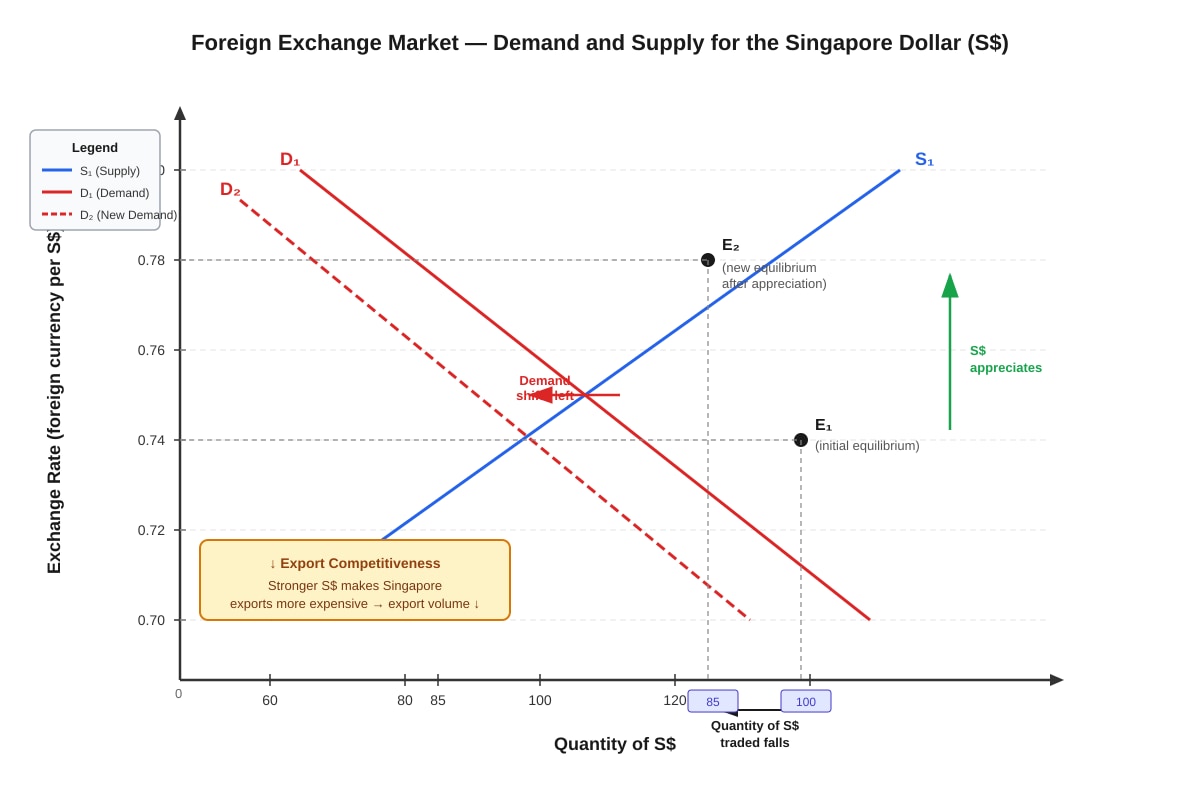
The diagram should show the foreign exchange market for the Singapore dollar.
Image pending generation: graph for Q12.
Explanation (3 marks):
- The MAS allows the S$ NEER to appreciate gradually, meaning the Singapore dollar buys more units of foreign currency.
- A stronger S$ makes Singapore's exports more expensive in foreign currency terms, reducing the quantity demanded of Singapore's exports abroad.
- Simultaneously, imports become cheaper in S$ terms, potentially increasing import demand.
- The combined effect is a reduction in net exports (X – M), which could narrow the current account surplus or reduce aggregate demand.
- The extent of the impact depends on the price elasticity of demand for exports and imports (Marshall-Lerner condition). If the sum of PEDx and PEDm is greater than 1, the trade balance will worsen following appreciation.
Marking Scheme:
- 1 mark for correctly labelled axes (exchange rate and quantity of S$).
- 1 mark for showing the initial equilibrium and the shift (demand increase or supply decrease leading to appreciation).
- 1 mark for correctly identifying the new equilibrium with a higher exchange rate and lower quantity.
- 1 mark for explaining that appreciation makes exports more expensive abroad.
- 1 mark for explaining that imports become cheaper domestically.
- 1 mark for linking the change to reduced export competitiveness and/or referencing the Marshall-Lerner condition.
Common Mistakes:
- Drawing a goods market diagram instead of a foreign exchange market diagram.
- Confusing appreciation with depreciation.
- Not explaining the mechanism linking exchange rate changes to export/import volumes.
Question 13 [4 marks]
Answer:
Two possible reasons for Singapore's current account surplus of 17.6% of GDP:
(a) Strong export performance in high-value sectors [2 marks] Singapore specialises in high-value exports such as electronics (semiconductors), pharmaceuticals, and refined petroleum. Global demand for these products, particularly semiconductors used in AI and consumer electronics, has been robust. Singapore's comparative advantage in these sectors — driven by skilled labour, advanced infrastructure, and strong intellectual property protections — enables it to run a large trade surplus, which is the primary driver of the current account surplus.
(b) Net inflows of primary income [2 marks] As a major financial hub and home to significant outward foreign direct investment (FDI), Singapore earns substantial investment income from abroad. Temasek Holdings, GIC, and many Singapore-based multinational corporations generate returns on overseas investments. These net inflows of primary income (investment income credits exceeding debits) add to the current account surplus beyond what the trade balance alone would suggest.
Other acceptable reasons:
- High domestic savings rate (the current account equals national savings minus investment).
- Relatively low import propensity for certain categories.
- Influx of foreign workers whose remittances abroad are offset by larger export earnings.
Marking Scheme:
- 2 marks per reason: 1 mark for identifying the reason, 1 mark for explaining how it contributes to the current account surplus.
Question 14 [4 marks]
Answer:
Free trade agreements such as the CPTPP and RCEP benefit Singapore's economy in several ways:
-
Reduced tariffs and non-tariff barriers among member countries lower the cost of exporting Singapore's goods and services, increasing market access for Singaporean firms. This is particularly important given Singapore's small domestic market — FTAs effectively expand the addressable market for its exports.
-
Increased foreign direct investment (FDI): FTAs provide greater certainty and protection for investors. Singapore's participation in the CPTPP and RCEP signals its commitment to open trade, attracting multinational corporations that use Singapore as a regional hub to access member-country markets.
-
Lower import costs for consumers and firms: Reduced tariffs on imported raw materials, intermediate goods, and consumer goods lower production costs for Singaporean businesses and increase consumer welfare through lower prices and greater variety.
-
Enhanced competitiveness and efficiency: Exposure to greater international competition incentivises domestic firms to improve productivity, innovate, and achieve economies of scale, leading to dynamic efficiency gains.
-
Strengthened supply chain integration: RCEP, in particular, creates common rules of origin, making it easier for Singapore-based firms to participate in regional supply chains and benefit from specialisation.
Marking Scheme:
- 1 mark per valid point, up to a maximum of 4 marks.
- Points must be explained, not merely stated.
Question 15 [4 marks]
Answer:
Yes, rising protectionism poses a significant threat:
- Singapore's economy is extremely trade-dependent (trade > 300% of GDP). Any increase in global tariffs, quotas, or trade restrictions directly reduces demand for Singapore's exports and raises the cost of its imports.
- Protectionism disrupts global supply chains, which Singapore is deeply integrated into as a manufacturing and logistics hub. For example, US-China trade tensions have already caused firms to relocate supply chains, creating both opportunities and risks for Singapore.
- Retaliatory trade measures could escalate, reducing global trade volumes and harming Singapore's export-oriented sectors (electronics, pharmaceuticals, petrochemicals).
However, the threat may be limited:
- Singapore's extensive FTA network (25+ agreements) provides alternative market access and reduces dependence on any single trading partner.
- Singapore has historically adapted to changing trade patterns — for example, shifting from labour-intensive manufacturing to high-value services and technology.
- Rising protectionism in some countries may create opportunities for Singapore as firms seek neutral, trade-friendly bases for their operations.
Judgement: On balance, rising global protectionism does pose a significant threat to Singapore's economic growth given its extreme openness. However, Singapore's diversification strategies, FTA network, and adaptability mitigate the severity of the threat.
Marking Scheme:
- Up to 2 marks for explaining why protectionism is a threat (with reference to the source material).
- Up to 1 mark for explaining why the threat may be limited.
- 1 mark for a clear, supported judgement.
Section C: Extended Response and Essay Questions (20 marks)
Question 16 [8 marks]
Answer:
Theory of Comparative Advantage (4 marks):
The theory of comparative advantage, developed by David Ricardo, states that countries should specialise in producing goods for which they have the lowest opportunity cost, even if one country is more efficient at producing all goods. Trade based on comparative advantage allows all participating countries to consume beyond their production possibility frontiers, resulting in mutual gains from trade.
For example, suppose Country A can produce 10 units of wine or 5 units of cloth with the same resources, while Country B can produce 6 units of wine or 6 units of cloth. Country A has a lower opportunity cost in wine (0.5 cloth per wine) and Country B has a lower opportunity cost in cloth (1 wine per cloth). Both countries benefit if A specialises in wine and B in cloth, and they trade.
Relevance to Modern Trade Patterns (4 marks):
The theory remains relevant in explaining broad trade patterns:
- Developing countries with abundant low-cost labour tend to specialise in labour-intensive manufacturing (e.g., textiles, assembly), while developed countries specialise in capital- and knowledge-intensive goods and services (e.g., pharmaceuticals, financial services).
- China's rise as a manufacturing hub reflects its comparative advantage in labour-intensive production, while the US specialises in technology and services.
However, the theory has limitations in explaining modern trade:
- Intra-industry trade: Much modern trade between developed countries involves exchanging similar goods (e.g., Germany and Japan trading different types of cars), which comparative advantage alone cannot explain. Economies of scale, product differentiation, and consumer preferences for variety (Krugman's new trade theory) are needed to explain this.
- Factor endowments and technology: The Heckscher-Ohlin model extends comparative advantage by linking it to factor endowments, but technology transfer and globalisation have blurred these distinctions.
- Dynamic comparative advantage: Countries can create comparative advantage through investment in education, technology, and infrastructure (e.g., Singapore's shift from labour-intensive to knowledge-intensive industries), which the static Ricardian model does not capture.
- Trade in services: The theory was developed for trade in goods and does not fully account for the growing trade in services, intellectual property, and digital products.
Judgement: Comparative advantage remains a foundational concept for understanding why countries trade, but it must be supplemented with other theories (Heckscher-Ohlin, new trade theory, Porter's competitive advantage) to fully explain the complexity of modern trade patterns.
Marking Scheme:
- Up to 4 marks for explaining the theory of comparative advantage (including a clear example or numerical illustration).
- Up to 2 marks for discussing relevance to modern trade (with specific examples).
- Up to 2 marks for evaluating limitations and providing a supported judgement.
Question 17 [6 marks]
Answer:
A current account deficit occurs when a country's total imports of goods, services, income, and transfers exceed its total exports. Key causes include:
1. Loss of price competitiveness [2 marks] If a country's inflation rate exceeds that of its trading partners, its exports become relatively more expensive and imports become relatively cheaper. This can be caused by:
- Higher domestic cost-push inflation (e.g., rising wages, energy costs).
- An overvalued exchange rate that makes exports uncompetitive. For example, the UK has experienced persistent current account deficits partly due to a strong pound and relatively high inflation.
2. Loss of non-price competitiveness [2 marks] Even if prices are competitive, a country may run a current account deficit if its goods and services are perceived as lower quality, less innovative, or less reliable. Factors include:
- Underinvestment in R&D and innovation.
- Poor infrastructure or logistics.
- Weak branding and marketing.
- Skills shortages in the labour force.
3. High domestic income and consumption [2 marks] During periods of rapid economic growth, rising household incomes lead to increased consumption, including of imported goods. If the marginal propensity to import is high (as in small open economies), growth can widen the current account deficit. This is sometimes called a "twin deficit" if accompanied by a fiscal deficit.
4. Structural factors [additional point]
- Declining industries that have lost comparative advantage (e.g., manufacturing in developed countries).
- Dependence on imported raw materials or energy (e.g., oil-importing countries).
- Demographic factors (e.g., an ageing population saving less, reducing the savings-investment surplus).
Marking Scheme:
- Up to 2 marks per cause, for identifying and explaining the cause with economic reasoning.
- Maximum 6 marks (three well-explained causes or two causes with detailed analysis).
Question 18 [6 marks]
Answer:
Exchange rate policy can be effective in correcting a current account deficit through depreciation or devaluation:
Mechanism (2 marks): A depreciation (under a floating exchange rate) or devaluation (under a fixed/managed rate) makes exports cheaper in foreign currency terms and imports more expensive in domestic currency terms. This should, in theory, increase export volumes and reduce import volumes, improving the trade balance and narrowing the current account deficit.
Conditions for effectiveness — Marshall-Lerner Condition (2 marks): The Marshall-Lerner condition states that depreciation will improve the current account only if the sum of the price elasticity of demand for exports (PEDx) and the price elasticity of demand for imports (PEDm) is greater than 1:
If demand for exports and imports is inelastic (sum < 1), depreciation could actually worsen the current account in the short run because the value of imports rises more than the value of exports.
J-Curve Effect (1 mark): In the short run, the current account may initially worsen after depreciation because contracts are pre-agreed and consumers are slow to adjust their purchasing patterns. Over time, as quantities adjust, the current account improves — this is known as the J-curve effect.
Limitations and evaluation (1 mark):
- Depreciation can cause imported inflation, reducing real incomes and potentially triggering wage-price spirals.
- Trading partners may retaliate with their own depreciations (competitive devaluations or "currency wars").
- If the deficit is caused by structural factors (e.g., loss of competitiveness due to low productivity), exchange rate adjustment alone is insufficient — supply-side policies are needed.
- For a country like Singapore, which imports most of its consumer goods and raw materials, depreciation would significantly raise the cost of living.
Judgement: Exchange rate policy can be effective in correcting a current account deficit, but its success depends on the elasticity of demand for exports and imports, the time horizon, and the underlying cause of the deficit. It is most effective when combined with supply-side policies to improve competitiveness.
Marking Scheme:
- 2 marks for explaining the mechanism of depreciation/devaluation.
- 2 marks for discussing the Marshall-Lerner condition.
- 1 mark for the J-curve effect.
- 1 mark for evaluation/limitations and a supported judgement.
Question 19 [6 marks]
Answer:
The case for free trade (3 marks):
Free trade allows countries to specialise according to comparative advantage, leading to:
- Greater efficiency and lower prices: Competition from imports drives domestic firms to reduce costs and improve quality, benefiting consumers.
- Economies of scale: Access to larger international markets allows firms to produce at lower average costs.
- Increased consumer choice: Consumers benefit from a wider variety of goods and services.
- Dynamic efficiency: Exposure to international competition encourages innovation and technological advancement.
- Economic growth: Trade expands markets for domestic producers, increasing output and employment in export sectors.
The case for protecting domestic industries (3 marks):
- Infant industry argument: New industries in developing countries may need temporary protection (tariffs, subsidies) to achieve economies of scale and become competitive. Without protection, they may be unable to survive competition from established foreign firms.
- National security: Certain industries (defence, food production, energy) are strategically important and should not be dependent on foreign suppliers.
- Anti-dumping: Protection may be justified when foreign firms sell goods below cost to drive domestic competitors out of the market.
- Employment protection: Free trade can lead to job losses in uncompetitive industries, causing structural unemployment and social costs, particularly in regions dependent on a single industry.
- Revenue generation: Tariffs can be an important source of government revenue in developing countries.
Judgement: While free trade generates significant economic benefits, a blanket commitment to free trade may not be appropriate in all circumstances. A balanced approach — pursuing free trade while providing targeted, time-limited protection for infant industries and strategic sectors — is likely to be optimal. The key is to ensure that protection is temporary, transparent, and accompanied by measures to improve competitiveness.
Marking Scheme:
- Up to 3 marks for the case for free trade (with economic reasoning and examples).
- Up to 3 marks for the case for protection (with economic reasoning and examples).
- A supported judgement is embedded within the discussion.
Question 20 [6 marks]
Answer:
How globalisation affects income inequality (3 marks):
Globalisation — the increasing integration of economies through trade, investment, migration, and technology — affects income inequality through several channels:
-
Trade liberalisation: According to the Stolper-Samuelson theorem, trade benefits the abundant factor of production and harms the scarce factor. In developed countries, unskilled labour is the scarce factor, so trade with labour-abundant developing countries tends to reduce demand for unskilled workers, widening the wage gap between skilled and unskilled workers. In developing countries, unskilled labour benefits, potentially reducing inequality.
-
Foreign direct investment (FDI): MNCs often pay higher wages than domestic firms, but these benefits tend to accrue to skilled workers and those in urban areas, exacerbating urban-rural and skilled-unskilled wage gaps.
-
Technology transfer: Globalisation facilitates the spread of technology, but this often favours skilled workers who can operate advanced machinery and systems, increasing the skill premium.
-
Capital mobility: Globalisation allows capital to move freely, giving owners of capital greater bargaining power relative to labour, potentially increasing the share of national income going to profits rather than wages.
Evaluation: Do the benefits outweigh the costs for developing economies? (3 marks):
Benefits:
- Access to larger markets enables developing countries to exploit comparative advantage, increasing export revenues and GDP.
- FDI brings capital, technology, and managerial expertise, boosting productivity and creating jobs.
- Technology transfer accelerates industrialisation and economic development.
- Consumers benefit from lower prices and greater variety of goods.
Costs:
- Income inequality may widen, as the benefits of globalisation are unevenly distributed.
- Developing countries may become dependent on volatile commodity exports or low-value-added manufacturing.
- Environmental degradation may result from rapid industrialisation.
- Cultural homogenisation and loss of local industries.
Judgement: For most developing economies, the benefits of globalisation outweigh the costs, but only if accompanied by appropriate domestic policies — investment in education and skills training, social safety nets, progressive taxation, and environmental regulations — to ensure that the gains from globalisation are widely shared.
Marking Scheme:
- Up to 3 marks for explaining how globalisation affects income inequality (with reference to economic theory).
- Up to 3 marks for evaluating whether benefits outweigh costs, with a supported judgement.
End of Answer Key