From Real Exams Quiz
A Level H2 Economics Market Failure Quiz
Free A Level H2 Econs Market Failure quiz, HY3 Exam version, with questions, answers, and A Level-style practice for Singapore students.
These static practice materials are generated from the site's syllabus and paper-generation workflow, with source and model context shown so students and parents can evaluate the material before use.
Questions
Free quiz and exam paper access
Enter your details to view this paper
Your access is remembered on this device.
Answers
A-Level Economics H2 Quiz - Market Failure: Answer Key
Topic: Market Failure
Total Marks: 40
Duration: 60 minutes
Section A: Short Structured Questions (1–8)
1. [2 marks]
A negative externality of consumption occurs when the consumption of a good by an individual imposes a cost on third parties not involved in the transaction, and this cost is not reflected in the market price.
Teaching note: Example – second-hand smoke from cigarettes. Mark: 1 mark for "cost on third party", 1 mark for "not reflected in price / external cost".
2. [1 mark]
Example: Vaccination (reduces disease spread to others); or education (more informed society); or beekeeping (pollination for neighbouring farms).
Any one correct example earns the mark.
3. [2 marks]
A merit good is a good that is under-consumed in the free market because individuals underestimate its private benefits; it also generates positive externalities.
Mark: 1 for under-consumption due to undervaluation, 1 for positive externality / social benefit > private benefit.
4. [2 marks]
A demerit good is over-consumed in the free market because consumers overestimate its private benefits or ignore its harm, and it creates negative externalities. A private good is both excludable and rivalrous with no external effect.
Mark: 1 for over-consumption / underestimation of harm, 1 for externality contrast.
5. [1 mark]
Any one: public goods, information failure, asymmetric information, market power/monopoly, factor immobility, common pool resources.
6. [1 mark]
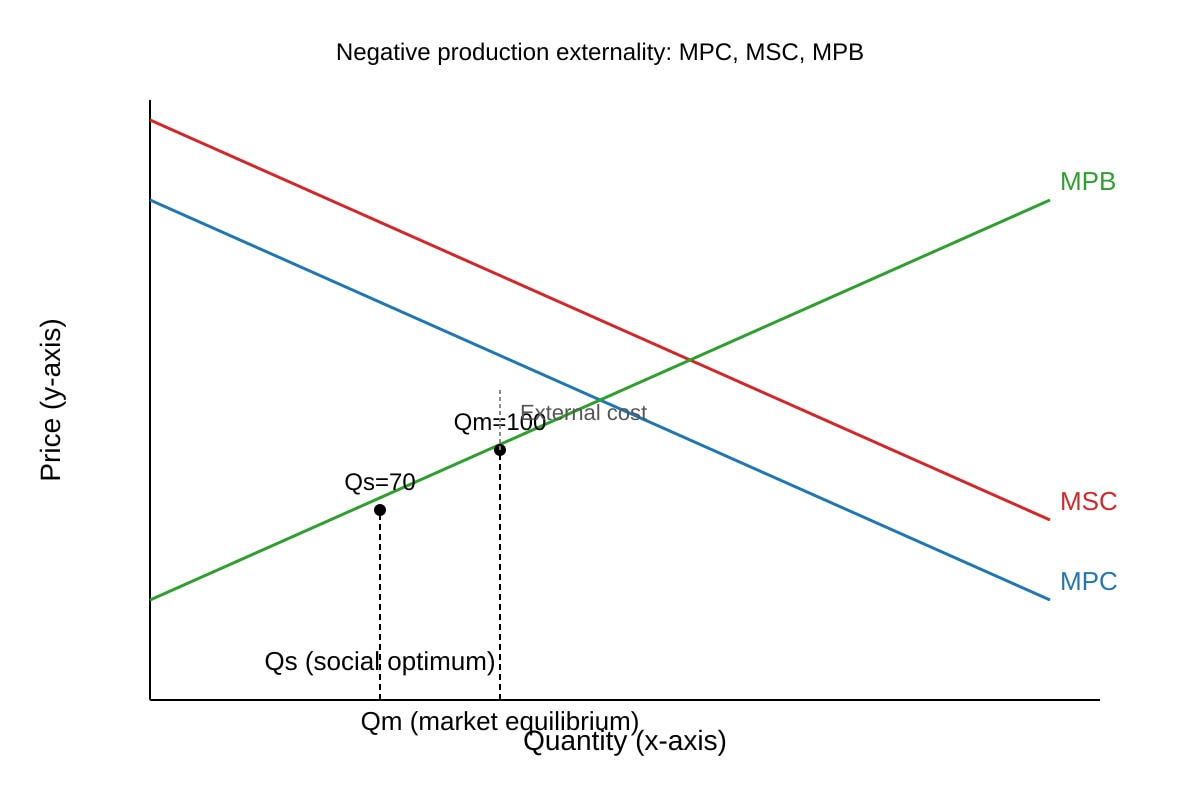
Socially optimal quantity = 70 (Qs).
From image: MSC = MPB at Qs=70; market overproduces at Qm=100.
7. [2 marks]
Deadweight loss is the net loss of social welfare when the market produces at a quantity where marginal social cost exceeds marginal social benefit (or vice versa), resulting in a triangle between MSC and MSB from Qs to Qm.
Mark: 1 definition, 1 link to over/under production.
8. [1 mark]
A subsidy lowers the private cost, encouraging producers/consumers to increase output/consumption closer to the socially optimal level where MSC = MSB.
Section B: Data and Diagram-Based Questions (9–14)
9. [1 mark]
External cost = MSC – MPC = 50 = $20 per MWh.
Working shown; unit stated.
10. [3 marks]
- Draw MPC, MSC, MPB; market equilibrium at Qm where MPC=MPB. [1]
- Tax shifts MPC to MPC+tax (=MSC), new equilibrium Q* where MSC=MPB. [1]
- Output falls from Qm to Q*, external cost reduced, DWL shrinks. [1]
Marking: diagram 1, explanation of shift 1, outcome 1.
11. [2 marks]
The levy internalises the externality: patrons previously ignored disposal cost (external cost on society). $0.10 levy raises private cost, reducing takeaway demand and food waste. [1] Corrects information/externality failure. [1]
12. [3 marks]
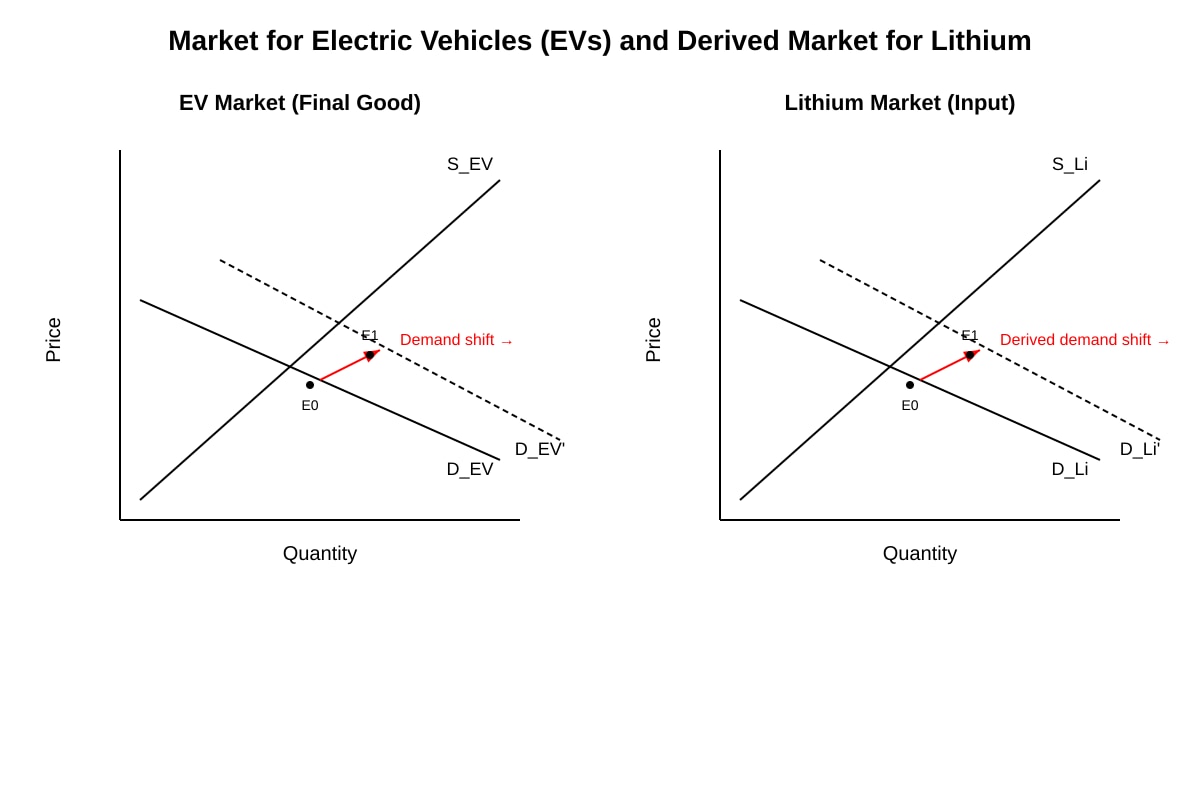
- EV demand rises (D_EV → D_EV') due to preferences/Policy. [1]
- Higher EV output increases derived demand for lithium (D_Li → D_Li'). [1]
- Lithium price and quantity rise; diagram shows both shifts. [1]
13. [2 marks]
- Total permits capped at socially optimal pollution level.
- Permits tradable so low-cost reducers sell to high-cost, achieving target at least cost.
(Any two valid conditions, 1 each.)
14. [1 mark]
Consumers lack info on long-term benefits (e.g., health screening), so they consume less than socially optimal; MPB < MSB.
Section C: Extended Response and Evaluation (15–20)
15. [4 marks]
Content: Max price below equilibrium reduces rent but causes shortage (excess demand). [1] May help tenants short-run but reduces supply, quality, black market. [1] If set above external cost / with public housing, failure reduced. [1] Evaluation: not necessarily; needs complementary supply policies. [1]
Descriptors: 2 for analysis, 2 for evaluation.
16. [4 marks]
For: Consumer choice drives demand, reduces waste via behaviour. [1]
Against: Info failure, free-rider, collective action; govt needed for bans/levy. [2]
Conclusion: Shared responsibility; pure consumer fix insufficient. [1]
17. [2 marks]
Diagram: MPB, MSB (above MPB), MPC. Subsidy shifts MPB to MSB; Q rises to Qs. [1] Welfare gain = triangle between MPB and MSB. [1]
18. [2 marks]
Sellers know defects (asymmetric info); buyers pay high price for "lemons", good cars exit market (Akerlof). [1] Market fails: under-provision of quality used cars. [1]
19. [2 marks]
Tax: price mechanism, flexible, revenue. [1] Regulation: direct ban, certain, less flexible. [1] Both correct negative externality but differ in efficiency.
20. [2 marks]
Unlikely: positive externality means MPB < MSB, market produces Qm < Qs. [1] Without intervention, under-consumption persists; only if voluntary giving/internalise, rare. [1]