From Real Exams Quiz
A Level H2 Economics Macroeconomics Quiz
Free A Level H2 Econs Macroeconomics quiz, Exam version, with questions, answers, and A Level-style practice for Singapore students.
These static practice materials are generated from the site's syllabus and paper-generation workflow, with source and model context shown so students and parents can evaluate the material before use.
Questions
Free quiz and exam paper access
Enter your details to view this paper
Your access is remembered on this device.
Answers
A-Level Economics H2 Quiz - Macroeconomics: Answer Key
Total Marks: 50
Section A: Multiple-Choice Questions (10 marks)
1. B) Reduce the rate of inflation
- Marks: 1
- Explanation: Contractionary monetary policy aims to decrease the money supply or increase interest rates to cool down an overheating economy and reduce inflationary pressures. Options A, C, and D are objectives of expansionary policy.
- Common Mistake: Students often confuse the objectives of expansionary and contractionary policies.
2. B) A decrease in the size of the multiplier
- Marks: 1
- Explanation: The multiplier (k) is calculated as 1/(1-MPC) or 1/MPS. A higher MPS means a smaller multiplier because less of any additional income is spent, reducing the ripple effect through the economy.
- Common Mistake: Confusing the relationship between MPS and the multiplier. A higher MPS leads to a smaller multiplier.
3. C) A sustained increase in consumer spending driven by low-interest rates
- Marks: 1
- Explanation: Demand-pull inflation is caused by an increase in aggregate demand that outpaces the economy's productive capacity. Low interest rates stimulate consumption and investment, shifting AD to the right. Options A, B, and D are causes of cost-push inflation.
- Common Mistake: Confusing the causes of demand-pull and cost-push inflation.
4. D) Government spending
- Marks: 1
- Explanation: In the circular flow model, injections are additions to the circular flow that are not generated by household spending. These are investment (I), government spending (G), and exports (X). Savings, taxation, and imports are leakages.
- Common Mistake: Forgetting that government spending is an injection, not a leakage.
5. B) A recession or a downturn in the business cycle
- Marks: 1
- Explanation: Cyclical unemployment is directly linked to the business cycle. It rises during recessions when aggregate demand falls and firms lay off workers. It falls during expansions.
- Common Mistake: Confusing cyclical unemployment with structural or frictional unemployment.
6. C) Providing tax incentives for firms to invest in employee training
- Marks: 1
- Explanation: Supply-side policies aim to increase the productive capacity of the economy. Tax incentives for training improve the quality of the labour force (human capital), boosting labour productivity. Options A and B are demand-side policies. Option D is a protectionist trade policy.
- Common Mistake: Confusing supply-side policies with demand-management policies.
7. C) Benefit Singaporean consumers buying US goods
- Marks: 1
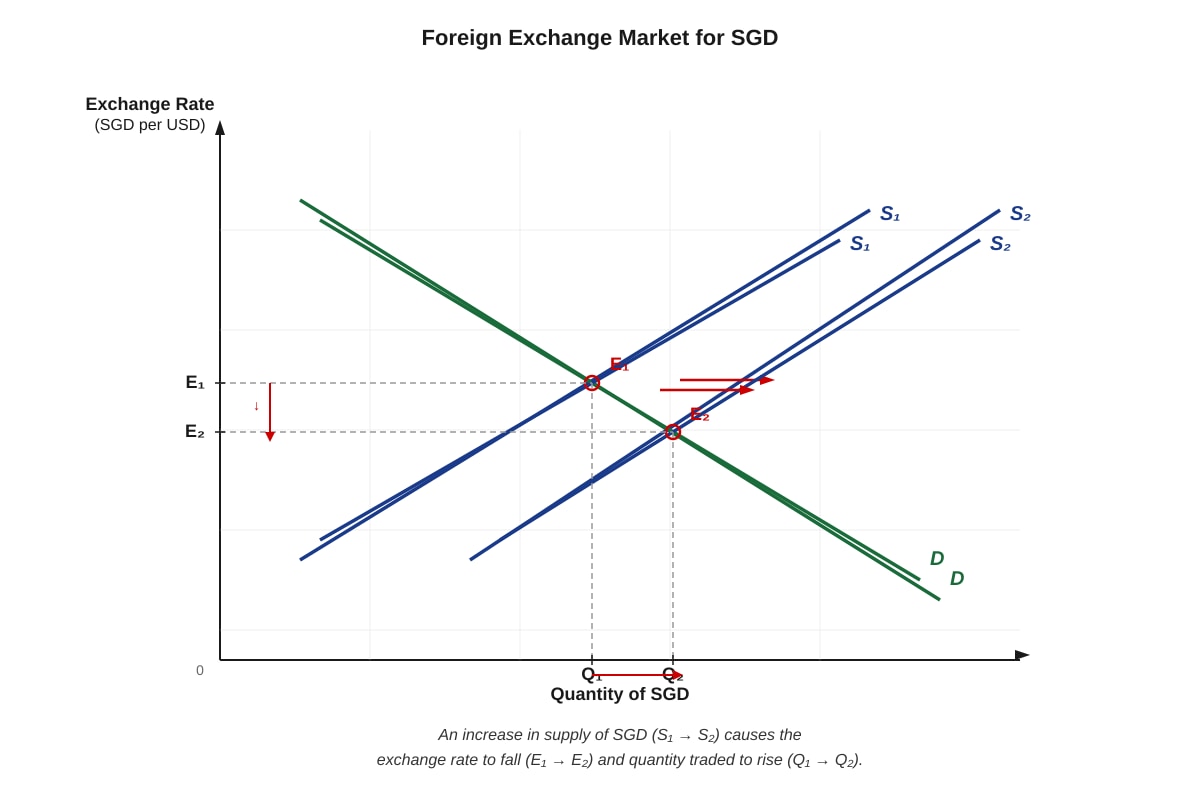
- Explanation: An appreciation of the SGD means it strengthens relative to the USD. Each SGD can buy more USD, making US goods cheaper for Singaporean consumers. Options A, B, and D describe the effects of a depreciation.
- Common Mistake: Reversing the effects of appreciation and depreciation.
8. C) Inflation and unemployment
- Marks: 1
- Explanation: The Phillips Curve shows an inverse relationship between the rate of inflation and the rate of unemployment in the short run. Lower unemployment is associated with higher inflation, and vice versa.
- Common Mistake: Confusing the Phillips Curve with other economic relationships.
9. C) Borrowing from the public or financial institutions
- Marks: 1
- Explanation: A budget deficit occurs when government spending exceeds tax revenue. The government must finance this shortfall by borrowing, typically by issuing government bonds. Options A and B would reduce the deficit, not finance it.
- Common Mistake: Thinking a deficit is financed by printing money (which is a separate monetary policy action) or by increasing taxes (which is a fiscal policy action to reduce the deficit).
10. C) An increase in real Gross Domestic Product (GDP)
- Marks: 1
- Explanation: Economic growth is typically measured as the percentage increase in real GDP (GDP adjusted for inflation) over a period. Options A, B, and D are other macroeconomic indicators but are not direct measures of economic growth.
- Common Mistake: Confusing economic growth with other positive economic outcomes like lower inequality or lower unemployment.
Section B: Data-Response Questions (20 marks)
11. (a) Describe the trend in Singapore's real GDP growth from 2020 to 2024. [2]
- Answer:
- Singapore's real GDP growth was negative in 2020 (-4.1%), followed by a sharp recovery in 2021 (8.9%). [1]
- Growth then moderated in 2022 (3.6%) and slowed further in 2023 (1.1%), before picking up slightly in 2024 (2.4%). [1]
- Marking Notes: Award 1 mark for identifying the contraction in 2020 and the strong rebound in 2021. Award 1 mark for describing the subsequent moderation and slight recovery. Accept alternative descriptions that accurately capture the overall trend.
(b) With reference to the data, explain the relationship between real GDP growth and the unemployment rate over the period 2020-2022. [3]
- Answer:
- The data shows an inverse relationship between real GDP growth and the unemployment rate. [1]
- In 2020, when real GDP contracted by 4.1%, the unemployment rate was at its highest (3.0%). [1]
- As the economy recovered and real GDP growth turned positive and strong in 2021 (8.9%) and 2022 (3.6%), the unemployment rate fell to 2.7% and then 2.1%. [1]
- Explanation: This relationship is explained by Okun's Law, which states that there is a negative relationship between output growth and unemployment. When the economy grows, firms need more workers, so unemployment falls. When the economy contracts, firms lay off workers, and unemployment rises.
- Marking Notes: Award 1 mark for identifying the inverse relationship. Award 1 mark for correctly referencing the 2020 data. Award 1 mark for correctly referencing the 2021 and/or 2022 data.
12. (a) Using the data, identify the year in which Singapore experienced the highest inflation rate and suggest one possible cause for this. [2]
- Answer:
- The highest inflation rate was in 2022 (6.1%). [1]
- One possible cause: The sharp increase in global energy and food prices following the Russia-Ukraine war, which increased production costs and was passed on to consumers (cost-push inflation). [1]
- Explanation: Cost-push inflation occurs when the costs of production (e.g., raw materials, energy, wages) rise, causing the Short-Run Aggregate Supply (SRAS) curve to shift leftward, leading to a higher price level.
- Marking Notes: Award 1 mark for correctly identifying 2022. Award 1 mark for a plausible cause, such as supply chain disruptions, rising energy prices, or the Russia-Ukraine war.
(b) Explain how the Monetary Authority of Singapore (MAS) could use its exchange rate policy to address the high inflation observed in 2022. [4]
- Answer:
- The MAS conducts monetary policy by managing the Singapore dollar's exchange rate against a basket of currencies (the trade-weighted exchange rate, or S$NEER). [1]
- To fight inflation, the MAS can appreciate the Singapore dollar. [1]
- An appreciation makes imported goods and raw materials cheaper in SGD terms. Since Singapore imports a large proportion of its consumption goods and inputs, this directly reduces imported inflation. [1]
- A stronger SGD also reduces demand for Singapore's exports, dampening aggregate demand and reducing demand-pull inflationary pressures. [1]
- Explanation: Singapore's unique monetary policy framework uses the exchange rate as its primary tool because the economy is small and open, and the trade-weighted exchange rate has a powerful and direct effect on domestic prices.
- Marking Notes: Award 1 mark for stating the MAS uses the exchange rate. Award 1 mark for identifying an appreciation. Award 1 mark for explaining the effect on import prices. Award 1 mark for explaining the effect on aggregate demand.
13. (a) Define the term "fiscal policy". [1]
- Answer: Fiscal policy refers to the use of the government's budget (government spending and taxation) to influence the level of aggregate demand and economic activity. [1]
- Explanation: It is a demand-side policy tool managed by the government (Ministry of Finance), as opposed to monetary policy which is managed by the central bank.
- Marking Notes: Award 1 mark for a clear definition that includes government spending and/or taxation.
(b) Explain how the Singapore government could use fiscal policy to support economic growth during a recession. [3]
- Answer:
- The government could implement expansionary fiscal policy. [1]
- This could involve increasing government spending on infrastructure projects, healthcare, or education. This directly injects money into the circular flow, creating jobs and income. [1]
- Alternatively, the government could cut taxes (e.g., corporate or personal income tax). This increases disposable income for households and post-tax profits for firms, encouraging consumption and investment, which boosts aggregate demand. [1]
- Explanation: The goal is to shift the AD curve to the right to close a recessionary gap.
- Marking Notes: Award 1 mark for identifying expansionary fiscal policy. Award 1 mark for explaining increased government spending. Award 1 mark for explaining tax cuts.
14. With reference to the data and your knowledge of macroeconomics, discuss whether the Singapore government should be more concerned about inflation or unemployment in 2024. [5]
- Answer:
- Introduction: In 2024, the data shows an inflation rate of 2.4% and an unemployment rate of 1.9%. Both are relatively low, but a government must weigh the costs of each. [1]
- Argument for being more concerned about inflation: While 2.4% is moderate, it is still above the MAS's preferred target range (around 0-2% for core inflation). High inflation erodes purchasing power, hurts savers, and can lead to uncertainty and wage-price spirals if it becomes entrenched. The government may want to ensure inflation is fully under control before easing policy. [1]
- Argument for being more concerned about unemployment: The unemployment rate of 1.9% is very low, close to the natural rate of unemployment. This suggests the economy is near full employment. Therefore, unemployment is less of a concern. However, the government should be mindful of structural or frictional unemployment that may not be captured in the headline rate. [1]
- Evaluation/Judgment: On balance, the Singapore government should likely be more concerned about maintaining price stability in 2024. The unemployment rate is already at a very healthy level, suggesting the labour market is tight. The inflation rate, while falling, is still a risk. If inflation expectations become unanchored, it could be costly to bring down later. The government's priority should be to ensure inflation returns to its target range without causing a sharp rise in unemployment. [2]
- Marking Notes:
- Award 1 mark for a clear introduction that references the data.
- Award 1 mark for a well-reasoned argument on inflation.
- Award 1 mark for a well-reasoned argument on unemployment.
- Award 2 marks for a balanced evaluation that makes a clear, justified judgment. A simple statement without justification is worth 1 mark.
- Common Mistake: Providing a one-sided answer without considering the other side of the argument.
Section C: Essay Questions (20 marks)
Answer two of the following questions. Each question is worth 10 marks.
15. (a) Explain the concept of the multiplier effect and how it is influenced by the marginal propensity to consume (MPC). [4]
- Answer:
- The multiplier effect refers to the process by which an initial change in an injection (e.g., government spending, investment) leads to a larger final change in national income (real GDP). [1]
- The size of the multiplier (k) is determined by the marginal propensity to consume (MPC). The formula is: k = 1 / (1 - MPC) or k = 1 / MPS. [1]
- A higher MPC means that households spend a larger proportion of any additional income they receive. This spending becomes income for others, who then spend a portion of it, and so on. This creates a larger cumulative effect. [1]
- For example, if MPC = 0.8, the multiplier is 5 (1/(1-0.8)). An initial 500 million. If MPC = 0.5, the multiplier is only 2. [1]
- Marking Notes: Award 1 mark for defining the multiplier effect. Award 1 mark for stating the formula or the relationship between MPC and the multiplier. Award 1 mark for explaining the causal chain. Award 1 mark for a numerical example or further elaboration.
(b) Discuss the extent to which an increase in government spending on infrastructure is an effective policy to close a recessionary gap. [6]
- Answer:
- Introduction: A recessionary gap occurs when actual GDP is below potential GDP, leading to unemployment. An increase in government spending on infrastructure is an expansionary fiscal policy aimed at boosting AD. [1]
- Arguments for effectiveness:
- Direct injection: Government spending directly increases the G component of AD (AD = C + I + G + (X-M)), immediately boosting aggregate demand. [1]
- Multiplier effect: The spending creates jobs and income for construction workers and suppliers, who then spend more, creating a ripple effect throughout the economy. [1]
- Supply-side benefits: Infrastructure spending (e.g., on roads, ports, digital networks) improves the economy's productive capacity in the long run, shifting the LRAS curve to the right. This helps achieve non-inflationary growth. [1]
- Arguments against effectiveness (limitations):
- Time lags: There are significant time lags in fiscal policy. It takes time to plan, approve, and implement infrastructure projects. By the time the spending takes effect, the economy may have already recovered, potentially causing overheating. [1]
- Crowding out: Increased government borrowing to finance the spending can push up interest rates, which may crowd out private investment, reducing the net positive impact on AD. [1]
- Leakages: Some of the increased income may be saved, spent on imports, or paid in taxes, reducing the size of the multiplier effect. [1]
- Evaluation/Judgment: The effectiveness depends on several factors. If the recession is deep and prolonged, and the government can implement projects quickly (e.g., on maintenance or "shovel-ready" projects), it can be highly effective. The presence of a large multiplier and significant supply-side benefits makes it a strong tool. However, if the economy is near full capacity or if crowding out is significant, its effectiveness is limited. It is often most effective when combined with accommodative monetary policy (low interest rates). [1]
- Marking Notes:
- Award 1 mark for a clear introduction.
- Award up to 3 marks for arguments for effectiveness (must include at least one of the points above).
- Award up to 3 marks for arguments against effectiveness (must include at least one of the points above).
- Award 1 mark for a balanced evaluation and a justified conclusion.
- Common Mistake: Only discussing the demand-side effects and ignoring the potential supply-side benefits or limitations like time lags and crowding out.
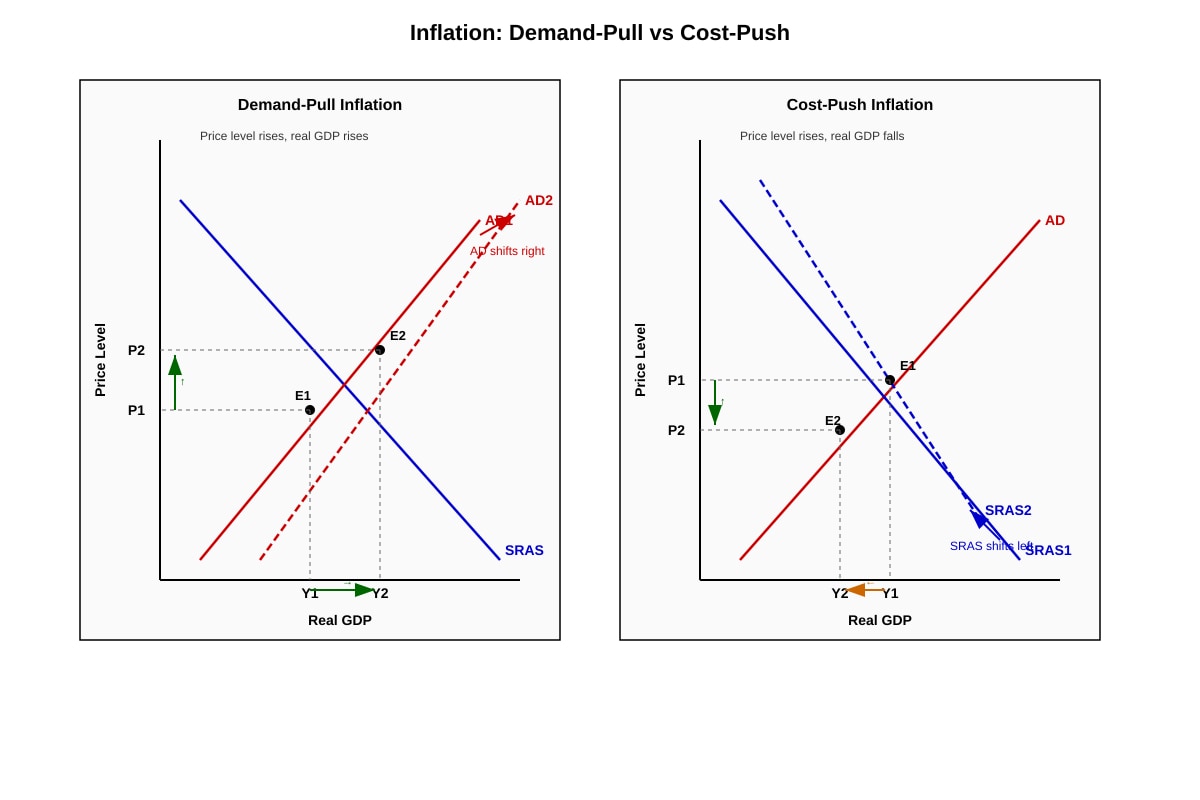
16. (a) Using an Aggregate Demand-Aggregate Supply (AD-AS) diagram, explain the difference between demand-pull and cost-push inflation. [4]
- Answer:
- Demand-pull inflation: This is caused by an increase in aggregate demand that outstrips the economy's productive capacity. In the AD-AS diagram, the AD curve shifts to the right (from AD1 to AD2). This leads to a higher price level (P1 to P2) and an increase in real GDP (Y1 to Y2). [2]
- Cost-push inflation: This is caused by an increase in the costs of production (e.g., wages, raw materials). In the AD-AS diagram, the Short-Run Aggregate Supply (SRAS) curve shifts to the left (from SRAS1 to SRAS2). This leads to a higher price level (P1 to P2) but a decrease in real GDP (Y1 to Y2), a phenomenon known as stagflation. [2]
- Marking Notes:
- Award 1 mark for correctly explaining demand-pull inflation with a reference to the AD shift.
- Award 1 mark for correctly explaining the effect on price level and real GDP for demand-pull.
- Award 1 mark for correctly explaining cost-push inflation with a reference to the SRAS shift.
- Award 1 mark for correctly explaining the effect on price level and real GDP for cost-push.
- Note on Diagram: The answer should describe the diagram shown in the
<image_placeholder>tag. The key difference is that demand-pull inflation is associated with rising output, while cost-push inflation is associated with falling output.
(b) Evaluate the view that controlling inflation should be the primary macroeconomic objective for a government. [6]
- Answer:
- Introduction: Governments typically have four main macroeconomic objectives: price stability, full employment, economic growth, and a healthy balance of payments. The view that controlling inflation should be the primary objective requires careful evaluation. [1]
- Arguments for inflation being the primary objective:
- Costs of inflation: High and volatile inflation creates uncertainty, discourages investment, erodes the real value of savings and fixed incomes, and can lead to a loss of international competitiveness. It can also cause a wage-price spiral if expectations become unanchored. [1]
- Foundation for other objectives: Low and stable inflation is often seen as a precondition for achieving other objectives. It provides a stable environment for firms to plan and invest (promoting growth and employment) and helps maintain international competitiveness. [1]
- Arguments against inflation being the primary objective:
- Other objectives may be more pressing: During a deep recession, high unemployment and negative growth are far more damaging than low inflation. The government's priority should be to boost demand and create jobs, even if it means accepting slightly higher inflation. [1]
- Trade-offs: The Phillips Curve suggests a short-run trade-off between inflation and unemployment. A single-minded focus on reducing inflation could lead to unnecessarily high unemployment and lost output. [1]
- Type of inflation matters: Cost-push inflation (e.g., from an oil price shock) is often temporary and may not require a harsh policy response that would harm growth and employment. The government should focus on the underlying cause. [1]
- Evaluation/Judgment: The view is too simplistic. While controlling inflation is crucial for long-term stability, it should not always be the primary objective. The appropriate priority depends on the state of the economy. In a period of high inflation and strong growth (like 2022), controlling inflation is paramount. In a period of deep recession and deflationary pressure (like 2020), boosting growth and employment is more important. A pragmatic government will balance its objectives based on the prevailing economic conditions. [1]
- Marking Notes:
- Award 1 mark for a clear introduction.
- Award up to 2 marks for arguments supporting the view.
- Award up to 2 marks for arguments against the view.
- Award 1 mark for a balanced evaluation and a justified conclusion.
- Common Mistake: Taking a one-sided view without considering the context or the trade-offs involved.
17. (a) Explain how a decrease in the policy interest rate by a central bank can stimulate aggregate demand in an economy. [4]
- Answer:
- A decrease in the policy interest rate (e.g., the Federal Funds Rate in the US) is an expansionary monetary policy tool. [1]
- Effect on consumption: Lower interest rates reduce the cost of borrowing for households (e.g., mortgages, car loans, credit cards). This encourages households to increase consumption (C). It also reduces the incentive to save, as the return on savings is lower, further boosting spending. [1]
- Effect on investment: Lower interest rates reduce the cost of borrowing for firms to finance capital projects (e.g., new machinery, factories). This encourages firms to increase investment (I). [1]
- Effect on net exports: Lower interest rates can lead to a depreciation of the domestic currency (as investors seek higher returns elsewhere). A weaker currency makes exports cheaper and imports more expensive, boosting net exports (X-M). [1]
- The combined increase in C, I, and (X-M) leads to a rightward shift in the AD curve, increasing real GDP and the price level.
- Marking Notes: Award 1 mark for identifying the policy. Award 1 mark for explaining the effect on consumption. Award 1 mark for explaining the effect on investment. Award 1 mark for explaining the effect on net exports.
(b) Discuss the limitations of using monetary policy to achieve full employment in an economy. [6]
- Answer:
- Introduction: Monetary policy, primarily through interest rate adjustments, is a key tool to manage aggregate demand and influence employment. However, it has several limitations in achieving full employment. [1]
- Limitation 1: Time lags. There are significant inside lags (time to recognise the problem and implement a policy) and outside lags (time for the policy to affect the economy). By the time the policy takes effect, the economic situation may have changed, potentially making the policy pro-cyclical. [1]
- Limitation 2: Liquidity trap. In a severe recession, if interest rates are already near zero, the central bank cannot lower them further. This is a liquidity trap. Conventional monetary policy becomes ineffective, as further monetary expansion may not stimulate borrowing and spending. [1]
- Limitation 3: Ineffectiveness against structural unemployment. Monetary policy is a demand-side tool. It is effective against cyclical unemployment but cannot solve structural unemployment (e.g., a mismatch between workers' skills and available jobs). Supply-side policies are needed for this. [1]
- Limitation 4: Conflicting objectives. An expansionary policy to reduce unemployment may cause inflation to rise above the target. The central bank may be forced to tighten policy to control inflation, even if unemployment is still high. [1]
- Limitation 5: Global influences. In a small, open economy like Singapore, domestic interest rates are heavily influenced by global interest rates. The central bank may not be able to set rates independently to achieve domestic goals. [1]
- Evaluation/Judgment: Monetary policy is a powerful and flexible tool for managing the business cycle and reducing cyclical unemployment. However, it is not a panacea. Its effectiveness is limited by time lags, the liquidity trap, and its inability to address structural issues. For achieving and sustaining full employment, it is often most effective when used in conjunction with fiscal policy and targeted supply-side policies. [1]
- Marking Notes:
- Award 1 mark for a clear introduction.
- Award up to 4 marks for identifying and explaining different limitations (1 mark each).
- Award 1 mark for a balanced evaluation and a justified conclusion.
- Common Mistake: Only listing limitations without explaining why they are limitations.
18. (a) Distinguish between structural and frictional unemployment. [4]
- Answer:
- Frictional unemployment: This is short-term, temporary unemployment that occurs when workers are between jobs. It arises from the time it takes for workers to search for and find new jobs that match their skills. It is a natural part of a dynamic economy and is often considered a sign of a healthy labour market. [2]
- Structural unemployment: This is long-term, chronic unemployment that occurs when there is a mismatch between the skills of the labour force and the skills demanded by employers. This can be caused by technological change, changes in consumer tastes, or the decline of certain industries. It is a more serious problem than frictional unemployment. [2]
- Explanation: The key difference is the cause and duration. Frictional is short-term and due to the search process; structural is long-term and due to a fundamental mismatch.
- Marking Notes: Award 2 marks for a clear definition and explanation of frictional unemployment. Award 2 marks for a clear definition and explanation of structural unemployment. A simple one-sentence distinction is worth 2 marks.
(b) Assess the effectiveness of supply-side policies in reducing different types of unemployment. [6]
- Answer:
- Introduction: Supply-side policies aim to increase the economy's productive capacity and improve the functioning of markets. Their effectiveness varies depending on the type of unemployment they are targeting. [1]
- Effectiveness against structural unemployment: Supply-side policies are the most effective tool for reducing structural unemployment.
- Education and training: Policies that improve the skills and retrain workers (e.g., SkillsFuture in Singapore) directly address the skills mismatch, making workers employable in growing industries. [1]
- Labour market reforms: Policies that reduce the power of unions, lower minimum wages, or reduce employment protection legislation can make the labour market more flexible, encouraging firms to hire. [1]
- Geographical mobility: Policies that reduce the cost of moving (e.g., housing subsidies) can help workers move to areas with more job opportunities. [1]
- Effectiveness against frictional unemployment: Supply-side policies can be effective but may have unintended consequences.
- Improving information: Policies that improve job-matching services (e.g., online job portals) can reduce the time workers spend searching, lowering frictional unemployment. [1]
- Reducing unemployment benefits: Lowering the level or duration of benefits can incentivise the unemployed to accept jobs more quickly, reducing frictional unemployment. However, this may be socially undesirable. [1]
- Effectiveness against cyclical unemployment: Supply-side policies are ineffective in the short run against cyclical unemployment, which is caused by a lack of aggregate demand. Demand-side policies (fiscal/monetary) are needed to boost spending. However, supply-side policies can help prevent cyclical unemployment from becoming structural by making the economy more adaptable. [1]
- Evaluation/Judgment: Supply-side policies are essential for tackling structural unemployment and improving the long-run health of the labour market. They can also help reduce frictional unemployment. However, they are not a quick fix and often take years to have an effect. They are ineffective against short-term cyclical unemployment and must be complemented by demand-side management. Their effectiveness also depends on the specific design and implementation of the policies. [1]
- Marking Notes:
- Award 1 mark for a clear introduction.
- Award up to 2 marks for explaining effectiveness against structural unemployment.
- Award up to 2 marks for explaining effectiveness against frictional and cyclical unemployment.
- Award 1 mark for a balanced evaluation and a justified conclusion.
- Common Mistake: Claiming supply-side policies are a universal solution for all types of unemployment.
19. (a) Explain the concept of the balance of payments and its main components. [4]
- Answer:
- The balance of payments (BOP) is a record of all economic transactions between the residents of a country and the rest of the world over a period of time (usually a year). It is based on the principle of double-entry bookkeeping and must always balance. [1]
- The main components are:
- Current Account: This records transactions in goods (trade balance), services (e.g., tourism, financial services), primary income (e.g., profits, dividends, interest), and secondary income (e.g., remittances, foreign aid). [1]
- Capital and Financial Account: The capital account records capital transfers (e.g., debt forgiveness). The financial account records transactions in financial assets and liabilities, including foreign direct investment (FDI), portfolio investment (e.g., stocks and bonds), and changes in reserve assets. [1]
- The relationship is: Current Account Balance + Capital and Financial Account Balance = 0 (balancing item). A current account deficit must be financed by a surplus in the capital and financial account (net capital inflows). [1]
- Marking Notes: Award 1 mark for a clear definition. Award 1 mark for explaining the current account. Award 1 mark for explaining the capital and financial account. Award 1 mark for explaining the relationship between the accounts.
(b) Discuss the economic consequences of a persistent current account deficit for a country. [6]
- Answer:
- Introduction: A current account deficit (CAD) means a country is spending more on imports, income, and transfers than it is earning from exports, income, and transfers. A persistent CAD can have significant consequences. [1]
- Negative consequences:
- Increased foreign debt: A CAD must be financed by borrowing from abroad or selling domestic assets. This leads to a build-up of foreign debt, which requires future interest and principal payments, reducing future national income. [1]
- Loss of international confidence: A large and persistent CAD can lead to a loss of confidence in the country's currency and economy. Foreign investors may demand higher interest rates to hold the country's debt, or they may pull out their capital, leading to a sharp currency depreciation and a financial crisis. [1]
- Depreciation pressure: A persistent CAD implies a high demand for foreign currency to pay for imports, putting downward pressure on the domestic currency. A depreciation can lead to imported inflation. [1]
- Lower future living standards: To service foreign debt, the country may need to consume less in the future, lowering living standards. [1]
- Positive consequences (or mitigating factors):
- Financing productive investment: If the CAD is used to finance high levels of productive investment (e.g., importing capital goods), it can boost future productive capacity and economic growth, allowing the country to repay its debts. This is a "good" deficit. [1]
- Sign of strong economy: A CAD can be a sign of a strong, growing economy that is attracting foreign capital. For example, the US has
<stage3_quiz_answers_md>
A-Level Economics H2 Quiz - Macroeconomics (Answer Key)
Total Marks: 50
Section A: Multiple-Choice Questions (10 marks)
1 mark each.
1. B) Reduce the rate of inflation
2. B) A decrease in the size of the multiplier
3. C) A sustained increase in consumer spending driven by low-interest rates
4. D) Government spending
5. B) A recession or a downturn in the business cycle
6. C) Providing tax incentives for firms to invest in employee training
7. C) Benefit Singaporean consumers buying US goods
8. C) Inflation and unemployment
9. C) Borrowing from the public or financial institutions
10. C) An increase in real Gross Domestic Product (GDP)
Section B: Data-Response Questions (20 marks)
11. (a) [2]
- Real GDP growth was negative in 2020 (-4.1%), then rebounded sharply in 2021 (8.9%), before slowing down in subsequent years (3.6% in 2022, 1.1% in 2023, and 2.4% in 2024). Overall, the trend shows a V-shaped recovery followed by a moderation to a more sustainable growth rate.
(b) [3]
- From 2020 to 2022, there is a clear inverse relationship between real GDP growth and the unemployment rate. In 2020, when real GDP contracted by 4.1%, the unemployment rate was at its highest at 3.0%. As real GDP growth rebounded strongly to 8.9% in 2021 and remained positive at 3.6% in 2022, the unemployment rate fell to 2.7% and then 2.1% respectively. This is consistent with Okun's Law, which suggests that higher economic growth is associated with lower unemployment as firms hire more workers to meet rising demand.
12. (a) [2]
- The highest inflation rate was in 2022 at 6.1%.
- One possible cause: A sharp increase in global commodity prices (e.g., energy and food prices) due to supply chain disruptions or geopolitical tensions, leading to cost-push inflation.
(b) [4]
- The MAS uses the exchange rate as its main monetary policy tool. To address high inflation, the MAS would appreciate the Singapore dollar (i.e., shift the centre of the S$NEER policy band upwards, or increase the slope of the band).
- An appreciation makes imports cheaper in local currency terms, directly lowering the cost of imported goods and raw materials.
- This reduces imported inflation and dampens cost-push pressures.
- A stronger currency also makes Singapore's exports more expensive, reducing external demand and thus cooling overall aggregate demand, which helps to ease demand-pull inflationary pressures.
- The appreciation helps to anchor inflation expectations and maintain price stability in the medium term.
13. (a) [1]
- Fiscal policy refers to the use of government spending and taxation to influence the level of aggregate demand and economic activity in the economy.
(b) [3]
- During a recession, the government could adopt an expansionary fiscal policy.
- It could increase government spending on infrastructure projects, healthcare, or education, which directly injects money into the circular flow, creating jobs and boosting aggregate demand.
- It could also reduce taxes (e.g., personal income tax or corporate tax) to increase disposable income and encourage consumption and investment.
- These measures would shift the aggregate demand curve to the right, helping to close the deflationary gap and stimulate economic growth.
14. [5]
- Introduction: In 2024, Singapore's inflation rate was 2.4% (within the MAS's comfort zone of 1-3%) and the unemployment rate was 1.9% (near full employment). Both indicators appear relatively healthy.
- Argument for focusing on inflation: Although inflation has moderated, it is still above the historical norm. The government should remain vigilant to ensure inflation stays anchored, as high inflation erodes purchasing power, hurts savers, and can lead to a wage-price spiral. Maintaining price stability is crucial for long-term economic competitiveness and attracting foreign investment.
- Argument for focusing on unemployment: The unemployment rate is very low, suggesting the economy is at or near full employment. However, the government should be concerned about the quality of employment and structural unemployment. With rapid technological changes and global shifts, there may be hidden underemployment or skills mismatches. Policies should focus on retraining and upskilling workers to ensure they remain employable.
- Conclusion: Given that inflation is within the target range and unemployment is at a very low level, the government should perhaps be equally concerned with both, but with a slight emphasis on maintaining price stability to safeguard the external competitiveness of the Singapore economy. However, the low unemployment rate suggests that the more pressing concern might be to ensure that the workforce is future-ready, thus a focus on supply-side policies to address potential structural unemployment is also important. Overall, the government should maintain a balanced approach, but given the low unemployment, inflation control may warrant slightly more attention to prevent it from re-accelerating.
Section C: Essay Questions (20 marks)
Answer two questions. Each is worth 10 marks.
15. (a) [4]
- The multiplier effect refers to the phenomenon where an initial change in an injection (e.g., government spending, investment, or exports) leads to a larger final change in national income. This occurs because one person's spending becomes another person's income, which is then partly spent again, creating a ripple effect through the economy.
- The size of the multiplier is determined by the marginal propensity to consume (MPC). The formula for the simple multiplier is 1/(1-MPC) or 1/MPS.
- A higher MPC means that a larger proportion of additional income is spent, leading to a larger multiplier. Conversely, a lower MPC (or higher MPS) results in a smaller multiplier, as more income leaks out of the circular flow into savings.
(b) [6]
- Introduction: An increase in government spending on infrastructure is a classic expansionary fiscal policy tool used to close a recessionary (deflationary) gap.
- Effectiveness:
- It directly injects money into the economy, creating jobs in construction and related industries, which boosts aggregate demand (AD) and shifts the AD curve rightward.
- The multiplier effect amplifies the initial spending, leading to a larger increase in national income.
- Infrastructure spending has positive supply-side effects: it improves productivity, reduces business costs, and increases the economy's potential output in the long run, which can help sustain growth without causing inflation.
- Limitations:
- Time lags: There are significant lags between the decision to spend, the implementation of projects, and the actual impact on AD. By the time the spending takes effect, the economy may have already recovered, leading to demand-pull inflation.
- Crowding out: If the government finances the spending through borrowing, it may drive up interest rates, which could crowd out private investment, offsetting some of the expansionary effect.
- Leakages: In an open economy like Singapore, a significant portion of the increased spending may leak out through imports (high marginal propensity to import), reducing the size of the multiplier.
- Efficiency: The effectiveness depends on the quality and selection of infrastructure projects. Poorly chosen projects may not generate the desired economic returns.
- Conclusion: While an increase in infrastructure spending is generally effective in closing a recessionary gap, its success depends on the timing, the state of the economy, and the nature of the projects. It is most effective when the economy is in a deep recession, there is spare capacity, and the projects are well-planned and productive. However, it should be complemented with other policies to address potential limitations.
16. (a) [4]
- Demand-pull inflation occurs when aggregate demand (AD) exceeds the economy's productive capacity, leading to upward pressure on the price level. In an AD-AS diagram, the AD curve shifts rightward from AD1 to AD2, causing the price level to rise from P1 to P2 and real GDP to increase from Y1 to Y2. This is often caused by factors such as increased consumer spending, investment, government spending, or net exports.
- Cost-push inflation occurs when the costs of production (e.g., wages, raw materials, energy) rise, causing the short-run aggregate supply (SRAS) curve to shift leftward from SRAS1 to SRAS2. This leads to a higher price level (P1 to P2) but a lower real GDP (Y1 to Y2), creating a situation of stagflation. This is often caused by supply shocks such as oil price hikes or wage increases above productivity growth.
(b) [6]
- Introduction: The view that controlling inflation should be the primary macroeconomic objective is a common one, particularly among central banks. However, its validity depends on the economic context and the trade-offs involved.
- Arguments for controlling inflation as the primary objective:
- Price stability is essential for economic certainty, which encourages investment and long-term planning.
- High inflation erodes the real value of savings and incomes, hurting the poor and those on fixed incomes.
- Inflation can lead to a loss of international competitiveness, worsening the current account balance.
- Controlling inflation helps to anchor inflation expectations, preventing a wage-price spiral.
- Low and stable inflation is a prerequisite for sustainable economic growth and full employment in the long run.
- Arguments against making it the primary objective:
- Trade-off with unemployment: In the short run, contractionary policies to control inflation can lead to higher unemployment and lower economic growth (as shown by the Phillips Curve).
- Other objectives matter: Full employment, economic growth, and a healthy balance of payments are also crucial for a nation's welfare. Focusing solely on inflation may neglect these.
- Cost-push inflation: If inflation is caused by supply-side shocks, contractionary monetary policy may be ineffective and could worsen the recessionary impact.
- Context-dependent: In a deep recession with deflationary pressures, the priority should be to stimulate growth and employment, not to control inflation.
- Conclusion: While controlling inflation is a vital objective for macroeconomic stability, it should not always be the primary one. The appropriate priority depends on the prevailing economic conditions. In a high-inflation environment, it should be the focus, but in a recession with low inflation, stimulating growth and employment should take precedence. A balanced approach that considers all objectives is generally more prudent.
17. (a) [4]
- A decrease in the policy interest rate by a central bank is a key expansionary monetary policy tool.
- It lowers the cost of borrowing for commercial banks, which in turn reduces the interest rates they charge their customers.
- Consumption: Lower interest rates reduce the cost of borrowing for consumer durables (e.g., cars, houses), encouraging households to increase consumption. It also reduces the incentive to save, as returns on savings fall, further boosting spending.
- Investment: Lower interest rates reduce the cost of capital for firms, making new investment projects more profitable. This encourages firms to increase investment spending.
- Wealth effect: Lower interest rates can lead to higher asset prices (e.g., property, stocks), increasing household wealth and confidence, which further stimulates consumption.
- Net exports: Lower interest rates may lead to a depreciation of the domestic currency, making exports cheaper and imports more expensive, thus boosting net exports.
- All these channels lead to an increase in aggregate demand, shifting the AD curve rightward and stimulating economic activity.
(b) [6]
- Introduction: Monetary policy is a powerful tool for managing aggregate demand, but it has several limitations in achieving full employment.
- Limitations:
- Liquidity trap: In a severe recession or when interest rates are already very low, further cuts may have little effect as households and firms are unwilling to borrow and spend despite low rates. They may prefer to hold cash.
- Time lags: There are significant recognition, decision, and implementation lags. By the time the policy takes effect, the economic conditions may have changed, potentially destabilising the economy.
- Crowding out: If the policy leads to expectations of future inflation, long-term interest rates may rise, offsetting the intended stimulative effect.
- Structural unemployment: Monetary policy is a demand-side tool and cannot address structural unemployment, which arises from a mismatch of skills or location. It cannot solve frictional unemployment either, which is a natural part of a dynamic labour market.
- Globalisation and open economy: In a small open economy like Singapore, the effectiveness of interest rate policy is limited because the exchange rate is the primary tool. Changes in global interest rates can also influence domestic conditions, reducing the autonomy of the central bank.
- Confidence and expectations: If businesses and consumers are pessimistic about the future, they may not respond to lower interest rates. The policy's effectiveness depends heavily on confidence.
- Conclusion: While monetary policy can help to reduce cyclical unemployment by stimulating aggregate demand, it is not sufficient to achieve full employment on its own. It must be complemented by fiscal policy and, more importantly, supply-side policies to address structural and frictional unemployment. The limitations of monetary policy highlight the need for a comprehensive and coordinated policy approach.
18. (a) [4]
- Structural unemployment arises from a mismatch between the skills or location of workers and the requirements of available jobs. It is caused by long-term changes in the economy, such as technological advancements, shifts in consumer demand, or the decline of certain industries. Workers may need retraining or relocation to find new jobs. It is a persistent and long-term form of unemployment.
- Frictional unemployment is short-term and arises from the normal time it takes for workers to search for new jobs or for new entrants to find their first job. It is caused by imperfect information in the labour market and the time taken to match workers with suitable vacancies. It is a natural and temporary part of a healthy labour market.
(b) [6]
- Introduction: Supply-side policies aim to increase the productive capacity of the economy and improve the functioning of the labour market. Their effectiveness varies across different types of unemployment.
- Effectiveness in reducing structural unemployment:
- Education and training programs: These are highly effective as they equip workers with the skills needed for new and growing industries, reducing the skills mismatch.
- Labour market reforms: Policies that reduce the power of unions, lower minimum wages, or reduce employment protection can make the labour market more flexible, encouraging firms to hire workers. However, these may be controversial and may not address the root cause of the skills gap.
- Geographic mobility incentives: Subsidies for relocation or investment in infrastructure in declining regions can help workers move to areas with job opportunities.
- Effectiveness in reducing frictional unemployment:
- Improving job information: Better job matching services, online job portals, and career counselling can reduce the time workers spend searching for jobs.
- Reducing barriers to entry: Simplifying licensing requirements and reducing the cost of job search can help reduce frictional unemployment.
- Limitations:
- Time lags: Supply-side policies, especially education and training, take a long time to have an effect.
- Cost: Many of these policies are expensive and require significant government funding.
- Effectiveness on cyclical unemployment: Supply-side policies are not designed to address cyclical unemployment, which requires demand-side management (fiscal or monetary policy).
- Political and social constraints: Some policies, such as reducing employment protection, may face strong political opposition.
- Conclusion: Supply-side policies are particularly effective in reducing structural and frictional unemployment by improving the efficiency of the labour market and the skills of the workforce. However, they are less effective in addressing cyclical unemployment and may take time to yield results. A comprehensive approach that combines supply-side policies with appropriate demand-side management is necessary to achieve full employment.