AI Generated Exam Paper
A Level H2 Economics Practice Paper 3
Free A Level H2 Econs Practice Paper 3, LongCat AI version, with questions, answers, and A Level-style practice for Singapore students.
These static practice materials are generated from the site's syllabus and paper-generation workflow, with source and model context shown so students and parents can evaluate the material before use.
Questions
Free quiz and exam paper access
Enter your details to view this paper
Your access is remembered on this device.
Answers
TuitionGoWhere Practice Paper — Economics H2 A-Level
Answer Key and Marking Scheme
Paper: Practice Paper — Microeconomics Version: 3 of 5
Section A: Short-Answer and Data Response
Question 1 [2]
Define the price elasticity of demand and state its formula.
Answer:
Price elasticity of demand (PED) measures the degree of responsiveness of the quantity demanded of a good to a change in its own price, ceteris paribus.
Formula:
Or equivalently:
Marking:
- 1 mark for a correct definition (must mention "responsiveness of quantity demanded to a change in its own price").
- 1 mark for the correct formula.
Common mistakes:
- Confusing PED with PES (price elasticity of supply) or income elasticity.
- Omitting "ceteris paribus" or "own price" — the definition must specify it is the good's own price.
Question 2 [2]
Explain one reason why the price elasticity of demand for insulin is likely to be price inelastic.
Answer:
Insulin is likely to have a price inelastic demand because it is a necessity for diabetic patients who require it to survive. There are no close substitutes for insulin — patients cannot easily switch to an alternative product. When a good has no close substitutes and is essential for health/survival, consumers will continue to purchase it even if the price rises significantly, meaning the percentage change in quantity demanded is proportionally smaller than the percentage change in price (|PED| < 1).
Marking:
- 1 mark for identifying the relevant reason (necessity / no close substitutes / few substitutes).
- 1 mark for explaining the link to inelastic demand (small change in Qd relative to change in price).
Common mistakes:
- Simply stating "it is a necessity" without explaining why this leads to inelastic demand.
- Confusing price inelasticity with perfectly inelastic demand.
Question 3 [3]
Calculate the cross elasticity of demand for Good Y with respect to the price of Good X.
Answer:
The formula for cross elasticity of demand (XED) is:
Step 1: Calculate the percentage change in quantity demanded of Good Y:
Step 2: Calculate the percentage change in price of Good X:
Step 3: Calculate XED:
Interpretation: The XED is positive (+1.25), which indicates that Goods X and Y are substitutes. When the price of Good X rises, consumers switch to Good Y, increasing the demand for Good Y.
Marking:
- 1 mark for correct formula or correct method shown.
- 1 mark for correct numerical answer (+1.25).
- 1 mark for correct interpretation (substitutes, with explanation).
Common mistakes:
- Using the wrong base for percentage change (must use original values).
- Getting a negative sign — a positive XED means substitutes, negative means complements.
- Not stating what the sign of the result indicates.
Question 4 [3]
Using a diagram, explain how a government-imposed price ceiling below the equilibrium price creates a shortage.
Answer:
A price ceiling is a maximum legal price set by the government, below the market equilibrium price.
Diagram explanation:
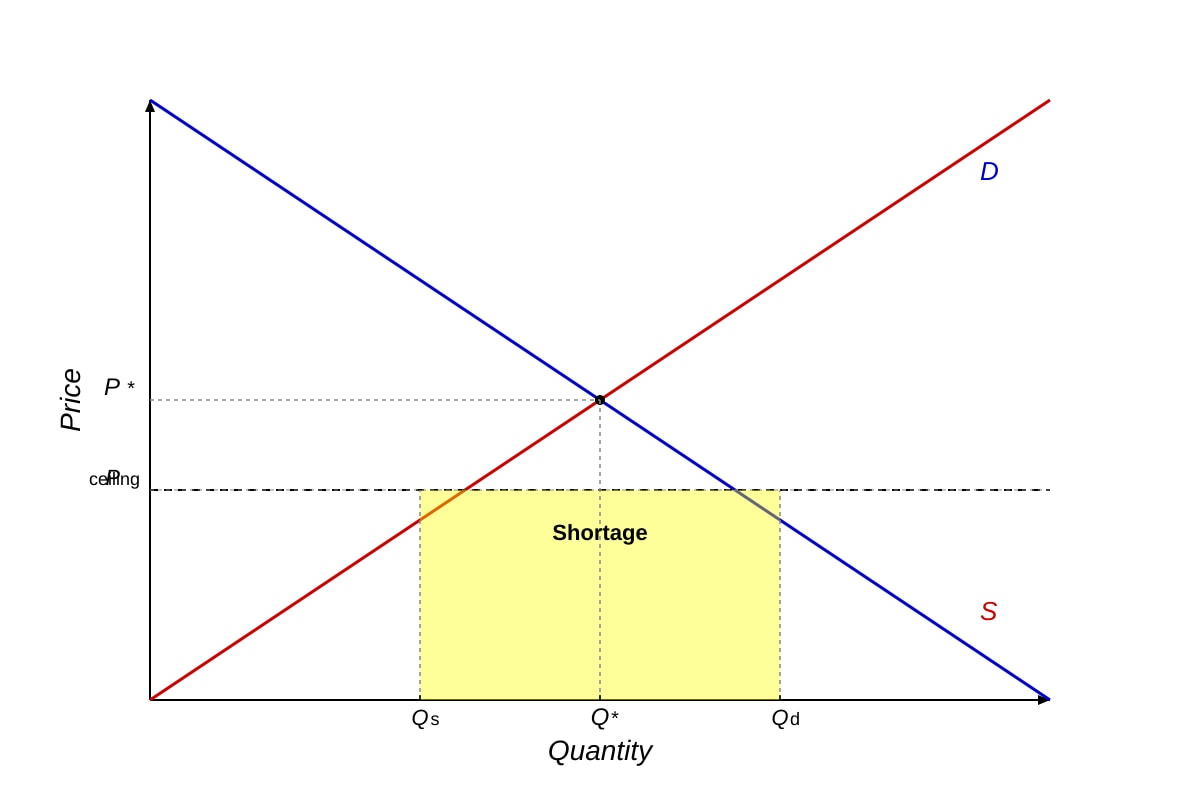
Generated diagram for Q4.
At the equilibrium price P* = 7 (below equilibrium):
- At $7, consumers wish to buy Qd = 70 units (read off the demand curve).
- At $7, producers are only willing to supply Qs = 30 units (read off the supply curve).
- This creates a shortage (excess demand) of Qd − Qs = 70 − 30 = 40 units.
The shortage arises because the artificially low price encourages more consumption while discouraging production. Since the price cannot rise to clear the market (the ceiling prevents it), the shortage persists.
Marking:
- 1 mark for a correctly drawn and labelled diagram showing D, S, equilibrium, price ceiling below equilibrium, Qd, Qs, and shortage.
- 1 mark for explaining that at the ceiling price, quantity demanded exceeds quantity supplied.
- 1 mark for explaining why the shortage occurs (low price encourages demand, discourages supply; price cannot adjust to clear the market).
Common mistakes:
- Drawing the price ceiling above equilibrium (this would be non-binding and have no effect).
- Not labelling the shortage/excess demand on the diagram.
- Confusing a price ceiling with a price floor.
Question 5 [4]
Explain two possible effects of the ABSD increase on the Singapore housing market.
Answer:
Effect 1: Fall in demand from foreign buyers, leading to lower property prices.
The ABSD increase from 30% to 60% significantly raises the cost of purchasing property for foreign buyers. For example, a 1.2 million in stamp duty, up from $600,000. This acts as a substantial increase in the total cost of purchase, causing the demand from foreign buyers to decrease (a shift of the demand curve to the left in the foreign buyer segment). This would put downward pressure on property prices, particularly in the luxury segment where foreign buyers are more active. This is consistent with the government's aim of cooling the market.
Effect 2: Fall in transaction volumes and negative impact on related industries.
As demand from foreign buyers (and potentially permanent residents, if the ABSD also applies to them) falls, the total number of property transactions is likely to decline. Lower transaction volumes reduce revenue for property agents, developers, and the construction sector. The construction sector may experience reduced demand for new housing projects, potentially leading to job losses and slower growth in that industry. This represents an unintended negative consequence of the policy.
Marking:
- 2 marks per effect (1 mark for identifying the effect, 1 mark for explaining it using economic concepts).
- Maximum 4 marks.
Common mistakes:
- Only discussing one effect in detail instead of two.
- Not using economic terminology (demand shift, downward pressure on prices, transaction volumes).
- Discussing effects on unrelated markets.
Question 6 [3]
Distinguish between productive efficiency and allocative efficiency. Give one example of each.
Answer:
Productive efficiency occurs when firms produce goods at the lowest possible average cost, i.e., at the minimum point of the average cost (AC) curve. It is about using resources in the most cost-effective way. A firm is productively efficient when it operates where MC = AC (the minimum point of AC).
Example: A car manufacturer that adopts lean manufacturing techniques to produce each car at the lowest possible cost per unit is productively efficient.
Allocative efficiency occurs when resources are allocated to produce the combination of goods and services that best reflects consumer preferences. It occurs where price (P) equals marginal cost (MC), meaning the value consumers place on the last unit (reflected by P) equals the cost of producing it (MC). At this point, consumer surplus plus producer surplus is maximised, and there is no deadweight loss.
Example: A perfectly competitive market in long-run equilibrium, where P = MC, is allocatively efficient because society's resources are being used to produce the goods consumers value most.
Key distinction: Productive efficiency is about how cheaply we produce (cost minimisation), while allocative efficiency is about what we produce (whether the right mix of goods is being produced to maximise welfare).
Marking:
- 1 mark for correct definition of productive efficiency.
- 1 mark for correct definition of allocative efficiency.
- 1 mark for a valid example of each (or clear distinction with examples).
Common mistakes:
- Confusing the two concepts.
- Giving the same example for both.
- Not mentioning P = MC for allocative efficiency or minimum AC for productive efficiency.
Question 7 [3]
Explain why a firm in perfect competition is a price taker but a monopolist is a price maker.
Answer:
Perfect competition — price taker:
In perfect competition, there are many small firms producing identical (homogeneous) products, and each firm has a very small market share. No single firm can influence the market price because its output is negligible relative to the total market. The market price is determined by the intersection of market demand and market supply. Each firm faces a perfectly elastic (horizontal) demand curve at the market-determined price. If a firm tries to charge above the market price, consumers will simply buy from competitors. Hence, the firm must "take" the market price as given.
Monopoly — price maker:
A monopolist is the sole supplier in the market and faces the entire market demand curve, which is downward sloping. Because the monopolist controls the entire market supply, it can choose to produce less to drive the price up, or produce more to lower the price. The monopolist therefore has the power to set its price (or equivalently, its output level) along the demand curve. It is a "price maker" because it has market power — the ability to influence the market price through its output decisions.
Marking:
- 1 mark for explaining why a perfectly competitive firm is a price taker (many firms, homogeneous products, small market share, horizontal demand curve).
- 1 mark for explaining why a monopolist is a price maker (sole supplier, faces market demand, downward-sloping demand, controls supply).
- 1 mark for a clear contrast/comparison between the two.
Common mistakes:
- Simply stating "many firms vs. one firm" without explaining the mechanism.
- Not mentioning the shape of the demand curve each firm faces.
Section B: Essay Questions
Question 8 [10]
(a) [4] Explain the conditions under which a merger might lead to lower prices for consumers.
Answer:
A merger might lead to lower prices for consumers under the following conditions:
1. Significant economies of scale: When two firms merge, the combined entity may achieve lower average costs through economies of scale. These include:
- Technical economies: Larger-scale production allows the use of more efficient technology and machinery.
- Financial economies: The merged firm may access cheaper borrowing due to its larger size and lower perceived risk.
- Managerial economies: Specialisation of management functions can reduce per-unit overhead costs.
- Purchasing economies: Greater bargaining power with suppliers allows the firm to negotiate bulk discounts.
If these cost savings are passed on to consumers (rather than retained as higher profits), prices could fall.
2. Elimination of duplication and rationalisation: The merger may allow the combined firm to eliminate duplicated operations (e.g., overlapping distribution networks, redundant administrative functions), reducing overall costs and enabling lower prices.
3. Increased efficiency through synergies: The merger may combine complementary strengths (e.g., one firm's R&D capability with the other's distribution network), leading to more efficient production and lower costs.
Marking:
- Up to 2 marks for explaining economies of scale (with specific types).
- Up to 2 marks for explaining other conditions (rationalisation, synergies, or pass-through of cost savings).
- Maximum 4 marks.
(b) [6] Discuss whether the Singapore government should approve the merger.
Answer:
Case for approval (benefits):
-
Economies of scale: The combined entity controlling 70% of the market could achieve significant cost savings through bulk purchasing from suppliers, shared distribution networks, and reduced overheads. These savings could be passed on to consumers in the form of lower grocery prices, benefiting Singaporean households, especially lower-income families who spend a larger proportion of income on food.
-
Improved competitiveness against imports: A larger, more efficient domestic firm may be better positioned to compete with imported goods and online grocery platforms, maintaining consumer choice and keeping prices competitive.
-
Investment and innovation: The merged firm may have greater financial resources to invest in supply chain technology, cold storage, and e-commerce capabilities, improving service quality for consumers.
Case against approval (costs):
-
Reduced competition and higher prices: With a 70% market share, the merged firm would have substantial market power. It could raise prices above competitive levels, exploiting consumers who have fewer alternatives. This is especially concerning in Singapore, where the grocery market is already concentrated.
-
Lower quality and less choice: With reduced competitive pressure, the merged firm may have less incentive to maintain product quality, variety, and innovation. Consumers could face reduced choice as the firm rationalises product lines.
-
Barriers to entry for new firms: The dominant position of the merged firm could create high barriers to entry (e.g., exclusive supplier agreements, prime retail locations), making it difficult for new competitors to enter and challenge the incumbent.
-
Impact on suppliers: The merged firm's increased bargaining power could squeeze supplier margins, potentially reducing the viability of local farmers and small suppliers.
Evaluation:
The decision depends on whether the efficiency gains from the merger outweigh the welfare losses from reduced competition. Given that the combined market share of 70% is very high, the competition concerns are significant. The government should consider:
- Imposing conditions on the merger (e.g., price caps, requirements to maintain supplier relationships, obligations to keep certain store locations open).
- Monitoring the market post-merger to ensure cost savings are passed to consumers.
- Considering whether the merger is necessary for efficiency gains, or whether the firms could achieve similar benefits through other means (e.g., strategic alliances).
On balance, the government should be cautious. The high market share suggests significant market power, and the potential for consumer harm is substantial. Approval should only come with strict conditions and ongoing regulatory oversight.
Marking:
- Up to 2 marks for explaining potential benefits of the merger.
- Up to 2 marks for explaining potential costs/concerns of the merger.
- Up to 2 marks for evaluation and reasoned judgement (weighing trade-offs, considering conditions, context-specific reasoning).
- Maximum 6 marks.
Question 9 [10]
(a) [4] Using a diagram, explain how a firm with market power determines its profit-maximising price and output.
Answer:
A firm with market power (such as a monopolist or dominant firm) maximises profit where Marginal Cost (MC) = Marginal Revenue (MR).
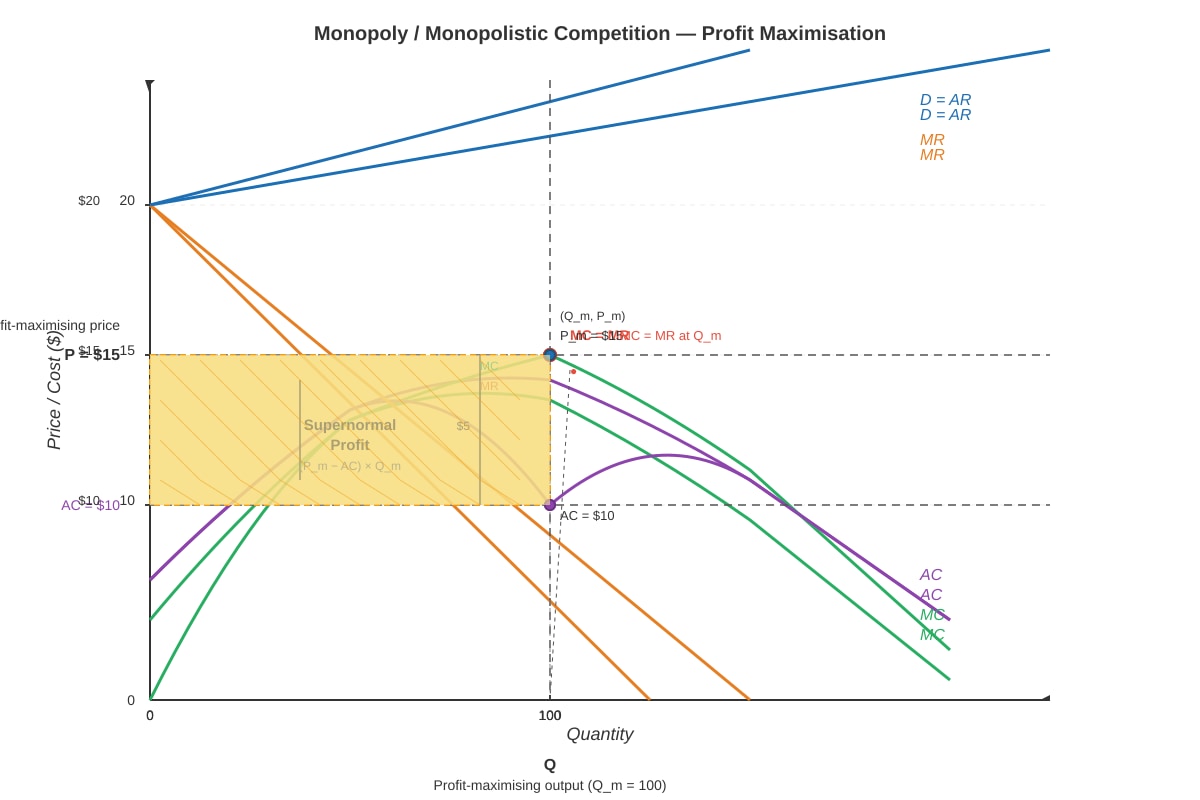
Generated diagram for Q9.
Explanation:
- The firm faces a downward-sloping demand curve (D = AR) because it has market power — it must lower its price to sell more units.
- The marginal revenue (MR) curve lies below the AR curve because to sell an additional unit, the firm must lower the price on all units sold, so MR < AR.
- The firm produces at the output level Q_m where MC = MR (the profit-maximising condition). This is because:
- If MC < MR, producing an additional unit adds more to revenue than to cost, so profit increases — the firm should expand output.
- If MC > MR, producing an additional unit adds more to cost than to revenue, so profit falls — the firm should reduce output.
- Profit is maximised where MC = MR.
- The profit-maximising price P_m is found by reading up from Q_m to the demand curve (AR), since the demand curve shows the price consumers are willing to pay for that quantity.
- At Q_m, if P_m > AC, the firm earns supernormal profit (shaded area = (P_m − AC) × Q_m).
Marking:
- 1 mark for a correctly drawn and labelled diagram (D=AR, MR, MC, AC, Q_m, P_m, profit area).
- 1 mark for explaining the MC = MR profit-maximising condition.
- 1 mark for explaining how the price is determined from the demand curve.
- 1 mark for explaining supernormal profit (P > AC at Q_m).
- Maximum 4 marks.
(b) [6] Evaluate whether the Singapore government should regulate the pricing strategies of dominant ride-hailing platforms.
Answer:
Case for regulation:
-
Consumer protection during peak hours: Dynamic pricing (surge pricing) can lead to very high fares during peak periods, which may exploit consumers who have limited alternatives (e.g., during rush hour or bad weather). Regulation could cap surge multipliers to protect consumers from excessive prices.
-
Addressing market failure — market power: With over 80% market share, Grab has significant market power. Without regulation, the firm may set prices above the competitive level, leading to allocative inefficiency (P > MC) and a deadweight loss to society. Regulation could promote a more efficient allocation of resources.
-
Driver welfare: High commission rates (e.g., 20-25%) reduce driver earnings. Regulation could set maximum commission rates, ensuring a fairer distribution of revenue between the platform and its drivers, who are often lower-income workers.
Case against regulation:
-
Dynamic pricing improves allocative efficiency: Surge pricing during peak hours serves an economic function — it rationes limited driver supply among consumers who value the service most, and it incentivises more drivers to come online during high-demand periods. Capping prices could worsen shortages during peak times.
-
Risk of unintended consequences: Price caps could reduce the profitability of ride-hailing, leading to fewer drivers on the platform, longer waiting times, and reduced service quality. Some drivers may exit the market entirely.
-
Market contestability: The ride-hailing market is relatively contestable — new entrants (e.g., Gojek, TADA, Ryde) can enter if profits are high. This competitive threat may discipline Grab's pricing behaviour without the need for regulation.
-
Regulatory burden and costs: Regulation requires monitoring and enforcement, which imposes costs on the government. There is also a risk of regulatory capture or poorly designed rules that distort the market further.
Evaluation:
On balance, some form of light-touch regulation may be justified, but heavy-handed price controls should be avoided. The government could:
- Require transparency in pricing algorithms so consumers understand how fares are calculated.
- Cap extreme surge multipliers (e.g., no more than 2x the base fare) to prevent exploitation while preserving the signalling function of dynamic pricing.
- Monitor driver commission rates and encourage competition from alternative platforms rather than directly regulating prices.
The key consideration is balancing consumer protection with the efficiency benefits of market-based pricing. Given Singapore's small market and the difficulty of sustaining multiple competing platforms, some regulatory oversight is warranted, but it should be proportionate and not stifle innovation.
Marking:
- Up to 2 marks for arguments in favour of regulation.
- Up to 2 marks for arguments against regulation.
- Up to 2 marks for evaluation and reasoned judgement.
- Maximum 6 marks.
Question 10 [10]
(a) [4] Explain why healthcare may be considered a merit good and how the free market would lead to its under-consumption.
Answer:
Healthcare as a merit good:
A merit good is a good that is deemed intrinsically desirable by society but would be under-consumed if left to the free market. Healthcare has the characteristics of a merit good for several reasons:
-
Positive externalities: When individuals consume healthcare (e.g., vaccinations, treatment of infectious diseases), there are spillover benefits to third parties. A vaccinated person reduces the risk of disease transmission to others. The marginal social benefit (MSB) of healthcare consumption exceeds the marginal private benefit (MPB). In a free market, individuals only consider their private benefits and ignore the external benefits, leading to under-consumption relative to the socially optimal level.
-
Information asymmetry: Patients often lack the medical knowledge to assess the quality and necessity of healthcare services. They rely on doctors' recommendations, and may under-consume necessary treatments (especially preventive care) because they do not fully understand the long-term health benefits. This is a form of information failure.
-
Societal values: Society generally believes that access to healthcare should not be determined solely by ability to pay. There is a moral argument that healthcare is a basic right, and that government intervention is needed to ensure equitable access.
Under-consumption in a free market:
In a free market, healthcare would be consumed where MPB = MPC (marginal private cost). However, because of positive externalities, MSB > MPB. The socially optimal level of consumption is where MSB = MSC (marginal social cost). Since the free market equilibrium occurs at a lower quantity than the socially optimal quantity, healthcare is under-consummed. This results in a deadweight loss, representing the welfare loss to society from the under-consumption.
Marking:
- 2 marks for explaining why healthcare is a merit good (positive externalities, information asymmetry, societal values — any two well-explained points).
- 2 marks for explaining under-consumption in the free market (MSB > MPB, free market produces less than socially optimal quantity, deadweight loss).
- Maximum 4 marks.
(b) [6] Discuss whether providing heavy subsidies is the best policy for the Singapore government to improve healthcare access.
Answer:
Case for heavy subsidies:
-
Improved access for low-income groups: Subsidies reduce the price of healthcare, making it affordable for lower-income households who might otherwise forgo necessary treatment. This promotes equity and ensures that healthcare access is not solely determined by ability to pay.
-
Capturing positive externalities: By encouraging greater consumption of healthcare (especially preventive care and vaccinations), subsidies help move consumption closer to the socially optimal level, internalising the positive externalities and reducing the deadweight loss.
-
Reduced long-term healthcare costs: Subsidised preventive care (e.g., regular check-ups, screenings) can detect health problems early, reducing the need for expensive emergency treatment later. This can lower overall healthcare expenditure in the long run.
Case against heavy subsidies (limitations):
-
Over-consumption and moral hazard: When healthcare is heavily subsidised, patients may over-consume services because they face a very low out-of-pocket cost. This is known as moral hazard — individuals may visit the doctor for minor ailments they would otherwise self-treat, wasting scarce healthcare resources.
-
Heavy fiscal burden: Subsidies require significant government expenditure, which must be funded through taxation or reallocation from other public services. In an ageing society like Singapore, healthcare costs are rising rapidly, and the fiscal sustainability of heavy subsidies is a concern.
-
Inefficiency in resource allocation: Subsidies may lead to an over-allocation of resources to healthcare at the expense of other sectors (e.g., education, infrastructure). The opportunity cost of heavy subsidies must be considered.
Alternative/complementary policies:
-
Co-payment systems (e.g., MediShield Life, Medisave): Singapore's approach of combining subsidies with mandatory co-payments and medical savings accounts helps to mitigate moral hazard while still ensuring access. Patients have "skin in the game," discouraging over-consumption.
-
Means-testing subsidies: Targeting subsidies at lower-income groups (as Singapore does with its tiered subsidy system) ensures that public funds are directed where they are most needed, improving both equity and efficiency.
-
Supply-side policies: Investing in healthcare infrastructure, training more doctors and nurses, and promoting competition among healthcare providers can increase supply and reduce costs without relying solely on demand-side subsidies.
-
Health education and prevention campaigns: Promoting healthy lifestyles and preventive care can reduce the demand for curative healthcare services, lowering overall costs.
Evaluation:
Heavy subsidies alone are not the best policy. While they improve access and address the positive externalities associated with healthcare, they also create moral hazard and fiscal challenges. Singapore's hybrid approach — combining targeted subsidies with co-payment mechanisms (Medisave, MediShield Life) and supply-side investments — is a more sustainable and efficient model. The government should continue to refine this approach, ensuring that subsidies are well-targeted and that co-payment mechanisms are designed to discourage over-consumption without creating barriers to necessary care.
Marking:
- Up to 2 marks for explaining the benefits of heavy subsidies.
- Up to 2 marks for explaining the limitations of heavy subsidies and/or alternative policies.
- Up to 2 marks for evaluation and reasoned judgement (weighing trade-offs, considering Singapore's specific context, recommending a balanced approach).
- Maximum 6 marks.
Mark Summary
| Section | Question | Marks |
|---|---|---|
| A | Q1 | 2 |
| A | Q2 | 2 |
| A | Q3 | 3 |
| A | Q4 | 3 |
| A | Q5 | 4 |
| A | Q6 | 3 |
| A | Q7 | 3 |
| Section A Total | 20 | |
| B | Q8 (a)+(b) | 10 |
| B | Q9 (a)+(b) | 10 |
| B | Q10 (a)+(b) | 10 |
| Section B Total (any 2 of 3) | 20 | |
| Grand Total | 40 |