From Real Exams Exam Paper
A Level H2 Economics Practice Paper 5
Free A Level H2 Econs Practice Paper 5, HY3 Exam version, with questions, answers, and A Level-style practice for Singapore students.
These static practice materials are generated from the site's syllabus and paper-generation workflow, with source and model context shown so students and parents can evaluate the material before use.
Questions
Free quiz and exam paper access
Enter your details to view this paper
Your access is remembered on this device.
Answers
Answer Key – TuitionGoWhere Practice Paper (Version 5) Economics H2 A-Level
Total Marks: 60
Section A (12 marks)
Q1 [2 marks]
- Opportunity cost is the value of the next best alternative forgone when a choice is made. (1 mark)
- From a consumer's perspective: if a consumer spends $10 on a meal, the opportunity cost is the other good (e.g., a book) they could have bought instead. (1 mark) Teaching note: Scarcity forces consumers to choose; every choice has a trade-off.
Q2 [3 marks]
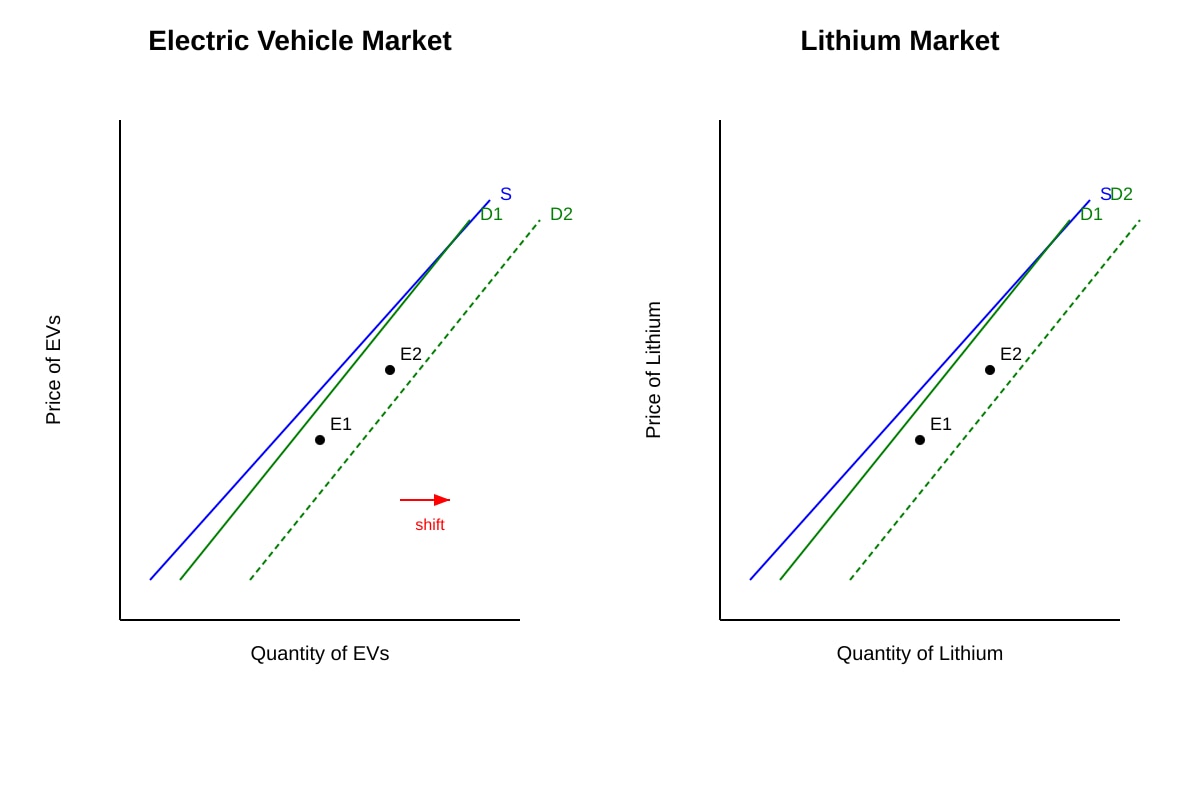
- Diagram: EV market D shifts right → higher P and Q of EVs. (1 mark)
- Derived demand for lithium (input) increases → lithium D shifts right. (1 mark)
- Lithium market: new equilibrium E2 with higher price and quantity. (1 mark) Expected visual: Q2-fig1 shows both shifts right, labelled axes and E1→E2.
Q3 [2 marks]
- Signalling function: price signals where resources are needed (e.g., high price attracts producers). (1 mark) OR incentive (rewards production) OR rationing (allocates via price). (1 mark for explanation)
Q4 [2 marks]
- Price of books falls → books cheaper relative to movies. (1 mark)
- Opportunity cost of a movie (in terms of books given up) rises because each movie now costs more books. (1 mark)
Q5 [3 marks]
- PPC drawn as downward sloping curve. (1 mark)
- Point inside curve shows unemployment/under-utilisation. (1 mark)
- Explanation: resources not fully used, productive efficiency not achieved. (1 mark)
Section B (18 marks)
Q6 [2 marks]
- Movement along: caused by change in own price. (1 mark)
- Shift: caused by non-price determinant (income, tastes, etc.). (1 mark)
Q7 [3 marks] Midpoint formula: %ΔQ = (80-100)/((80+100)/2) = -20/90 = -22.2%; %ΔP = (5-4)/4.5 = 1/4.5 = 22.2% PED = |-22.2 / 22.2| = 1.0 (unit elastic). (3 marks: 1 for Q%, 1 for P%, 1 for final) Common mistake: Using simple % (100→80 = -20%) gives wrong base.
Q8 [2 marks]
- Income elasticity = %ΔQ / %ΔIncome = -5 / +10 = -0.5. (1 mark)
- Negative → inferior good. (1 mark)
Q9 [4 marks]
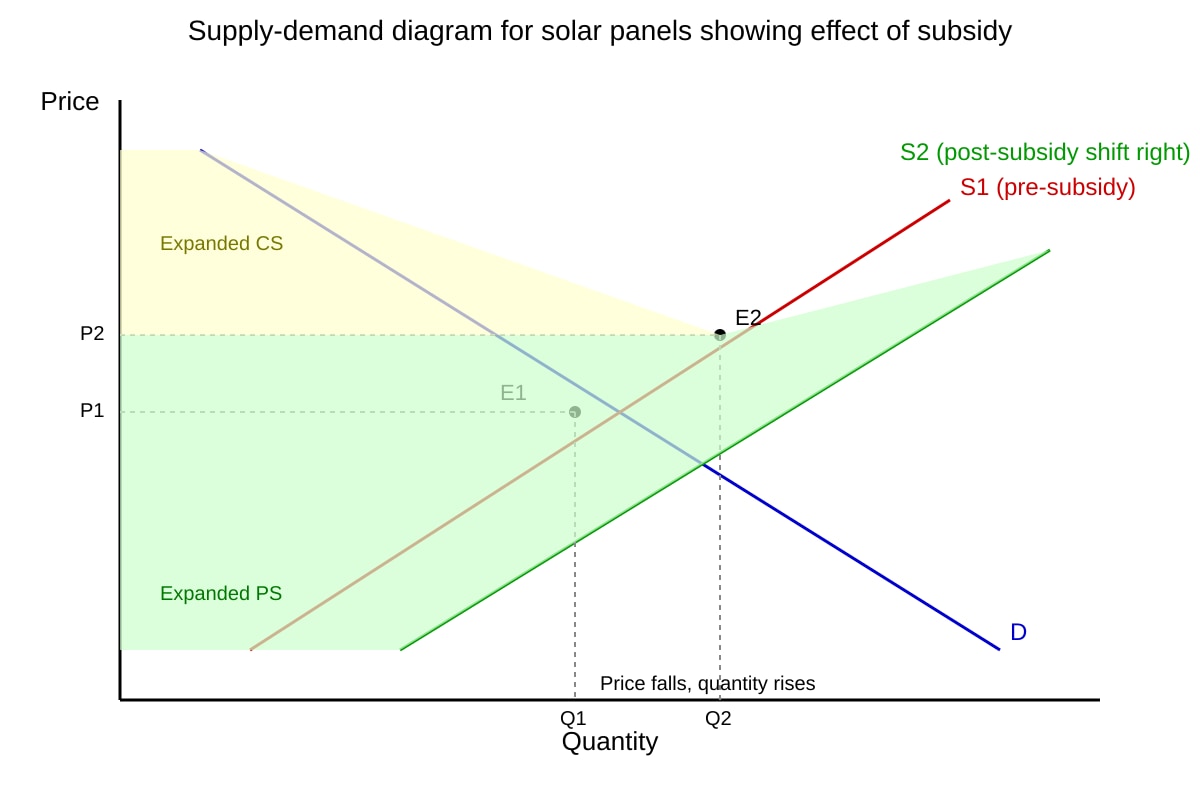
- Subsidy lowers producer cost → S shifts right. (1 mark)
- Price falls, quantity rises. (1 mark)
- Consumer surplus expands (lower price, more bought). (1 mark)
- Producer surplus expands (effective price received net of subsidy higher). (1 mark) Visual: Q9-fig1 shows expanded CS and PS.
Q10 [3 marks]
- Max price below eq → shortage (excess demand). (1 mark)
- Unintended: black market, rationing by queue, low maintenance. (2 marks for one explained)
Q11 [2 marks]
- XED = %ΔQd of A / %ΔP of B. (1 mark)
- Negative → complements (e.g., cars and petrol). (1 mark)
Section C (12 marks)
Q12 [3 marks]
- Profit max where MR = MC. (1 mark)
- MC must be rising so that beyond that point MC > MR, reducing profit. (2 marks)
Q13 [2 marks]
- Non-price competition: branding, advertising, product differentiation. (1 mark)
- Some price competition but not pure price war. (1 mark)
Q14 [2 marks]
- Revenue max at MR = 0, output higher than profit max (MR=MC). (2 marks)
Q15 [5 marks]
- Define merger, market before (competitive/oligopoly). (1)
- Benefit: scale economies → lower price, better tech. (2)
- Disadvantage: less competition → higher price, reduced choice. (2) Marking: Balanced discussion with diagram optional but credit if used.
Section D (18 marks)
Q16 [2 marks]
- Negative externality: textile waste harms environment not priced in. (2 marks)
Q17 [3 marks]
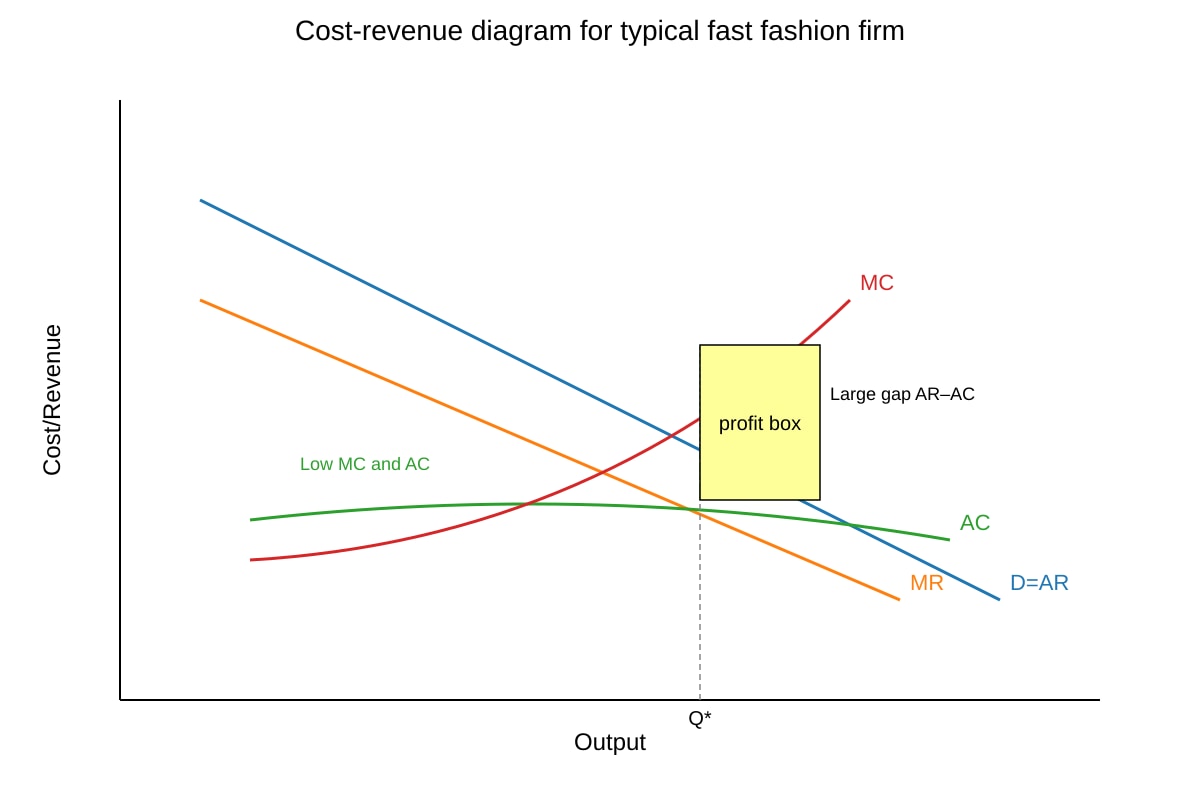
- Diagram shows low AC, large profit gap. (1)
- Cost reason: cheap materials, low MC → high profit, no incentive to switch. (2) Visual: Q17-fig1 profit box highlighted.
Q18 [8 marks]
- Role of consumer choice (2): demand shifts to sustainable if they act.
- Market failure (2): externality, info asymmetry.
- Barriers (2): cheap fast fashion, low income, limited info.
- Need systemic (2): regulation, EPR. Descriptor: 8 = eval with balance; 4–5 = one-sided; 2 = list.
Q19 [2 marks]
- Consumers lack info on harm → choose by price only. (2 marks)
Q20 [3 marks]
- E.g., labelling law (1), improves info → better choice (2). OR quota on waste.
End of Answer Key