From Real Exams Exam Paper
A Level H2 Economics Practice Paper 3
Free A Level H2 Econs Practice Paper 3, LongCat Exam version, with questions, answers, and A Level-style practice for Singapore students.
These static practice materials are generated from the site's syllabus and paper-generation workflow, with source and model context shown so students and parents can evaluate the material before use.
Questions
Free quiz and exam paper access
Enter your details to view this paper
Your access is remembered on this device.
Answers
A-Level Economics H2 Quiz - Microeconomics
Answer Key and Marking Scheme
Section A: Short Answer Questions (10 marks)
Question 1 (2 marks)
Definition: Price elasticity of demand (PED) measures the responsiveness of quantity demanded to a change in the price of the good itself, ceteris paribus. [1 mark]
Formula:
or equivalently:
[1 mark]
Teaching note: PED is typically negative due to the inverse relationship between price and quantity demanded (law of demand). However, economists often refer to the absolute value. The key is that PED measures responsiveness — how much quantity demanded changes in percentage terms relative to the price change.
Question 2 (2 marks)
Working:
Answer: PED = −1.5 (or 1.5 in absolute terms) [1 mark for correct calculation, 1 mark for correct answer]
Interpretation: Since |PED| > 1, demand is price elastic — quantity demanded changes by a larger percentage than the price change.
Teaching note: The negative sign reflects the law of demand (price and quantity demanded move in opposite directions). Students should show the substitution of values into the formula for the method mark even if the final answer is incorrect.
Question 3 (2 marks)
Normal good: A good for which demand increases as consumer income increases (positive income elasticity of demand). [½ mark] Example: restaurant meals, branded clothing, private transport. [½ mark]
Inferior good: A good for which demand decreases as consumer income increases (negative income elasticity of demand). [½ mark] Example: instant noodles, public transport, second-hand goods. [½ mark]
Teaching note: The distinction depends on the direction of the income-demand relationship. Normal goods have a positive relationship; inferior goods have a negative relationship. The same good can be normal for one income group and inferior for another.
Question 4 (2 marks)
The supply curve is upward sloping because of the positive relationship between price and quantity supplied, ceteris paribus. [1 mark]
As price rises, firms are willing and able to supply more because:
- Higher prices increase profitability/producer surplus, incentivising firms to expand output
- Higher prices may attract new firms into the market
- At higher output levels, marginal cost tends to rise (law of diminishing returns), so firms require a higher price to justify producing additional units [1 mark for any valid explanation]
Teaching note: The upward slope reflects the law of supply. Students should connect the incentive effect (higher price = greater reward) with the cost effect (higher output = higher marginal cost).
Question 5 (2 marks)
Any two of the following characteristics: [1 mark each, maximum 2 marks]
- Many buyers and sellers (no single agent can influence the market price)
- Homogeneous/identical products (perfect substitutes)
- Perfect information (all agents have full knowledge of prices and product quality)
- No barriers to entry or exit (firms can freely enter or leave the market)
- Firms are price takers (they accept the market-determined price)
Teaching note: Perfect competition is a theoretical benchmark. In reality, no market satisfies all these conditions perfectly, but some agricultural and financial markets approximate it closely.
Section B: Data Response and Analysis (15 marks)
Question 6 (3 marks)
Mark scheme:
- Level 1 (1 mark): Identifies that Grab's market share increased / the market became more concentrated
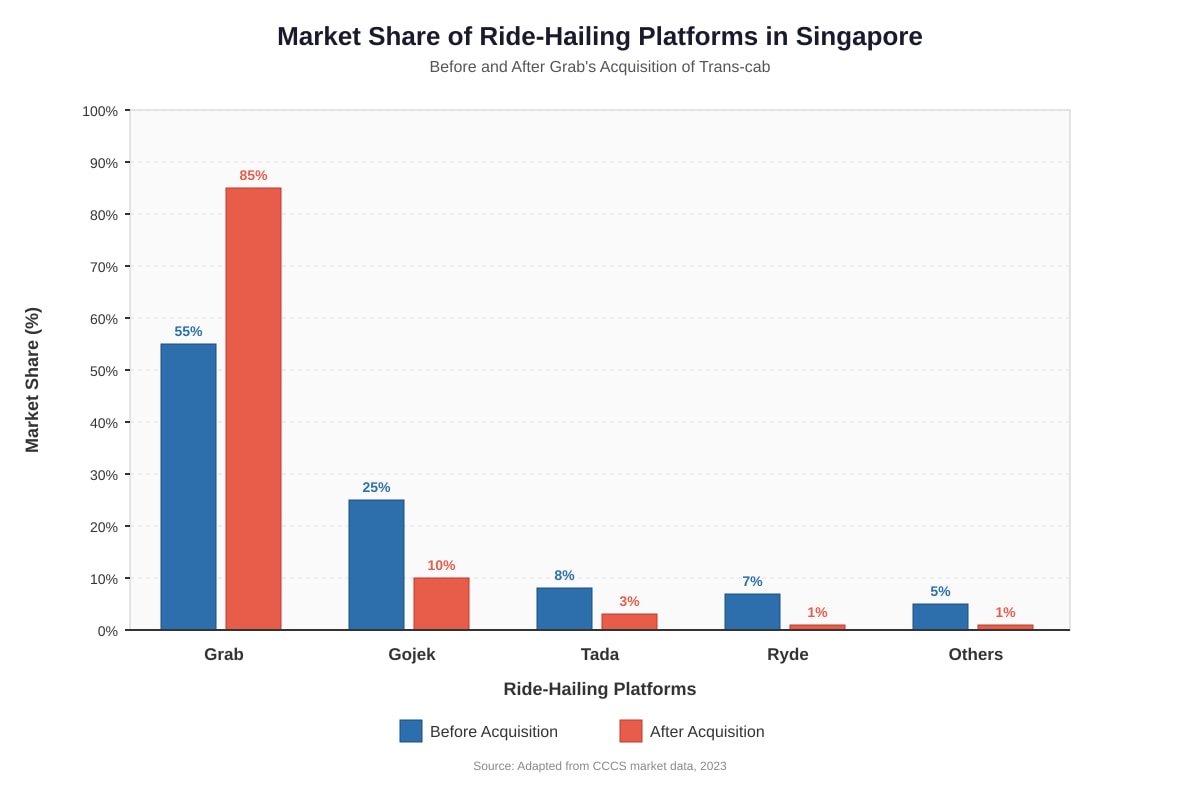
- Level 2 (2 marks): Describes the change with reference to specific data from the extract (e.g., Grab's share rose from 55% to 85%; Gojek's share fell from 25% to 10%; smaller players lost share)
- Level 3 (3 marks): Describes the change accurately with data and identifies the structural shift (e.g., from a more competitive oligopoly toward a near-monopoly/market dominance by Grab)
Expected response:
Following the acquisition, Grab's market share increased significantly from approximately 55% to 85% of the combined ride-hailing and taxi market. [1 mark] Gojek's share fell from 25% to 10%, while smaller players such as Tada and Ryde saw their shares decline from 8% to 3% and 7% to 1% respectively. [1 mark] This represents a significant increase in market concentration, with the market structure shifting from a competitive oligopoly toward one dominated by a single firm (Grab), approaching a near-monopoly position. [1 mark]
Teaching note: Students must use specific data from the extract to support their description. Generic statements without data references will not achieve full marks.
Question 7 (3 marks)
Mark scheme:
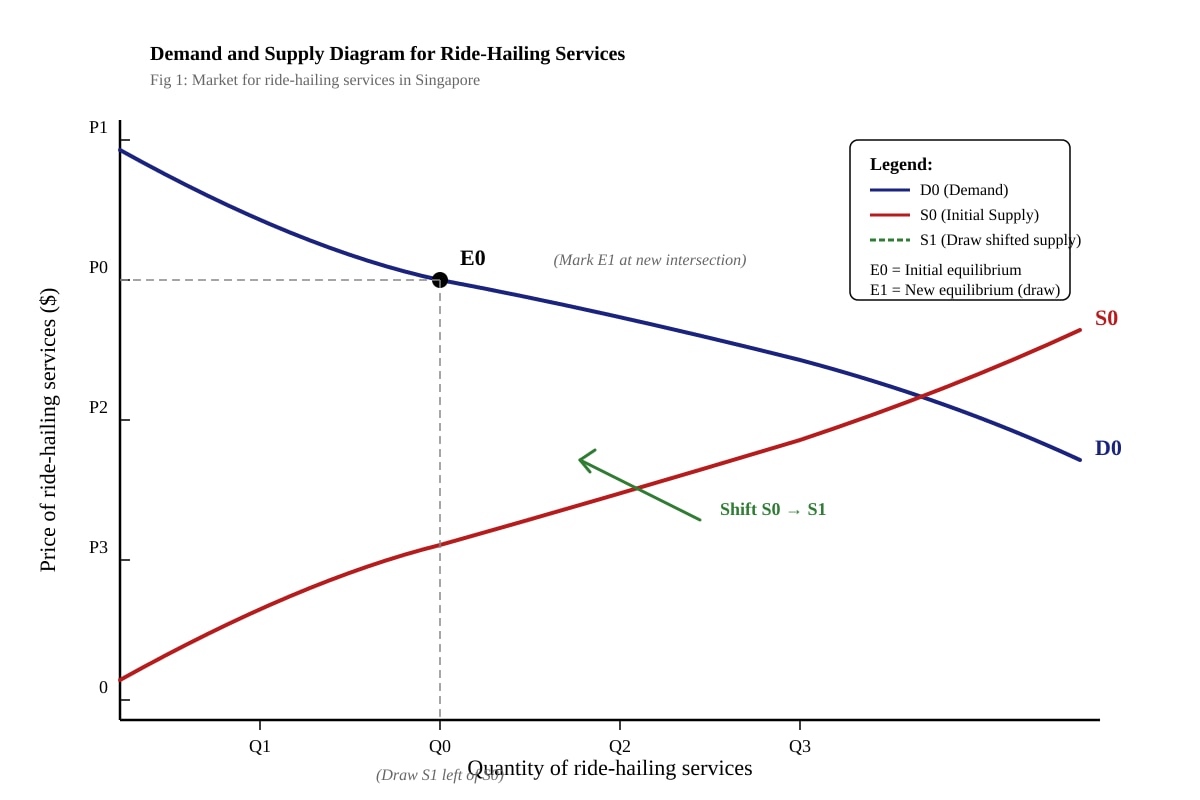
- 1 mark: Correctly drawn and labelled demand and supply diagram showing initial equilibrium
- 1 mark: Correct shift of the supply curve to the left (S0 → S1) reflecting reduced competition / fewer suppliers
- 1 mark: Correct identification of new equilibrium with higher price (P1 > P0) and lower quantity (Q1 < Q0)
Expected diagram features:
Generated image for this question.
id: Q7-fig1-answer type: diagram linked_question: Q7 description: Completed demand and supply diagram showing the effect of reduced competition on the ride-hailing market. D0 is downward sloping. S0 is upward sloping, intersecting D0 at E0 (P0, Q0). S1 is shifted left from S0, intersecting D0 at E1 (P1, Q1) where P1 > P0 and Q1 < Q0. labels: D0 (downward sloping), S0 (initial supply, upward sloping), S1 (new supply, left of S0, upward sloping), E0 (P0, Q0), E1 (P1, Q1) values: P1 > P0, Q1 < Q0 must_show: Both supply curves clearly labelled, both equilibrium points labelled with prices and quantities, arrow showing leftward shift of supply curve, axes labelled "Price ($)" and "Quantity"
Explanation: The acquisition reduces the number of competitors in the market, effectively reducing market supply. The supply curve shifts leftward from S0 to S1. At the original price P0, there is now a shortage, which puts upward pressure on price. The new equilibrium E1 is at a higher price P1 and a lower quantity Q1. [1 mark for explanation]
Teaching note: Some students may argue that the acquisition could increase supply (more driver-partners joined Grab). Either argument is acceptable if logically consistent and correctly illustrated. The key is the quality of reasoning, not the direction of the shift.
Question 8 (3 marks)
Mark scheme:
- 1 mark: Defines or explains low barriers to entry (e.g., low capital requirements, easy access to driver-partners)
- 1 mark: Explains the mechanism — if Grab raises prices above the competitive level, new firms are attracted to enter the market to capture supernormal profits
- 1 mark: Links to the long-run outcome — new entry increases market supply, driving prices back down toward the competitive level, limiting Grab's pricing power
Expected response:
Low barriers to entry mean that new firms can easily enter the ride-hailing market without significant capital investment or regulatory obstacles. [1 mark] If Grab attempts to exploit its dominant market position by raising prices significantly above the competitive level, the resulting supernormal profits would attract new entrants (as the CCCS noted, driver-partners are readily available and platform setup costs are low). [1 mark] These new entrants would increase market supply, intensifying competition and driving prices back down. Therefore, the threat of potential entry constrains Grab's ability to raise prices in the long run, even though it currently holds 85% market share. [1 mark]
Teaching note: This question tests understanding of contestable market theory. Even a dominant firm may behave competitively if the market is contestable (low barriers to entry and exit). Students should distinguish between short-run market power and long-run competitive discipline.
Question 9 (3 marks)
Working:
[1 mark for correct formula, 1 mark for correct substitution and calculation]
Interpretation: The XED is positive (+2.5), which means Grab and Gojek services are substitutes. [½ mark] A positive XED indicates that as the price of Grab services rises, consumers switch to Gojek, increasing demand for Gojek. The magnitude of 2.5 suggests they are close substitutes — demand for Gojek is highly responsive to changes in Grab's price. [½ mark]
Teaching note: XED is positive for substitutes (goods that can replace each other) and negative for complements (goods used together). The larger the absolute value, the stronger the relationship. Students should always interpret the sign and magnitude of elasticity values.
Question 10 (3 marks)
Mark scheme:
- 1 mark: Identifies an argument supporting the CCCS decision (e.g., low barriers to entry, continued presence of Gojek, consumer benefits from network effects)
- 1 mark: Identifies an argument against the CCCS decision (e.g., 85% market share is dominant, 8% fare increase post-acquisition, reduced consumer choice, potential for predatory pricing)
- 1 mark: Provides a reasoned judgement weighing both sides
Expected response:
Supporting the CCCS: The CCCS may be correct because barriers to entry remain low — new platforms can enter easily, and the continued presence of Gojek (10% share) provides some competitive constraint. The 12% growth in driver-partners also suggests the market remains dynamic. [1 mark]
Against the CCCS: However, the 85% market share gives Grab significant market power. The 8% fare increase within six months of the acquisition suggests that Grab is already exercising this power. Smaller competitors have been marginalised (Tada and Ryde now hold only 3% and 1% respectively), reducing consumer choice and potentially leading to further price increases and quality deterioration in the long run. [1 mark]
Judgement: The CCCS's conclusion may be premature. While low barriers to entry provide some long-run discipline, in the short to medium term, consumers are already facing higher prices. The CCCS should monitor the market closely and consider behavioural remedies (e.g., price caps or service quality standards) rather than relying solely on the threat of entry to protect consumers. [1 mark]
Teaching note: Evaluation questions require students to present both sides and reach a supported judgement. The judgement must be consistent with the analysis presented. There is no single "correct" answer — what matters is the quality of economic reasoning.
Section C: Extended Response (15 marks)
Question 11 (15 marks)
"Government intervention in markets always leads to a net welfare loss."
Discuss this statement with reference to a market of your choice.
Mark scheme (levels-based):
| Level | Marks | Descriptor |
|---|---|---|
| Level 1 | 1–4 | Basic understanding; one-sided argument; limited economic terminology; no real-world reference |
| Level 2 | 5–8 | Some analysis of intervention effects; identifies welfare gains or losses; limited evaluation; some use of examples |
| Level 3 | 9–12 | Good analysis of both welfare gains and losses; uses relevant economic theory (diagrams, concepts); supported by real-world examples; some evaluation |
| Level 4 | 13–15 | Comprehensive analysis; clear understanding of when intervention creates vs. reduces welfare loss; well-supported with examples; strong evaluation with reasoned judgement |
Indicative content:
Arguments that intervention CAN lead to net welfare loss (supporting the statement):
- Deadweight loss from taxation: Taxes create a wedge between the price consumers pay and the price producers receive, reducing the quantity traded below the socially optimal level. The resulting deadweight loss represents a net welfare loss. [Analysis + diagram reference]
- Price controls: Price ceilings (e.g., rent control) can create shortages, black markets, and misallocation of resources. Price floors (e.g., minimum wage) can create surpluses (unemployment). Both distort market outcomes.
- Subsidies: While subsidies can correct under-consumption of merit goods, they impose a cost on taxpayers and may lead to over-consumption or inefficiency if the subsidy is poorly targeted.
- Regulatory burden: Excessive regulation can increase compliance costs, reduce innovation, and create barriers to entry, reducing dynamic efficiency.
Arguments that intervention CAN lead to net welfare gain (challenging the statement):
- Correcting market failure: In the presence of negative externalities (e.g., pollution), the free market over-produces. A Pigouvian tax can internalise the externality, shifting output toward the socially optimal level and eliminating the welfare loss from over-production. [Analysis + diagram reference]
- Public goods: The free market under-provides public goods (e.g., national defence, street lighting) due to the free-rider problem. Government provision can achieve a more efficient outcome.
- Merit goods: Goods like education and healthcare are under-consumed in a free market due to information failures and positive externalities. Subsidies or direct provision can increase consumption toward the socially optimal level.
- Market dominance: In markets with monopoly power, firms restrict output and raise prices above marginal cost, creating a deadweight loss. Government intervention (e.g., price regulation, antitrust action) can improve allocative efficiency.
Evaluation/Judgement:
The statement is too absolute. Whether government intervention leads to a net welfare loss depends on:
- The type of market failure being addressed (if any)
- The design and implementation of the intervention (well-designed interventions can improve outcomes; poorly designed ones can worsen them)
- The magnitude of the intervention relative to the market failure
- Dynamic effects (e.g., long-run innovation impacts)
In markets with clear market failures (e.g., pollution, public goods), well-designed intervention is likely to yield net welfare gains. In markets functioning efficiently, intervention is more likely to create net welfare losses. The key is whether the intervention addresses a genuine market failure and is implemented at the appropriate scale.
Teaching note: This question tests the ability to evaluate a sweeping statement. Students should avoid a one-sided answer. The best responses acknowledge that the statement contains some truth (intervention can create inefficiency) but is overly absolute (intervention can also correct market failures and improve welfare). A clear, well-supported judgement is essential for Level 4.
Question 12 (15 marks)
Discuss whether price discrimination is the best strategy for a firm operating in an oligopolistic market to increase its profits.
Mark scheme (levels-based):
| Level | Marks | Descriptor |
|---|---|---|
| Level 1 | 1–4 | Basic understanding of price discrimination; limited analysis; no reference to oligopoly context |
| Level 2 | 5–8 | Explains price discrimination; identifies conditions; some analysis of profit effects; limited evaluation |
| Level 3 | 9–12 | Good analysis of how price discrimination increases profits; considers oligopoly-specific factors (interdependence, game theory); evaluates alternatives; some judgement |
| Level 4 | 13–15 | Comprehensive analysis; considers multiple types of price discrimination; evaluates in oligopoly context with strategic considerations; strong judgement on "best strategy" |
Indicative content:
How price discrimination can increase profits:
- First-degree (perfect) price discrimination: The firm charges each consumer their maximum willingness to capture all consumer surplus as producer surplus/profit. This maximises revenue but requires perfect information about each consumer's willingness to pay — rarely achievable in practice.
- Second-degree price discrimination: The firm charges different prices based on quantity consumed or product versioning (e.g., bulk discounts, premium vs. standard versions). This captures some consumer surplus and can increase total revenue.
- Third-degree price discrimination: The firm segments the market into groups with different price elasticities of demand and charges each group a different price (e.g., student discounts, peak/off-peak pricing). Profit is maximised when MR = MC in each segment.
Conditions required for price discrimination:
- The firm must have some degree of market power (ability to set prices)
- The market must be separable into distinct segments
- No arbitrage between segments (consumers cannot resell between markets)
Why price discrimination may be effective in an oligopoly:
- Oligopolistic firms have market power (downward-sloping demand curves), satisfying condition 1
- Oligopolists can use non-price competition strategies alongside price discrimination
- Price discrimination allows firms to extract more consumer surplus without triggering a price war (if segments are clearly defined)
Why price discrimination may NOT be the best strategy in an oligopoly:
- Interdependence and retaliation: In an oligopoly, firms are interdependent. If one firm introduces price discrimination, rivals may respond with their own pricing strategies, potentially triggering a price war that erodes profits for all firms.
- Consumer resentment: Price discrimination can lead to consumer dissatisfaction and reputational damage, particularly if the pricing is perceived as unfair. This is especially risky in an oligopoly where consumers can switch to rivals.
- Arbitrage risk: In oligopolistic markets with similar products, consumers may find ways to arbitrage between segments, undermining the price discrimination strategy.
- Alternative strategies may be more effective:
- Product differentiation: Creating brand loyalty through advertising and innovation can sustain higher prices without the complexity of price discrimination
- Collusion/cartel behaviour: Coordinating prices with rivals (though illegal) can be more profitable than individual price discrimination
- Limit pricing: Setting prices low enough to deter new entrants can protect long-term market share
- Non-price competition: Competing on quality, service, or innovation rather than price can build sustainable competitive advantage
Evaluation/Judgement:
Price discrimination can be a profitable strategy for an oligopolistic firm, particularly when market segments are clearly identifiable and arbitrage is difficult (e.g., airline pricing, cinema tickets). However, it is not necessarily the best strategy because:
- The oligopolistic context introduces strategic complexity — rivals' reactions matter
- The administrative and informational costs of implementing price discrimination may be substantial
- Alternative strategies (product differentiation, innovation) may yield more sustainable long-term profits
The "best" strategy depends on market-specific factors: the nature of the product, the degree of interdependence between firms, consumer awareness and sensitivity, and the regulatory environment. Price discrimination is one tool among many, and its effectiveness varies by context.
Teaching note: The word "best" in the question demands evaluation. Students must compare price discrimination with alternative strategies and reach a contextualised judgement. Simply explaining how price discrimination works is insufficient for high marks — the oligopoly context and strategic considerations are essential.
End of Answer Key