From Real Exams Exam Paper
A Level H2 Economics Practice Paper 2
Free A Level H2 Econs Practice Paper 2, LongCat Exam version, with questions, answers, and A Level-style practice for Singapore students.
These static practice materials are generated from the site's syllabus and paper-generation workflow, with source and model context shown so students and parents can evaluate the material before use.
Questions
Free quiz and exam paper access
Enter your details to view this paper
Your access is remembered on this device.
Answers
TuitionGoWhere Practice Paper - Economics H2 A-Level
Answer Key — Version 2 of 5
Section A: Case Study
Question 1 [4 marks]
Calculation:
Total trips = Number of vehicles × Average trips per vehicle per month Total trips = 48,000 × 320 = 15,360,000 trips per month
Limitation (any one, 2 marks):
- The calculation assumes all 48,000 private-hire vehicles belong to Grab, but the case states Grab holds 70% of the private-hire market. The actual number of Grab vehicles is approximately 33,600 (70% × 48,000), so the figure is an overestimate.
- The average of 320 trips per driver per month may not apply uniformly — some drivers may be part-time and complete fewer trips, while full-time drivers may complete more.
- The figure does not account for seasonal variation in demand (e.g., more trips during rainy days or public holidays).
Mark breakdown:
- Correct formula/setup: 1 mark
- Correct final answer (15,360,000): 1 mark
- Valid limitation identified: 1 mark
- Explanation of limitation: 1 mark
Common mistakes:
- Forgetting to state the unit (trips per month).
- Stating a limitation without explaining why it matters.
Question 2 [4 marks]
Explanation:
Grab's PED of −1.4 (less elastic) compared to Gojek's −1.8 (more elastic) can be explained by:
-
Brand loyalty and market dominance (2 marks): Grab holds 70% of the private-hire market, making it the dominant platform. Consumers who are accustomed to Grab's app interface, loyalty rewards (GrabRewards), and integrated ecosystem (GrabFood, GrabPay) are less likely to switch to alternatives when Grab raises prices. This makes demand less price-elastic. Gojek, as a smaller competitor, has less brand loyalty, so its consumers are more price-sensitive.
-
Availability of substitutes (2 marks): Because Grab is the largest platform, passengers perceive fewer close substitutes for Grab specifically — switching away from Grab means switching to a smaller platform with potentially longer wait times. Gojek users, however, can more easily switch to Grab (the dominant player) or TADA, making Gojek's demand more elastic.
Mark breakdown:
- First valid reason with explanation: 2 marks
- Second valid reason with explanation: 2 marks
Common mistakes:
- Simply restating the numbers without explaining the economic reasoning.
- Confusing elasticity with the law of demand.
Question 3(a) [4 marks]
Diagram and explanation:
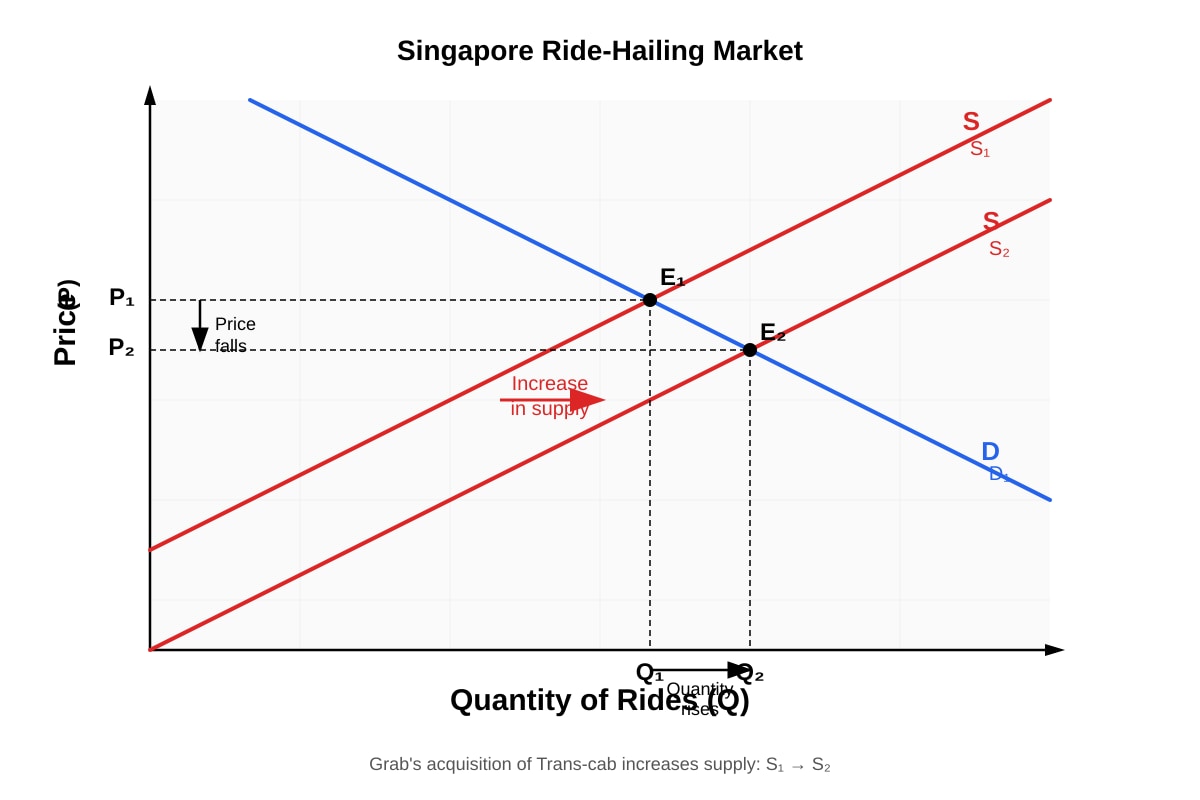
Generated graph for Q3(a).
Explanation:
The acquisition of Trans-cab allows Grab to integrate 2,500 additional taxis into its fleet, increasing the total supply of ride-hailing services in Singapore. This is represented by a rightward shift of the supply curve from S1 to S2. The demand curve remains unchanged in the short run. The new equilibrium moves from E1 to E2, resulting in a lower market price (P1 → P2) and a higher quantity of rides (Q1 → Q2).
Mark breakdown:
- Correctly drawn and labelled diagram (D, S1, S2, P1, P2, Q1, Q2): 2 marks
- Correct explanation of supply shift and new equilibrium: 2 marks
Question 3(b) [2 marks]
One factor (any one, 2 marks):
- Economies of scale may not materialise: Grab's argument that the acquisition would lower long-run average costs depends on successful integration. If there are diseconomies of scale (e.g., management complexity integrating Trans-cab's fleet), costs could rise, shifting supply leftward instead.
- Demand may change simultaneously: If Singapore's population grows or tourism recovers post-pandemic, demand could increase (D shifts right), potentially offsetting the price reduction from the supply increase.
- Dynamic pricing algorithms: Grab uses surge pricing, so the "market price" is not a single equilibrium price but a range. The average fare may not fall even if the supply increase would suggest so.
Mark breakdown:
- Valid factor identified: 1 mark
- Explanation of how it changes the outcome: 1 mark
Question 4 [4 marks]
Explanation:
A two-sided market connects two distinct user groups — in this case, drivers and passengers. Network effects mean that the value of the platform to each group depends on the size of the other group.
-
Passenger side (2 marks): Passengers prefer platforms with more drivers because this reduces waiting times and increases the probability of finding a ride quickly. Grab, with its 70% market share, already has the largest driver network, making it the most attractive platform for passengers.
-
Driver side (2 marks): Drivers prefer platforms with more passengers because this means more trip requests, higher earnings, and less idle time. Since Grab has the most passengers (due to its market dominance), it attracts even more drivers.
-
Barrier to entry (integrated): A new entrant (e.g., a new ride-hailing app) would start with few drivers and few passengers. Without a critical mass of users on both sides, the platform would offer poor service (long wait times for passengers, low earnings for drivers), making it unattractive. This "chicken-and-egg" problem, driven by network effects, acts as a significant barrier to entry, reinforcing Grab's market dominance.
Mark breakdown:
- Explanation of two-sided market concept: 1 mark
- Network effects on passenger side: 1 mark
- Network effects on driver side: 1 mark
- Link to barrier to entry: 1 mark
Common mistakes:
- Describing network effects without linking them to the two-sided nature of the market.
- Failing to explain why this constitutes a barrier to entry.
Question 5(a) [2 marks]
Calculation:
Percentage change in consumer surplus:
Consumer surplus fell by approximately 9.2%.
Mark breakdown:
- Correct formula/substitution: 1 mark
- Correct final answer (−9.2% or −9.19%): 1 mark
Question 5(b) [4 marks]
Discussion:
A fall in consumer surplus does not necessarily mean the acquisition is harmful to society because:
Arguments that it may still be harmful (2 marks):
- The $17 million annual fall in consumer surplus represents a direct welfare loss to consumers. If fares have risen or service quality has declined, consumers are worse off.
- The increase in Grab's market share to 78% raises concerns about market dominance. In the long run, reduced competition could lead to further price increases, lower innovation, and reduced consumer choice — dynamic inefficiency.
Arguments that it may not be harmful (2 marks):
- Producer surplus and total welfare: The acquisition may have increased producer surplus through economies of scale (better fleet utilisation, lower average costs). If the gain in producer surplus exceeds the loss in consumer surplus, total welfare (consumer surplus + producer surplus) could increase.
- Long-run benefits: Grab has argued that the acquisition enables investment in electric vehicle infrastructure and fleet modernisation. If these investments reduce long-run costs and improve service quality, consumer surplus could recover or exceed pre-acquisition levels in the future.
- Government regulation: The CCCS imposed conditions (fare transparency, data-sharing) to mitigate potential anti-competitive effects. The Point-to-Point Transport Industry Act also provides regulatory oversight, which may prevent abuse of market power.
Mark breakdown:
- One argument that the acquisition is harmful, with explanation: 2 marks
- One argument that the acquisition may not be harmful, with explanation: 2 marks
Common mistakes:
- Asserting that a fall in consumer surplus always means societal harm without considering producer surplus or dynamic effects.
- Not using the data from the case study to support arguments.
Question 6 [6 marks]
Assessment:
This question requires students to weigh arguments for and against the government blocking the acquisition, reaching a reasoned judgement.
Arguments for blocking the acquisition (3 marks):
- Increased market concentration: Grab's market share rising to 78% significantly reduces competition. With fewer competitors, Grab may have greater market power to raise fares, reduce service quality, or engage in anti-competitive practices such as predatory pricing against remaining rivals (TADA).
- Consumer harm: The data shows consumer surplus fell by $17 million/year post-acquisition, suggesting consumers are already worse off. Blocking the acquisition could have preserved competition and maintained lower fares.
- Barrier to entry: The acquisition strengthens Grab's network effects, making it even harder for new entrants to compete. Blocking it would preserve a more contestable market.
Arguments against blocking the acquisition (3 marks):
- Economies of scale: The acquisition allows Grab to achieve cost savings through better fleet utilisation, shared maintenance facilities, and bulk purchasing. These savings could be passed on to consumers in the form of lower fares in the long run.
- Regulatory safeguards: The CCCS approved the acquisition subject to conditions (fare transparency, data-sharing). These conditions mitigate the risk of anti-competitive behaviour, making a blanket block unnecessary.
- Market contestability: Despite Grab's dominance, the market remains contestable. TADA and Gojek still operate, and the low barriers to switching between apps (multi-homing) mean consumers can easily change providers. The threat of potential entry may discipline Grab's pricing.
Judgement (included within the above): A strong answer should conclude with a clear judgement, e.g., "On balance, the government was right to approve the acquisition with conditions rather than block it outright, because the regulatory safeguards address the main competition concerns while allowing the realisation of economies of scale. However, ongoing monitoring by CCCS is essential to ensure compliance."
Mark breakdown:
- Knowledge and understanding of relevant concepts (market power, competition, regulation): 2 marks
- Analysis of arguments for and against, using case evidence: 2 marks
- Evaluation with reasoned judgement: 2 marks
Section B: Structured Response
Question 7 [5 marks]
Explanation:
Allocative efficiency occurs when resources are allocated to produce the combination of goods and services that best reflects consumer preferences. It is achieved where P = MC (price equals marginal cost), meaning the value consumers place on the last unit produced equals the cost of producing it.
Productive efficiency occurs when firms produce at the lowest possible average cost, i.e., at the minimum point of the AC curve. This ensures no resources are wasted in production.
Diagram:
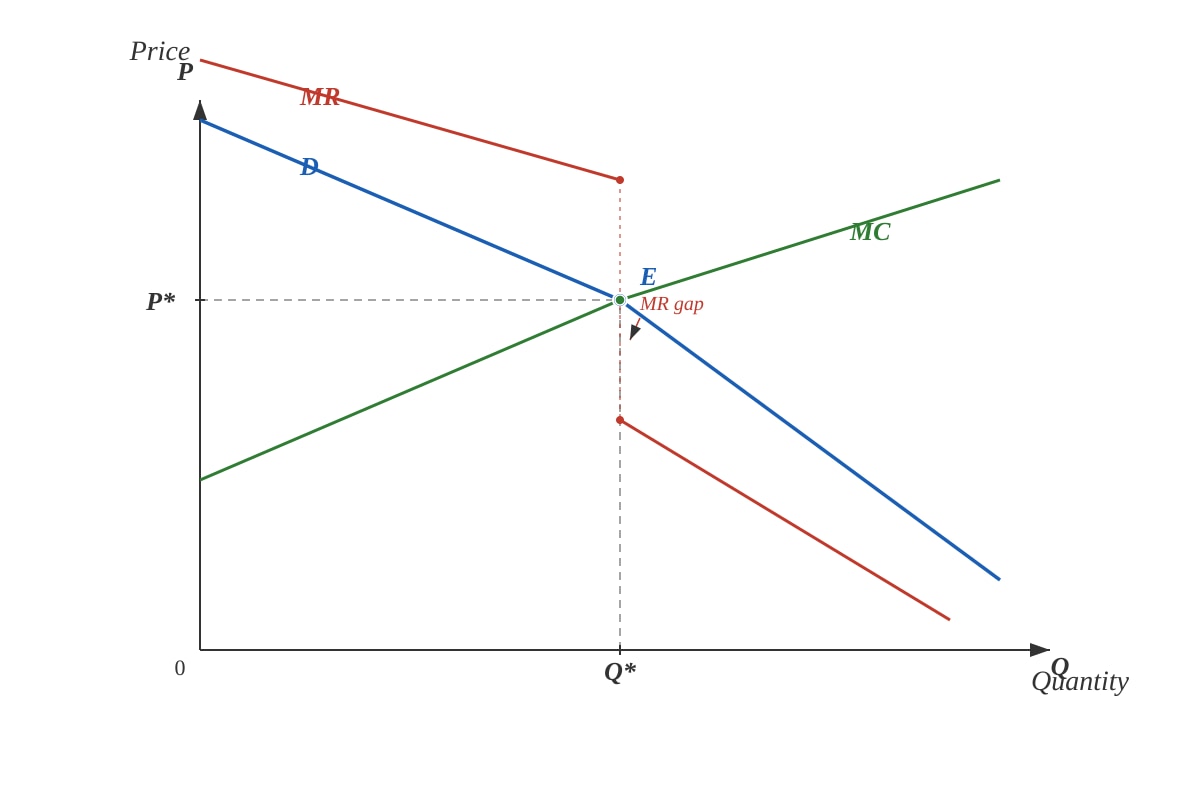
Generated graph for Q8(a).
Mark breakdown:
- Correctly drawn kinked demand curve with kink: 1 mark
- MR curve with vertical discontinuity at kink quantity: 1 mark
- MC curve passing through MR gap, with P* and Q* labelled: 1 mark
Question 8(b) [2 marks]
Explanation:
Prices in oligopoly tend to be sticky because:
-
If the firm raises its price above P*, competitors are assumed not to follow (they keep their prices low to gain market share). The firm faces a relatively elastic demand curve above P*, so a price increase leads to a large fall in quantity demanded and revenue. The firm is reluctant to raise prices.
-
If the firm lowers its price below P*, competitors are assumed to match the price cut (to avoid losing market share). The firm faces a relatively inelastic demand curve below P*, so a price cut leads to only a small increase in quantity demanded and may reduce total revenue. The firm is reluctant to cut prices.
-
Since the MC curve passes through the vertical gap in the MR curve, changes in costs (within the range of the gap) do not change the profit-maximising price or quantity. The firm has no incentive to change price even if costs change slightly.
Mark breakdown:
- Explanation of asymmetric competitor responses (above and below P*): 1 mark
- Link to price stickiness / reluctance to change price: 1 mark
Question 9 [5 marks]
Two conditions for successful price discrimination:
Condition 1: Different price elasticities of demand in different market segments (2 marks)
The firm must be able to identify and separate consumer groups with different PEDs. The group with more inelastic demand is charged a higher price, and the group with more elastic demand is charged a lower price. If all consumers have the same PED, price discrimination cannot increase revenue.
Example from transport: Airlines charge business travellers higher fares than leisure travellers. Business travellers have more inelastic demand (they need to travel for work, expenses are paid by employers, and travel dates are inflexible), while leisure travellers have more elastic demand (they can choose not to travel, switch destinations, or travel at different times).
Condition 2: Ability to prevent resale / arbitrage (2 marks)
The firm must be able to prevent consumers in the low-price segment from reselling the good or service to consumers in the high-price segment. If resale is possible, arbitrage would eliminate the price difference.
Example from transport: Train operators in Singapore (SMRT) offer concession fares for students and senior citizens. These are tied to specific concession cards that are non-transferable, preventing adults from buying student-priced tickets. Similarly, advance-purchase airline tickets are non-transferable by name, preventing resale.
Mark breakdown:
- Condition 1 identified and explained: 1 mark
- Transport example for condition 1: 1 mark
- Condition 2 identified and explained: 1 mark
- Transport example for condition 2: 1 mark
- Overall coherence and economic reasoning: 1 mark
Section C: Essay
Question 10 [15 marks]
"Government intervention in markets always leads to a net welfare loss." Discuss.
Marking Descriptors:
| Level | Marks | Descriptors |
|---|---|---|
| Level 1 | 1–5 | Limited understanding of government intervention. Descriptive, lacking analysis or evaluation. May list policies without explaining welfare effects. |
| Level 2 | 6–10 | Sound understanding of at least two forms of intervention. Some analysis of welfare effects using diagrams or theory. Limited evaluation or weak conclusion. |
| Level 3 | 11–14 | Good understanding of multiple forms of intervention. Clear analysis with relevant diagrams. Balanced evaluation considering both welfare gains and losses. Some use of Singapore examples. |
| Level 4 | 15 | Excellent understanding. Sophisticated analysis with well-integrated diagrams. Strong evaluation with clear judgement. Effective use of Singapore context throughout. |
Suggested content:
Introduction (AO1 — Knowledge):
- Define government intervention: actions by the state to influence market outcomes (taxes, subsidies, price controls, regulation, direct provision, tradable permits).
- Define net welfare loss (deadweight loss): the reduction in total surplus (consumer + producer surplus) that results from a market distortion.
- The statement implies that intervention is always harmful — this requires evaluation of when intervention creates vs. destroys welfare.
Body — Arguments that intervention CAN lead to net welfare loss (AO2 — Analysis):
-
Price floors (minimum prices): A price floor set above equilibrium (e.g., minimum wage) creates a surplus (excess supply). This leads to deadweight loss because some mutually beneficial transactions do not occur. In Singapore, while there is no national minimum wage, the Progressive Wage Model for certain sectors could create similar effects if set too high.
-
Taxes: Indirect taxes (e.g., GST) create a wedge between the price paid by consumers and the price received by producers, reducing the equilibrium quantity. This creates deadweight loss. Singapore's GST increase from 7% to 9% in 2024 could theoretically reduce consumer welfare and create deadweight loss in affected markets.
-
Price ceilings (maximum prices): Rent control or fare caps set below equilibrium create shortages, leading to deadweight loss through queuing, black markets, or reduced quality.
Body — Arguments that intervention does NOT always lead to net welfare loss (AO2 — Analysis):
-
Correcting market failure — Externalities: When negative externalities exist (e.g., pollution from vehicles), the market overproduces the good. A Pigouvian tax (e.g., Singapore's Carbon Tax, introduced in 2019 at 25/tonne in 2024) internalises the externality, shifting the supply curve leftward toward the socially optimal output. This can increase total welfare by eliminating deadweight loss from overproduction.
-
Correcting market failure — Public goods: Markets underprovide public goods (e.g., national defence, street lighting) due to the free-rider problem. Government provision through taxation can achieve a more efficient allocation, increasing welfare.
-
Correcting market failure — Merit goods: Markets underconsume merit goods (e.g., education, healthcare) due to information failure and positive externalities. Government subsidies (e.g., Singapore's heavy subsidies for public education and healthcare) can increase consumption toward the socially optimal level, reducing deadweight loss.
-
Promoting competition: Government regulation to prevent monopolies (e.g., CCCS reviewing mergers) can improve welfare by maintaining competitive markets. Blocking the Grab-Trans-cab merger could have preserved competition and consumer surplus.
Evaluation (AO3 — Evaluation):
- The impact of intervention depends on the type of market failure being addressed. Intervention to correct market failure can improve welfare; intervention in an already efficient market is likely to create deadweight loss.
- Government failure is a risk: imperfect information, regulatory capture, and bureaucratic inefficiency can cause intervention to be worse than the original market failure. For example, poorly designed price controls in Singapore's HDB resale market could create distortions.
- Magnitude matters: Even well-intentioned intervention can create net welfare loss if the policy is poorly calibrated (e.g., a tax rate that is too high relative to the externality).
- Singapore context: Singapore's government is generally considered efficient and well-informed, which may reduce the risk of government failure. Policies like the Carbon Tax and CCCS merger reviews are evidence-based, suggesting intervention can improve welfare in this context.
Judgement: The statement is too absolute. Government intervention does not "always" lead to net welfare loss. When intervention corrects market failure (externalities, public goods, merit goods, information asymmetry), it can improve allocative efficiency and increase total welfare. However, intervention in markets that are already functioning efficiently, or intervention that is poorly designed, can indeed create net welfare loss. The key is whether the intervention addresses a genuine market failure and is well-implemented.
Question 11 [15 marks]
Discuss whether the growth of platform-based firms such as Grab and Gojek is necessarily beneficial for consumers in Singapore.
Marking Descriptors:
| Level | Marks | Descriptors |
|---|---|---|
| Level 1 | 1–5 | Limited understanding of platform economics. Descriptive, lacking analysis. May list benefits/drawbacks without economic reasoning. |
| Level 2 | 6–10 | Sound understanding of platform firms and their effects. Some analysis using relevant concepts (network effects, market power, consumer surplus). Limited evaluation. |
| Level 3 | 11–14 | Good understanding with clear analysis of both benefits and drawbacks. Use of relevant economic theory and Singapore case evidence. Balanced evaluation with judgement. |
| Level 4 | 15 | Excellent understanding. Sophisticated analysis integrating multiple concepts. Strong evaluation with nuanced judgement. Effective use of case evidence throughout. |
Suggested content:
Introduction (AO1):
- Define platform-based firms: digital intermediaries that connect two or more user groups (e.g., drivers and passengers for Grab/Gojek).
- Outline the scope: benefits (convenience, efficiency, lower transaction costs) vs. drawbacks (market power, data privacy, worker welfare).
- The word "necessarily" requires evaluation — are the benefits guaranteed, or do they depend on conditions?
Body — Arguments that growth IS beneficial for consumers (AO2):
-
Lower transaction costs and increased convenience: Platform firms reduce search and matching costs. Consumers can book a ride instantly through an app, compare prices, and pay digitally. This increases consumer welfare by saving time and effort.
-
Increased competition (initially): The entry of Grab and Gojek into Singapore's transport market disrupted the traditional taxi monopoly (ComfortDelGro). Competition led to lower fares, better service quality, and innovation (e.g., cashless payments, ride tracking). Consumer surplus increased.
-
Economies of scope: Platform firms that operate across multiple services (ride-hailing, food delivery, payments) can achieve cost savings that may be passed on to consumers. Grab's integrated ecosystem (GrabRewards, GrabPay) provides additional value to consumers.
-
Improved allocative efficiency: Dynamic pricing (surge pricing) helps allocate rides to those who value them most during peak periods, improving the efficiency of resource allocation.
Body — Arguments that growth is NOT necessarily beneficial for consumers (AO2):
-
Market concentration and market power: As platforms grow and consolidate (e.g., Grab's acquisition of Trans-cab), market concentration increases. With Grab holding 78% of the combined market, the firm may have the power to raise fares, reduce service quality, or engage in anti-competitive practices. The case data shows consumer surplus fell by $17 million/year post-acquisition.
-
Network effects as barriers to entry: The dominance of large platforms creates barriers to entry for new competitors, reducing contestability. This could lead to long-term consumer harm through higher prices and less innovation.
-
Price discrimination and data exploitation: Platform firms collect vast amounts of consumer data, which can be used for personalised pricing (first-degree price discrimination), potentially extracting more consumer surplus. Consumers may also face reduced privacy.
-
Surge pricing: While surge pricing improves allocative efficiency, it can also be seen as exploitative, particularly during emergencies or when consumers have limited alternatives. Consumers may pay significantly higher fares during peak periods.
-
Impact on workers: While not directly a consumer issue, the gig economy model used by platform firms raises questions about driver welfare. If drivers are poorly compensated, this could affect service quality for consumers in the long run.
Evaluation (AO3):
- The benefits of platform firms are not automatic — they depend on the degree of competition in the market. When platforms first enter, they increase competition and benefit consumers. As they grow and consolidate, the benefits may diminish.
- Government regulation plays a crucial role. Singapore's CCCS and the Point-to-Point Transport Industry Act help mitigate the risks of market power. The effectiveness of regulation determines whether platform growth benefits consumers.
- Time horizon matters: Short-term benefits (convenience, lower fares) may differ from long-term effects (market concentration, reduced innovation).
- Consumer heterogeneity: Benefits may vary across consumer groups. Tech-savvy consumers benefit more from app-based services, while elderly or low-income consumers may be disadvantaged.
Judgement: The growth of platform-based firms is not "necessarily" beneficial for consumers. While there are clear benefits in terms of convenience, lower transaction costs, and initial competitive pressure, the long-term effects depend on market structure, the effectiveness of regulation, and the behaviour of the firms. In Singapore's case, the consolidation of the ride-hailing market raises legitimate concerns about consumer welfare, suggesting that ongoing regulatory vigilance is essential to ensure that platform growth continues to benefit consumers.
Mark Summary
| Section | Question | Marks |
|---|---|---|
| A — Case Study | Q1 | 4 |
| Q2 | 4 | |
| Q3(a) | 4 | |
| Q3(b) | 2 | |
| Q4 | 4 | |
| Q5(a) | 2 | |
| Q5(b) | 4 | |
| Q6 | 6 | |
| Section A Total | 30 | |
| B — Structured Response | Q7 | 5 |
| Q8(a) | 3 | |
| Q8(b) | 2 | |
| Q9 | 5 | |
| Section B Total | 15 | |
| C — Essay | Q10 or Q11 | 15 |
| Section C Total | 15 | |
| Grand Total | 60 |