AI Generated Quiz
A Level H1 Economics Policy Evaluation Quiz
Free A Level H1 Econs Policy Evaluation quiz, LongCat AI version, with questions, answers, and A Level-style practice for Singapore students.
These static practice materials are generated from the site's syllabus and paper-generation workflow, with source and model context shown so students and parents can evaluate the material before use.
Questions
Free quiz and exam paper access
Enter your details to view this paper
Your access is remembered on this device.
Answers
A-Level Economics H1 Quiz - Policy Evaluation
Answer Key and Marking Scheme
Section A: Short-Answer Questions (20 marks)
1. Define the term government failure in the context of economic policy. (2 marks)
Answer: Government failure occurs when government intervention in a market leads to a worsening of allocative efficiency — that is, the misallocation of resources compared to the free-market outcome, resulting in a deadweight loss to society. It arises when the costs of intervention exceed the benefits, or when the policy produces unintended negative consequences that outweigh the intended gains.
Marking: 1 mark for identifying that government failure involves a worsening of efficiency/resource allocation; 1 mark for linking it to intervention causing net welfare loss or deadweight loss.
Common mistakes: Students sometimes confuse government failure with market failure. Government failure is about the cure being worse than the disease — the intervention itself creates inefficiency.
2. State two reasons why a government subsidy to correct a positive externality might fail to achieve an efficient outcome. (2 marks)
Answer: (a) Difficulty in estimating the exact value of the external benefit — if the government overestimates the marginal external benefit, the subsidy will be too large, leading to over-consumption (allocative inefficiency beyond the socially optimal quantity). If it underestimates, the subsidy will be insufficient and under-consumption will persist.
(b) Opportunity cost and government revenue constraints — the subsidy must be financed through taxation (which itself creates deadweight losses) or reallocation of spending from other areas. If the deadweight loss from taxation exceeds the externality corrected, there is a net welfare loss.
Other acceptable answers: Administrative costs of implementing the subsidy; subsidy may benefit those who would have consumed the good anyway (deadweight loss of subsidy expenditure); information asymmetry — government lacks perfect information about the true MEB; time lags in implementation.
Marking: 1 mark per valid reason, clearly explained. Vague answers such as "it costs money" without elaboration receive 0 marks.
3. Distinguish between allocative efficiency and productive efficiency. (2 marks)
Answer:
-
Allocative efficiency occurs when resources are allocated to produce the combination of goods and services that best reflects society's preferences. It is achieved where Price = Marginal Cost (P = MC), meaning the value consumers place on the last unit equals the cost of producing it. It is concerned with producing the right mix of goods.
-
Productive efficiency occurs when goods are produced at the lowest possible average cost, i.e., on the lowest point of the average cost curve (minimum ATC). It is concerned with producing goods in the cheapest way possible, regardless of whether the right mix is being produced.
Marking: 1 mark for a correct definition of allocative efficiency (must reference P = MC or matching output to consumer preferences); 1 mark for a correct definition of productive efficiency (must reference minimum AC or lowest cost production).
4. A government imposes a price ceiling on rental housing below the equilibrium price. State one likely consequence of this policy. (2 marks)
Answer: A price ceiling set below the equilibrium price creates a shortage (excess demand) in the rental housing market, because the quantity of housing demanded exceeds the quantity supplied at the artificially low price. This can lead to the development of a black market where landlords charge illegal rents, deterioration in housing quality (as landlords have less incentive to maintain properties), and long waiting lists or non-price rationing mechanisms.
Marking: 2 marks for a clearly explained consequence with economic reasoning. 1 mark for stating "shortage" without explanation.
5. What is the regulatory capture problem? Give one example. (2 marks)
Answer: Regulatory capture occurs when a regulatory agency, created to act in the public interest, instead advances the commercial or political concerns of the special interest groups it is supposed to be regulating. Over time, the regulated industries gain disproportionate influence over the regulators, leading to regulations that favour producers rather than consumers.
Example: A telecommunications regulatory body may set prices or entry barriers that protect incumbent telecom firms from competition, rather than promoting consumer welfare. This can happen because regulators often have close relationships with industry executives, or because the industry provides the technical expertise the regulator depends on.
Marking: 1 mark for a correct definition; 1 mark for a valid example.
6. Explain why indirect taxes on demerit goods may be regressive in nature. (2 marks)
Answer: Indirect taxes on demerit goods (e.g., taxes on cigarettes, alcohol, or sugar-sweetened beverages) tend to be regressive because lower-income households spend a larger proportion of their income on these goods compared to higher-income households. Although the tax is the same absolute amount for all consumers, it represents a greater burden as a percentage of income for the poor. For example, a S$2 tax on a pack of cigarettes takes up a much larger share of a low-income earner's disposable income than a high-income earner's.
Marking: 1 mark for identifying that the tax takes a larger proportion of low-income earners' income; 1 mark for explaining the reasoning (lower-income households spend a higher % of income on demerit goods, or the tax is a flat/regressive rate relative to income).
7. State two conditions necessary for a Pigouvian tax to achieve allocative efficiency. (2 marks)
Answer: (a) The government must be able to accurately measure the marginal external cost (MEC) of the activity, so that the tax is set exactly equal to the MEC at the socially optimal output level.
(b) The tax must be applied directly to the source of the externality (i.e., the polluting activity itself), and there must be no close substitutes that consumers or producers can switch to in order to avoid the tax while still generating the same externality.
Other acceptable answers: The demand or supply must be responsive (elastic enough) to the tax for it to change behaviour; enforcement must be effective and evasion minimal.
Marking: 1 mark per valid condition.
8. Define moral hazard and explain how it can reduce the effectiveness of government insurance schemes. (2 marks)
Answer: Moral hazard occurs when individuals or firms, because they are insured or protected against risk, change their behaviour to become less careful or more risk-taking, knowing that the costs of their actions will be borne by the insurer.
In the context of government insurance schemes (e.g., deposit insurance for banks, unemployment insurance), moral hazard reduces effectiveness because:
- Banks may take on excessive risks in lending, knowing that deposits are government-guaranteed.
- Unemployed workers may reduce their job search effort, knowing they receive unemployment benefits.
This leads to higher costs for the government and can create systemic risks that the insurance scheme was designed to prevent.
Marking: 1 mark for a correct definition of moral hazard; 1 mark for a clear explanation of how it undermines a government insurance scheme.
9. What is the law of unintended consequences? Illustrate with one example from economic policy. (2 marks)
Answer: The law of unintended consequences states that actions of people — and especially of government — always have effects that are unanticipated or unintended. In economic policy, interventions can produce outcomes that were not foreseen by policymakers, sometimes undermining the original objective or creating new problems.
Example: Rent control (a price ceiling on housing) was intended to make housing affordable for low-income tenants. However, unintended consequences include: reduced supply of rental housing (landlords convert to other uses or stop maintaining properties), deterioration in housing quality, black markets, and misallocation of housing (e.g., tenants staying in units too large for their needs because rent is cheap).
Marking: 1 mark for a correct definition; 1 mark for a valid and clearly explained example.
10. State one advantage and one disadvantage of using cost-benefit analysis (CBA) to evaluate a government infrastructure project. (2 marks)
Answer:
-
Advantage: CBA provides a systematic and comprehensive framework for comparing all the costs and benefits of a project (including externalities) in monetary terms, allowing policymakers to make more informed, objective decisions about whether the project generates a net social benefit.
-
Disadvantage: CBA requires monetising intangible costs and benefits (e.g., environmental damage, human life, cultural heritage), which is inherently subjective and contentious. Different valuation methods can produce very different results, potentially undermining the objectivity of the analysis.
Other acceptable disadvantage: CBA may undervalue benefits that accrue to future generations (due to discounting); distributional effects are often ignored.
Marking: 1 mark for a valid advantage; 1 mark for a valid disadvantage.
Section B: Data Response and Structured Questions (20 marks)
11. With reference to the extract, identify the type of market failure that the carbon tax is designed to address. Explain your answer. (3 marks)
Answer: The carbon tax is designed to address negative externalities (specifically, negative externalities of production/consumption arising from greenhouse gas emissions).
When firms burn fossil fuels, they generate CO₂ emissions that contribute to climate change. The social cost of these emissions (e.g., rising sea levels, extreme weather, health impacts) is not reflected in the private cost of production. This means firms overproduce relative to the socially optimal level because they do not bear the full cost of their actions. The marginal social cost (MSC) exceeds the marginal private cost (MPC), resulting in a deadweight loss. The carbon tax internalises this externality by making firms pay for the external cost.
Marking:
- 1 mark for correctly identifying negative externalities (or negative externalities of production).
- 1 mark for explaining that the social cost exceeds the private cost (MSC > MPC).
- 1 mark for linking to the extract (greenhouse gas emissions / climate change).
12. Using the data in the extract, explain why some economists argue that the initial carbon tax rate of S$5/tCO₂e may be insufficient to correct the market failure. (3 marks)
Answer: The extract states that the estimated social cost of carbon is approximately S100 per tCO₂e, while the initial carbon tax is only **S5 is far below the estimated MEC of S100, the tax is too low to fully internalise the externality. As a result, firms will reduce emissions only marginally, and the market outcome will still involve overproduction relative to the socially optimal level — the market failure is only partially corrected.
Marking:
- 1 mark for identifying the gap between the tax rate (S75–S$100).
- 1 mark for explaining that a Pigouvian tax should equal the MEC to achieve allocative efficiency.
- 1 mark for concluding that the tax is insufficient to fully correct the externality.
13. (a) Define carbon leakage. (1 mark)
Answer: Carbon leakage refers to the situation where emissions reduction in one country (or region) is offset by an increase in emissions in another country, typically because energy-intensive industries relocate to jurisdictions with less stringent climate policies or lower carbon prices.
(b) Explain how carbon leakage might reduce the effectiveness of Singapore's carbon tax as a policy to reduce global greenhouse gas emissions. (3 marks)
Answer: If Singapore's carbon tax raises the cost of production for energy-intensive industries (e.g., petrochemicals, semiconductors), these firms may relocate their operations to countries without a carbon tax or with a lower carbon price (e.g., neighbouring Southeast Asian countries). While Singapore's domestic emissions would fall, global emissions would not decrease — they would simply be displaced. In some cases, global emissions could even increase if the relocating firms use less efficient or more carbon-intensive production methods in the new country. This undermines the effectiveness of the carbon tax as a tool for reducing global greenhouse gas emissions, even if it succeeds in reducing domestic emissions.
Marking (part b):
- 1 mark for explaining that firms may relocate to countries with lower/no carbon pricing.
- 1 mark for explaining that emissions are displaced, not eliminated (no net global reduction).
- 1 mark for noting that global emissions could increase if production is less efficient elsewhere.
14. Evaluate whether a grant-based approach (like E2F) or a carbon tax is likely to be more effective in reducing industrial emissions in Singapore. (5 marks)
Answer:
Carbon tax — advantages:
- A carbon tax creates a continuous price signal that incentivises firms to reduce emissions at every margin — firms will invest in cleaner technology as long as the cost of abatement is less than the tax. This promotes cost-effective emission reductions across the economy.
- It generates government revenue that can be recycled into green initiatives or used to reduce other distortionary taxes.
- It harnesses market forces rather than requiring the government to pick winners or decide which technologies to fund.
Carbon tax — limitations:
- At low rates (S$5/tCO₂e), the price signal may be too weak to induce significant behavioural change, especially for firms with high abatement costs.
- It may cause carbon leakage (as discussed in Q13), reducing global effectiveness.
- It imposes immediate costs on firms, potentially affecting competitiveness and employment in the short run.
Grant-based approach (E2F) — advantages:
- Grants directly lower the cost of adopting energy-efficient technology, making it financially viable for firms (especially SMEs) that may lack capital.
- They can be targeted at specific technologies or sectors where emission reductions are most cost-effective.
- They are politically more acceptable as they reward positive behaviour rather than penalising pollution.
Grant-based approach — limitations:
- Grants rely on government picking winners — the government may not have the information to identify the most efficient technologies.
- They do not create a continuous incentive to reduce emissions beyond the subsidised investment.
- They are fiscally costly and may lead to deadweight loss if firms receive grants for investments they would have made anyway.
- There is a risk of rent-seeking behaviour by firms.
Evaluation: A carbon tax is likely to be more effective in the long run because it provides a persistent, economy-wide incentive to reduce emissions and allows firms flexibility in how they respond. However, given Singapore's small, open economy and the risk of carbon leakage, a combination of both policies may be optimal — using the carbon tax as the primary price signal while using grants (like E2F) to overcome capital market barriers and support the transition, especially for SMEs.
Marking (Level-based):
- Level 1 (1–2 marks): Describes one or two points without evaluation or with limited economic analysis.
- Level 2 (3–4 marks): Explains advantages and/or disadvantages of both policies with some economic reasoning. Attempts at evaluation but may be one-sided or lack a clear conclusion.
- Level 3 (5 marks): Balanced analysis of both policies with clear economic reasoning, use of extract evidence, and a well-supported evaluative conclusion (e.g., arguing for a combination approach, or clearly justifying one policy as more effective with conditions).
15. Discuss whether the Singapore government's phased approach to increasing the carbon tax is justified. In your answer, consider both economic efficiency and equity considerations. (5 marks)
Answer:
Arguments in favour of the phased approach (justified):
Economic efficiency:
- A phased approach allows firms time to adjust — investing in cleaner technologies, restructuring operations, and finding cost-effective abatement strategies. An abrupt, large tax increase could cause sudden economic disruption, firm closures, and job losses, especially in energy-intensive industries.
- It provides predictability and credibility — firms can plan long-term investments knowing the future trajectory of the tax. This may actually encourage earlier investment in clean technology to avoid future higher taxes.
- It minimises the risk of carbon leakage in the short run by giving firms time to improve efficiency before facing the full tax rate.
Equity:
- A gradual increase allows consumers and workers in affected industries time to adjust — retraining, finding alternative employment, or adapting consumption patterns.
- It gives the government time to recycle revenue through targeted support for low-income households who may be disproportionately affected by higher energy prices.
*Arguments against the phased approach (not justified):
Economic efficiency:
- A low initial tax (S75–S$100) means the externality is barely being internalised in the early years, so the market failure persists. The environmental damage from continued high emissions during the phase-in period may be irreversible (climate change is cumulative).
- A slow phase-in may create moral hazard — firms may delay investment in clean technology, knowing the tax will remain low for several years.
Equity:
- Delaying the full tax means future generations bear more of the environmental cost, raising intergenerational equity concerns.
- If the phased approach is too slow, it may not meet Singapore's international climate commitments (e.g., Paris Agreement targets).
Evaluation: The phased approach is broadly justified given Singapore's economic structure (small, open economy with energy-intensive industries) and the need to balance environmental goals with economic competitiveness. However, the phase-in period should not be so slow that it delays meaningful emission reductions. The government should consider accelerating the timeline if technological progress or international carbon border adjustments (e.g., EU CBAM) reduce the risk of carbon leakage.
Marking (Level-based):
- Level 1 (1–2 marks): Identifies one or two points for or against without balanced discussion or economic analysis.
- Level 2 (3–4 marks): Discusses both efficiency and equity considerations with some balance. May lack a clear evaluative conclusion.
- Level 3 (5 marks): Balanced discussion of efficiency and equity arguments on both sides, with clear economic reasoning, reference to the extract, and a well-supported evaluative judgement.
Section C: Essay Questions (20 marks — 10 marks each)
Students answer two of three questions. Full model answers provided for all three.
16. "Government intervention in markets always leads to a more efficient outcome than leaving markets to operate freely." Evaluate this statement with reference to one specific market failure and two different government policies that could be used to address it. (10 marks)
Model Answer:
Introduction: The statement assumes that government intervention invariably improves market outcomes. While intervention can correct market failures and improve allocative efficiency, it can also lead to government failure, where the intervention creates new inefficiencies or exacerbates existing ones. This essay evaluates the statement using negative externalities from pollution as the market failure, examining a Pigouvian tax and direct regulation (emission standards) as two policy responses.
Market failure — negative externalities from pollution: When firms pollute, they impose costs on third parties (e.g., health costs, environmental damage) that are not reflected in market prices. The marginal social cost (MSC) exceeds the marginal private cost (MPC), leading to overproduction of the polluting good relative to the socially optimal quantity (where MSB = MSC). This represents a misallocation of resources and a deadweight loss.
Policy 1: Pigouvian tax A Pigouvian tax set equal to the marginal external cost (MEC) at the socially optimal output shifts the supply curve upward from MPC to MSC, internalising the externity. The new market equilibrium achieves the socially optimal quantity where P = MSC.
Conditions for success:
- Government must accurately estimate the MEC — difficult in practice due to uncertainty and incomplete information.
- The tax must be enforceable and evasion must be minimal.
- Demand should be price-elastic for the tax to significantly reduce quantity.
Potential for government failure:
- If the MEC is overestimated, the tax is too high and leads to under-production (a new deadweight loss).
- Administrative costs of implementation may be high.
- Regressive impact on low-income consumers.
Policy 2: Direct regulation (emission standards) The government sets a legal limit on the amount of pollution each firm can emit, with penalties for non-compliance.
Conditions for success:
- Standards must be set at the correct level to achieve the socially optimal output.
- Effective monitoring and enforcement are essential.
- Penalties must be sufficiently large to deter non-compliance.
Potential for government failure:
- Regulatory capture — firms may lobby for lenient standards.
- One-size-fits-all standards may be inefficient because different firms have different abatement costs. A tax allows low-abatement-cost firms to reduce more, achieving the same total reduction at lower cost.
- Enforcement costs can be substantial.
- Firms have no incentive to reduce emissions below the standard (no continuous incentive).
Evaluation: Government intervention does not always lead to a more efficient outcome. Whether intervention improves welfare depends on:
- The accuracy of information available to the government.
- The costs of implementation and enforcement relative to the benefits.
- The risk of government failure (regulatory capture, rent-seeking, unintended consequences).
- The design of the policy — market-based instruments (taxes) are generally more efficient than command-and-control (regulation) because they allow flexibility and harness market forces.
In conclusion, while government intervention can improve efficiency when market failures exist, it is not a guarantee. Poorly designed or implemented policies can worsen outcomes. The key is to design policies that minimise government failure while effectively addressing the market failure.
Marking Descriptors:
| Level | Marks | Descriptors |
|---|---|---|
| Level 1 | 1–3 | Describes market failure and/or policies with little economic analysis. No evaluation. May be largely descriptive. |
| Level 2 | 4–6 | Explains the market failure and at least one policy with some economic reasoning. Limited evaluation, possibly one-sided. |
| Level 3 | 7–8 | Analyses both policies with clear economic reasoning and diagrams/concepts. Some evaluation of conditions for success and failure. |
| Level 4 | 9–10 | Comprehensive analysis of both policies with sophisticated economic reasoning, clear evaluation of the statement, well-structured argument, and a supported conclusion. |
17. Singapore relies heavily on market-based policies (such as taxes and tradable permits) rather than direct regulation to correct market failures. Discuss the view that market-based policies are always superior to direct regulation in achieving an efficient allocation of resources. (10 marks)
Model Answer:
Introduction: Market-based policies (MBPs) use price signals and market incentives to correct market failures, while direct regulation (command-and-control) sets legal limits or standards. While MBPs are often more efficient in theory, they are not always superior — their effectiveness depends on market conditions, information availability, and the nature of the market failure.
Advantages of market-based policies:
- Cost-effectiveness: MBPs (e.g., carbon taxes, tradable permits) allow firms with lower abatement costs to reduce more, achieving a given environmental target at lower total cost than uniform regulations.
- Dynamic efficiency: MBPs provide continuous incentives for innovation — firms can profit by developing cleaner technology. Regulation provides no incentive to go beyond the standard.
- Revenue generation: Taxes generate government revenue that can be used to reduce other distortionary taxes (double dividend hypothesis).
- Flexibility: Firms choose how to respond, rather than being forced into specific technologies.
Limitations of market-based policies:
- Information requirements: MBPs require accurate measurement of external costs to set the right tax rate or permit quantity. If the government sets the tax too low (as with Singapore's initial S75–S$100 social cost), the externality is under-corrected.
- Monitoring and enforcement: Tradable permits require robust monitoring of emissions. In countries with weak institutions, regulation may be more enforceable.
- Distributional effects: Taxes on essential goods (e.g., fuel, food) are regressive. Regulation may be more equitable if it targets producers rather than consumers.
- Market power: If a few firms dominate the market, they may manipulate permit prices or pass taxes to consumers without reducing emissions.
- Uncertainty: Under a tax, the quantity of emissions reduction is uncertain (depends on elasticities). Under tradable permits, the price is uncertain. When the marginal damage curve is steep (e.g., threshold effects in pollution), quantity-based instruments (permits/regulation) may be preferable to price-based instruments (taxes) — this is the Weitzman rule.
When direct regulation may be superior:
- When the cost of exceeding a pollution threshold is catastrophic (e.g., nuclear safety), regulation setting absolute limits is more appropriate than a tax.
- When monitoring emissions is difficult but monitoring technology use is easy (e.g., mandating catalytic converters).
- When property rights are poorly defined and markets cannot function (e.g., common pool resources in developing countries).
- When administrative simplicity is valued over economic efficiency (e.g., banning a highly toxic substance outright).
Evaluation: MBPs are generally superior in terms of static and dynamic efficiency, but they are not universally better. The optimal policy depends on the characteristics of the market failure, the institutional capacity of the government, and the equity implications. In practice, a mix of both approaches is often optimal — for example, Singapore uses a carbon tax (MBP) alongside emission standards for vehicles (regulation).
Marking Descriptors:
| Level | Marks | Descriptors |
|---|---|---|
| Level 1 | 1–3 | Describes MBPs and/or regulation with little analysis. No evaluation. |
| Level 2 | 4–6 | Explains advantages of MBPs with some comparison to regulation. Limited evaluation. |
| Level 3 | 7–8 | Balanced analysis of both approaches with clear economic reasoning. Some discussion of conditions under which each is superior. |
| Level 4 | 9–10 | Comprehensive, nuanced analysis with reference to economic theory (e.g., Weitzman rule, information asymmetry). Clear evaluative conclusion. |
18. A government is considering two policies to reduce traffic congestion in its capital city: (i) a congestion charge, or (ii) increased investment in public transport infrastructure. Evaluate which policy is likely to be more effective in reducing congestion and improving economic welfare. (10 marks)
Model Answer:
Introduction: Traffic congestion is a negative externality of consumption — each additional driver imposes costs on other road users (longer journey times, pollution, accidents) that are not reflected in the private cost of driving. This leads to overuse of roads relative to the socially optimal level. This essay evaluates a congestion charge and public transport investment as two policy responses.
Policy 1: Congestion charge A congestion charge is a Pigouvian tax on driving in the city centre during peak hours. It internalises the marginal external cost of congestion by raising the private cost of driving to equal the marginal social cost.
Effectiveness:
- Short-run: Reduces congestion by discouraging some drivers (especially those with lower willingness to pay) from entering the charged zone. Evidence from London (introduced 2003) shows a 30% reduction in traffic in the charging zone in the first year.
- Long-run: Encourages a modal shift to public transport, carpooling, or cycling. Provides a continuous incentive to reduce driving.
- Revenue generation: Revenue can be reinvested in public transport, creating a virtuous cycle.
Limitations:
- Regressive: Low-income commuters who cannot easily switch modes bear a disproportionate burden.
- Boundary effects: Traffic may increase just outside the charging zone (displacement).
- Political unpopularity: Congestion charges face strong public opposition (e.g., New York's repeated delays).
- Requires complementary public transport: If public transport alternatives are inadequate, the charge simply raises costs without providing alternatives.
Policy 2: Public transport investment Investing in public transport (e.g., new rail lines, bus rapid transit, improved frequency) increases the availability and quality of alternatives to driving.
Effectiveness:
- Long-run: Can achieve a sustained modal shift by making public transport more attractive. Cities like Tokyo and Hong Kong have very high public transport usage due to extensive networks.
- Equity: Benefits low-income households who rely on public transport.
- Positive externalities: Reduces pollution, accidents, and urban sprawl.
Limitations:
- Time lag: Infrastructure projects take years to plan and build — no immediate congestion relief.
- High capital cost: Requires substantial government expenditure (opportunity cost).
- Induced demand: Improved public transport may not reduce car usage if road capacity remains unchanged (some studies show that making roads more attractive induces more driving).
- Complementary measures needed: Without demand-side measures (e.g., parking restrictions, congestion charges), public transport investment alone may not significantly reduce congestion.
Evaluation:
- In the short run, a congestion charge is more effective because it can be implemented quickly and directly changes behaviour through price signals.
- In the long run, public transport investment is essential for providing sustainable alternatives, but it works best in conjunction with a congestion charge. The charge generates revenue that can fund public transport, and the public transport provides the alternative that makes the charge politically and economically viable.
- Equity is a concern for both: the congestion charge is regressive, while public transport investment benefits all income groups. The government could use congestion charge revenue to subsidise public transport fares for low-income groups, addressing equity concerns.
Conclusion: Neither policy alone is sufficient. The most effective approach is a combination of both — using a congestion charge to manage demand in the short run while investing in public transport to provide long-term alternatives. This is the approach taken by cities like London, Stockholm, and Singapore (ERP + MRT expansion).
Marking Descriptors:
| Level | Marks | Descriptors |
|---|---|---|
| Level 1 | 1–3 | Describes one or both policies with little economic analysis. No evaluation. |
| Level 2 | 4–6 | Explains both policies with some economic reasoning. Limited evaluation or comparison. |
| Level 3 | 7–8 | Analyses both policies with clear economic reasoning (externalities, short-run vs. long-run, equity). Some evaluative comparison. |
| Level 4 | 9–10 | Comprehensive analysis with sophisticated economic reasoning, clear evaluation of both policies, discussion of complementarity, and a well-supported conclusion. |
Section D: Application and Analysis (20 marks)
19. (a) Explain two economic problems that arise from a universal fuel subsidy. (4 marks)
Answer:
Problem 1: Over-consumption and allocative inefficiency The fuel subsidy artificially lowers the price of petrol below the market equilibrium, leading to over-consumption of fuel. Consumers do not face the true social cost of fuel (which includes negative externalities such as pollution, carbon emissions, and congestion). This results in a deadweight loss — resources are misallocated towards excessive fuel consumption at the expense of other goods and services. The subsidy encourages overuse of private vehicles, worsening traffic congestion and air pollution.
Problem 2: Huge fiscal burden and opportunity cost At 4% of GDP, the fuel subsidy represents a massive government expenditure that could be spent on alternative priorities such as healthcare, education, or targeted welfare programmes. This represents a significant opportunity cost. Moreover, as fuel prices rise globally, the cost of the subsidy increases, potentially leading to fiscal deficits or cuts in other areas of spending. The subsidy also disproportionately benefits higher-income households (who own cars and consume more fuel), making it an inequitable use of public funds.
Other acceptable problems: Encourages fuel smuggling to neighbouring countries; discourages investment in fuel-efficient technology or renewable energy; creates dependency and is politically difficult to remove.
Marking: 2 marks per problem (1 mark for identifying the problem, 1 mark for explaining the economic reasoning).
19. (b) Discuss two advantages and two disadvantages of replacing the universal subsidy with a targeted cash transfer to low-income households. (6 marks)
Answer:
Advantage 1: Improved equity and targeting A targeted cash transfer directs government support specifically to low-income households who are most affected by rising fuel costs. Unlike the universal subsidy (which benefits all consumers, including the wealthy), the cash transfer ensures that limited government resources are directed to those who need them most. This is a more progressive use of public funds and reduces income inequality.
Advantage 2: Restoring market signals and reducing over-consumption Removing the universal subsidy allows fuel prices to reflect true market costs (including externalities), reducing over-consumption and the associated deadweight loss. Consumers face the correct price signal and are incentivised to use fuel more efficiently, switch to public transport, or adopt fuel-efficient vehicles. This improves allocative efficiency.
Disadvantage 1: Administrative complexity and targeting errors Implementing a targeted cash transfer requires the government to identify and verify eligible low-income households, which is administratively complex and costly. There is a risk of exclusion errors (genuinely poor households being missed) and inclusion errors (ineligible households receiving transfers). In countries with large informal economies, accurate targeting is particularly challenging.
Disadvantage 2: Political resistance and short-run hardship Removing a popular universal subsidy is politically unpopular — all consumers face higher fuel prices, and the cash transfer may not fully compensate middle-income households who are not eligible. In the short run, low-income households may also struggle if the cash transfer is delayed, insufficient, or irregular. There may be public protests and social unrest (as seen in Nigeria, Indonesia, and other countries that have attempted subsidy reform).
Marking: 1.5 marks per point (1 mark for identifying the advantage/disadvantage, 0.5 marks for clear explanation). Total: 6 marks.
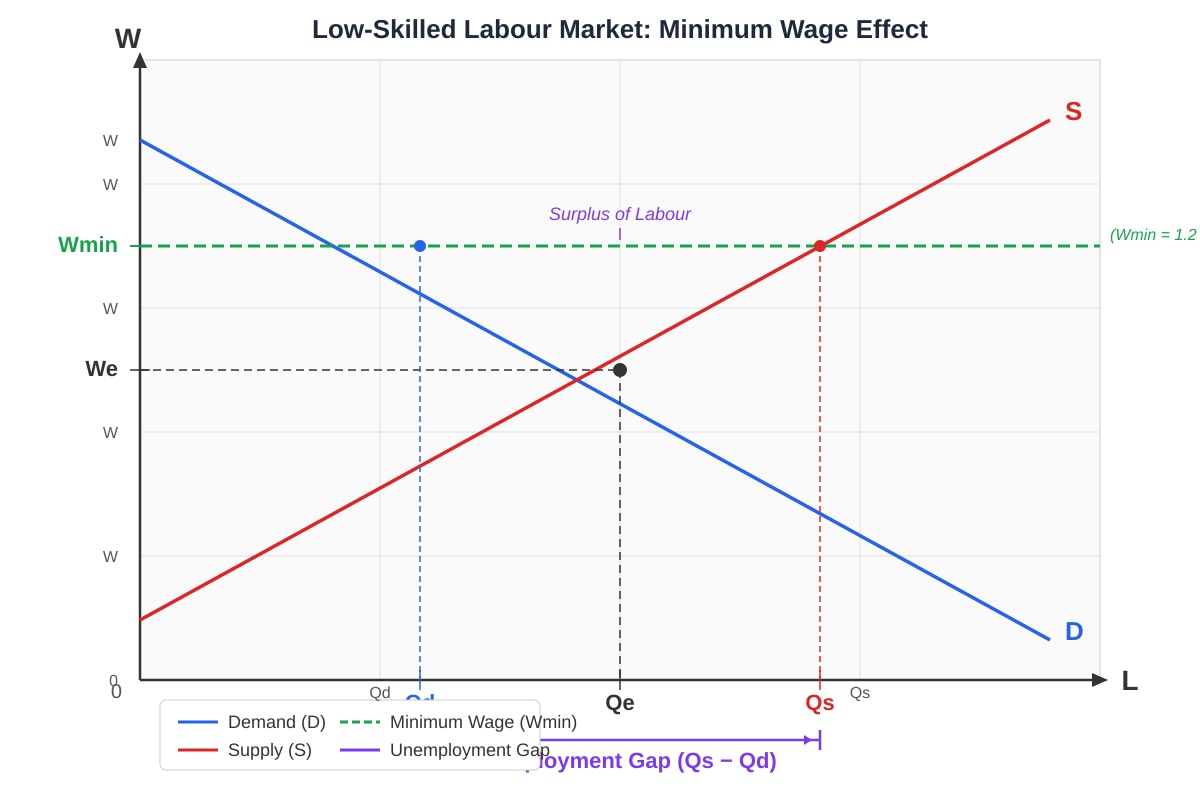
20. (a) With reference to the diagram, explain the effect of the minimum wage on employment and unemployment in the low-skilled labour market. (3 marks)
Answer: The diagram shows a minimum wage (Wmin) set above the equilibrium wage (We). At Wmin:
- The quantity of labour demanded falls from Qe to Qd (firms hire fewer workers because labour is more expensive).
- The quantity of labour supplied increases from Qe to Qs (more workers are willing to work at the higher wage).
- This creates excess supply of labour (unemployment) equal to Qs − Qd.
Employment falls from Qe to Qd (a reduction of Qe − Qd workers). Unemployment rises by the amount of the excess supply (Qs − Qd), which includes both workers who lost their jobs (Qe − Qd) and new entrants attracted by the higher wage (Qs − Qe).
Marking:
- 1 mark for stating that employment falls (from Qe to Qd).
- 1 mark for stating that unemployment rises (excess supply of Qs − Qd).
- 1 mark for explaining the mechanism (higher wage reduces quantity demanded and increases quantity supplied).
20. (b) Evaluate whether the introduction of a minimum wage is likely to be an effective policy for reducing income inequality. (4 marks)
Answer:
Benefits (may reduce inequality):
- The minimum wage directly raises the wages of low-skilled workers who are employed, lifting their income above the market-clearing level. This compresses the wage distribution from below, reducing the gap between low-income and median-income workers.
- It can reduce in-work poverty and improve living standards for the working poor, especially in sectors where wages would otherwise be very low due to excess labour supply (e.g., retail, food service).
- It may encourage firms to invest in training and productivity to justify the higher wage (efficiency wage theory), potentially raising long-run incomes.
Limitations (may not reduce inequality or could worsen it):
- The minimum wage only benefits employed workers. Those who become unemployed due to the policy (Qe − Qd in the diagram) may fall into unemployment or poverty, potentially worsening inequality.
- If the minimum wage leads firms to substitute capital for labour (automation) or shift to informal employment, some low-skilled workers may lose formal employment protections entirely.
- The minimum wage does not help the unemployed, disabled, or those outside the labour force — groups that often have the lowest incomes. A more targeted policy (e.g., earned income tax credit, or Workfare in Singapore) may be more effective.
- If the minimum wage is set too high, it could reduce overall employment significantly, harming the very group it is intended to help.
Evaluation: The minimum wage can be a useful tool for reducing income inequality if set at a moderate level that does not cause significant job losses. However, it should be complemented by other policies (e.g., training subsidies, in-work benefits) to support those who may lose employment and to address inequality among those outside the labour force.
Marking:
- 1 mark for explaining a benefit of the minimum wage for reducing inequality.
- 1 mark for explaining a limitation.
- 1 mark for additional analysis (e.g., conditions for effectiveness, complementary policies).
- 1 mark for a clear evaluative conclusion.
20. (c) Suggest one alternative or complementary policy that the government could use alongside the minimum wage to improve the welfare of low-income workers, and explain how it would work. (3 marks)
Answer:
Policy: Workfare Income Supplement (WIS) / Earned Income Tax Credit (EITC)
A Workfare Income Supplement (or EITC in the US context) is a wage supplement paid by the government to low-income workers, typically through a cash transfer or tax credit that is conditional on being employed.
How it works:
- The government tops up the earnings of workers whose income falls below a certain threshold. For example, for every dollar earned, the government adds a supplement (e.g., 20–40% of earnings).
- As income rises, the supplement is gradually phased out, ensuring that the benefit is targeted at the lowest-income workers.
- Unlike the minimum wage, the WIS/EITC does not increase the cost of labour to employers, so it does not reduce the quantity of labour demanded. Instead, it increases workers' take-home income without creating unemployment.
Advantages over minimum wage alone:
- It directly targets low-income workers rather than all workers in a sector.
- It does not create a disincentive to hire (no increase in labour costs for firms).
- It encourages labour force participation (unlike unemployment benefits, it rewards work).
Marking:
- 1 mark for identifying a valid policy (WIS, EITC, training subsidy, etc.).
- 1 mark for explaining how the policy works.
- 1 mark for explaining how it complements the minimum wage or improves welfare.
End of Answer Key
Mark Summary:
| Section | Marks |
|---|---|
| A: Q1–Q10 | 20 |
| B: Q11–Q15 | 20 |
| C: Q16–Q18 (×2) | 20 |
| D: Q19–Q20 | 20 |
| Total | 60 |
Note: In Section C, students answer 2 of 3 questions (10 marks each = 20 marks). All three model answers are provided for reference.