AI Generated Quiz
A Level H1 Economics Microeconomics Quiz
Free A Level H1 Econs Microeconomics quiz, LongCat AI version, with questions, answers, and A Level-style practice for Singapore students.
These static practice materials are generated from the site's syllabus and paper-generation workflow, with source and model context shown so students and parents can evaluate the material before use.
Questions

Free quiz and exam paper access
Enter your details to view this paper
Your access is remembered on this device.
Answers
A-Level Economics H1 Quiz - Microeconomics: Answer Key
Section A: Central Economic Problem, Demand & Supply (Questions 1–7)
Question 1 [3 marks]
Answer:
Scarcity refers to the fundamental economic problem that human wants for goods and services are unlimited, but the resources available to satisfy those wants are limited [1 mark].
Because resources are scarce, choosing to use resources for one purpose means giving up the next best alternative — this is opportunity cost [1 mark]. For example, if a government uses land to build a hospital, the opportunity cost is the school or park that could have been built instead. Without scarcity, all wants could be satisfied and there would be no need to make choices, so opportunity cost would not exist [1 mark].
Marking notes:
- 1 mark for a clear definition of scarcity (must mention unlimited wants + limited resources).
- 1 mark for explaining the link to opportunity cost.
- 1 mark for a clear example or further development showing understanding.
Question 2
(a) [3 marks]
Answer:
The PPC should be plotted with Fish on the x-axis and Coconuts on the y-axis [1 mark]. All six points (A–F) should be correctly plotted using the data from the table [1 mark]. The curve should be drawn as a smooth concave (bowed-outward) curve connecting the points, reflecting increasing opportunity cost [1 mark].
Marking notes:
- Axes must be correctly labelled with units.
- Points must be accurately plotted.
- Curve shape must be concave (not a straight line or convex).
(b) [2 marks]
Answer:
Moving from A to B: Fish increases by 20 tonnes; Coconuts fall from 120 to 115, a decrease of 5 tonnes.
Opportunity cost of 20 tonnes of fish = 5 tonnes of coconuts [1 mark].
Opportunity cost of 1 tonne of fish = 5 ÷ 20 = 0.25 tonnes of coconuts [1 mark].
Teaching note: Opportunity cost is what you give up divided by what you gain. Students should always state the units.
(c) [3 marks]
Answer:
The data suggests increasing opportunity cost [1 mark].
| Movement | Fish gained | Coconuts lost | OC per 20 tonnes of fish |
|---|---|---|---|
| A → B | 20 | 5 | 5 coconuts |
| B → C | 20 | 10 | 10 coconuts |
| C → D | 20 | 15 | 15 coconuts |
| D → E | 20 | 25 | 25 coconuts |
| E → F | 20 | 65 | 65 coconuts |
As more fish is produced, increasingly more coconuts must be sacrificed each time [1 mark]. This is because resources are not equally suited to the production of both goods — as production shifts toward fish, less suitable resources are reallocated, reducing efficiency [1 mark].
Marking notes:
- 1 mark for identifying increasing OC.
- 1 mark for showing evidence from the table.
- 1 mark for explaining the economic reasoning (resource heterogeneity / diminishing returns).
Question 3
(a) [1 mark]
Answer:
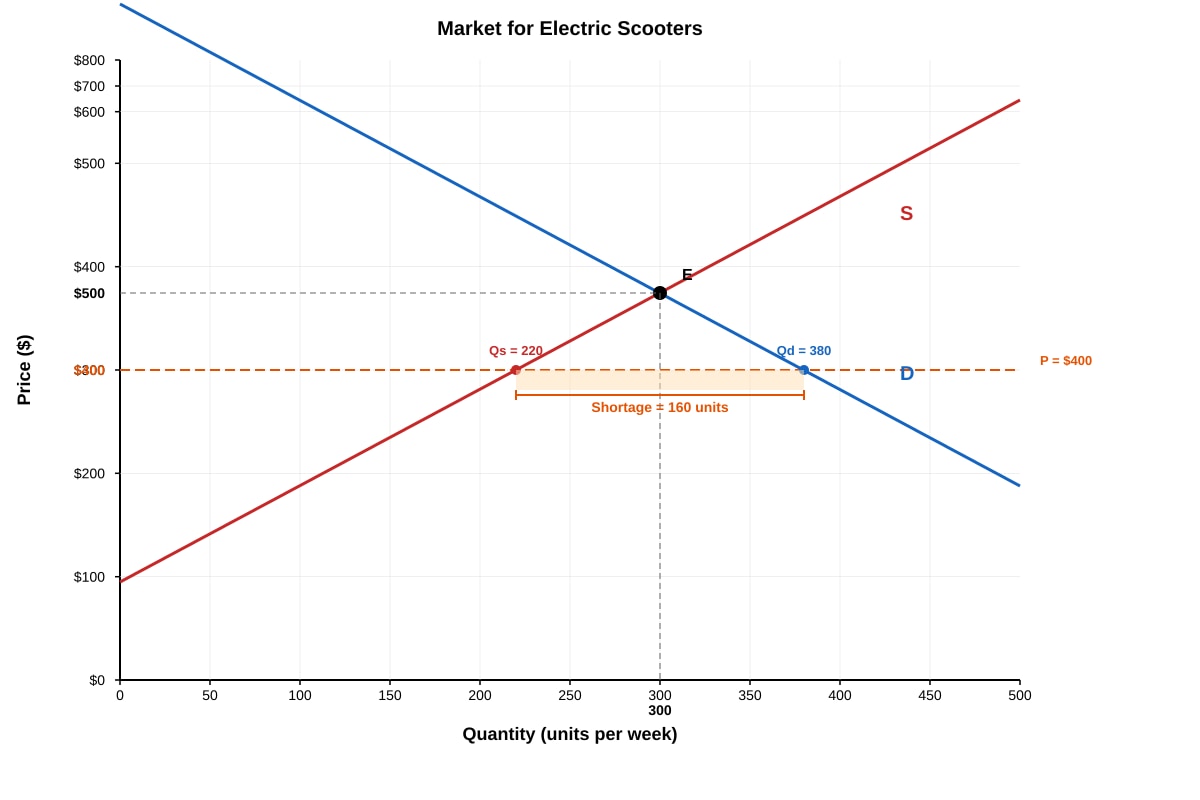
Equilibrium price = $500; Equilibrium quantity = 300 units per week.
Marking note: Both values must be correct for 1 mark. Units required.
(b) [2 marks]
Answer:
At the price ceiling of $400:
- Quantity demanded = 380 units
- Quantity supplied = 220 units
Shortage = Qd – Qs = 380 – 220 = 160 units [1 mark for correct working, 1 mark for correct answer].
Common mistake: Students may confuse shortage with surplus. A price ceiling set below equilibrium creates a shortage (excess demand).
(c) [4 marks]
Answer:
Reason 1: To make electric scooters more affordable for lower-income consumers, improving equity and access to environmentally friendly transport [2 marks — 1 for identifying the reason, 1 for brief explanation].
Reason 2: To encourage a shift away from petrol-powered vehicles, reducing negative externalities such as air pollution and carbon emissions, thereby moving the market closer to the socially optimal level of consumption [2 marks — 1 for identifying the reason, 1 for brief explanation].
Acceptable alternatives: Reducing traffic congestion; promoting a "car-lite" society (Singapore government policy); correcting information failure if consumers underestimate the benefits of e-scooters.
Marking notes: 2 marks per reason. 1 mark for a valid reason, 1 mark for explanation/development. Generic answers without economic reasoning get only 1 mark each.
Question 4 [4 marks]
Answer:
A movement along the demand curve occurs when the price of the good itself changes, causing a change in quantity demanded [1 mark]. For example, if the price of apples falls from 1 per kg, consumers buy more apples — this is represented as a movement down along the demand curve [1 mark].
A shift of the demand curve occurs when a factor other than the price of the good changes (a determinant of demand), causing demand to increase or decrease at every price [1 mark]. For example, if consumer incomes rise, people may buy more apples at every price — the entire demand curve shifts to the right [1 mark].
Marking notes:
- 1 mark for defining movement along.
- 1 mark for a correct example.
- 1 mark for defining a shift.
- 1 mark for a correct example.
- Students must use the terms "change in quantity demanded" (movement) vs "change in demand" (shift) for full marks.
Question 5
(a) [3 marks]
Answer:
Using the midpoint (arc elasticity) formula:
[1 mark for correct %ΔQd, 1 mark for correct %ΔP, 1 mark for final answer]
Common mistake: Students using the simple (non-midpoint) formula will get a different answer (e.g., –25%/25% = –1.0 in this case it happens to be the same, but it often differs). The midpoint method is preferred for A-Level.
(b) [2 marks]
Answer:
Demand is unit elastic (|PED| = 1.0) [1 mark]. This means that the percentage change in quantity demanded is exactly equal to the percentage change in price [1 mark].
Accept: "Price elastic" is incorrect. "Price inelastic" is incorrect. The answer must be "unit elastic" or "unitary elastic."
(c) [3 marks]
Answer:
When |PED| = 1 (unit elastic), a change in price leads to an equal proportional change in quantity demanded [1 mark]. Therefore, total revenue remains unchanged after the price increase [1 mark].
Check: Before: TR = 800. After: TR = 800. Total revenue stays at $800 [1 mark].
Teaching note: This is a key relationship students must memorise:
- If demand is price elastic (|PED| > 1): price rise → TR falls.
- If demand is price inelastic (|PED| < 1): price rise → TR rises.
- If demand is unit elastic (|PED| = 1): price change → TR unchanged.
Question 6
(a) [2 marks]
Answer:
A positive XED of +2.5 means that Good A and Good B are substitutes [1 mark]. This is because a positive XED indicates that when the price of Good B rises, the quantity demanded of Good A rises (they move in the same direction) [1 mark].
(b) [2 marks]
Answer:
[1 mark for correct formula rearrangement, 1 mark for correct answer]
The quantity demanded of Good A will increase by 25%.
Question 7 [5 marks]
Answer:
The price mechanism is the system by which the forces of demand and supply determine the allocation of resources in a free market. It performs three key functions:
1. Rationing: When a good is scarce, its price rises, which rations the available supply to those willing and able to pay the highest price [1 mark]. For example, during a shortage of face masks in 2020, prices rose, ensuring that available masks went to those who valued them most.
2. Signalling: Price changes act as signals to producers and consumers about changes in market conditions [1 mark]. For instance, if the price of solar panels falls due to improved technology, this signals to consumers that solar panels are now more affordable, and signals to producers that they should consider entering the solar panel market.
3. Incentive: Higher prices incentivise producers to supply more (to earn greater profit) and incentivise consumers to buy less (to save money) [1 mark]. For example, if the price of durians rises during off-season, durian farmers are incentivised to invest in storage or off-season cultivation.
Overall: Together, these three functions ensure that resources are allocated according to consumer preferences and producer costs, guiding the economy toward an efficient outcome without central planning [1 mark for a synthesising statement].
Marking notes: 1 mark per function (max 3) + 1 mark per relevant example (max 2). Alternatively, 1 mark per function + 1 mark for a well-developed example + 1 mark for a concluding synthesis. Maximum 5 marks.
Section B: Elasticity, Market Structures & Efficiency (Questions 8–14)
Question 8
(a) [3 marks]
Answer:
The firm maximises profit where Marginal Cost (MC) = Marginal Revenue (MR) [1 mark].
From the table, MC = MR = 12) exceeds MR ($10), meaning the 4th unit reduces profit [1 mark].
The firm should produce 3 units (or up to the point where MC = MR and MC is rising). At Q = 3, MC = 10, so the firm should actually check: at Q = 3, MC = 10, so producing the 3rd unit adds to profit. At Q = 4, MC = 10, so the 4th unit reduces profit. Therefore, profit is maximised at Q = 3 [1 mark].
Correction/Clarification: Looking at the data more carefully:
- Q = 1: MC = 10 → produce (MR > MC)
- Q = 2: MC = 10 → produce (MR > MC)
- Q = 3: MC = 10 → produce (MR > MC)
- Q = 4: MC = 10 → do not produce (MC > MR)
Profit is maximised at Q = 3 units (the last unit where MR ≥ MC).
(b) [2 marks]
Answer:
At Q = 3:
- Total Revenue = $30
- Total Cost = $42
Profit = TR – TC = 42 = –12) [1 mark for correct working, 1 mark for correct answer].
Note: The firm is making a loss at all output levels because even at the best output (Q = 3), TC > TR. However, Q = 3 minimises the loss. At Q = 0, the loss would be 20 to $12.
Accept: Students who identify Q = 2 (where TC = 20, loss = $14) or other outputs should be assessed on their reasoning. The key is the MC = MR condition.
(c) [3 marks]
Answer:
In long-run equilibrium, a perfectly competitive firm produces where P = MC [1 mark]. Since price (P) represents the marginal social benefit (MSB) to consumers and marginal cost (MC) represents the marginal social cost (MSC) of production, P = MC means MSB = MSC [1 mark]. This is the condition for allocative efficiency — resources are allocated to produce the combination of goods and services that society values most, and no one can be made better off without making someone else worse off [1 mark].
Marking notes:
- 1 mark for stating P = MC.
- 1 mark for linking to MSB = MSC.
- 1 mark for explaining allocative efficiency.
Question 9
(a) [2 marks]
Answer:
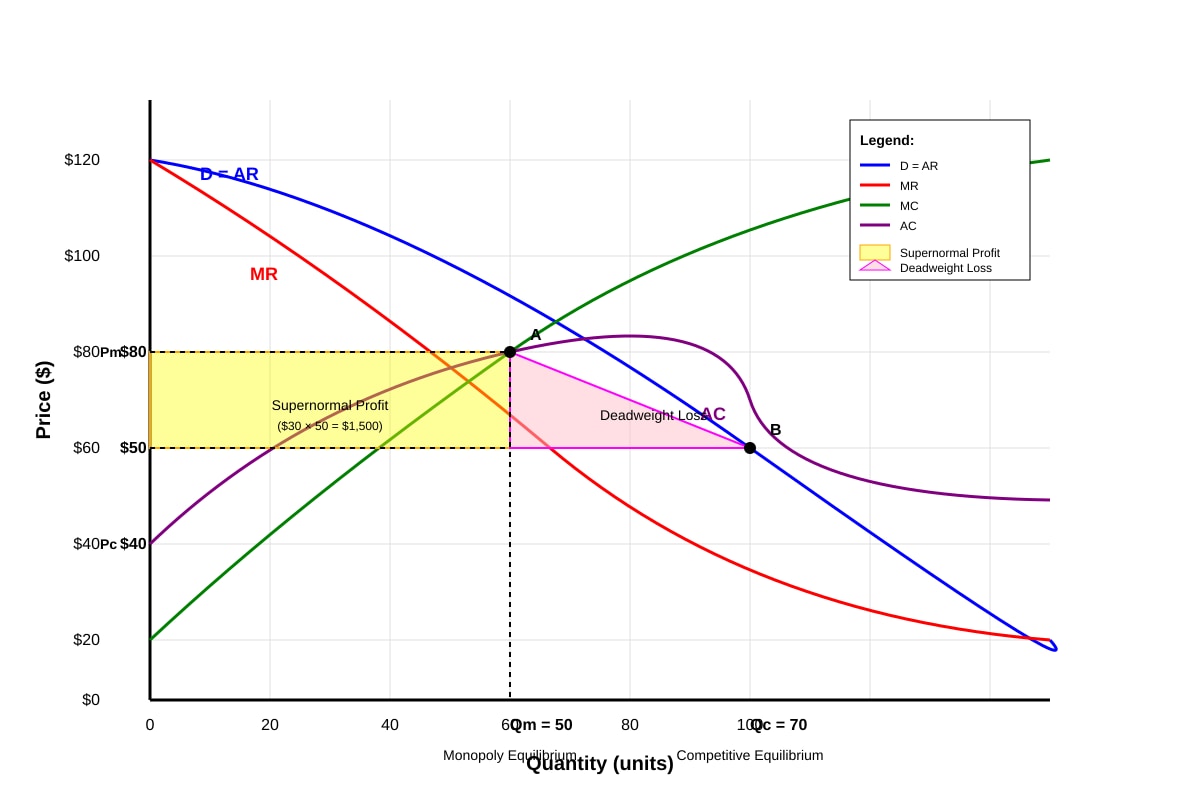
The profit-maximising quantity is where MC = MR, which is at Qm = 50 units [1 mark]. Reading up to the demand curve, the corresponding price is Pm = $80 [1 mark].
(b) [1 mark]
Answer:
The supernormal profit area is the rectangle bounded by:
- Vertically: between P = 50 (average cost at Q = 50)
- Horizontally: from Q = 0 to Q = 50
Total supernormal profit = (50) × 50 = $1,500.
(c) [4 marks]
Answer:
A monopoly restricts output to Qm = 50 (where MC = MR) and charges a higher price Pm = $80, rather than producing the allocatively efficient output Qc = 70 (where P = MC = D) [1 mark].
At the monopoly output, the marginal social benefit (MSB, shown by the demand curve) exceeds the marginal social cost (MSC, shown by the MC curve) [1 mark]. This means society values additional units of output more than it costs to produce them, but the monopoly does not produce them [1 mark].
The deadweight loss is the triangle between the demand curve and the MC curve, from Qm = 50 to Qc = 70. This represents the loss of consumer and producer surplus that is not transferred to anyone — a net welfare loss to society [1 mark].
Marking notes:
- 1 mark for identifying restricted output/higher price.
- 1 mark for MSB > MSC at monopoly output.
- 1 mark for explaining the unexploited gains from trade.
- 1 mark for identifying deadweight loss on the diagram.
Question 10 [4 marks]
Answer:
Productive efficiency occurs when firms produce at the lowest possible average cost, i.e., at the minimum point of the average cost (AC) curve [1 mark]. The condition is P = minimum AC [1 mark].
Allocative efficiency occurs when resources are allocated to produce the combination of goods and services that best matches society's preferences, i.e., where the marginal social benefit equals the marginal social cost [1 mark]. The condition is P = MC (or MSB = MSC) [1 mark].
Marking notes: 1 mark per definition + 1 mark per condition. Students must clearly distinguish between the two concepts.
Question 11
(a) [2 marks]
Answer:
Supply is price inelastic because PES = 0.3, which is less than 1 [1 mark]. This means that the percentage change in quantity supplied is proportionally smaller than the percentage change in price [1 mark].
(b) [4 marks]
Answer:
Factor 1: Limited spare capacity / time period. In the short run, firms may not have the ability to quickly increase production in response to a price rise because they are already operating near full capacity. For example, a factory running 24/7 cannot easily produce more output without building new facilities [2 marks — 1 for factor, 1 for explanation].
Factor 2: Perishability or storage constraints. If the product is perishable (e.g., fresh produce), producers cannot store surplus and gradually release it, making it difficult to respond to price changes. Alternatively, if raw materials are scarce or take time to obtain, supply cannot quickly increase [2 marks — 1 for factor, 1 for explanation].
Acceptable alternatives: Length and complexity of production process; difficulty in acquiring factors of production; natural constraints (e.g., agricultural products dependent on weather).
Question 12
(a) [2 marks]
Answer:
Instant noodles are classified as an inferior good [1 mark]. This is because the YED is negative (–0.7), meaning that as income rises, the quantity demanded of instant noodles falls [1 mark].
(b) [2 marks]
Answer:
[1 mark for correct formula, 1 mark for correct answer]
The quantity demanded of instant noodles will fall by 5.6%.
(c) [3 marks]
Answer:
Firms benefit from knowing the YED of their products for several reasons:
Demand forecasting: If a firm knows its product is a normal good with high YED, it can anticipate increased demand during economic expansions and plan production accordingly [1 mark].
Pricing and marketing strategy: If a product is an inferior good, the firm may target lower-income segments or adjust marketing during periods of rising incomes [1 mark].
Investment decisions: Firms producing luxury goods (high positive YED) may invest more during periods of expected income growth, while firms producing inferior goods may diversify their product range [1 mark].
Marking notes: 1 mark per valid point, well explained. Maximum 3 marks.
Question 13 [4 marks]
Answer:
The supply of agricultural products like rice tends to be price inelastic in the short run due to:
1. Time needed for production (time period): Rice takes several months to grow from planting to harvest. Even if the price of rice rises today, farmers cannot immediately increase the quantity supplied because they must wait for the next harvest cycle [2 marks — 1 for identifying the determinant, 1 for applying it to rice].
2. Limited ability to store or reallocate resources: Agricultural land is often specialised for specific crops, and farmers cannot quickly switch to or from rice production. Additionally, rice requires specific climatic and soil conditions, limiting the ability to rapidly expand supply [2 marks — 1 for identifying the determinant, 1 for applying it to rice].
Acceptable alternative: Perishability — while rice can be stored, fresh agricultural products cannot, limiting the ability to respond to price changes.
Question 14 [6 marks]
Answer:
In a perfectly competitive market: An increase in demand shifts the demand curve to the right [1 mark]. In the short run, both price and output rise as firms along the industry supply curve produce more. In the long run, the higher price attracts new firms to enter the industry, increasing market supply and returning price to its original level (assuming constant costs) [1 mark]. The market remains allocatively efficient (P = MC) in the long-run equilibrium [1 mark].
In a monopoly market: An increase in demand shifts the demand (AR) curve and the MR curve to the right [1 mark]. The monopoly increases both price and output (to the new MC = MR point), but the price increase is proportionally larger than in perfect competition because the monopolist restricts output to maximise profit [1 mark]. The monopoly continues to be allocatively inefficient (P > MC), and the deadweight loss may increase if the gap between MSB and MSC widens [1 mark].
Comparison: Both market structures see an increase in output, but the perfectly competitive market achieves a more efficient outcome (lower price, higher output, P = MC) compared to the monopoly (higher price, lower output relative to the social optimum, P > MC).
Marking notes: Award marks for accurate analysis of each market structure (max 4) and for explicit comparison (max 2). Diagram references are not required but may support the answer.
Section C: Market Failure & Government Intervention (Questions 15–20)
Question 15
(a) [1 mark]
Answer:
Qm is at the intersection of MPB and MPC (the market equilibrium). Qs is at the intersection of MSB and MPC (the socially optimal point). Qm > Qs.
(b) [3 marks]
Answer:
The market equilibrium quantity exceeds the socially optimal quantity because consumers only consider their private benefits (MPB) when making consumption decisions, ignoring the external costs imposed on third parties (e.g., second-hand smoke, healthcare costs) [1 mark].
The marginal social benefit (MSB) is less than the marginal private benefit (MPB) by the amount of the marginal external cost [1 mark]. Since the market operates where MPB = MPC (ignoring the externality), it overproduces cigarettes relative to the socially optimal level where MSB = MPC [1 mark].
(c) [1 mark]
Answer:
The deadweight loss is the triangle between the MSB curve and the MPC curve, from Qs to Qm. This area represents the net welfare loss to society from overproduction of cigarettes.
Question 16 [4 marks]
Answer:
Public good: A public good has two characteristics — non-rivalry (one person's consumption does not reduce the amount available for others) and non-excludability (it is impossible or very costly to prevent non-payers from consuming the good) [1 mark]. Example: National defence — everyone benefits from national defence regardless of whether they pay for it, and one person's protection does not reduce protection for others [1 mark].
Merit good: A merit good is a good that is under-consumed in a free market because individuals underestimate its private benefits (due to information failure) or because it generates positive externalities [1 mark]. Example: Education — individuals may not fully appreciate the long-term benefits of education, and society benefits from a more educated workforce (positive externality) [1 mark].
Key difference: Public goods are defined by their characteristics (non-rivalry, non-excludability), while merit goods are defined by the gap between private and social valuation. Merit goods can be provided by the market but are under-consumed; public goods are typically not provided by the market at all (free-rider problem).
Question 17
(a) [5 marks]
Answer:
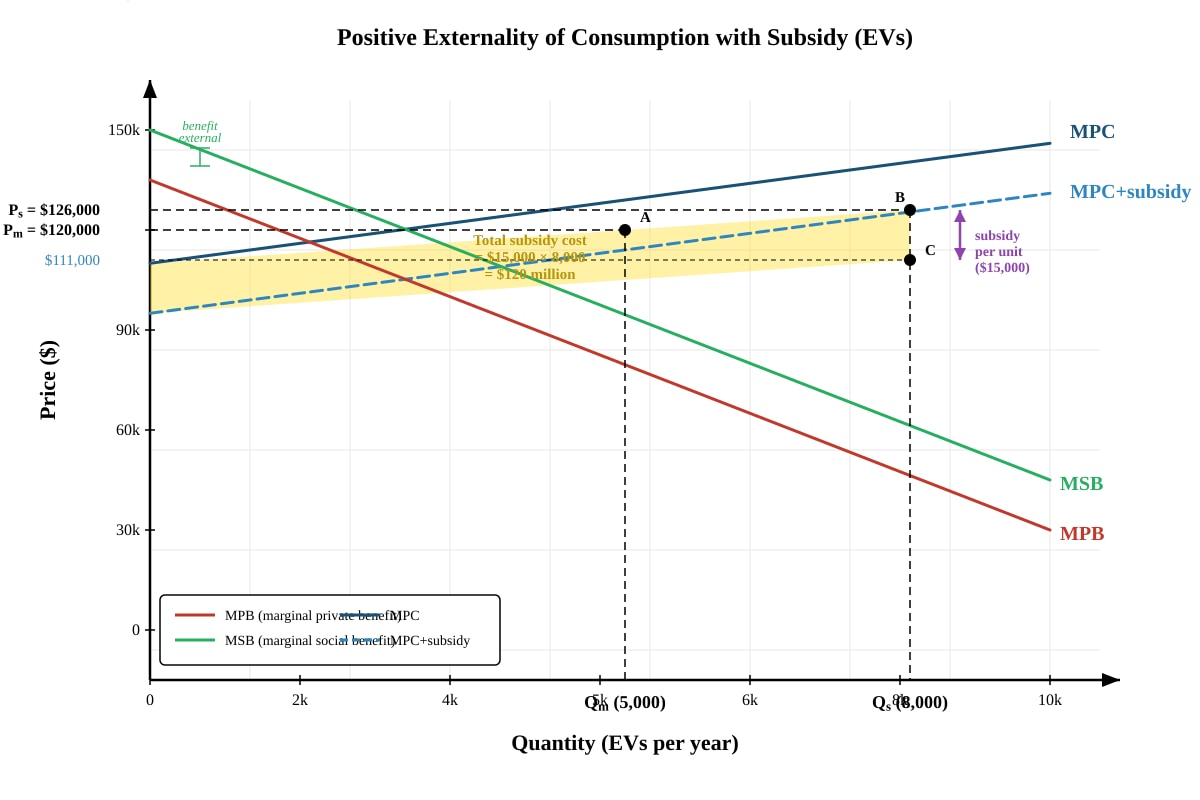
Electric vehicles generate positive externalities of consumption — when consumers buy EVs, third parties benefit from reduced air pollution and lower carbon emissions, but these benefits are not reflected in the market price [1 mark].
In a free market, consumers only consider their private benefits (MPB), so the market equilibrium is at Qm (where MPB = MPC), which is below the socially optimal quantity Qs (where MSB = MPC) [1 mark].
A per-unit subsidy to EV buyers (or producers) effectively reduces the cost of purchasing EVs, shifting the supply curve rightward (or increasing demand) [1 mark]. If the subsidy is set equal to the marginal external benefit, the new equilibrium quantity increases to Qs, achieving the socially optimal level of consumption [1 mark].
The subsidy internalises the externality by bridging the gap between MPB and MSB, ensuring that the market produces the quantity where MSB = MSC [1 mark].
Marking notes: 1 mark for identifying positive externities, 1 mark for explaining under-consumption, 1 mark for explaining the subsidy mechanism, 1 mark for showing the new equilibrium at Qs, 1 mark for concluding on allocative efficiency.
**(b) [3 marks]]
Answer:
Limitation: Government failure / information failure. The government may not know the exact size of the marginal external benefit, leading to an incorrect subsidy level [1 mark]. If the subsidy is too large, it could lead to over-consumption of EVs (beyond Qs), creating a new deadweight loss [1 mark]. Additionally, the subsidy must be funded through taxation, which itself may create distortions in other markets (excess burden of taxation) [1 mark].
Acceptable alternatives: Subsidies may disproportionately benefit higher-income households who can afford EVs, worsening income inequality; subsidies may create dependency and reduce incentives for firms to lower production costs; opportunity cost of government spending.
Question 18 [4 marks]
Answer:
Asymmetric information occurs when one party in a transaction has more or better information than the other party [1 mark].
Example — Used car market (lemons problem): Sellers of used cars know the true condition of the vehicle, but buyers do not [1 mark]. Buyers, unable to distinguish between high-quality and low-quality cars, are only willing to pay an average price. This drives sellers of high-quality cars out of the market (since they cannot get a fair price), leaving mostly low-quality cars ("lemons") — a situation known as adverse selection [1 mark]. The market fails because the equilibrium quantity of used cars is lower than the socially efficient level, and the quality of goods traded is below what consumers would be willing to pay for if they had full information [1 mark].
Acceptable alternatives: Insurance markets (moral hazard, adverse selection); financial markets; healthcare markets.
Question 19
**(a) [4 marks]
Answer:
Traffic congestion is a negative externality of consumption — when an additional driver enters the city centre, they impose costs on other road users in the form of increased travel time, pollution, and fuel waste, but these external costs are not reflected in the private cost of driving [1 mark].
In a free market, drivers only consider their private costs (fuel, vehicle wear) and private benefits, leading to an equilibrium quantity of traffic (Qm) that exceeds the socially optimal level (Qs) where MSB = MSC [1 mark].
A congestion charge (tax) increases the private cost of driving into the city centre by the amount of the marginal external cost [1 mark]. This shifts the supply (or marginal private cost) curve upward, reducing the equilibrium quantity of vehicles to the socially optimal level Qs, thereby eliminating the deadweight loss [1 mark].
(b) [6 marks]
Answer:
Criterion 1: Effectiveness in reducing congestion
- Congestion charge: Directly increases the cost of driving, providing an immediate incentive to reduce car use. Evidence from London's congestion charge shows a significant reduction in traffic volumes (approximately 15–20% in the charging zone). This is a targeted and relatively quick-acting policy [1 mark for analysis].
- Public transport investment: Improves the quality and availability of alternatives to driving, encouraging a modal shift. However, the effect is slower to materialise as infrastructure takes years to build, and the impact depends on the quality of the alternative [1 mark for analysis].
Criterion 2: Equity / distributional impact
- Congestion charge: May be regressive, as lower-income drivers who cannot afford the charge are disproportionately affected, while wealthier drivers can continue driving. This raises equity concerns [1 mark for analysis].
- Public transport investment: Generally more equitable as it benefits all income groups by providing affordable alternatives. Lower-income households, who are more reliant on public transport, benefit disproportionately [1 mark for analysis].
Criterion 3: Government revenue vs. cost
- Congestion charge: Generates government revenue that can be reinvested in transport infrastructure. The administrative cost of implementation (cameras, enforcement) is relatively low compared to large infrastructure projects [1 mark for analysis].
- Public transport investment: Requires significant upfront government expenditure and ongoing subsidies. The financial burden on the government is much higher [1 mark for analysis].
Judgement: The most effective approach likely involves a combination of both policies — a congestion charge provides an immediate deterrent while public transport investment provides viable alternatives. Relying on only one policy may be insufficient [1 mark for judgement — this mark is only awarded if the student makes a clear evaluative conclusion].
Marking notes: Up to 4 marks for analysis (comparing the two policies on at least two criteria) + up to 2 marks for evaluative judgement. Maximum 6 marks.
Question 20 [8 marks]
Answer:
Introduction: Market failure occurs when the free market mechanism fails to allocate resources efficiently. Government intervention aims to correct this, but it does not always lead to a more efficient outcome. This essay evaluates the statement with reference to two types of market failure and two forms of government intervention.
Argument 1: Government intervention CAN improve efficiency — Negative externalities and taxation When negative externalities exist (e.g., pollution from factories), the market overproduces the good because MSC > MPC. A Pigouvian tax equal to the marginal external cost can internalise the externity, shifting the MPC curve up to equal MSC and reducing output to the socially optimal level [2 marks — 1 for explanation, 1 for diagram reference or example].
Argument 2: Government intervention CAN improve efficiency — Public goods and direct provision Public goods (e.g., street lighting) are under-provided by the market due to the free-rider problem. Government provision, funded through taxation, can ensure that the optimal quantity is produced, improving allocative efficiency [2 marks — 1 for explanation, 1 for example].
Argument 3: Government intervention may NOT improve efficiency — Government failure Governments may lack the information needed to set the correct tax rate or subsidy level. If a tax is set too high, it can lead to under-consumption and a new deadweight loss. Additionally, government intervention may be influenced by political considerations rather than economic efficiency (e.g., subsidies to politically important industries) [2 marks — 1 for identifying government failure, 1 for explanation].
Argument 4: Government intervention may NOT improve efficiency — Regulatory capture and unintended consequences Regulation may be captured by the industries being regulated, leading to rules that benefit producers rather than consumers. For example, licensing requirements may restrict competition and create artificial scarcity. Price controls (e.g., minimum wages, rent controls) can create surpluses or shortages if not set at the equilibrium level [2 marks — 1 for identifying the issue, 1 for explanation].
Conclusion: While government intervention has the potential to correct market failure and improve efficiency, it is not guaranteed to do so. The effectiveness depends on the accuracy of government information, the design of the policy, and the absence of government failure. In some cases, government intervention may worsen the misallocation of resources. Therefore, the statement is too absolute — government intervention can but does not always lead to a more efficient outcome [1 mark for a clear, justified conclusion].
Marking scheme for 8-mark essay:
| Marks | Descriptor |
|---|---|
| 7–8 | Well-structured response with clear analysis of at least two types of market failure and two forms of government intervention. Includes evaluative judgement with a justified conclusion. Uses economic terminology accurately. |
| 5–6 | Good analysis of market failure and government intervention, but evaluation may be limited or one-sided. Conclusion present but may lack depth. |
| 3–4 | Some relevant knowledge and analysis, but response may be descriptive rather than evaluative. Limited use of examples or economic reasoning. |
| 1–2 | Basic knowledge shown, but response lacks structure, analysis, or relevance to the question. |
| 0 | No relevant content. |
End of Answer Key