AI Generated Quiz
A Level H1 Economics Microeconomics Quiz
Free A Level H1 Econs Microeconomics quiz, HY3 AI version, with questions, answers, and A Level-style practice for Singapore students.
These static practice materials are generated from the site's syllabus and paper-generation workflow, with source and model context shown so students and parents can evaluate the material before use.
Questions
Free quiz and exam paper access
Enter your details to view this paper
Your access is remembered on this device.
Answers
A-Level Economics H1 Quiz - Microeconomics: Answer Key
Total Marks: 40
Level: A-Level H1
Topic: Microeconomics
Note: Content generated from LLM-inferred templates (Stage 4/5) using syllabus-first design. Not claimed as past-year exam derived.
Section A Answers (Q1–8)
Q1. [2 marks]
Opportunity cost is the value of the next best alternative forgone when a choice is made.
Teaching note: Scarcity forces choices; whenever resources are used for one purpose, the benefit of the alternative use is lost. Mark: 1 for definition, 1 for "next best alternative" idea.
Q2. [2 marks]
Both Country A and Country B saw petrol prices rise from 2021 to 2023. Country A was consistently higher: 1.80 (+28.6%) vs Country B 1.40 (+27.3%).
Marking: 1 for both increased, 1 for comparative magnitude / Country A higher. Common mistake: stating only one country.
Q3. [2 marks]
Any two of: income, consumer preferences, population size, price of substitutes/complements, expectations of future prices.
1 mark each. Syllabus: non-price determinants of demand.
Q4. [2 marks]
The price mechanism signals where resources are needed: rising prices indicate shortage and attract producers; falling prices indicate surplus and signal exit.
1 for signalling scarcity/shortage, 1 for attracting resources.
Q5. [2 marks]
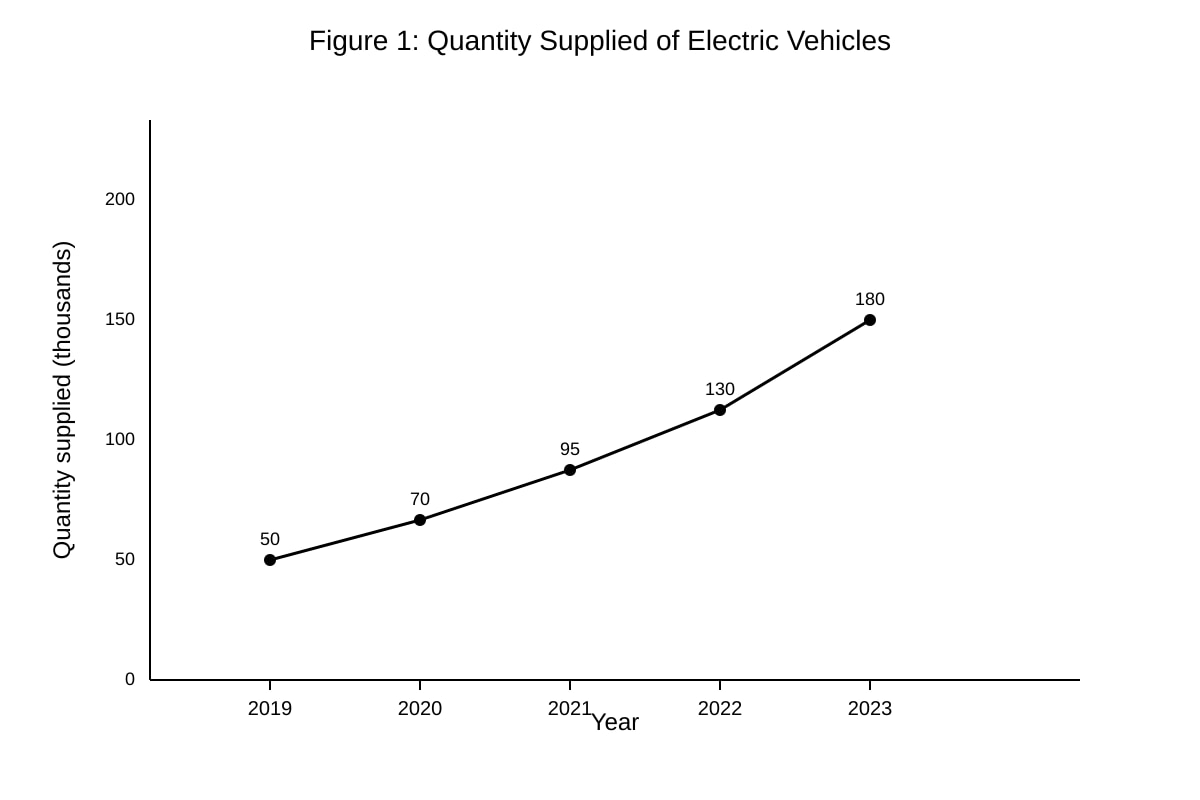
Quantity supplied rose from 50,000 in 2019 to 180,000 in 2023, an increasing trend at an accelerating rate.
1 for direction, 1 for rate/quantified. Image shows points 50→70→95→130→180.
Q6. [2 marks]
A negative externality is a cost imposed on third parties not involved in a transaction, where MSC > MPC.
1 for third-party cost, 1 for example or MPC/MSC note.
Q7. [1 mark]
Information failure (consumers underestimate health costs).
Accept "asymmetric info" not in syllabus; use information failure.
Q8. [2 marks]
Non-excludable and non-rivalrous.
1 each. Public goods: people cannot be excluded, one's use does not reduce another's.
Section B Answers (Q9–14)
Q9. [3 marks]
%ΔP = (1.50−1.20)/1.20 × 100 = +25%
%ΔQd = (720,000−800,000)/800,000 × 100 = −10%
PED = −10 / 25 = −0.4 (|0.4| inelastic)
1 for each step; final value.
Q10. [2 marks]
No. Since |PED|=0.4 < 1, demand is inelastic; raising price reduces Qd proportionally less, so total revenue (=P×Q) rises. But operator asked "should raise to increase revenue" — answer: yes if goal is revenue, but socially may reduce ridership.
Syllabus: inelastic demand → price↑ → TR↑. 2 marks for correct application.
Q11. [4 marks]
(1) Perishability: vegetables cannot be stored long, so supply cannot respond quickly to price rises [2]. (2) Growing time: biological cycle limits output adjustment in short run [2].
Any two valid reasons, 2 marks each.
Q12. [4 marks]
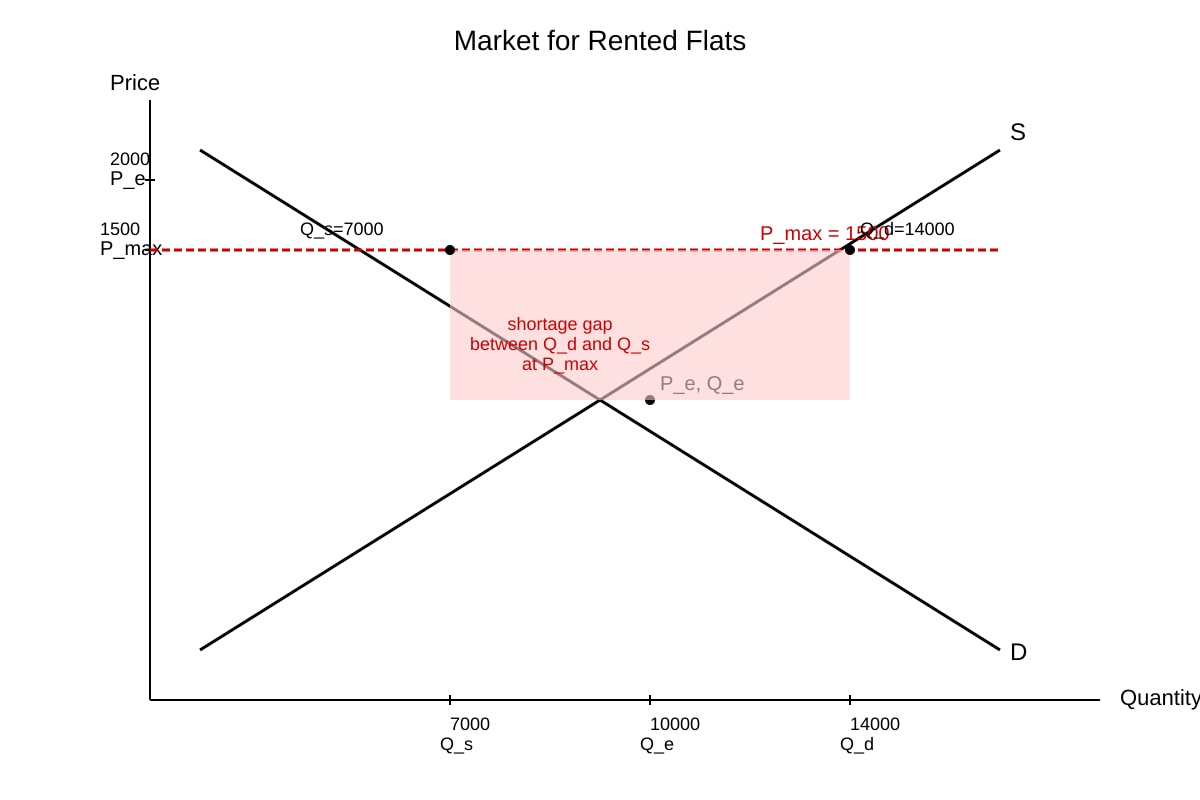
At P_max (2000), Qd=14,000 > Qs=7,000, creating shortage of 7,000. Consumers gain lower price but many unsatisfied; producers supply less.
2 for diagram reading, 2 for shortage/expansion-contraction explanation.
Q13. [2 marks]
Consumer surplus = difference between what consumers pay and max willingness to pay. On diagram, area above price and below demand curve.
1 def, 1 location.
Q14. [4 marks]
Subsidy shifts S right (S1→S2), equilibrium price falls (P_e→P_s), quantity rises (Q_e→Q_s).
Diagram description: 2 marks; price/quantity effect: 2 marks.
Section C Answers (Q15–20)
Q15. [4 marks]
Tax shifts MPC toward MSC (S→S_tax). Equilibrium moves from Q_market to Q_social where MSB=MSC, reducing output and deadweight loss.
2 for diagram description, 2 for correction logic.
Q16. [4 marks]
For: equity — everyone accesses knowledge regardless of income (non-excludable benefit). Against: opportunity cost of tax funds; may not target poor. Evaluation: net equity gain if access gap large.
2 for equity justification, 2 for counter / eval.
Q17. [3 marks]
Market Y DWL (30) > Market X (12). Difference due to higher elasticity or larger market in Y, so tax distorts more.
1 compare, 2 reason.
Q18. [4 marks]
Permits cap total pollution (env effectiveness), allow low-cost abaters to sell (efficiency). Limit: monitoring needed, initial allocation disputed.
2 for pros, 2 for limits/eval.
Q19. [3 marks]
Non-excludable, non-rivalrous [2]. Private market under-provides because free-rider problem → no profit incentive [1].
Q20. [4 marks]
Short-term gain (28→41%) shows education works; drop to 33% shows weak persistence. Effective only with reinforcement.
2 evidence, 2 eval of durability.