From Real Exams Quiz
A Level H1 Economics Market Failure Quiz
Free A Level H1 Econs Market Failure quiz, Qwen3.7 Exam version, with questions, answers, and A Level-style practice for Singapore students.
These static practice materials are generated from the site's syllabus and paper-generation workflow, with source and model context shown so students and parents can evaluate the material before use.
Questions
Free quiz and exam paper access
Enter your details to view this paper
Your access is remembered on this device.
Answers
A-Level Economics H1 Quiz - Market Failure (Answer Key)
Section A: Multiple Choice & Short Definitions
Q1. Answer: B
- Reasoning: A negative externality of production occurs when the production of a good imposes costs on third parties not involved in the transaction. Therefore, the Marginal Social Cost (MSC) = Marginal Private Cost (MPC) + External Cost. Thus, MSC > MPC.
- Common Mistake: Confusing production externalities (cost side) with consumption externalities (benefit side).
Q2. Answer: D
- Reasoning: Public goods are defined by non-rivalry (one person’s consumption does not reduce availability for others) and non-excludability (it is impossible or too costly to prevent non-payers from consuming).
- Teaching Note: Private goods are rival and excludable. Club goods are non-rival but excludable. Common resources are rival but non-excludable.
Q3. Answer: B
- Reasoning: Merit goods (e.g., education, healthcare) have positive externalities. However, due to information failure, consumers often undervalue the long-term private benefits (e.g., better health, higher income). This leads to under-consumption relative to the social optimum.
- Common Mistake: Thinking merit goods are under-provided because they are expensive (supply-side issue) rather than undervalued (demand-side information failure).
Q4. Answer: A
- Reasoning: Asymmetric information exists when one party in a transaction has more or better information than the other. In the used car market ("lemons problem"), the seller knows the true quality, but the buyer does not.
- Common Mistake: Confusing asymmetric information with externalities (Q4 B) or monopoly power (Q4 D).
Q5. Answer:
Opportunity cost is the value of the next best alternative foregone. In the context of government spending on healthcare, it is the benefit that could have been gained if those funds were spent on the next best alternative, such as education or infrastructure development.
- Marking: 1 mark for definition, 1 mark for context application.
Q6. Answer:
The price mechanism fails because of the free-rider problem. Since public goods are non-excludable, individuals can benefit from the good without paying for it. Rational consumers will wait for others to pay, leading to zero or insufficient demand in the free market, causing missing markets.
- Marking: 1 mark for identifying free-rider problem/non-excludability, 1 mark for explaining the resulting lack of provision.
Q7. Answer:
- Direct Tax: Levied directly on income or wealth (e.g., Personal Income Tax).
- Indirect Tax: Levied on expenditure/goods and services (e.g., GST or Excise Duty).
- Marking: 1 mark for correct distinction, 1 mark for valid examples.
Section B: Data Response & Diagrammatic Analysis
Q8. Answer:
- Assumption: The question states to assume the tax per unit is set equal to the external cost. From Table 1, External Cost = $0.40.
- Formula: Tax Revenue = Tax per unit Quantity After Tax.
- Calculation: .
- Answer: $3.4 million.
- Marks: 1 for correct formula/identification of tax per unit, 1 for correct final answer.
Q9. Answer:
- Formula: PED = % Change in Quantity Demanded / % Change in Price.
- % Change in Q: .
- % Change in P: .
- PED: .
- Conclusion: Since , demand is price inelastic.
- Marks: 1 for % change Q, 1 for % change P, 1 for correct classification.
Q10. Answer:
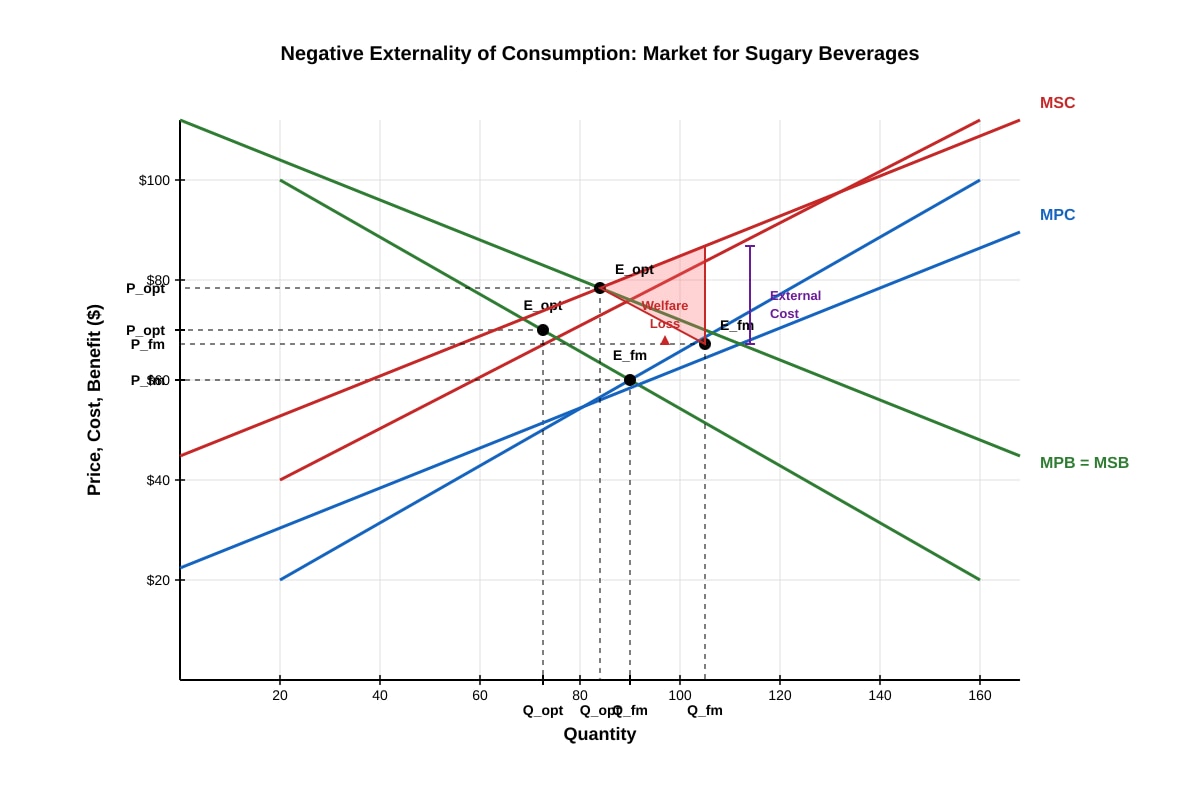
- Diagram Requirements:
- Y-axis: Price/Cost/Benefit. X-axis: Quantity.
- MPB = MSB: Downward sloping demand curve.
- MPC: Upward sloping (or horizontal if constant cost) supply curve.
- MSC: Above MPC by the vertical distance of the external cost ($0.40).
- Free Market Equilibrium (): Where MPC intersects MPB.
- Social Optimum (): Where MSC intersects MSB.
- Welfare Loss: The triangle area between and , bounded by the MSC and MSB curves.
- Marking:
- 1 mark for correct axes and curves (MPC, MSC, MPB/MSB).
- 1 mark for correct positioning of MSC above MPC.
- 1 mark for identifying and correctly.
- 1 mark for shading the welfare loss triangle correctly.
- 1 mark for clear labels.
Q11. Answer:
- At , the Marginal Social Cost (MSC) is greater than the Marginal Social Benefit (MSB).
- This means the cost to society of producing the last unit exceeds the benefit derived from it.
- Resources are over-allocated to this good, resulting in a net welfare loss to society. Allocative efficiency occurs where MSC = MSB, which is at , not .
- Marks: 1 for MSC > MSB at , 1 for explanation of over-allocation, 1 for linking to efficiency condition (MSC=MSB).
Q12. Answer:
- A subsidy to producers of sugar-free drinks lowers their cost of production.
- This shifts the Supply curve to the right (from S1 to S2).
- This leads to a lower equilibrium price and a higher equilibrium quantity for sugar-free drinks.
- This encourages consumers to substitute away from sugary drinks, helping to reduce the negative externality.
- Marks: 1 for shift direction, 1 for price/quantity effect, 1 for substitution effect logic.
Q13. Answer:
- Limitation: Difficulty in accurately measuring the external cost.
- Explanation: If the government sets the tax too low, it fails to internalize the full externality. If set too high, it creates unnecessary welfare loss and reduces consumer surplus excessively.
- Alternative Limitation: Regressive nature. Taxes on beverages take a larger percentage of income from low-income households.
- Marks: 1 for identifying limitation, 1 for explanation.
Section C: Structured Essay Questions & Additional Short Questions
Q14. Answer:
(a) Why private sector fails:
- Public goods are non-excludable and non-rival.
- Private firms cannot charge users effectively because of the free-rider problem (people can consume without paying).
- Therefore, private firms cannot make a profit, leading to missing markets (zero provision).
(b) Evaluation of Government Provision vs. Other Methods:
-
Government Provision: Ensures the good is provided for social welfare (e.g., national defense, street lighting). It solves the missing market problem directly.
- Evaluation: Can be inefficient due to lack of profit motive (X-inefficiency). May lead to over-provision if not carefully planned. Opportunity cost of tax revenue.
-
Private Contracting/Regulation: Government can pay private firms to provide the good (contracting out) or regulate private provision.
- Evaluation: Contracting out can introduce competition and efficiency. However, monitoring costs are high, and private firms may still cut corners on quality.
-
Conclusion: Government provision is often necessary for pure public goods due to the complete failure of the price mechanism. However, efficiency can be improved by using private sector involvement where possible (e.g., public-private partnerships).
-
Marking:
- Up to 6 marks for part (a): Clear explanation of non-excludability, free-rider problem, and missing markets.
- Up to 6 marks for part (b): Balanced evaluation comparing government provision with alternatives, considering efficiency, equity, and practical implementation.
Q15. Answer:
- Definition: Merit goods are goods that are under-consumed in a free market because consumers undervalue their long-term benefits (information failure) and/or they generate positive externalities.
- Example: Education (e.g., primary/secondary schooling in Singapore) or Healthcare (e.g., subsidized clinics).
- Marking: 1 mark for definition, 1 mark for valid example.
Q16. Answer:
- Consumers suffer from imperfect information regarding the long-term private benefits of the good (e.g., students may not realize how much education increases future earnings).
- As a result, the Marginal Private Benefit (MPB) perceived by consumers is lower than the true Marginal Social Benefit (MSB).
- This leads to consumption at a level where MPB = MPC, which is lower than the socially optimal level where MSB = MSC.
- Marking: 1 mark for linking information failure to undervaluation, 1 mark for explaining the resulting under-consumption.
Q17. Answer:
- Negative Externality of Production: Costs imposed on third parties during the production process.
- Example: Industrial pollution from a factory affecting local air quality.
- Negative Externality of Consumption: Costs imposed on third parties during the consumption of a good.
- Example: Second-hand smoke from smoking affecting bystanders.
- Marking: 1 mark for correct distinction, 1 mark for valid examples.
Q18. Answer:
- The free-rider problem occurs when individuals can benefit from a good or service without paying for it, typically because the good is non-excludable.
- Rational individuals will choose not to pay, hoping others will cover the cost.
- If everyone acts this way, no one pays, and the good is not provided by the private market, leading to market failure (missing market).
- Marking: 1 mark for explaining the mechanism (non-excludability/not paying), 1 mark for linking to market failure.
Q19. Answer:
- Equity/Fairness: To ensure low-income households can afford essential goods (e.g., rent control or staple foods).
- Prevent Exploitation: To prevent monopolies or suppliers from charging excessively high prices during crises (e.g., price caps on masks during a pandemic).
- Marking: 1 mark for each valid reason.
Q20. Answer:
- Unintended Consequence: Surplus (Excess Supply).
- Explanation: If the minimum price is set above the equilibrium price, Quantity Supplied will exceed Quantity Demanded ().
- Result: This leads to unsold stock, which the government may need to buy and store (costly) or destroy, leading to resource wastage.
- Marking: 1 mark for identifying surplus, 1 mark for explanation.