From Real Exams Quiz
A Level H1 Economics Market Failure Quiz
Free A Level H1 Econs Market Failure quiz, LongCat Exam version, with questions, answers, and A Level-style practice for Singapore students.
These static practice materials are generated from the site's syllabus and paper-generation workflow, with source and model context shown so students and parents can evaluate the material before use.
Questions
Free quiz and exam paper access
Enter your details to view this paper
Your access is remembered on this device.
Answers
A-Level Economics H1 Quiz - Market Failure
Answer Key and Marking Scheme
Section A: Short Answer Questions (10 marks)
Question 1 [2 marks]
Answer:
Market failure occurs when the free market mechanism, operating without government intervention, fails to allocate resources efficiently. This means that the price mechanism, left to its own devices, results in either an over-allocation or under-allocation of resources to the production or consumption of a particular good or service relative to the socially optimal level.
Marking Notes:
- 1 mark for identifying that the free market does not allocate resources efficiently.
- 1 mark for explaining that this leads to over- or under-production/consumption relative to the social optimum.
- Do not award full marks for simply defining "failure" without reference to resource allocation or efficiency.
Question 2 [2 marks]
Answer:
(a) Non-rivalry — one person's consumption of the good does not reduce the amount available for others.
(b) Non-excludability — it is not possible to prevent anyone from consuming the good, even if they have not paid for it.
Marking Notes:
- 1 mark for each correct characteristic.
- Accept equivalent phrasing, e.g., "cannot exclude non-payers" for non-excludability, or "consumption by one does not diminish availability to others" for non-rivalry.
- Do not accept "provided by the government" as a characteristic — this is a common misconception.
Question 3 [2 marks]
Answer:
A positive externality occurs when the production or consumption of a good imposes benefits on third parties who are not involved in the market transaction, and these benefits are not reflected in the market price. Example: Education — when individuals receive education, society benefits from a more productive workforce and lower crime rates.
A negative externality occurs when the production or consumption of a good imposes costs on third parties who are not involved in the market transaction, and these costs are not reflected in the market price. Example: Air pollution from factories — nearby residents suffer health problems for which they are not compensated.
Marking Notes:
- 1 mark for correctly distinguishing between the two (benefits vs costs to third parties).
- 1 mark for providing a valid example of each.
- The example must clearly identify the third-party effect, not just describe the good.
Question 4 [2 marks]
Answer:
Asymmetric information occurs when one party in a market transaction has more or better information than the other party, leading to an imbalance in the transaction and potentially resulting in an inefficient allocation of resources.
Example: In the market for used cars, the seller typically knows more about the condition of the car than the buyer (the "lemons" problem). This can lead to adverse selection, where buyers are unwilling to pay fair prices because they fear purchasing a low-quality product, causing the market to shrink or fail.
Marking Notes:
- 1 mark for a correct definition that identifies the imbalance of information between parties.
- 1 mark for a valid example that illustrates the concept in a real-world market context.
- Accept other valid examples: health insurance (the insured knows more about their health than the insurer), financial products (banks know more about risk than borrowers).
Question 5 [2 marks]
Answer:
The free market underprovides merit goods because consumers tend to undervalue them. This occurs due to information failure — individuals do not fully appreciate the long-term private benefits of consuming merit goods (e.g., the full health benefits of education or vaccinations). As a result, the marginal private benefit (MPB) perceived by consumers is lower than the true marginal social benefit (MSB). In a free market, consumers base their decisions on MPB, leading to a level of consumption below the socially optimal level where MSB = MSC.
Marking Notes:
- 1 mark for identifying that consumers undervalue merit goods / there is information failure.
- 1 mark for explaining that this leads to MPB < MSB and therefore underconsumption relative to the social optimum.
- Do not award full marks if the answer only states "the government should provide merit goods" without explaining why the market fails.
Section B: Structured / Data Response Questions (20 marks)
Question 6 [1 mark]
Answer:
One external benefit of EV adoption mentioned in the extract is reduced air pollution (accept also: lower greenhouse gas emissions, improved public health outcomes).
Marking Notes:
- 1 mark for any one of the three external benefits explicitly mentioned in Extract A.
- Do not accept "reduced fuel costs" or "lower maintenance costs" — these are private benefits, not external benefits.
Question 7 [3 marks]
Answer:
The free market would underconsume electric vehicles because the social benefits of EV adoption exceed the private benefits enjoyed by individual car owners. This represents a positive externality in consumption. In a free market, consumers base their purchasing decisions on the marginal private benefit (MPB) — the benefits they personally receive, such as lower fuel costs and convenience. However, they do not take into account the external benefits they generate for society, such as reduced air pollution and improved public health. Since MPB < MSB, the market equilibrium quantity is below the socially optimal quantity. The market fails to account for the full social value of EVs, resulting in underconsumption.
Marking Notes:
- 1 mark for identifying the positive externality (social benefits > private benefits).
- 1 mark for explaining that consumers base decisions on private benefits only.
- 1 mark for concluding that this leads to underconsumption relative to the socially optimal level.
- For full marks, the answer must use the concept of external benefit/positive externality explicitly.
Question 8 [4 marks]
Answer:
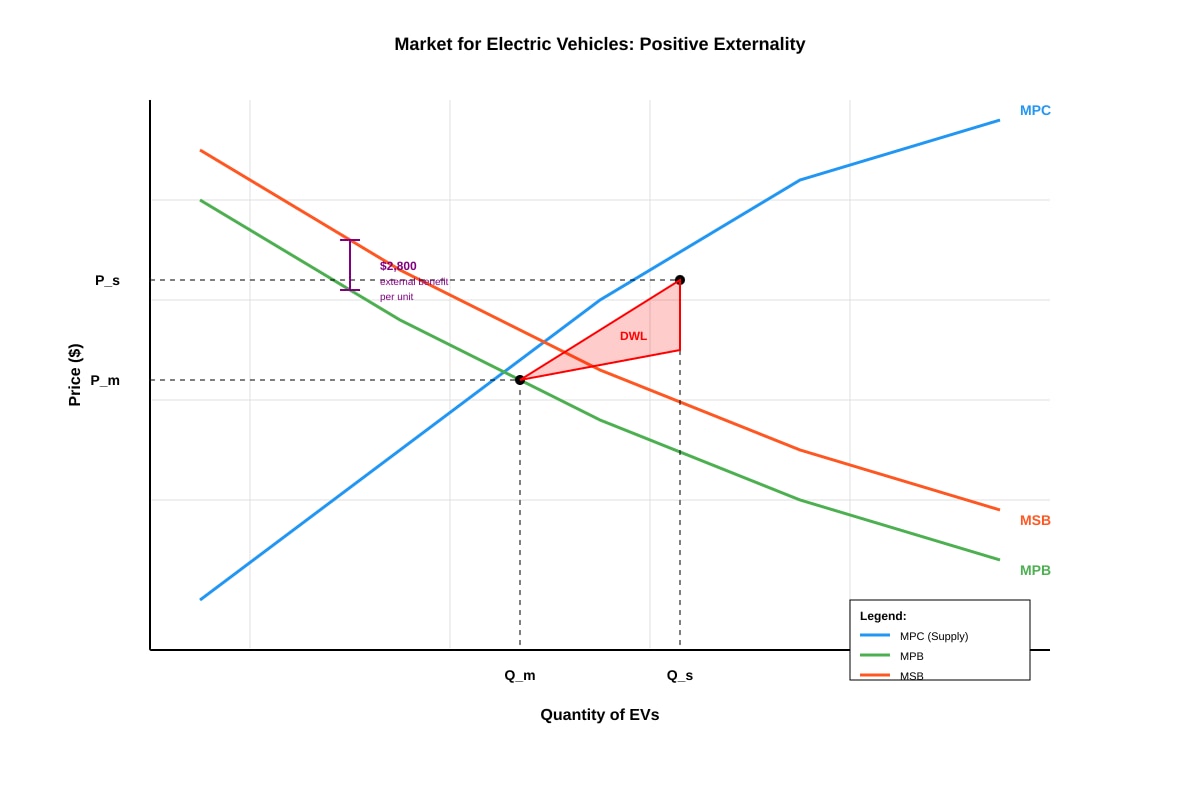
When each EV generates 2,800 at every quantity. This is because society values each EV more than the individual consumer does, due to the additional external benefits (cleaner air, better public health, lower emissions).
In a free market, consumers and producers interact based on MPB and MPC (marginal private cost). The market equilibrium occurs where MPB = MPC, at quantity Q_m and price P_m.
However, the socially optimal level of output occurs where MSB = MPC, at quantity Q_s and price P_s. Since MSB lies above MPB, Q_s > Q_m, meaning the efficient level of output is higher than the market equilibrium.
The difference between Q_s and Q_m represents the underproduction by the free market. The deadweight loss (welfare loss) is the triangle between the MSB and MPC curves from Q_m to Q_s, representing the lost social surplus that could have been gained if more EVs were consumed.
Marking Notes:
- 1 mark for explaining that MSB = MPB + $2,800 (external benefit).
- 1 mark for identifying the market equilibrium (MPB = MPC) and the social optimum (MSB = MPC).
- 1 mark for explaining that Q_s > Q_m (the efficient quantity is higher).
- 1 mark for identifying/explaining the deadweight loss.
- The diagram (Q8-fig1) should show: MSB above MPB by $2,800, MPC upward sloping, Q_m < Q_s, and a shaded DWL triangle. Award diagram marks if the diagram is correctly drawn and labelled.
Question 9 [2 marks]
Answer:
The VES rebates may be considered regressive because they disproportionately benefit higher-income households, who are more likely to purchase new electric vehicles. Lower-income households, who are more likely to purchase second-hand ICE vehicles or keep older polluting cars for longer, do not benefit from the rebates. In effect, the policy uses public funds (foregone tax revenue) to subsidise purchases by wealthier individuals, while the costs of the policy (e.g., through other taxes or reduced government revenue) may be borne more broadly, including by lower-income groups. This means the policy may widen rather than narrow the welfare gap between income groups.
Marking Notes:
- 1 mark for identifying that higher-income households benefit more (they are the ones buying new EVs).
- 1 mark for explaining why this is regressive (lower-income groups do not benefit / the policy redistributes resources toward the wealthy).
- Accept alternative valid reasoning, e.g., lower-income households bear a disproportionate share of the pollution costs.
Question 10 [4 marks]
Answer:
The VES rebate scheme can be effective in correcting the market failure associated with vehicle emissions because it internalises the externality by making low-emission vehicles relatively cheaper and high-emission vehicles relatively more expensive. This shifts consumer demand toward EVs, moving the market closer to the socially optimal level of consumption. The rebate effectively acts as a subsidy for positive externalities, encouraging consumers to take into account the social benefits of their purchasing decisions.
However, there are limitations. First, the rebate may be insufficient to fully bridge the gap between MPB and MSB — the $2,800 per year external benefit may require a larger incentive to achieve the socially optimal quantity. Second, as noted in the extract, the rebate is regressive, benefiting higher-income households more. Third, the rebate alone does not address non-price barriers such as range anxiety and the lack of charging infrastructure, which may limit its effectiveness. The government's commitment to deploying 60,000 charging points is a complementary measure that addresses this barrier.
Furthermore, the effectiveness depends on the price elasticity of demand (PED) for EVs. If demand is price inelastic (due to consumer preferences, habit, or lack of alternatives), even a significant rebate may not substantially increase EV uptake. The data in the extract shows that EV adoption rose from 1.2% to 15.7% between 2020 and 2023, suggesting the policy has had some effect, but the majority of consumers still choose ICE vehicles.
Overall, the VES rebate is a useful policy tool but is most effective when combined with complementary measures (infrastructure investment, public education, and regulation) rather than used in isolation.
Marking Notes:
- 1 mark for explaining how the VES rebate corrects the market failure (internalises the externality / shifts demand toward EVs).
- 1 mark for identifying a limitation (regressiveness, insufficient rebate size, non-price barriers, PED considerations).
- 1 mark for a second limitation or a developed point.
- 1 mark for a reasoned evaluative conclusion that weighs effectiveness against limitations.
- For Level 3 (3–4 marks): Must have explanation of the policy, at least one developed limitation, and a reasoned conclusion.
- For Level 2 (2 marks): Explanation of policy with limited or no evaluation.
- For Level 1 (1 mark): Basic statement with no development.
Question 11 [2 marks]
Answer:
Total external costs fell from 375 million in 2023, a decrease of **320 million to 180 million to $130 million.
Marking Notes:
- 1 mark for identifying the correct values for both years (375m).
- 1 mark for stating the direction and magnitude of change (decreased by $125m / 25%).
- Accept answers that describe the trend qualitatively (e.g., "fell steadily") with reference to the data.
- Do not award full marks if the answer only states one year's figure without comparison.
Question 12 [2 marks]
Answer:
Percentage change = [(New Value − Old Value) / Old Value] × 100
= [(1,500 − 2,800) / 2,800] × 100
= [−1,300 / 2,800] × 100
= −46.4% (to 1 d.p.)
Cigarette consumption fell by approximately 46.4% from 2015 to 2023.
Marking Notes:
- 1 mark for correct formula/method.
- 1 mark for correct final answer (−46.4% or 46.4% decrease).
- Accept answers between 46% and 47% depending on rounding.
- Do not penalise for missing negative sign if "decrease" is stated.
Question 13 [4 marks]
Answer:
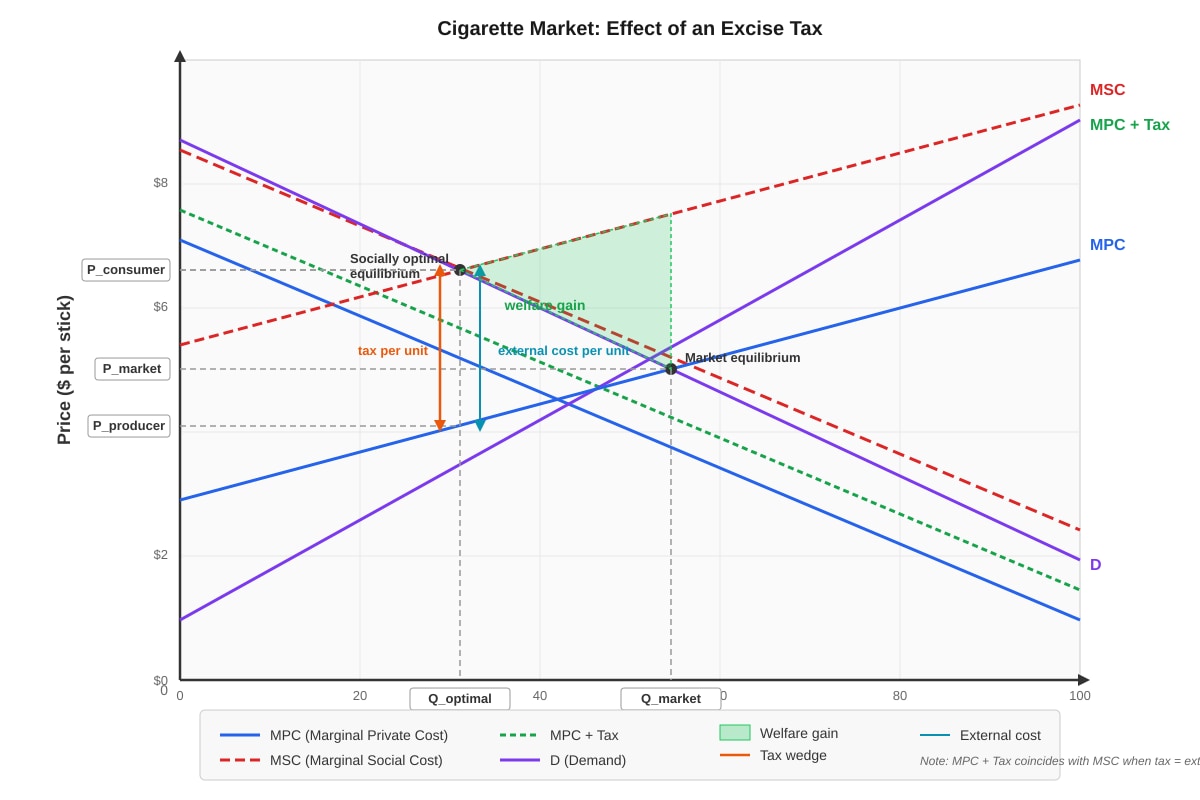
Cigarettes are a demerit good with negative externalities in consumption. The marginal social cost (MSC) of cigarette consumption exceeds the marginal private cost (MPC) because smoking imposes costs on third parties (e.g., second-hand smoke health effects, public healthcare costs, productivity losses).
In a free market, the equilibrium occurs where demand (MPB) = MPC, at quantity Q_market. However, the socially optimal quantity occurs where demand (MPB) = MSC, at quantity Q_optimal, which is lower than Q_market. The free market overproduces cigarettes relative to the social optimum.
An excise tax on cigarettes shifts the supply curve upward from MPC to MPC + Tax. If the tax per unit is set equal to the external cost per unit at Q_optimal, the new supply curve (MPC + Tax) intersects demand at Q_optimal. This reduces consumption to the socially efficient level, eliminating the deadweight loss that existed at the market equilibrium.
The tax also generates government revenue, which can be used to fund healthcare or anti-smoking campaigns.
Marking Notes:
- 1 mark for explaining that MSC > MPC (negative externality in consumption).
- 1 mark for identifying that the free market overproduces (Q_market > Q_optimal).
- 1 mark for explaining that the tax shifts the supply curve upward and reduces quantity to Q_optimal.
- 1 mark for the diagram (Q13-fig1) showing MSC above MPC, the tax wedge, and the reduction in quantity.
- The diagram must show: D, MPC, MSC, MPC+Tax, Q_market, Q_optimal, and the tax per unit. Award partial credit for partially correct diagrams.
Question 14 [2 marks]
Answer:
Cigarettes are classified as a demerit good because they are considered to be harmful to the consumer themselves, and consumers are assumed to have imperfect information about the true extent of the harm. A demerit good is one where the government judges that individuals would not make rational, fully informed choices about its consumption — they underestimate the long-term health costs (e.g., lung cancer, heart disease) and may be addicted, meaning their revealed preference does not reflect their true welfare.
This is distinct from a good with negative externalities, where the harm falls primarily on third parties (e.g., second-hand smoke). While cigarettes do have negative externalities, the classification as a demerit good emphasises the information failure and irrationality on the part of the consumer, not just the external costs imposed on others.
Marking Notes:
- 1 mark for explaining that demerit goods harm the consumer and involve information failure / irrational consumption.
- 1 mark for distinguishing this from negative externalities (harm to third parties vs. harm to self).
- Do not award full marks if the answer only states "cigarettes are bad for you" without reference to information failure.
Question 15 [4 marks]
Answer:
Excise taxes work by increasing the price of cigarettes, thereby reducing quantity demanded along the demand curve. The effectiveness of taxation depends critically on the price elasticity of demand (PED) for cigarettes. Cigarettes are generally price inelastic in demand because they are addictive — consumers find it difficult to reduce consumption significantly in response to price increases. This means that a tax will reduce consumption only modestly while generating significant government revenue. However, even a small reduction in consumption can have meaningful public health benefits given the large external costs involved.
Advertising bans address the market failure from a different angle. Cigarette advertising can create a positive image of smoking, contributing to information failure and encouraging consumption, particularly among young people. By banning advertising, the government reduces the demand for cigarettes by shifting the demand curve leftward. This can be effective in reducing long-term consumption, especially among new and potential smokers, but may have limited impact on existing addicted smokers.
Graphic health warnings directly address information failure by ensuring that consumers are more fully aware of the health risks of smoking. This shifts the demand curve to the left as consumers reassess the private costs of smoking. However, if consumers are already aware of the risks (as is likely in Singapore, where smoking is widely known to be harmful), the additional impact of graphic warnings may be limited. Addiction also means that even fully informed consumers may not reduce consumption.
Evaluation: The most effective policy depends on the nature of the market failure being addressed. If the primary concern is negative externalities, taxation is most direct, as it internalises the external cost. If the primary concern is information failure, advertising bans and health warnings may be more effective. In practice, a combination of all three is likely to be most effective, as they address different dimensions of the market failure. Given the addictive nature of cigarettes (making PED inelastic), taxation alone is unlikely to be sufficient, and complementary measures that shift the demand curve (bans, warnings) are essential.
Marking Notes:
- 1 mark for explaining how at least one policy works.
- 1 mark for explaining a second policy or for discussing PED in relation to taxation.
- 1 mark for evaluating the relative effectiveness of the policies.
- 1 mark for a reasoned conclusion that considers the nature of the market failure and/or the addictive nature of cigarettes.
- For full marks, the answer must discuss at least two policies and provide a comparative evaluation.
Section C: Essay Question (10 marks)
Marking Criteria for Essay Questions (16–20):
| Level | Marks | Descriptors |
|---|---|---|
| Level 1 | 1–3 | Basic understanding; limited analysis; no evaluation; may be largely descriptive or irrelevant. |
| Level 2 | 4–6 | Some understanding of relevant concepts; basic analysis; limited or unbalanced evaluation; may lack depth or use of examples. |
| Level 3 | 7–8 | Good understanding; clear analysis with relevant economic theory; balanced evaluation with a reasoned conclusion; use of examples. |
| Level 4 | 9–10 | Excellent understanding; thorough and accurate analysis; well-structured argument with sustained evaluation; effective use of examples; clear and well-supported conclusion. |
Question 16
"Government intervention to correct market failure always leads to a more efficient allocation of resources."
Model Answer / Marking Guidance:
Introduction: Define market failure and government intervention. State that while intervention can improve efficiency, it is not guaranteed to do so — the outcome depends on the type of intervention, the accuracy of government information, and potential government failure.
Arguments FOR the statement (intervention improves efficiency):
-
Taxes on negative externalities (e.g., carbon tax, cigarette excise tax) can internalise external costs, shifting the market equilibrium toward the socially optimal quantity. If the tax equals the marginal external cost, the deadweight loss is eliminated, and allocative efficiency is achieved.
-
Subsidies for positive externalities (e.g., EV rebates, education subsidies) can increase consumption of merit goods toward the socially optimal level, correcting underconsumption.
-
Direct provision of public goods (e.g., national defence, street lighting) overcomes the free-rider problem, ensuring that goods that would not be provided by the market are available.
-
Regulation (e.g., emission standards, smoking bans) can directly limit harmful activities where price-based measures are insufficient.
Arguments AGAINST the statement (intervention may not improve efficiency):
-
Government failure — governments may lack the information needed to set the correct tax or subsidy level. If a tax is set too high, it can create a new deadweight loss by reducing output below the social optimum (overcorrection).
-
Regulatory capture — regulated industries may influence regulators to serve their own interests rather than the public interest, leading to inefficient outcomes.
-
Moral hazard — government intervention (e.g., subsidies) may encourage inefficient behaviour. For example, subsidies for EVs may encourage consumers to replace functional ICE vehicles prematurely, wasting resources.
-
Administrative costs — the cost of implementing, monitoring, and enforcing government policies may exceed the efficiency gains, particularly for complex regulations.
-
Unintended consequences — e.g., high cigarette taxes may encourage smuggling and black market activity, undermining the policy's effectiveness.
Conclusion: Government intervention can lead to a more efficient allocation of resources, but it does not always do so. The effectiveness depends on the accuracy of government information, the design of the policy, and the absence of government failure. In some cases, well-designed intervention (e.g., a Pigouvian tax set at the correct level) can achieve efficiency, but in others, poorly designed intervention may worsen the outcome.
Question 17
"The provision of public goods is the most significant form of market failure in Singapore."
Model Answer / Marking Guidance:
Introduction: Define public goods (non-rivalry, non-excludability) and explain why they represent market failure (free-rider problem → zero market provision). Acknowledge that while public goods are important, other forms of market failure may be more significant in Singapore's context.
Arguments that public goods are the most significant:
-
Singapore relies heavily on government provision of public goods such as national defence, public infrastructure, and street lighting. Without government intervention, these would not be provided at all due to the free-rider problem.
-
Public health (e.g., pandemic preparedness, vector control for dengue) has public good characteristics and is critical for Singapore's dense urban environment.
Arguments that other forms of market failure are more significant:
-
Negative externalities — Singapore faces significant external costs from vehicle emissions, industrial pollution, and congestion. The government has implemented multiple policies (VES, COE, ERP) to address these, suggesting they are a major concern.
-
Merit/demerit goods — The government heavily intervenes in education (merit good) and regulates tobacco and alcohol (demerit goods), indicating these are significant market failures.
-
Information failure — In healthcare and financial services, asymmetric information is a major concern. The government regulates these sectors extensively (e.g., MediShield Life, CPF, financial advisory regulations).
-
Market power — Singapore's small, open economy means certain sectors (telecommunications, utilities, banking) are dominated by a few firms, leading to potential allocative inefficiency.
Conclusion: While public goods are a fundamental form of market failure, in Singapore's context, negative externalities (particularly from transport and congestion) and information failure (in healthcare and finance) may be more significant in terms of the scale of government intervention required and the economic costs involved. The significance depends on the criteria used — public goods represent the most complete market failure (zero provision), but other forms may impose larger welfare losses.
Question 18
Evaluate the view that taxation is the most effective policy for correcting all forms of market failure.
Model Answer / Marking Guidance:
Introduction: Taxation (specifically Pigouvian taxes) is a key policy tool for correcting market failure, particularly negative externalities. However, its effectiveness varies depending on the type of market failure.
Where taxation is effective:
-
Negative externalities — Taxes can internalise external costs (e.g., carbon tax, cigarette excise tax). If set at the correct level (equal to marginal external cost), they achieve allocative efficiency.
-
Demerit goods — Taxes can reduce consumption of harmful goods, though effectiveness depends on PED.
Where taxation is less effective or inappropriate:
-
Public goods — Taxation alone cannot provide public goods; the government must directly provide them (taxation is the funding mechanism, not the solution to the free-rider problem).
-
Positive externalities — Subsidies (negative taxes) are more appropriate than taxes for encouraging consumption of merit goods.
-
Information failure — Taxation does not address the root cause of information failure. Advertising bans, mandatory disclosure, and education campaigns are more direct solutions.
-
Practical limitations — Setting the correct tax rate requires accurate measurement of external costs, which is often difficult. If the tax is set incorrectly, it can create new inefficiencies.
-
Regressive impact — Taxes on goods like cigarettes and fuel tend to be regressive, disproportionately affecting lower-income households.
Conclusion: Taxation is an effective tool for correcting negative externalities but is not universally the best policy for all forms of market failure. A combination of policies — taxes, subsidies, regulation, direct provision, and information campaigns — is typically needed.
Question 19
"Information failure is the root cause of all market failure."
Model Answer / Marking Guidance:
Introduction: Information failure is a significant cause of market failure, but it is not the sole cause. Other sources include the nature of public goods, externalities, and market power.
Arguments that information failure is a root cause:
-
Merit and demerit goods — Underconsumption of merit goods (e.g., education) and overconsumption of demerit goods (e.g., cigarettes) are directly caused by consumers' imperfect information about the true costs and benefits.
-
Asymmetric information — Adverse selection and moral hazard in insurance and financial markets arise from information asymmetry.
-
Externalities — One could argue that if all parties had perfect information, externalities would be internalised through negotiation (Coase theorem), suggesting information failure underlies externality-based market failure.
Arguments that information failure is NOT the root cause of all market failure:
-
Public goods — The free-rider problem arises from the non-excludable nature of public goods, not from information failure. Even with perfect information, individuals would still have an incentive to free-ride.
-
Externalities — Externalities exist because property rights are not well-defined or enforceable, not necessarily because of information failure. A factory polluting a river imposes costs regardless of whether the affected parties are informed.
-
Market power — Monopoly power leads to allocative inefficiency (P > MC) due to the structure of the market, not information failure.
Conclusion: Information failure is an important cause of some types of market failure (merit/demerit goods, asymmetric information), but it is not the root cause of all market failure. Public goods and externalities have distinct causes related to the characteristics of goods and the absence of property rights.
Question 20
Evaluate the economic case for government intervention in the market for vaccinations.
Model Answer / Marking Guidance:
Introduction: Vaccinations are a classic example of a merit good with significant positive externalities. The economic case for government intervention is strong, but the form of intervention matters.
The case FOR government intervention:
-
Positive externalities (herd immunity) — When an individual is vaccinated, they not only protect themselves but also reduce the risk of transmission to others. The marginal social benefit (MSB) exceeds the marginal private benefit (MPB). In a free market, individuals base their decision on MPB only, leading to underconsumption relative to the social optimum. The externality can be illustrated using an externality diagram (MSB above MPB).
-
Merit good / information failure — Individuals may underestimate the private benefits of vaccination due to lack of information, misinformation (e.g., anti-vaccine movements), or short-sightedness. This further reduces demand below the optimal level.
-
Public good characteristics (near-public good) — At the population level, herd immunity has non-rival and non-excludable characteristics, resembling a public good. The free-rider problem may arise — individuals may rely on others to get vaccinated while not vaccinating themselves.
Forms of government intervention:
-
Subsidies — Reduce the price of vaccinations, increasing consumption toward the social optimum. Singapore's subsidised vaccination programmes at polyclinics are an example.
-
Direct provision — Free vaccinations at public healthcare facilities ensure universal access.
-
Compulsory vaccination — Mandating vaccination (e.g., for school entry) directly addresses the free-rider problem and ensures herd immunity. However, this raises ethical concerns about individual liberty.
-
Public education campaigns — Address information failure by providing accurate information about vaccine safety and effectiveness.
Limitations and evaluation:
-
Government failure — The government may not set the correct subsidy level or may choose the wrong vaccines to subsidise.
-
Ethical concerns — Compulsory vaccination infringes on individual freedom and bodily autonomy. This is a normative judgement that economics alone cannot resolve.
-
Cost — Subsidising vaccinations for the entire population is expensive, and the opportunity cost must be considered.
-
Effectiveness depends on context — In Singapore, where public trust in healthcare is high and the government has strong institutional capacity, intervention is likely to be more effective than in countries with weaker institutions.
Conclusion: The economic case for government intervention in vaccinations is strong, given the significant positive externalities and information failure. However, the optimal form of intervention depends on the specific context, and compulsory vaccination involves trade-offs between economic efficiency and individual rights that require careful consideration.
END OF ANSWER KEY