From Real Exams Quiz
A Level H1 Economics International Economics Quiz
Free A Level H1 Econs International Economics quiz, DeepSeek Exam version, with questions, answers, and A Level-style practice for Singapore students.
These static practice materials are generated from the site's syllabus and paper-generation workflow, with source and model context shown so students and parents can evaluate the material before use.
Questions
Free quiz and exam paper access
Enter your details to view this paper
Your access is remembered on this device.
Answers
A-Level Economics H1 Quiz - International Economics
ANSWER KEY AND MARKING SCHEME
Total Marks: 40
Section A: Data Interpretation (Questions 1–5)
1. With reference to Table 1, compare Singapore's exports of goods and exports of services from 2019 to 2022. [2 marks]
Answer: Both exports of goods and exports of services increased over the period from 2019 to 2022. [1 mark] Exports of goods rose from S702.3 billion, while exports of services increased from S251.7 billion. Exports of goods remained significantly larger than exports of services throughout the period, and the absolute increase in goods exports (S46.1 billion). [1 mark]
Marking notes:
- Award 1 mark for identifying that both increased.
- Award 1 mark for comparative detail (magnitude, relative size, or specific figures with comparison language).
- Accept any valid comparative observation supported by the data.
2. Describe the trend in Singapore's imports of goods from 2019 to 2022. [2 marks]
Answer: Singapore's imports of goods generally increased from 2019 to 2022, rising from S631.5 billion. [1 mark] However, there was a slight decline from 2019 to 2020 (from S452.1 billion), before a strong recovery and increase from 2020 to 2022. [1 mark]
Marking notes:
- Award 1 mark for identifying the overall increasing trend.
- Award 1 mark for noting the dip in 2020 and subsequent recovery.
- Accept "generally increasing" or "rising trend with a temporary decline in 2020."
3. Using Table 1, calculate Singapore's balance of trade in goods for 2022. Show your working. [2 marks]
Answer: Balance of trade in goods = Exports of goods − Imports of goods [1 mark] = S631.5 billion = S$70.8 billion (surplus) [1 mark]
Marking notes:
- Award 1 mark for correct formula or method.
- Award 1 mark for correct answer with correct unit (S$ billion).
- Accept "S$70.8 billion trade surplus."
4. With reference to Extract 1, explain one benefit of Free Trade Agreements for Singapore's economy. [2 marks]
Answer: FTAs provide Singaporean exporters with greater market access to partner countries by reducing tariff barriers. [1 mark] This allows Singaporean firms to sell their goods and services more competitively in foreign markets, increasing export revenue and supporting economic growth. This is particularly important given that 85% of Singapore's trade is with FTA partners. [1 mark]
Marking notes:
- Award 1 mark for identifying a benefit from the extract (e.g., reduced tariffs, greater market access, enabling global competitiveness).
- Award 1 mark for explaining how this benefits the economy (e.g., increased exports, growth, employment).
- Must reference the extract explicitly or implicitly.
5. State one reason why a small domestic market makes international trade particularly important for Singapore. [2 marks]
Answer: A small domestic market limits the potential for economies of scale and constrains the demand for locally produced goods and services. [1 mark] International trade allows Singaporean firms to access larger foreign markets, enabling them to achieve economies of scale, increase production, and sustain higher levels of output and employment than would be possible with domestic demand alone. [1 mark]
Marking notes:
- Award 1 mark for stating the constraint (limited domestic demand, small market size).
- Award 1 mark for explaining why trade addresses this (access to larger markets, economies of scale, growth).
- Accept other valid reasons (e.g., lack of natural resources requiring imports).
Section B: Structured Response (Questions 6–10)
6. Define the term "comparative advantage." [2 marks]
Answer: Comparative advantage refers to the ability of a country to produce a good or service at a lower opportunity cost than another country. [2 marks]
Marking notes:
- Award 2 marks for a precise definition including "lower opportunity cost."
- Award 1 mark for a partial definition (e.g., "producing a good more efficiently" without reference to opportunity cost).
7. Explain how the theory of comparative advantage suggests that countries can gain from international trade. [2 marks]
Answer: According to the theory of comparative advantage, if countries specialise in producing goods in which they have a lower opportunity cost and then trade with each other, total world output increases. [1 mark] Both countries can consume beyond their own production possibility curves, meaning they gain from trade by obtaining goods at a lower opportunity cost than if they produced them domestically. [1 mark]
Marking notes:
- Award 1 mark for explaining specialisation based on comparative advantage.
- Award 1 mark for explaining the gain (increased total output, consumption beyond PPC, or mutual benefit).
8. Using a diagram, explain how a tariff affects the price and quantity of imported goods in a country. [4 marks]
Answer:
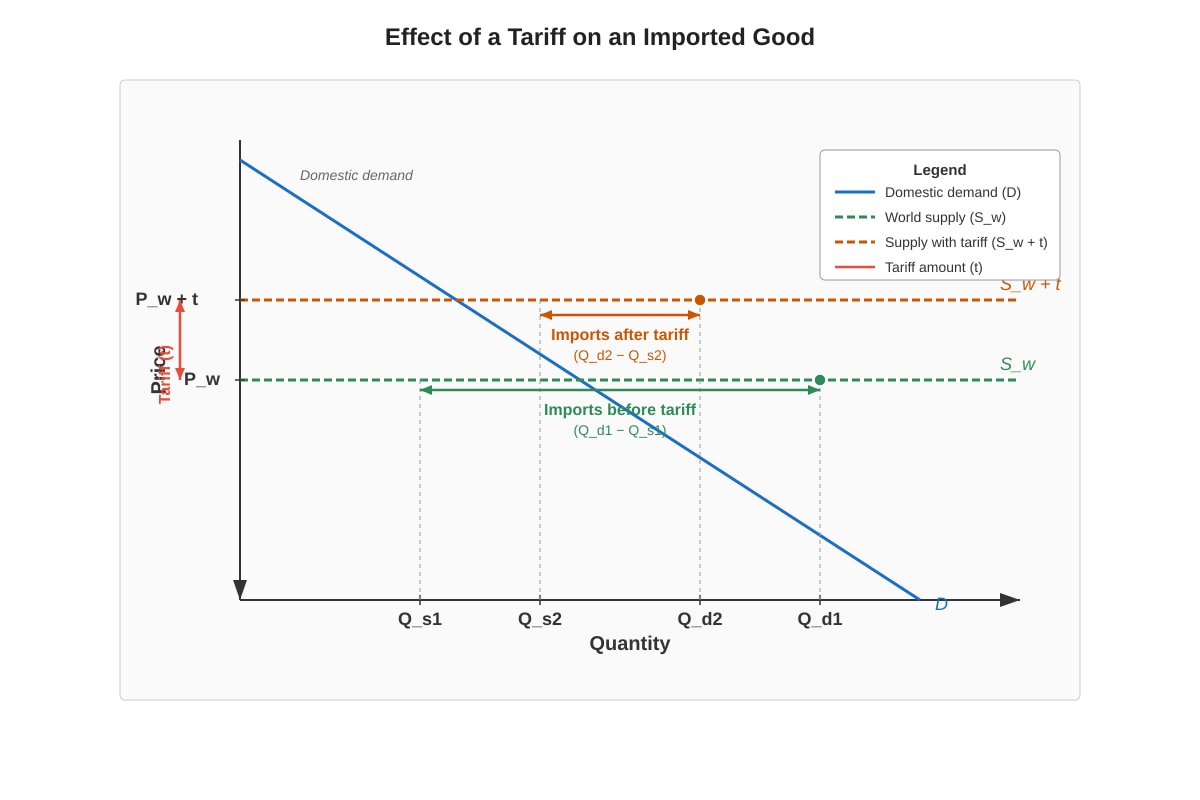
Generated diagram for this question.
A tariff is a tax on imported goods. [1 mark] The imposition of a tariff shifts the world supply curve upward by the amount of the tariff, raising the domestic price from Pw to Pw + t. [1 mark] At the higher price, domestic quantity demanded falls from Qd1 to Qd2, while domestic quantity supplied increases from Qs1 to Qs2. [1 mark] As a result, the quantity of imports falls from (Qd1 − Qs1) to (Qd2 − Qs2). [1 mark]
Marking notes:
- Award 1 mark for correctly labelled diagram (axes, demand curve, world price, tariff-inclusive price).
- Award 1 mark for explaining the price increase.
- Award 1 mark for explaining the effect on quantity demanded and domestic supply.
- Award 1 mark for explaining the reduction in import quantity.
- Maximum 3 marks without a diagram.
9. Explain two reasons why a government might impose protectionist measures despite the benefits of free trade. [4 marks]
Answer: Reason 1: Protecting infant industries. [1 mark] A government may impose tariffs or quotas to protect new domestic industries that are not yet able to compete with established foreign competitors. Once these industries mature and achieve economies of scale, the protection can be removed. [1 mark]
Reason 2: Protecting domestic employment. [1 mark] If domestic industries face strong foreign competition, they may be forced to reduce output and lay off workers. Protectionist measures can safeguard jobs in vulnerable sectors, reducing structural unemployment and the associated social costs. [1 mark]
Marking notes:
- Award 1 mark for each reason identified (maximum 2 reasons).
- Award 1 mark for each explanation (maximum 2 explanations).
- Accept other valid reasons: national security, anti-dumping, revenue generation, improving balance of payments, preventing unfair competition.
10. Explain the difference between a current account deficit and a current account surplus. [2 marks]
Answer: A current account deficit occurs when a country's total imports of goods, services, investment income, and transfers exceed its total exports of these items. [1 mark] A current account surplus occurs when a country's total exports exceed its total imports, meaning it earns more foreign currency from its international transactions than it spends. [1 mark]
Marking notes:
- Award 1 mark for defining current account deficit.
- Award 1 mark for defining current account surplus.
- Accept answers that explain the difference in terms of net outflow vs. net inflow of foreign currency.
Section C: Structured Response (Questions 11–15)
11. Explain how a depreciation of a country's currency might affect its current account balance. [2 marks]
Answer: A depreciation makes a country's exports cheaper for foreign buyers and imports more expensive for domestic consumers. [1 mark] Assuming the Marshall-Lerner condition holds, this will increase export revenue and reduce import expenditure, leading to an improvement in the current account balance. [1 mark]
Marking notes:
- Award 1 mark for explaining the price effects of depreciation on exports and imports.
- Award 1 mark for linking these price effects to an improvement in the current account (may reference Marshall-Lerner condition or J-curve effect).
12. Identify and explain one factor that could cause a country's terms of trade to improve. [2 marks]
Answer: An increase in the relative price of a country's exports compared to its imports will improve its terms of trade. [1 mark] This could be caused by a rise in global demand for the country's key exports, such as an increase in demand for electronics from Singapore, which pushes up export prices while import prices remain unchanged. [1 mark]
Marking notes:
- Award 1 mark for identifying a valid factor (e.g., rise in export prices, fall in import prices, increased global demand for exports, improved productivity in export sector).
- Award 1 mark for explaining how this factor leads to an improvement in the terms of trade ratio (index of export prices / index of import prices).
13. Explain how globalisation has affected the pattern of international trade for a small, open economy like Singapore. [2 marks]
Answer: Globalisation has led to increased trade liberalisation and the fragmentation of production processes across global value chains. [1 mark] For Singapore, this has meant a shift towards higher value-added exports such as pharmaceuticals, electronics, and financial services, while also increasing its role as a regional trading hub, with a greater volume of both imports and exports as a percentage of GDP. [1 mark]
Marking notes:
- Award 1 mark for identifying a feature of globalisation (e.g., trade liberalisation, global value chains, increased capital flows).
- Award 1 mark for explaining the specific impact on Singapore's trade pattern (e.g., shift to high-value exports, increased trade volume, role as a hub).
14. State and explain one limitation of using comparative advantage as the sole basis for a country's trade policy. [2 marks]
Answer: Comparative advantage assumes that factors of production are immobile between countries and that there are no transport costs, which is unrealistic. [1 mark] In reality, capital and labour can move across borders, and significant transport costs can erode the gains from specialisation, meaning a country might not benefit from specialising solely based on current comparative advantage. [1 mark]
Marking notes:
- Award 1 mark for stating a valid limitation (e.g., unrealistic assumptions, risk of over-specialisation, ignores strategic industries, dynamic comparative advantage).
- Award 1 mark for explaining why this limitation matters for trade policy.
15. Explain how international trade can lead to structural unemployment in an economy. [2 marks]
Answer: International trade can lead to structural unemployment when domestic industries decline due to an inability to compete with cheaper or higher-quality imports. [1 mark] Workers in these declining industries may lose their jobs and find it difficult to move to expanding sectors because they lack the necessary skills or are geographically immobile, resulting in long-term unemployment. [1 mark]
Marking notes:
- Award 1 mark for identifying the link between trade and declining domestic industries.
- Award 1 mark for explaining the mismatch of skills or geographic immobility that leads to structural unemployment.
Section D: Extended Response (Questions 16–20)
16. Discuss the extent to which free trade is always beneficial for a small, open economy like Singapore. [6 marks]
Answer: Free trade offers significant benefits to a small, open economy like Singapore. It allows access to larger markets, enabling firms to achieve economies of scale that would be impossible with a small domestic market. It also provides consumers with a wider variety of goods and services at lower prices, increasing consumer welfare. Furthermore, free trade encourages competition and efficiency, driving innovation and productivity growth.
However, free trade is not without potential drawbacks. It can lead to structural unemployment as domestic industries that cannot compete with foreign firms decline. Singapore has experienced this in sectors like low-end manufacturing. There is also a risk of over-specialisation, making the economy vulnerable to external shocks in specific sectors. Additionally, free trade may exacerbate income inequality if the gains from trade are not evenly distributed.
On balance, while free trade is overwhelmingly beneficial for Singapore and has been a cornerstone of its economic success, it is not "always" beneficial in every aspect. The government must implement complementary policies, such as retraining programmes (e.g., SkillsFuture) and social safety nets, to mitigate the negative effects and ensure the gains from trade are broadly shared. Therefore, free trade is highly beneficial but requires active management to be sustainable and inclusive.
Marking notes (Levels-based):
- Level 3 (5-6 marks): A balanced discussion that clearly explains both benefits and limitations of free trade for a small, open economy, with specific reference to Singapore's context. A well-supported judgement on the extent to which it is "always" beneficial.
- Level 2 (3-4 marks): Explains some benefits and some limitations but may lack balance or specific application to Singapore. Judgement may be weak or absent.
- Level 1 (1-2 marks): Identifies only benefits or only limitations. Answer is largely descriptive and lacks analysis or evaluation.
17. Explain how a country's terms of trade are measured and discuss one factor that might cause them to deteriorate. [4 marks]
Answer: A country's terms of trade are measured by the ratio of its index of export prices to its index of import prices, usually multiplied by 100. The formula is: Terms of Trade = (Index of Export Prices / Index of Import Prices) × 100. An increase in the ratio indicates an improvement, while a decrease indicates a deterioration.
One factor that might cause a deterioration is a fall in the global demand for the country's key exports. For example, if Singapore's main trading partners experience an economic slowdown, the demand for Singapore's electronics and pharmaceutical exports may fall. This would lead to a decrease in export prices. Assuming import prices remain constant, the terms of trade ratio would fall, indicating a deterioration. This means the country must export a larger volume of goods to afford the same volume of imports.
Marking notes:
- Award 1 mark for stating the correct formula or method of measurement.
- Award 1 mark for explaining the meaning of the ratio.
- Award 1 mark for identifying a valid factor causing deterioration (e.g., fall in export prices, rise in import prices, depreciation of currency).
- Award 1 mark for explaining the causal link between the factor and the deterioration in the terms of trade.
18. Analyse the potential impact of a persistent current account surplus on a country's exchange rate and domestic inflation. [4 marks]
Answer: A persistent current account surplus implies that the demand for the country's currency (to buy its exports) consistently exceeds the supply of its currency (to pay for imports). This creates upward pressure on the exchange rate, leading to an appreciation of the domestic currency. [2 marks]
An appreciating currency makes imports cheaper. Cheaper imported raw materials and finished goods can lower production costs for domestic firms and reduce the price of imported consumer goods. This can exert a dampening effect on domestic inflation, potentially leading to lower inflation or even deflationary pressure. However, if the surplus is driven by strong export demand, the resulting increase in aggregate demand could be inflationary, though the exchange rate effect often dominates in a small, open economy. [2 marks]
Marking notes:
- Award up to 2 marks for explaining the link between a current account surplus and currency appreciation (demand/supply of currency).
- Award up to 2 marks for explaining the impact on domestic inflation (cheaper imports, lower cost-push inflation, potential demand-pull effects).
- Accept a well-reasoned analysis that considers both cost-push and demand-pull factors.
19. Evaluate the effectiveness of supply-side policies in improving the international competitiveness of a country's exports. [4 marks]
Answer: Supply-side policies aim to increase the productive capacity of the economy and improve the quality and efficiency of factors of production. Policies such as investment in education and training can improve labour productivity, leading to higher-quality exports and lower unit labour costs. Investment in infrastructure and technology can reduce production and logistics costs, making exports more price-competitive. [2 marks]
However, the effectiveness of these policies is subject to limitations. They often involve long time lags before results are seen. For example, educational reforms may take a decade to affect the workforce's skill level. Additionally, their success depends on complementary factors, such as a stable macroeconomic environment and demand for the improved exports. If global demand is weak, even more competitive exports may not sell. Therefore, while supply-side policies are crucial for long-term competitiveness, they are not a quick fix and must be part of a broader strategy. [2 marks]
Marking notes:
- Award up to 2 marks for explaining how supply-side policies can improve competitiveness (e.g., productivity, quality, cost reduction).
- Award up to 2 marks for evaluating their effectiveness (e.g., time lags, cost, need for demand, global factors).
- A good answer should provide a balanced judgement.
20. Discuss the view that protectionism is never justified in an increasingly globalised world economy. [6 marks]
Answer: The view that protectionism is never justified is based on the strong theoretical and empirical case for free trade. Free trade allows for efficient resource allocation based on comparative advantage, leading to higher global output and lower consumer prices. In a globalised world, protectionism disrupts global value chains, raises costs for producers who rely on imported inputs, and invites retaliation, potentially sparking trade wars that harm all involved. For a small, open economy like Singapore, protectionism would be particularly damaging, cutting off access to vital markets and inputs.
However, there are arguments that some forms of protectionism can be justified, even in a globalised world. Strategic protection of infant industries can allow them to develop a comparative advantage they would not otherwise achieve. Protection may also be justified on national security grounds for critical industries like defence or food security. Furthermore, temporary safeguards can be used to manage the social costs of rapid structural change caused by globalisation, giving workers time to retrain.
In conclusion, while the general principle of free trade is overwhelmingly beneficial and protectionism is often counterproductive, it is an overstatement to say it is "never" justified. There are specific, limited circumstances where targeted and temporary protectionist measures can serve a legitimate economic or social purpose. The key is that such measures should be the exception, not the rule, and should be carefully designed to avoid long-term inefficiency and retaliation.
Marking notes (Levels-based):
- Level 3 (5-6 marks): A balanced and well-argued discussion that presents both sides of the argument. Clearly evaluates the statement "never justified" with a reasoned conclusion. May use relevant examples.
- Level 2 (3-4 marks): Presents arguments for and against protectionism but may lack balance or a clear evaluative judgement. The discussion may be more descriptive.
- Level 1 (1-2 marks): A one-sided answer that argues only for or against protectionism. Lacks evaluation and may contain general statements without application to the globalised context.
END OF ANSWER KEY