AI Generated Exam Paper
A Level H1 Economics Practice Paper 2
Free A Level H1 Econs Practice Paper 2, Qwen3.6 AI version, with questions, answers, and A Level-style practice for Singapore students.
These static practice materials are generated from the site's syllabus and paper-generation workflow, with source and model context shown so students and parents can evaluate the material before use.
Questions
Free quiz and exam paper access
Enter your details to view this paper
Your access is remembered on this device.
Answers
TuitionGoWhere Practice Paper - Economics H1 A-Level (Answer Key)
Version: 2 of 5
Subject: Economics H1
Case Study 1: The Electric Vehicle Transition in Singapore
1. With reference to Table 1, compare the trend in new registrations of ICE cars and EVs from 2020 to 2023. [2]
-
Marking Scheme:
- 1 mark for correctly describing the trend in ICE registrations (decreasing).
- 1 mark for correctly describing the trend in EV registrations (increasing).
- Note: Must use comparative language or describe both trends.
-
Suggested Answer: From 2020 to 2023, new registrations of ICE cars decreased steadily from 28,500 to 24,000 units [1]. In contrast, new registrations of EVs increased significantly from 1,200 to 8,200 units over the same period [1].
2. Using the data in Table 1, calculate the percentage change in the average price of EVs from 2020 to 2023. [2]
-
Marking Scheme:
- 1 mark for correct formula/substitution.
- 1 mark for correct final answer.
-
Suggested Answer: Formula: Calculation: (approx) [2] (Accept -6.89% or -6.9%)
3. With reference to Extract 1, explain one reason why the demand for EVs might be price elastic for mass-market consumers. [3]
-
Marking Scheme:
- 1 mark for identifying a determinant of PED.
- 1 mark for application to EVs/mass market.
- 1 mark for explaining the link to elasticity (responsiveness).
-
Suggested Answer: Demand for EVs is likely price elastic because there are close substitutes available, specifically Internal Combustion Engine (ICE) vehicles [1]. The extract notes that 35% of consumers are concerned about the higher upfront cost compared to ICE vehicles [1]. This implies that if EV prices rise relative to ICE cars, mass-market consumers will easily switch back to ICE cars, resulting in a proportionately larger fall in quantity demanded for EVs [1].
4. Explain how the Early Adoption Incentive (EEAI) affects the market equilibrium for EVs. Use a demand and supply diagram to illustrate your answer. [6]
-
Marking Scheme:
- 2 marks for explanation of subsidy effect (shift in demand or supply).
- 2 marks for correct diagram (axes, curves, shifts, equilibrium points).
- 2 marks for analysis of change in price and quantity.
-
Suggested Answer: The EEAI acts as a subsidy to consumers, effectively lowering the price they pay. This increases the demand for EVs, shifting the demand curve to the right from D1 to D2 [2].
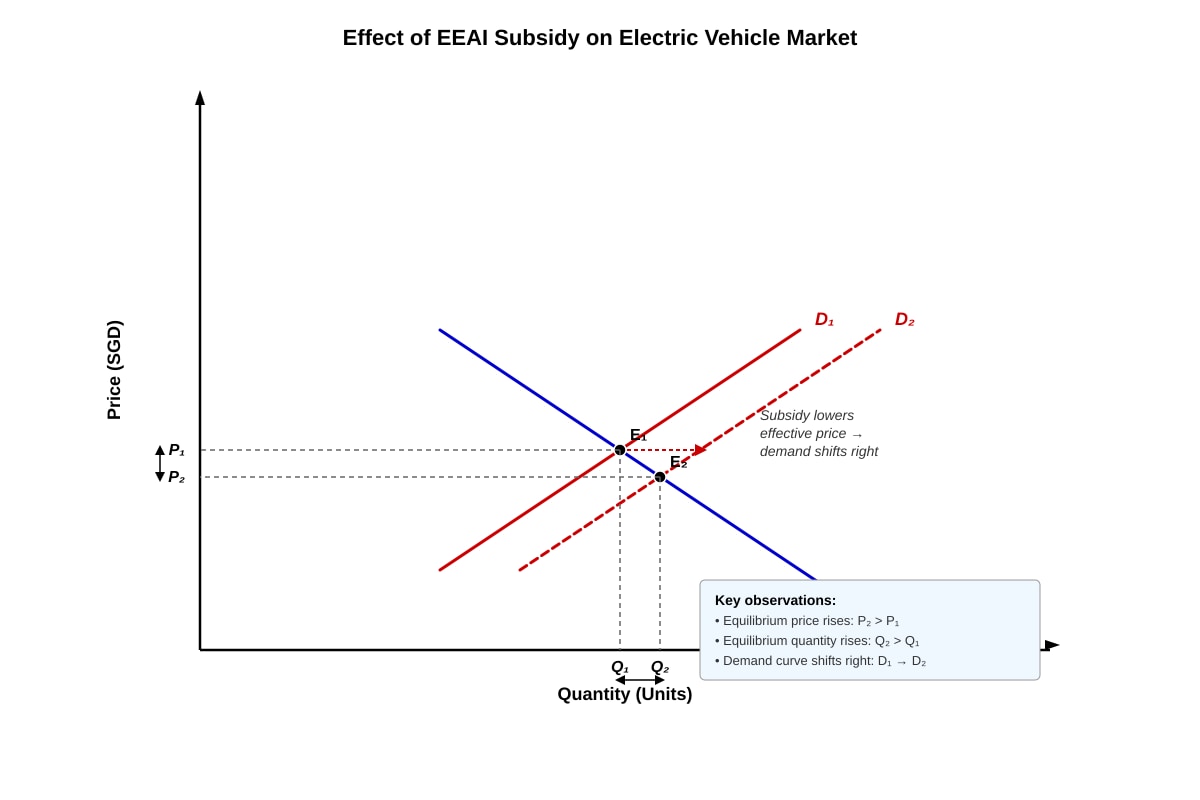
Generated diagram for this question.
:* * Y-axis: Price (SGD), X-axis: Quantity (Units). * Downward sloping D1, Upward sloping S. * D1 shifts right to D2. * Original equilibrium E1 (P1, Q1). New equilibrium E2 (P2, Q2). * P2 > P1, Q2 > Q1. [2]
As a result, the market equilibrium price increases from P1 to P2, and the equilibrium quantity increases from Q1 to Q2 [2].
5. With reference to Extract 2, explain why the lack of charging infrastructure represents a market failure. [4]
-
Marking Scheme:
- 1 mark for definition of market failure.
- 1 mark for identifying the type of failure (missing market/under-provision).
- 2 marks for application/explanation using extract.
-
Suggested Answer: Market failure occurs when the free market fails to allocate resources efficiently [1]. The lack of charging infrastructure is a barrier to EV adoption, leading to under-consumption of EVs relative to the social optimum (given the environmental benefits) [1]. Extract 2 states that structural limitations in HDBs and grid upgrades are needed, implying that the private sector may not provide sufficient charging points due to high initial costs or coordination issues [1]. This results in a negative externality of consumption being ignored (or positive externality of EVs not fully realized), leading to welfare loss [1].
6. Discuss the extent to which government subsidies are the most effective policy to increase EV adoption in Singapore. [10]
-
Marking Scheme:
- Level 1 (1-3 marks): Basic knowledge of subsidies. Limited analysis.
- Level 2 (4-6 marks): Explains how subsidies work. Identifies limitations. Some application.
- Level 3 (7-10 marks): Balanced discussion. Evaluates effectiveness against other policies (e.g., infrastructure, regulation). Clear judgment.
-
Suggested Answer: Argument for Subsidies: Subsidies like the EEAI lower the effective price of EVs, making them more affordable. This addresses the "higher upfront cost" concern cited by 35% of respondents in Extract 1. By shifting demand right, subsidies can accelerate adoption rates, helping Singapore meet its 2040 phase-out target. They are politically popular and provide immediate incentives.
Argument against Subsidies (Limitations): However, subsidies may not be the most effective if supply-side constraints exist. Extract 2 highlights that 45% of respondents are concerned about "charging infrastructure." If consumers cannot charge their cars, a price reduction is irrelevant. Subsidies also impose an opportunity cost on the government budget (SGD 20,000 per car) which could be spent on building charging points. Furthermore, if demand is inelastic in the short run due to range anxiety, subsidies may have limited impact.
Alternative Policies: Direct provision or grants for infrastructure (as mentioned in Extract 2) address the root cause of hesitation. Regulation (banning ICE sales by 2040) provides certainty. Education campaigns can address environmental awareness.
Evaluation/Judgment: Subsidies are effective in the short run to stimulate demand among price-sensitive consumers. However, they are not the most effective policy in isolation. Without complementary supply-side policies (infrastructure investment), subsidies may lead to frustration. Therefore, a policy mix of subsidies and infrastructure development is more effective than subsidies alone. In the long run, as infrastructure improves, the relative importance of subsidies may decline.
Case Study 2: Global Inflation and Monetary Policy
7. With reference to Table 2, describe the relationship between the Federal Funds Rate and the Inflation Rate from 2021 to 2023. [2]
-
Marking Scheme:
- 1 mark for noting the increase in Federal Funds Rate.
- 1 mark for noting the trend in Inflation (rise then fall).
-
Suggested Answer: From 2021 to 2023, the Federal Funds Rate increased significantly from 0.25% to 5.25% [1]. During the same period, the inflation rate first rose sharply from 4.7% to 8.0% in 2022, before falling to 4.1% in 2023 [1].
8. Using the data in Table 2, what can you conclude about the US economy’s performance in 2022 compared to 2021 in terms of Real GDP growth? [2]
-
Marking Scheme:
- 1 mark for identifying the change in GDP growth.
- 1 mark for interpreting the slowdown.
-
Suggested Answer: Real GDP growth slowed down significantly, falling from 5.9% in 2021 to 2.1% in 2022 [1]. This indicates a deceleration in economic activity, likely due to the tightening of monetary policy and supply chain issues [1].
9. With reference to Extract 3, distinguish between cost-push and demand-pull inflation. [4]
-
Marking Scheme:
- 2 marks for explaining demand-pull inflation.
- 2 marks for explaining cost-push inflation.
- Must reference Extract 3 for full marks.
-
Suggested Answer: Demand-pull inflation occurs when Aggregate Demand exceeds Aggregate Supply, often described as "too much money chasing too few goods." Extract 3 attributes this to "strong consumer demand fueled by fiscal stimulus checks" [2].
Cost-push inflation occurs when production costs rise, shifting Aggregate Supply to the left. Extract 3 attributes this to "supply chain disruptions," which increase the cost of inputs and lead to higher prices [2].
10. Explain how an increase in interest rates by the Federal Reserve helps to reduce inflation. Use an AD/AS diagram to illustrate your answer. [6]
-
Marking Scheme:
- 2 marks for explanation of transmission mechanism (C, I, AD).
- 2 marks for correct AD/AS diagram.
- 2 marks for analysis of price level and output.
-
Suggested Answer: Higher interest rates increase the cost of borrowing for households and firms. This discourages consumption (C) and investment (I) [1]. It also encourages saving. As C and I are components of Aggregate Demand (AD), AD decreases (shifts left) [1].
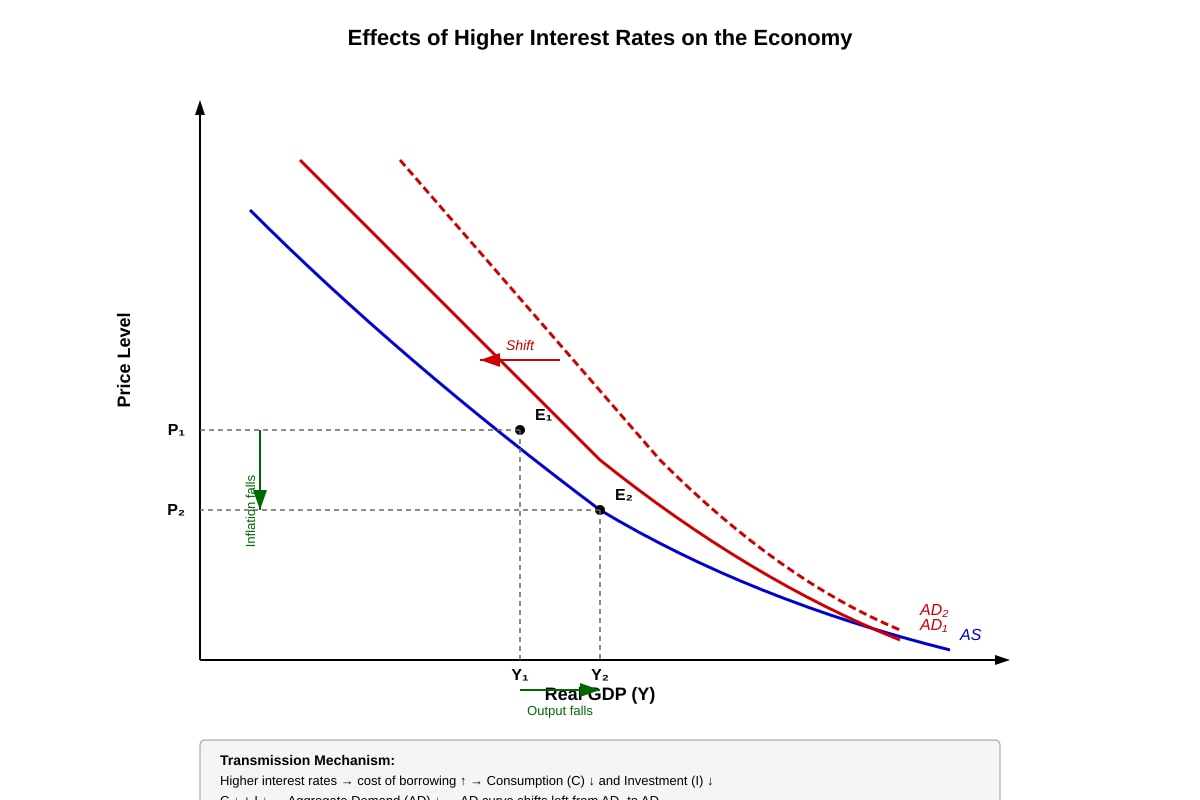
Generated diagram for this question.
:* * Y-axis: Price Level, X-axis: Real GDP. * Downward sloping AD, Upward sloping AS. * AD shifts left from AD1 to AD2. * Equilibrium moves from E1 (P1, Y1) to E2 (P2, Y2). * P2 < P1. [2]
This decrease in AD reduces upward pressure on prices, lowering the inflation rate from P1 to P2 [2].
11. With reference to Extract 5, explain why Singapore uses exchange rate policy instead of interest rate policy to manage inflation. [4]
-
Marking Scheme:
- 1 mark for identifying Singapore as a small open economy.
- 1 mark for explaining imported inflation.
- 1 mark for explaining how appreciation helps.
- 1 mark for contrasting with interest rate limitations.
-
Suggested Answer: Singapore is a small, open economy that imports most of its food and energy, making it vulnerable to imported inflation [1]. Interest rate policy is less effective because capital flows are highly mobile, and domestic interest rates are closely tied to global rates [1]. By appreciating the Singapore Dollar (SGD) against a basket of currencies, imports become cheaper in SGD terms [1]. This directly lowers the cost of imported goods and services, dampening inflation more effectively than interest rate hikes, which might also attract hot money flows and cause asset bubbles [1].
12. Discuss the potential trade-offs faced by the US Federal Reserve when using contractionary monetary policy to combat inflation. [10]
-
Marking Scheme:
- Level 1 (1-3 marks): Identifies trade-off (inflation vs unemployment). Basic explanation.
- Level 2 (4-6 marks): Explains the mechanism of the trade-off. Uses AD/AS or Phillips Curve logic.
- Level 3 (7-10 marks): Evaluates the severity of the trade-off. Considers short-run vs long-run. Clear judgment.
-
Suggested Answer: The Trade-off: The primary trade-off is between price stability (low inflation) and economic growth/employment. Contractionary monetary policy (raising interest rates) reduces Aggregate Demand. While this lowers inflation, it also leads to lower Real GDP and higher cyclical unemployment [4].
Analysis: As shown in Table 2, as the Fed raised rates, GDP growth slowed from 5.9% to 2.1%. If rates are raised too aggressively, it could cause a "hard landing" (recession), where unemployment rises significantly. This creates social costs (loss of income, poverty) and economic costs (lower potential growth due to hysteresis) [3].
Evaluation: However, the trade-off may be less severe if the inflation is primarily cost-push (supply-side). In this case, demand management is less effective and causes more pain for less gain. But if inflation is demand-pull, the trade-off is necessary to anchor inflation expectations.
Judgment: The Fed must balance the risk of entrenched high inflation (which damages long-term growth) against the short-term pain of higher unemployment. Given that inflation was at 40-year highs, the Fed prioritized price stability, accepting the slowdown in GDP. The effectiveness depends on the elasticity of AD and the state of the labor market. If the labor market remains tight (low unemployment as seen in 2022/2023), the trade-off may be manageable. However, if unemployment spikes, the Fed may need to pivot. Thus, the trade-off is significant but necessary to restore macroeconomic stability.