AI Generated Exam Paper
A Level H1 Economics Practice Paper 1
Free A Level H1 Econs Practice Paper 1, Qwen3.6 AI version, with questions, answers, and A Level-style practice for Singapore students.
These static practice materials are generated from the site's syllabus and paper-generation workflow, with source and model context shown so students and parents can evaluate the material before use.
Questions
Free quiz and exam paper access
Enter your details to view this paper
Your access is remembered on this device.
Answers
TuitionGoWhere Practice Paper - Economics H1 A-Level
Answer Key and Marking Scheme (Version 1)
Note to Markers:
- Award marks for correct application of economic concepts, accurate diagrammatic analysis, and logical reasoning.
- "Level-based" marking is used for discussion questions (Q4 and Q8).
- Diagrams must be clearly labeled (axes, curves, equilibrium points) to receive full marks.
CASE STUDY 1: The Electric Vehicle Transition in Singapore
Question 1
With reference to Table 1, compare the growth in Electric Vehicle (EV) registrations with the growth in Total New Car Registrations from 2019 to 2023. [4]
Marking Scheme:
- 1 mark for stating the trend in Total New Car Registrations (increased steadily/moderately).
- 1 mark for stating the trend in EV Registrations (increased rapidly/exponentially).
- 1 mark for comparative data point (e.g., EVs grew from 120 to 7,200, while Total grew from 24,500 to 30,500).
- 1 mark for comparative conclusion (e.g., EV growth rate is much higher than total market growth; EV share increased from 0.5% to 23.6%).
Sample Answer: Total new car registrations increased moderately from 24,500 in 2019 to 30,500 in 2023 [1]. In contrast, EV registrations grew exponentially from just 120 in 2019 to 7,200 in 2023 [1]. While the total market grew by approximately 24%, the number of EVs increased by 60 times [1]. Consequently, the share of EVs in total registrations rose significantly from 0.5% to 23.6%, indicating that EV adoption is driving the growth in the car market [1].
Question 2
Using the concept of Price Elasticity of Demand (PED), explain why the Electric Vehicle Early Adoption Incentive (EEAI) might be more effective in increasing EV adoption than a general reduction in income tax. [6]
Marking Scheme:
- 2 marks for defining/explaining PED (responsiveness of Qd to change in Price).
- 2 marks for explaining EEAI impact: Directly reduces price of EVs. If PED is elastic (due to substitutes like ICE cars), Qd increases significantly.
- 2 marks for explaining Income Tax impact: Increases disposable income. Depends on YED (Income Elasticity of Demand). Cars are normal/luxury goods, but the effect is indirect and diluted across all goods, not just EVs.
Sample Answer: Price Elasticity of Demand (PED) measures the responsiveness of quantity demanded to a change in price [1]. The EEAI acts as a subsidy, directly lowering the purchase price of EVs. Since EVs and ICE cars are close substitutes, the PED for EVs is likely elastic [1]. Therefore, a price reduction via EEAI will lead to a proportionately larger increase in quantity demanded for EVs [1]. In contrast, a general income tax reduction increases disposable income. While cars are normal goods (positive YED), the extra income may be spent on various goods and services, not specifically EVs [1]. The impact on EV demand is indirect and likely weaker than the direct price signal from the EEAI [1]. Thus, EEAI is more targeted and effective for specific adoption goals [1].
Question 3
With reference to Extract 2 and Extract 3, explain how the lack of charging infrastructure acts as a barrier to the demand for EVs. Use a demand and supply diagram to illustrate the impact of improved charging infrastructure on the equilibrium price and quantity of EVs. [8]
Marking Scheme:
- 2 marks for explanation: Lack of charging points increases "range anxiety," reducing consumer preference/utility for EVs (shift in tastes/preferences).
- 4 marks for Diagram:
- Correct axes (Price, Quantity).
- Initial D1 and S1 curves.
- Rightward shift of Demand from D1 to D2 (due to improved infrastructure/preferences).
- New equilibrium E2 with higher Price (P1 to P2) and higher Quantity (Q1 to Q2).
- 2 marks for written explanation of diagram: Improved infrastructure reduces range anxiety, shifting demand right. This leads to higher equilibrium price and quantity.
Sample Answer: Lack of charging infrastructure creates "range anxiety," which is a non-price determinant of demand. It reduces the perceived utility and convenience of owning an EV, causing consumers to prefer ICE vehicles or public transport. This acts as a barrier, keeping demand for EVs lower than it would otherwise be [2].
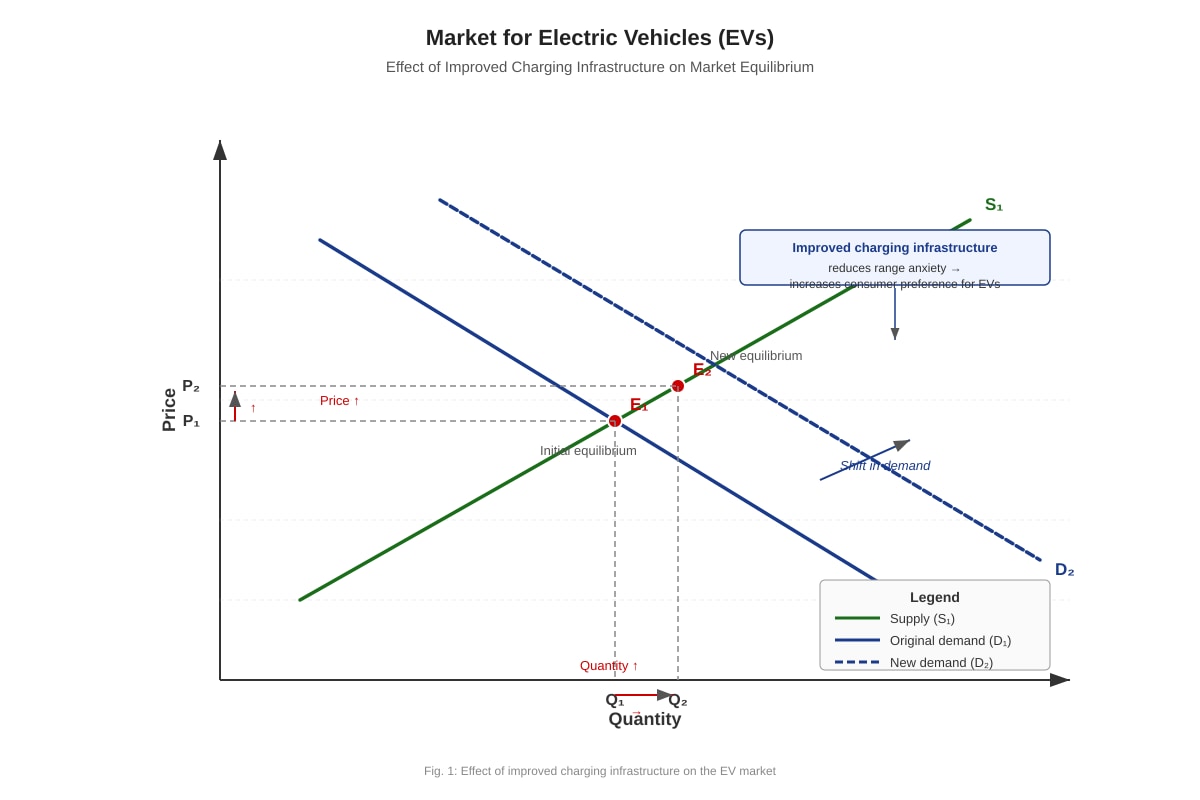
Generated diagram for this question.
*: The diagram should show the market for EVs. The initial equilibrium is at E1 (P1, Q1). Improved charging infrastructure (as planned in Extract 2) increases consumer confidence and preference for EVs. This causes the Demand curve to shift to the right from D1 to D2 [2]. Assuming supply remains constant in the short run, the new equilibrium is at E2, with a higher price (P2) and higher quantity (Q2) [2]. This illustrates that infrastructure development stimulates market growth [2].
Question 4
"Government intervention is necessary to correct the market failure associated with the negative externalities of internal combustion engine (ICE) vehicles." Discuss the extent to which subsidies for EVs (such as the EEAI) are more effective than carbon taxes on ICE vehicles in achieving Singapore’s environmental goals. [12]
Marking Scheme:
- Level 1 (1-4 marks): Basic definition of externalities. One-sided argument.
- Level 2 (5-8 marks): Explains both subsidies and taxes. Identifies market failure (MSC > MPC). Some evaluation of effectiveness.
- Level 3 (9-12 marks): Comprehensive analysis of both policies. Evaluates effectiveness based on PED, fiscal cost, equity, and speed of impact. Clear judgment.
Key Points for Answer:
- Market Failure Context: ICE vehicles generate negative externalities (pollution, congestion). MSC > MPC. Overconsumption at free market equilibrium. Goal: Reduce Q of ICE, Increase Q of EV.
- Argument for Subsidies (EEAI):
- Lowers price of EVs, encouraging substitution away from ICE.
- Helps overcome high initial cost barrier of EVs.
- Politically popular (consumers benefit directly).
- Limitation: Fiscal cost to government. May benefit wealthy buyers more (equity issue). Does not directly penalize pollution.
- Argument for Carbon Taxes (on ICE):
- Internalizes the externality. Makes polluters pay.
- Generates government revenue (can be used for green projects).
- Directly discourages ICE usage via higher prices.
- Limitation: Regressive (hurts low-income drivers). If PED for ICE is inelastic (necessity for some), consumption may not fall much.
- Evaluation/Judgment:
- Subsidies are effective for adoption of new tech (EVs) but expensive.
- Taxes are effective for discouraging bad behavior but face political resistance.
- Conclusion: A combination is best. Subsidies address the supply/adoption side of EVs, while taxes address the demand side of ICEs. In Singapore’s context, where land is scarce and pollution is a major concern, a multi-pronged approach (including regulations like the 2040 phase-out) is more effective than relying on one tool alone. Subsidies may be more effective in the short run to kickstart the market, while taxes ensure long-term behavioral change.
CASE STUDY 2: Inflation and Cost of Living in Post-Pandemic Singapore
Question 5
With reference to Table 2, describe the trend in All-Items CPI and Core Inflation from 2021 to 2023. [4]
Marking Scheme:
- 1 mark for trend in All-Items CPI (Rose sharply in 2022, fell in 2023 but remained elevated).
- 1 mark for data support for All-Items (2.3% -> 6.1% -> 4.8%).
- 1 mark for trend in Core Inflation (Rose in 2022, slight fall in 2023).
- 1 mark for comparison (All-Items is more volatile/higher than Core, indicating accommodation/transport costs played a big role).
Sample Answer: All-Items CPI increased sharply from 2.3% in 2021 to a peak of 6.1% in 2022, before moderating to 4.8% in 2023 [2]. Core inflation followed a similar pattern, rising from 1.7% to 3.6% in 2022 and slightly decreasing to 3.3% in 2023 [1]. The gap between All-Items and Core inflation widened in 2022 (2.5 percentage points), suggesting that accommodation and private road transport costs contributed significantly to the overall inflation spike [1].
Question 6
Using the Aggregate Demand and Aggregate Supply (AD/AS) model, explain how cost-push factors mentioned in Extract 5 led to the inflation observed in 2022. [6]
Marking Scheme:
- 2 marks for identifying cost-push factors: Rising global energy prices, supply chain disruptions.
- 4 marks for Diagram and Explanation:
- SRAS shifts left (upwards) from SRAS1 to SRAS2.
- Equilibrium moves from Y1/P1 to Y2/P2.
- Price Level increases (Inflation), Real Output decreases (Stagflationary pressure).
Sample Answer: Cost-push inflation occurs when production costs rise, causing firms to reduce supply at any given price level [1]. Extract 5 cites rising global energy prices and supply chain disruptions as key factors [1]. *
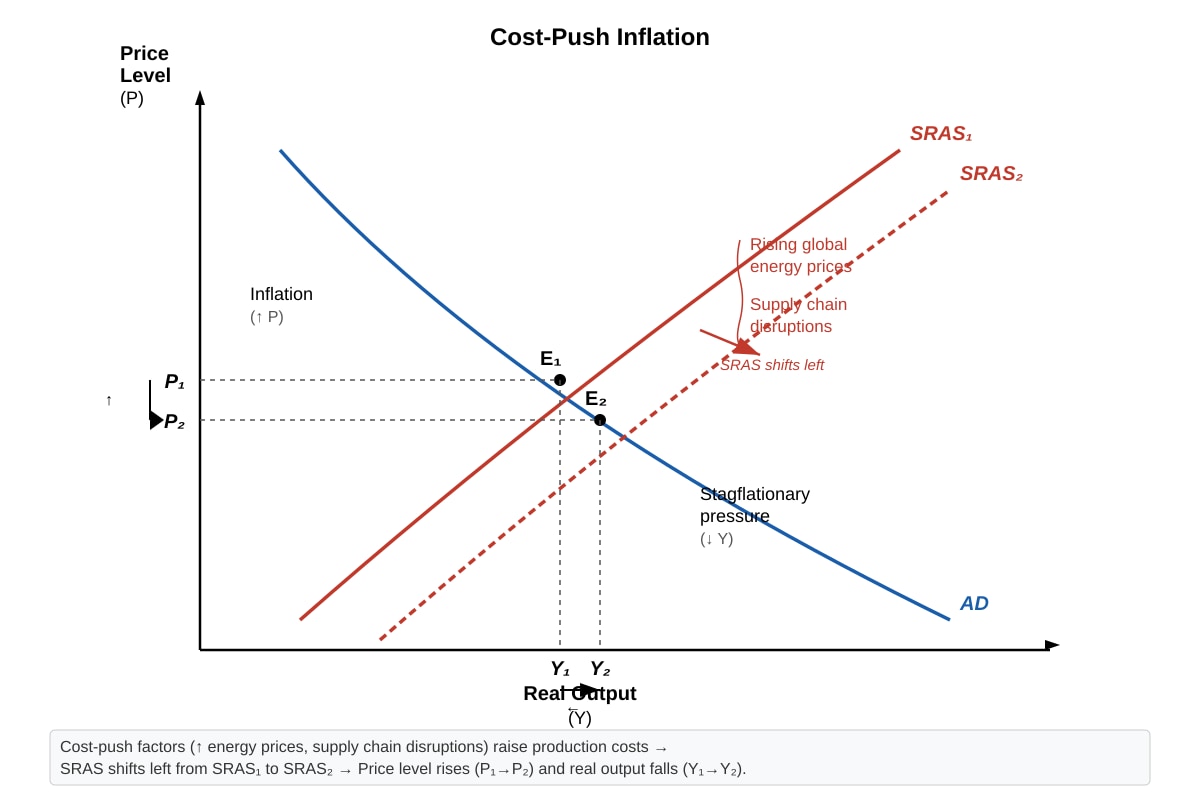
Generated diagram for this question.
*: In the AD/AS model, the Short-Run Aggregate Supply (SRAS) curve shifts to the left from SRAS1 to SRAS2 [2]. This results in a new equilibrium with a higher Price Level (P1 to P2) and lower Real GDP (Y1 to Y2) [2]. This explains the rise in CPI (inflation) observed in 2022, accompanied by potential slowdowns in output growth.
Question 7
With reference to Extract 6, explain how an appreciation of the Singapore Dollar can help reduce imported inflation. [6]
Marking Scheme:
- 2 marks for mechanism: Appreciation makes foreign currency cheaper / SGD stronger.
- 2 marks for impact on imports: Import prices (in SGD) fall.
- 2 marks for link to inflation: Lower input costs for firms and lower consumer prices for imported goods reduce overall CPI.
Sample Answer: When the MAS appreciates the Singapore Dollar (S$NEER), the SGD becomes stronger relative to a basket of currencies [2]. This means that Singaporeans need fewer SGD to buy the same amount of foreign currency [1]. Since Singapore imports most of its food, energy, and raw materials, the cost of these imports in SGD terms falls [1]. Lower import prices reduce production costs for local firms (e.g., electricity, raw materials) and lower prices for consumers directly [1]. This helps to dampen cost-push inflation and reduce the overall CPI [1].
Question 8
"The MAS’s policy of appreciating the Singapore Dollar is the most effective way to maintain price stability without causing significant unemployment." Discuss this statement. In your answer, consider the trade-offs between price stability and economic growth/employment. [14]
Marking Scheme:
- Level 1 (1-5 marks): Defines exchange rate policy. One-sided view.
- Level 2 (6-10 marks): Explains how appreciation fights inflation. Explains the negative impact on exports/employment. Some evaluation.
- Level 3 (11-14 marks): Detailed analysis of the trade-off. Considers the nature of Singapore’s economy (open, import-dependent). Evaluates "most effective" against alternatives (fiscal/supply-side). Clear, justified judgment.
Key Points for Answer:
-
Effectiveness for Price Stability:
- Singapore is a small, open economy with high import content. Exchange rate policy is the most direct tool to combat imported inflation (as seen in Q7).
- Interest rate policy is less effective due to global capital flows and the need to maintain SGD stability.
- Therefore, for price stability, it is highly effective.
-
Impact on Unemployment/Economic Growth:
- Appreciation makes Singapore’s exports more expensive and imports cheaper.
- Export-oriented sectors (manufacturing, electronics) may see reduced demand, leading to lower output and potential retrenchments (structural/cyclical unemployment).
- However, cheaper imports may boost consumption and lower costs for firms using imported inputs, potentially offsetting some job losses.
- The net effect on unemployment depends on the elasticity of demand for exports. If demand is elastic, job losses could be significant.
-
Trade-offs:
- There is a short-run trade-off between inflation and unemployment (Phillips Curve logic). Tight monetary policy (appreciation) lowers inflation but may slow growth.
- However, Singapore’s MAS targets a "gradual appreciation" to balance this. It doesn't appreciate sharply to avoid shocking the export sector.
-
Is it the "Most Effective"?
- Compared to Fiscal Policy: Fiscal policy (taxes/spending) is slow to implement and has long lags. Monetary policy (exchange rate) is more agile for an open economy.
- Compared to Supply-Side Policies: Supply-side policies (productivity growth) are the best long-term solution for non-inflationary growth, but they take years to work. They cannot stop immediate inflation spikes.
- Therefore, for maintaining price stability in the short-to-medium term, exchange rate policy is the most effective tool for Singapore.
-
Judgment:
- The statement is largely correct for Singapore’s specific context. The trade-off with unemployment is managed by the gradual nature of the policy and by complementing it with supply-side measures (e.g., SkillsFuture) to help workers transition. While there is a risk to export jobs, the benefit of keeping inflation low (which protects real incomes and competitiveness) outweighs the costs. Without price stability, uncertainty would hurt investment and employment more in the long run. Thus, it is the optimal primary tool, though not the only tool needed.