From Real Exams Exam Paper
A Level H1 Economics Practice Paper 4
Free A Level H1 Econs Practice Paper 4, Qwen3.6 Exam version, with questions, answers, and A Level-style practice for Singapore students.
These static practice materials are generated from the site's syllabus and paper-generation workflow, with source and model context shown so students and parents can evaluate the material before use.
Questions
Free quiz and exam paper access
Enter your details to view this paper
Your access is remembered on this device.
Answers
TuitionGoWhere Exam Practice (AI) - Economics H1 A-Level
Answer Key and Marking Scheme (Version 4)
Subject: Economics
Level: A-Level H1
Paper: Practice Paper (Version 4)
Total Marks: 50
Section A: Data Response and Interpretation
1. With reference to Table 1, compare the trend in Government Healthcare Expenditure (in SGD Billion) with the trend in Healthcare Spending as a percentage of GDP from 2018 to 2023.
[4 marks]
-
Marking Criteria:
- 1 mark for describing the trend in absolute expenditure (SGD Billion).
- 1 mark for describing the trend in % of GDP.
- 1 mark for using comparative language (e.g., "both increased," "expenditure rose faster").
- 1 mark for referencing specific data points or years to support the comparison.
-
Suggested Answer: Both Government Healthcare Expenditure and Healthcare Spending as a % of GDP increased from 2018 to 2023. Government expenditure rose steadily from SGD 11.2 billion in 2018 to SGD 17.5 billion in 2023 [1]. Similarly, the percentage of GDP spent on healthcare increased from 4.8% to 5.4% over the same period [1]. While both indicators show an upward trend, the absolute expenditure more than doubled in magnitude, whereas the % of GDP saw a more modest increase of 0.6 percentage points [1]. Notably, in 2021, while absolute spending continued to rise to SGD 14.8 billion, the % of GDP dipped slightly to 5.1% before rising again, suggesting GDP growth may have outpaced healthcare spending growth in that specific year [1].
2. Using the concept of opportunity cost, explain one constraint faced by the Singapore government in increasing healthcare subsidies under the "Healthier SG" initiative.
[3 marks]
-
Marking Criteria:
- 1 mark for defining opportunity cost.
- 1 mark for identifying a specific constraint/trade-off (e.g., reduced spending on other sectors, need for higher taxes).
- 1 mark for explaining the link to the context (healthcare subsidies).
-
Suggested Answer: Opportunity cost is the next best alternative foregone when a choice is made [1]. The Singapore government faces a fiscal constraint due to limited budget resources. By allocating significant funds to subsidize preventive healthcare under "Healthier SG," the government foregoes the opportunity to spend these funds on other public goods, such as infrastructure development or education [1]. Alternatively, if the government chooses to finance these subsidies through higher taxes, the opportunity cost is the reduced disposable income for households and lower consumption/investment in the private sector [1].
3. With reference to Extract 3, explain why the demand for preventive health screenings is likely to be more price elastic for lower-income households than for higher-income households.
[4 marks]
-
Marking Criteria:
- 1 mark for defining Price Elasticity of Demand (PED) or elasticity concept.
- 1 mark for identifying income as a determinant.
- 1 mark for explaining the lower-income perspective (proportion of income).
- 1 mark for explaining the higher-income perspective (insensitivity to price/insurance).
-
Suggested Answer: Price elasticity of demand measures the responsiveness of quantity demanded to a change in price. For lower-income households, healthcare costs constitute a larger proportion of their disposable income [1]. Therefore, a price change (or the removal of cost via subsidy) has a significant impact on their ability to afford screenings, making their demand more elastic (responsive) [1]. In contrast, higher-income households have higher disposable income, so the cost of screenings is a smaller fraction of their budget [1]. Additionally, Extract 3 notes that many higher-income individuals already have private insurance covering these costs, making their out-of-pocket demand less sensitive to price changes (inelastic) [1].
4. Define the term 'positive externality' and identify one specific positive externality of preventive healthcare mentioned in Extract 2.
[3 marks]
-
Marking Criteria:
- 1 mark for definition of positive externality.
- 1 mark for identifying the third party/society.
- 1 mark for extracting the specific example from Extract 2.
-
Suggested Answer: A positive externality occurs when the consumption or production of a good generates benefits to third parties who are not involved in the transaction and do not pay for these benefits [1]. In Extract 2, a specific positive externality mentioned is that healthy individuals remain productive in the workforce, which reduces absenteeism [1]. This benefits employers and the wider economy through higher productivity, a benefit not fully captured by the individual patient [1].
Section B: Analysis and Application
5. Using a Demand and Supply diagram, illustrate and explain how the provision of government subsidies for preventive screenings affects the market equilibrium price and quantity.
[6 marks]
-
Marking Criteria:
- 1 mark for correctly labeled axes (Price, Quantity).
- 1 mark for initial Demand (D) and Supply (S) curves and equilibrium (P1, Q1).
- 1 mark for showing the shift of the Supply curve to the right (S1 to S2) OR Demand curve to the right (if framed as consumer subsidy, though supply-side subsidy is standard for provider subsidies). Note: Accept either if explained correctly. Subsidies to providers shift Supply right. Subsidies to consumers shift Demand right. Extract implies government subsidizes the service, often interpreted as shifting Supply right or lowering effective price. Let's assume Supply shift for provider subsidy.
- 1 mark for new equilibrium (P2, Q2) showing lower price and higher quantity.
- 1 mark for explanation of the shift (subsidy lowers cost of provision/increases willingness to supply).
- 1 mark for conclusion on market outcome (increased consumption of preventive care).
-
Suggested Answer: *
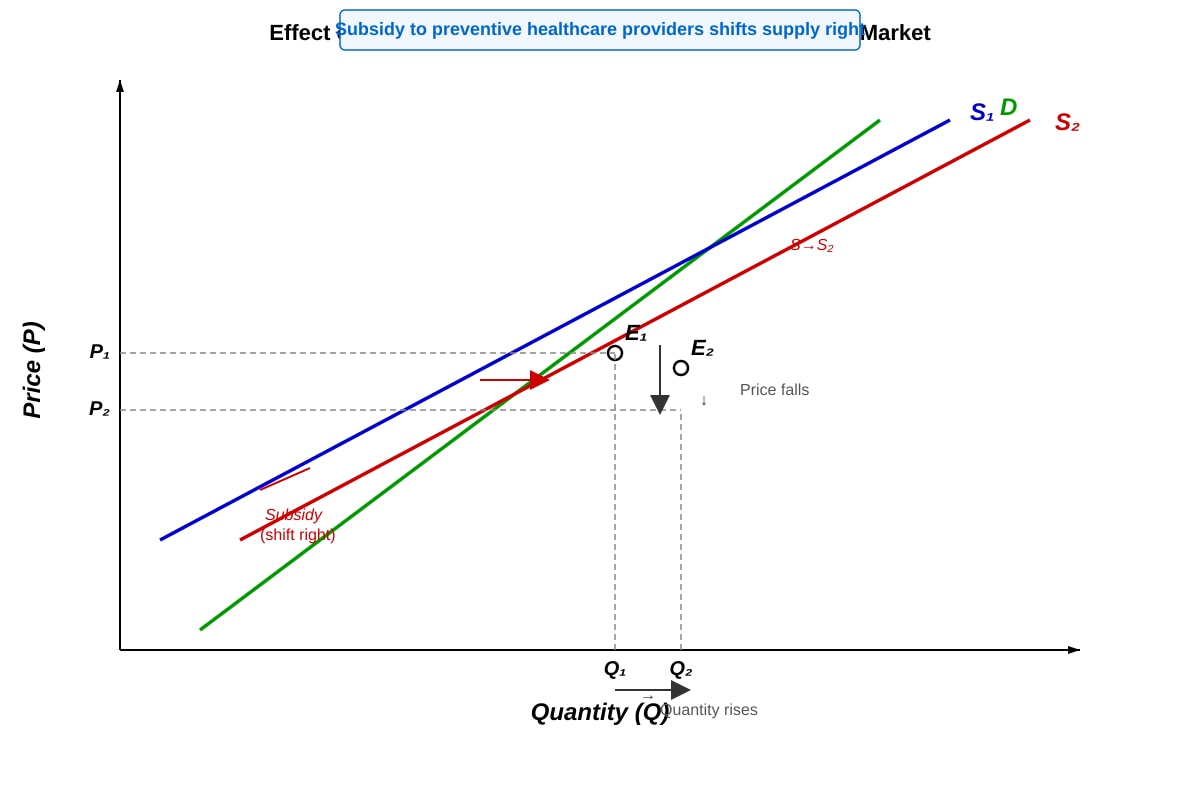
Generated diagram for this question.
*: Y-axis labeled Price, X-axis labeled Quantity. Downward sloping D, Upward sloping S. Initial equilibrium at P1, Q1. Supply curve shifts right from S1 to S2 due to subsidy. New equilibrium at P2 (lower) and Q2 (higher).
The government subsidy reduces the cost of providing preventive screenings for healthcare providers [1]. This encourages providers to offer more screenings at every price level, causing the supply curve to shift to the right from S1 to S2 [1]. As a result, the market equilibrium price falls from P1 to P2, and the equilibrium quantity increases from Q1 to Q2 [1]. The lower out-of-pocket cost for patients leads to an extension in demand, increasing the total number of screenings consumed [1]. This helps achieve the policy goal of higher uptake in preventive care [1]. The diagram clearly shows the inverse relationship between the subsidized price and the quantity demanded [1].
6. Explain how the existence of positive externalities in healthcare leads to market failure.
[6 marks]
-
Marking Criteria:
- 1 mark for defining market failure.
- 1 mark for distinguishing Private Benefit (MPB) and Social Benefit (MSB).
- 1 mark for stating MSB > MPB.
- 1 mark for explaining that free market ignores external benefits.
- 1 mark for identifying under-consumption/under-production (Qmkt < Qopt).
- 1 mark for mentioning deadweight loss/welfare loss.
-
Suggested Answer: Market failure occurs when the free market fails to allocate resources efficiently, leading to a net welfare loss [1]. In the case of preventive healthcare, there are positive externalities, meaning the Marginal Social Benefit (MSB) is greater than the Marginal Private Benefit (MPB) [1]. The MSB includes the private benefit to the patient plus the external benefit to society (e.g., higher productivity, reduced spread of disease) [1]. However, in a free market, consumers only consider their private benefits (MPB) when deciding how much healthcare to consume [1]. Consequently, the free market equilibrium quantity (Qmkt) is lower than the socially optimal quantity (Qopt) where MSB = MSC [1]. This under-consumption results in a deadweight loss to society, representing the potential welfare gains that are not realized [1].
7. Distinguish between 'merit goods' and 'public goods'. Explain why healthcare is classified as a merit good rather than a public good.
[6 marks]
-
Marking Criteria:
- 1 mark for defining Public Goods (Non-excludable, Non-rival).
- 1 mark for defining Merit Goods (Positive externalities, Information failure, Undervalued).
- 1 mark for explaining Excludability/Rivalry in healthcare.
- 1 mark for stating healthcare is excludable/rival.
- 1 mark for linking merit good characteristics to healthcare (information failure/positive externalities).
- 1 mark for clear conclusion/distinction.
-
Suggested Answer: Public goods are characterized by non-excludability (cannot prevent non-payers from consuming) and non-rivalry (one person's consumption does not reduce availability for others) [1]. Merit goods are goods that are deemed socially desirable, often characterized by positive externalities and information failure, where consumers underestimate the long-term benefits [1]. Healthcare is classified as a merit good because it is both excludable (hospitals can refuse service to non-payers) and rival (a doctor's time or a hospital bed used by one patient cannot be used by another simultaneously) [1]. Therefore, it does not fit the definition of a public good [1]. However, it is a merit good because individuals may lack perfect information about the benefits of preventive care (information failure) and because its consumption generates positive externalities for society [1]. Thus, government intervention is justified to correct under-consumption, not because of the technical characteristics of a public good [1].
Section C: Evaluation
8. Discuss the extent to which government subsidies are the most effective policy to correct the market failure caused by positive externalities in healthcare.
[10 marks]
-
Marking Criteria:
- Knowledge & Understanding (2 marks): Defines subsidies and market failure/positive externalities.
- Analysis (4 marks): Explains how subsidies work (shifts supply/demand, lowers price, increases quantity towards social optimum). Uses diagrammatic logic.
- Evaluation (4 marks): Discusses limitations of subsidies (fiscal cost, opportunity cost, inelastic demand, potential inefficiency). Compares with alternative policies (regulation, education). Makes a justified judgment.
-
Suggested Answer: Introduction: Market failure in healthcare arises due to positive externalities, leading to under-consumption. Government subsidies are a common intervention to align private incentives with social benefits. However, their effectiveness depends on elasticity, fiscal constraints, and the nature of the good.
Argument for Subsidies (Effectiveness): Subsidies effectively lower the price of preventive healthcare, making it more affordable. As shown in the diagram (Q5), this shifts the supply curve right (or demand right if consumer subsidy), increasing equilibrium quantity from Qmkt to Qopt [1]. This directly addresses the under-consumption problem. For lower-income groups, who have elastic demand (Extract 3), subsidies are particularly effective in increasing uptake [1]. By internalizing the external benefit, subsidies help achieve allocative efficiency where MSB = MSC [1]. The "Healthier SG" initiative’s full subsidy for basic screenings is a direct application of this, likely leading to significant short-term increases in screening rates [1].
Limitations of Subsidies: However, subsidies have significant drawbacks. Firstly, they impose a heavy fiscal burden on the government. As seen in Table 1, healthcare spending is already rising as a % of GDP. Further subsidies increase opportunity costs, potentially requiring higher taxes or cuts to other essential services like education or infrastructure [1]. Secondly, if demand is price inelastic (as seen in higher-income groups in Extract 3), subsidies may not significantly increase quantity but will instead increase producer revenue or consumer surplus without solving the market failure effectively [1]. Thirdly, subsidies do not address information failure directly. If consumers do not understand the value of preventive care, lowering the price may not be enough to change behavior [1].
Alternative Policies: Alternative policies include government provision (directly providing services to ensure access) and education campaigns (to correct information failure). Education might be more cost-effective in the long run by changing preferences, shifting the demand curve right organically [1]. Regulation (e.g., mandatory screenings for certain jobs) could also ensure uptake but may face political resistance [1].
Conclusion: In conclusion, subsidies are a highly effective tool for increasing immediate consumption, especially for price-sensitive groups, and are necessary to correct the positive externality. However, they are not the most effective policy in isolation due to fiscal constraints and their inability to address information failure. A combination of subsidies (to lower cost) and education (to raise awareness) is likely the most effective approach to ensure sustainable correction of market failure in healthcare [1]. Subsidies are necessary but insufficient on their own for long-term behavioral change [1].
(Note: Max 10 marks. Award marks for balanced argument, use of data from extracts, and clear judgment.)