From Real Exams Exam Paper
A Level H1 Economics Practice Paper 3
Free A Level H1 Econs Practice Paper 3, LongCat Exam version, with questions, answers, and A Level-style practice for Singapore students.
These static practice materials are generated from the site's syllabus and paper-generation workflow, with source and model context shown so students and parents can evaluate the material before use.
Questions
Free quiz and exam paper access
Enter your details to view this paper
Your access is remembered on this device.
Answers
TuitionGoWhere Practice Paper — Economics H1 A-Level
Answer Key — Version 3 of 5
Section A: Data Interpretation
1. With reference to Table 1, compare government healthcare expenditure and out-of-pocket expenditure from 2013 to 2023. [2]
Answer:
- Government expenditure rose from 5.82 billion in 2023, an increase of approximately 73%.
- Out-of-pocket expenditure rose from 7.64 billion in 2023, an increase of approximately 160%.
- Both sources of expenditure increased over the period, but out-of-pocket expenditure grew at a much faster rate than government expenditure.
- By 2023, out-of-pocket expenditure (5.82bn), whereas in 2013 government expenditure (2.94bn).
Mark scheme:
- [1] for identifying that both increased.
- [1] for noting that out-of-pocket grew faster / overtook government spending (comparative language required).
Common mistakes:
- Stating only one figure without comparison.
- Failing to reference Table 1 explicitly.
- Describing each trend separately without using comparative language (e.g., "whereas," "in contrast," "but").
2. Describe the trend in total healthcare expenditure from 2013 to 2023. Calculate the percentage increase over this period. Show your working. [3]
Answer:
-
Trend: Total healthcare expenditure increased steadily from 12.00 billion in 2018 and further to $18.20 billion in 2023. The trend is one of consistent and accelerating growth.
-
Calculation:
- Percentage increase =
- =
- = (approximately)
Mark scheme:
- [1] for describing the trend (increasing/rising).
- [1] for correct working shown.
- [1] for correct final answer (accept 116–117%).
Common mistakes:
- Omitting the formula or working.
- Arithmetic errors in subtraction or division.
- Describing the trend without mentioning the direction of change.
3. Using Extract 1, identify two reasons for the increase in healthcare expenditure in Singapore. [2]
Answer:
- Ageing population — The proportion of residents aged 65 and above rose from 11.8% in 2013 to 19.1% in 2023, increasing demand for chronic disease management and long-term care.
- Rising demand for health insurance — Private health insurance expenditure grew at 6.2% per annum between 2015 and 2023, reflecting increased uptake of coverage such as MediShield Life and private plans.
Mark scheme:
- [1] per valid reason identified, up to 2 marks.
- Reasons must be drawn from Extract 1.
Common mistakes:
- Giving generic answers not supported by the extract (e.g., "inflation" without reference to the text).
- Only giving one reason when two are required.
4. Explain why healthcare may be considered a merit good. [3]
Answer:
- A merit good is a good that is under-consumed in a free market because individuals underestimate or are unaware of its long-term benefits to themselves and society.
- Healthcare is considered a merit good because:
- Positive externalities: When individuals receive healthcare (e.g., vaccinations), it benefits others by reducing the spread of disease. The social marginal benefit exceeds the private marginal benefit, leading to under-consumption in a free market.
- Information failure: Individuals may not fully understand the long-term health benefits of preventive care (e.g., regular check-ups, screenings), leading them to consume less than the socially optimal level.
- Societal benefit: A healthy population is more productive, reducing absenteeism and increasing economic output, which benefits society as a whole.
Mark scheme:
- [1] for defining merit good correctly.
- [1] for explaining one reason (positive externality or information failure).
- [1] for developing the explanation with reference to healthcare specifically.
Common mistakes:
- Confusing merit goods with public goods.
- Providing only a definition without application to healthcare.
- Listing points without explanation.
5. With reference to Extract 1 and Table 1, explain one likely consequence of the shift in funding from government to out-of-pocket sources. [2]
Answer:
- As the share of healthcare funding shifts from government to out-of-pocket sources, lower-income households may face financial barriers to accessing healthcare. Since out-of-pocket spending requires individuals to pay directly at the point of use, those with lower incomes may delay or forgo necessary medical treatment, leading to worsening health outcomes and potentially greater long-term healthcare costs.
- This could also lead to greater inequality in healthcare access, as wealthier individuals can afford treatment while lower-income individuals cannot.
Mark scheme:
- [1] for identifying a valid consequence (e.g., reduced access for low-income households, inequality).
- [1] for explaining the consequence with reference to the data/extract.
Common mistakes:
- Stating a consequence without explaining it.
- Not referencing the extract or table.
Section B: Diagram and Application
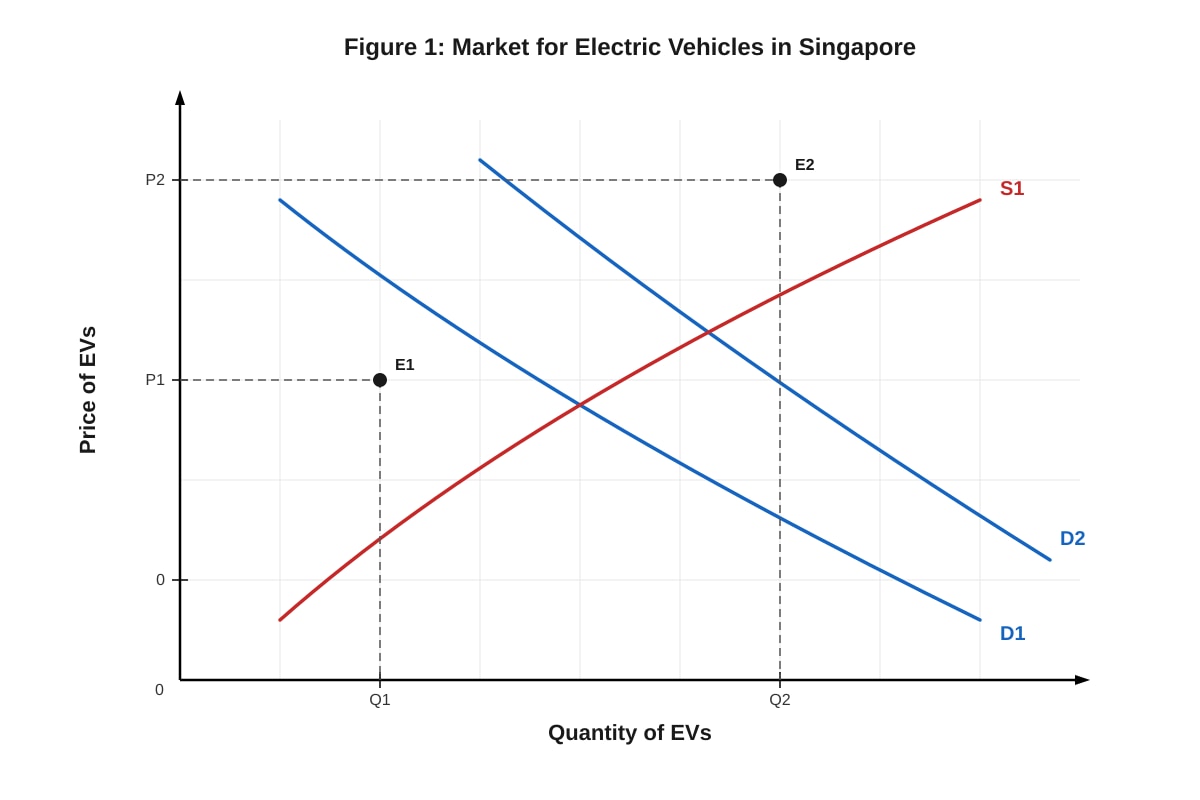
6. Using Figure 1, draw a diagram to illustrate the effect of the VES rebates and EEAI on the market for electric vehicles in Singapore. Label your diagram fully. [4]
Answer:
The diagram should show:
Image pending generation: graph for Q6.
- The VES rebates and EEAI effectively reduce the cost to consumers of purchasing EVs, increasing demand.
- The demand curve shifts rightward from D1 to D2.
- Equilibrium price rises from P1 to P2, and equilibrium quantity rises from Q1 to Q2.
- This is consistent with Extract 2, which shows EV registrations rising significantly.
Mark scheme:
- [1] for correct demand curve shift (rightward).
- [1] for showing new equilibrium with higher price and quantity.
- [1] for correctly labelling both demand curves and the supply curve.
- [1] for correctly labelling axes and equilibrium points.
Common mistakes:
- Shifting the supply curve instead of the demand curve.
- Showing a movement along the curve rather than a shift.
- Omitting axis labels or equilibrium labels.
7. With reference to Extract 2, calculate the approximate percentage increase in EV registrations from 2020 to 2023. Show your working. [2]
Answer:
- EV registrations in 2020: 1,396
- EV registrations in 2023: 11,963
- Percentage increase =
- =
- = (approximately 757%)
Mark scheme:
- [1] for correct working shown.
- [1] for correct final answer (accept 750–760%).
Common mistakes:
- Using the wrong base year (dividing by 2023 figure).
- Arithmetic errors.
8. Explain two factors that could explain the rise in EV registrations despite EVs being more expensive than ICE vehicles. [4]
Answer:
Factor 1: Government subsidies and rebates
- The VES rebates and the EV Early Adoption Incentive (EEAI) reduced the effective purchase price of EVs for consumers. The EEAI provided a 45% rebate on ARF (capped at $20,000), making EVs more affordable despite their higher sticker price. This effectively increased demand even though the market price remained higher.
Factor 2: Expansion of charging infrastructure
- The number of charging points increased from 1,600 in 2020 to 6,800 in 2023, reducing "range anxiety" and making EV ownership more convenient. Improved infrastructure lowers the non-monetary cost of owning an EV, shifting demand to the right.
Mark scheme:
- [2] per factor: [1] for identifying the factor, [1] for explaining how it increased EV demand.
- Factors must be supported by Extract 2.
Common mistakes:
- Giving factors not mentioned in the extract.
- Identifying a factor without explaining the link to increased demand.
9. The PED for electric vehicles in Singapore is estimated to be −0.8. Explain what this value means and discuss one factor that might explain this elasticity value. [3]
Answer:
- A PED of −0.8 means that a 1% increase in the price of EVs leads to a 0.8% decrease in the quantity demanded. Demand is price inelastic (PED between 0 and −1), meaning consumers are relatively unresponsive to price changes.
- One factor explaining this inelasticity: EVs may have few close substitutes in the short run, especially for consumers who are environmentally conscious or who have already invested in EV-compatible infrastructure (e.g., home charging). Additionally, government rebates may insulate consumers from the full price increase, reducing their price sensitivity.
- Alternatively, for consumers who view EVs as a necessity within the constraints of Singapore's vehicle quota system (COE), demand may be less responsive to price changes.
Mark scheme:
- [1] for explaining that PED = −0.8 means demand is price inelastic.
- [1] for interpreting the numerical value correctly (% change relationship).
- [1] for discussing a relevant factor (e.g., lack of substitutes, government rebates, necessity).
Common mistakes:
- Stating that −0.8 is elastic (it is inelastic since |PED| < 1).
- Not explaining the meaning of the numerical value.
10. Explain one positive externality associated with the adoption of electric vehicles. [2]
Answer:
- A positive externality occurs when the consumption or production of a good benefits third parties who are not directly involved in the transaction.
- The adoption of EVs generates a positive externality in the form of reduced air pollution. EVs produce zero tailpipe emissions, which improves air quality and reduces health problems (e.g., respiratory diseases) for the general population. The social marginal benefit of EV use exceeds the private marginal benefit, meaning the free market would under-consume EVs relative to the socially optimal level.
Mark scheme:
- [1] for identifying a valid positive externality (e.g., reduced air pollution, lower noise pollution, reduced GHG emissions).
- [1] for explaining why it is a positive externality (benefit to third parties, SMB > PMB).
Common mistakes:
- Describing a private benefit rather than an external benefit.
- Not explaining the concept of positive externality.
Section C: Policy Evaluation
11. With reference to Extract 3, identify two groups affected by the carbon tax and explain how each is affected. [4]
Answer:
Group 1: Energy-intensive industries (e.g., petrochemicals, refining)
- These firms face higher production costs because they must pay 50–$80 by 2030). This reduces their profit margins and may make them less competitive compared to rivals in Malaysia and Indonesia where carbon pricing is less stringent.
Group 2: Households
- Households may face higher prices for electricity and goods as firms pass on the cost of the carbon tax. However, the government has committed to using carbon tax revenue to provide rebates and offsets to cushion the impact on households, particularly lower-income groups.
Mark scheme:
- [2] per group: [1] for identifying the group, [1] for explaining the effect with reference to Extract 3.
Common mistakes:
- Identifying groups not mentioned in the extract.
- Stating the effect without explanation.
12. Explain how a carbon tax corrects the market failure associated with carbon emissions. Use a diagram to illustrate your answer. [5]
Answer:
-
Carbon emissions represent a negative externality of production. Firms that emit CO₂ impose costs on society (e.g., climate change, health problems) that are not reflected in their private costs. The marginal social cost (MSC) exceeds the marginal private cost (MPC), leading to over-production of carbon-intensive goods at the free market equilibrium (Qm) compared to the socially optimal quantity (Qs).
-
A carbon tax increases the firm's private cost of production by internalising the external cost. The supply curve shifts leftward from MPC to MPC + tax (= MSC). The new equilibrium quantity falls from Qm to Qs, and the price rises from Pm to Ps. This reduces carbon emissions to the socially optimal level.
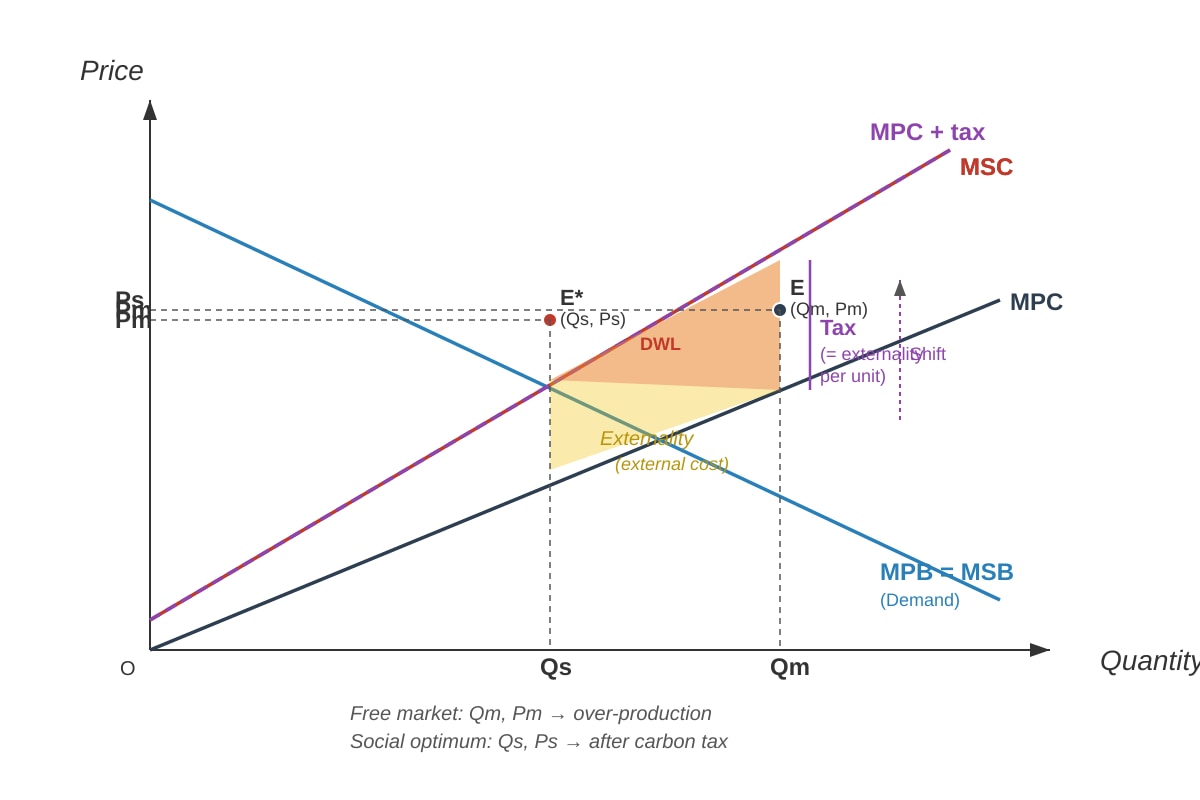
Generated graph for Q12.
Mark scheme:
- [1] for explaining the concept of negative externality (MSC > MPC).
- [1] for explaining how the carbon tax internalises the externality (shifts supply curve).
- [1] for stating the result (quantity falls, price rises, moves toward social optimum).
- [2] for the diagram: [1] for correct curves and shift, [1] for correct labels and equilibria.
Common mistakes:
- Drawing a positive externality diagram instead.
- Shifting the demand curve instead of the supply curve.
- Not explaining the link between the tax and the externality.
13. Discuss one advantage and one disadvantage of using a carbon tax compared to direct regulation (e.g., emission caps) to reduce carbon emissions. [4]
Answer:
Advantage: Economic efficiency / incentive to innovate
- A carbon tax gives firms flexibility in how they reduce emissions. Firms that can reduce emissions cheaply will do so, while those that cannot will pay the tax. This achieves the reduction at the lowest total cost to society (cost-effective). Additionally, the tax provides a continuous incentive for firms to invest in cleaner technology, as every unit of emissions avoided saves the tax. Under direct regulation (e.g., uniform emission caps), firms have no incentive to reduce emissions below the cap.
Disadvantage: Uncertainty in emission reduction
- A carbon tax sets the price of emissions but does not guarantee a specific quantity of emission reduction. If demand for carbon-intensive goods is price inelastic, the tax may need to be very high to achieve significant reductions, which could be politically difficult and economically damaging. In contrast, direct regulation (emission caps) provides certainty about the maximum level of emissions, which may be preferable when there is a specific environmental target to meet.
Mark scheme:
- [2] for advantage: [1] for identifying, [1] for explaining with economic reasoning.
- [2] for disadvantage: [1] for identifying, [1] for explaining with economic reasoning.
Common mistakes:
- Giving only one side (advantage or disadvantage).
- Providing generic points without economic reasoning.
14. Explain what is meant by "carbon leakage" and discuss why it is a concern for Singapore. [3]
Answer:
-
Carbon leakage occurs when firms relocate their production from a country with strict carbon pricing (e.g., Singapore) to countries with weaker environmental regulations (e.g., Malaysia, Indonesia). This does not reduce global emissions — it merely shifts them elsewhere.
-
It is a concern for Singapore because:
- Singapore's energy-intensive industries (petrochemicals, refining) face higher production costs due to the carbon tax, making them less competitive against regional rivals without similar carbon pricing.
- If firms relocate, Singapore loses GDP, tax revenue, and jobs, while global emissions remain unchanged or even increase (if the new location has less efficient technology).
- This undermines the environmental effectiveness of Singapore's carbon tax policy.
Mark scheme:
- [1] for defining carbon leakage correctly.
- [1] for explaining why it is a concern (loss of competitiveness).
- [1] for linking to Singapore's context (regional competition, environmental ineffectiveness).
Common mistakes:
- Defining carbon leakage incorrectly (e.g., as carbon emissions themselves).
- Not linking to Singapore's specific context.
15. Evaluate the effectiveness of Singapore's carbon tax policy in achieving its environmental objectives. [4]
Answer:
Introduction: Singapore's carbon tax aims to reduce greenhouse gas emissions by internalising the external cost of carbon. Its effectiveness depends on the tax rate, coverage, and complementary policies.
Arguments that it is effective:
- The tax provides a price signal that incentivises firms to reduce emissions and invest in cleaner technology. The planned increase to 80/tonne by 2030 will strengthen this incentive over time.
- Revenue generated (estimated $1.1bn by 2030) is being recycled into decarbonisation initiatives and grants for SMEs (e.g., Energy Efficiency Fund), supporting the green transition.
- The tax covers facilities emitting ≥25,000 tonnes CO₂e, which accounts for approximately 80% of Singapore's emissions, giving it broad coverage.
Arguments that it may be limited:
- The initial rate of 25/tonne, it may be insufficient for the most emissions-intensive sectors.
- Carbon leakage is a risk, as firms may relocate to neighbouring countries with weaker carbon pricing, undermining the policy's environmental impact.
- The tax does not address consumer behaviour directly (e.g., household energy use, transport choices), limiting its overall impact.
Judgement:
- The carbon tax is a necessary but not sufficient condition for achieving Singapore's environmental objectives. Its effectiveness will depend on the rate being high enough to change behaviour, complementary policies (grants, infrastructure investment), and international coordination to prevent carbon leakage. The progressive increase to 80 by 2030 is a positive step, but the policy should be evaluated alongside other measures such as renewable energy investment and energy efficiency standards.
Mark scheme:
- [1] for explaining how the carbon tax works to reduce emissions.
- [1] for discussing a factor supporting effectiveness.
- [1] for discussing a factor limiting effectiveness.
- [1] for a clear, balanced judgement.
Common mistakes:
- One-sided evaluation (only advantages or only disadvantages).
- No judgement or conclusion.
- Not referencing Extract 3.
Section D: Extended Data Response
16. With reference to Table 2, compare the Dependency Ratio Ceiling (DRC) for the manufacturing sector and the services sector from 2019 to 2023. [2]
Answer:
- The DRC for manufacturing fell from 60% in 2019 to 50% in 2023, a reduction of 10 percentage points.
- The DRC for services fell from 40% in 2019 to 35% in 2023, a reduction of 5 percentage points.
- Both sectors experienced a tightening of the DRC, but the manufacturing sector experienced a larger reduction (10 pp vs 5 pp).
- Throughout the period, the manufacturing DRC remained higher than the services DRC, meaning manufacturing firms were allowed a greater proportion of foreign workers.
Mark scheme:
- [1] for identifying that both DRCs decreased.
- [1] for noting that manufacturing had a larger reduction / was consistently higher.
Common mistakes:
- Only describing one sector.
- Not using comparative language.
17. Describe the trend in the resident unemployment rate from 2019 to 2023. Suggest one possible reason for the change observed in 2021. [3]
Answer:
-
The resident unemployment rate rose from 3.1% in 2019 to 3.5% in 2021, before falling to 2.7% in 2023. The overall trend shows an initial increase followed by a recovery to below the 2019 level.
-
The increase in 2021 is likely due to the COVID-19 pandemic, which caused widespread economic disruption, including reduced demand in sectors such as tourism, hospitality, and retail. Lockdowns and safe distancing measures led to business closures and retrenchments, raising unemployment.
Mark scheme:
- [1] for describing the trend (rose then fell).
- [1] for correct figures or direction.
- [1] for a valid reason for the 2021 increase (COVID-19 pandemic).
Common mistakes:
- Only describing the overall trend without noting the 2021 spike.
- Giving a reason not linked to the time period.
18. Using a demand and supply diagram, explain how an increase in the Foreign Worker Levy might affect the market for low-skilled foreign labour in Singapore. [4]
Answer:
-
The Foreign Worker Levy (FWL) is a tax paid by employers for each foreign worker they hire. An increase in the FWL raises the cost of employing foreign workers, which is equivalent to an increase in the cost of production for firms that rely on foreign labour.
-
In the market for low-skilled foreign labour, the demand curve shifts leftward (decrease in demand) because firms now find it more expensive to hire foreign workers. The supply of foreign labour to Singapore is assumed to be perfectly elastic (horizontal) in the short run, as workers can choose to work in other countries.

Generated image for this question.
id: Q18-ans-fig1 type: graph linked_question: Q18 description: Labour market diagram. Downward-sloping demand curve D1 intersects perfectly elastic (horizontal) supply curve S at (Q1, W). D2 shifts leftward to intersect S at (Q2, W) where Q2 < Q1. Wage remains unchanged but quantity of foreign labour demanded falls. labels: D1, D2, S (perfectly elastic), W (wage), Q1, Q2, Wage of foreign workers ($), Quantity of foreign workers values: Q2 < Q1, wage unchanged at W must_show: Leftward shift of demand, horizontal supply curve, lower quantity demanded, wage unchanged </image_quantity>
- The equilibrium wage (determined by the supply curve) remains unchanged, but the quantity of foreign labour demanded falls from Q1 to Q2.
- This is consistent with Table 2, which shows total foreign workers falling from 1.42 million in 2019 to 1.30 million in 2021.
Mark scheme:
- [1] for explaining that the FWL increases costs and reduces demand for foreign labour.
- [1] for correct diagram with leftward demand shift.
- [1] for correct labels (axes, curves, equilibria).
- [1] for explaining the outcome (quantity falls, wage unchanged under perfectly elastic supply).
Common mistakes:
- Shifting the supply curve instead of the demand curve.
- Showing a change in wage when supply is perfectly elastic.
- Not explaining the economic reasoning.
19. Explain two reasons why SMEs might be more adversely affected by the tightening of foreign worker policies than large firms. [4]
Answer:
Reason 1: Less capital to invest in automation
- SMEs typically have lower profit margins and less access to capital than large firms. The tightening of foreign worker policies incentivises firms to automate, but automation requires significant upfront investment in machinery and technology. SMEs may not have the financial resources to make these investments, leaving them unable to replace foreign workers and facing higher costs or reduced output.
Reason 2: Greater reliance on foreign labour in certain sectors
- SMEs in sectors such as food services, construction, and retail tend to be more labour-intensive and rely heavily on foreign workers for roles that are difficult to fill with local workers (e.g., due to the 3D nature — dirty, dangerous, demeaning). Large firms may have more diversified operations and greater ability to absorb cost increases or restructure their workforce.
Mark scheme:
- [2] per reason: [1] for identifying the reason, [1] for explaining why it disproportionately affects SMEs.
Common mistakes:
- Giving reasons that apply equally to SMEs and large firms.
- Not explaining the differential impact.
20. Evaluate whether the tightening of foreign worker policies is likely to benefit Singapore's economy in the long run. [5]
Answer:
Introduction: The tightening of foreign worker policies — through higher FWLs and lower DRCs — aims to reduce Singapore's reliance on low-cost foreign labour and drive productivity growth. Whether this benefits the economy in the long run depends on the ability of firms to adapt and the broader economic context.
Arguments that it will benefit the economy:
- Productivity growth: By making foreign labour more expensive, the policy incentivises firms to invest in automation and technology, raising labour productivity. Higher productivity is essential for sustained economic growth, especially as Singapore faces an ageing population and shrinking local workforce.
- Protection of local employment: Tightening foreign worker policies may encourage firms to hire more Singaporeans, supporting local wage growth and reducing income inequality between local and foreign workers.
- Structural transformation: The policy pushes the economy towards higher value-added industries that rely less on low-cost labour and more on innovation and skills, aligning with Singapore's long-term economic strategy.
Arguments that it may harm the economy:
- Labour shortages: In sectors where Singaporeans are unwilling to work (e.g., construction, marine, food services), the tightening may lead to labour shortages, project delays, and higher operating costs, reducing output and competitiveness.
- Impact on SMEs: As discussed in Q19, SMEs are disproportionately affected due to limited capital for automation. Some SMEs may shut down or relocate, reducing economic dynamism.
- Higher costs for consumers: If firms pass on higher labour costs to consumers, the cost of living may rise, reducing consumers' purchasing power and overall welfare.
Judgement:
- In the long run, the tightening of foreign worker policies is likely to benefit Singapore's economy if accompanied by sufficient support for firms (especially SMEs) to invest in automation and retrain workers. The policy aligns with the goal of achieving productivity-led growth, which is essential for a small, open economy with limited natural resources. However, the transition period may be painful for certain sectors and firms, and the government must ensure that complementary policies (grants, training programmes, phased implementation) are in place to manage the adjustment. Without such support, the policy could lead to structural unemployment and reduced competitiveness in the short to medium term.
Mark scheme:
- [1] for explaining the rationale behind the policy (productivity, local employment).
- [1] for discussing a benefit with economic reasoning.
- [1] for discussing a cost/risk with economic reasoning.
- [1] for considering the role of complementary policies or conditions.
- [1] for a clear, balanced judgement that addresses the "long run" timeframe.
Common mistakes:
- One-sided evaluation.
- Not addressing the "long run" specifically.
- No judgement or conclusion.
- Not referencing Extract 4 or Table 2.
End of Answer Key
Total Marks: 60
| Section | Topic | Marks |
|---|---|---|
| A | Data Interpretation | 11 |
| B | Diagram and Application | 15 |
| C | Policy Evaluation | 20 |
| D | Extended Data Response | 14 |
| Total | 60 |