From Real Exams Exam Paper
A Level H1 Economics Practice Paper 1
Free A Level H1 Econs Practice Paper 1, Exam version, with questions, answers, and A Level-style practice for Singapore students.
These static practice materials are generated from the site's syllabus and paper-generation workflow, with source and model context shown so students and parents can evaluate the material before use.
Questions
Free quiz and exam paper access
Enter your details to view this paper
Your access is remembered on this device.
Answers
TuitionGoWhere Practice Paper - Economics H1 A-Level (Answer Key)
Total Marks: 100 (Case Study 1: 50 marks, Case Study 2: 50 marks)
CASE STUDY 1: Singapore's Digital Economy and Market Dynamics [50 marks]
1. With reference to Table 1, describe the trend in Singapore's e-commerce sales from 2019 to 2023. [2]
Answer: E-commerce sales increased consistently from S11.8 billion in 2023 [1]. The growth was particularly rapid in 2020 (78% increase) before moderating to steady growth of approximately 15-18% annually in subsequent years [1].
Marking Scheme:
- 1 mark: Identifying overall upward trend with figures
- 1 mark: Noting acceleration in 2020 and subsequent moderation
2. Using Extract 1, explain the estimated value of price elasticity of demand for online food delivery services. [3]
Answer: The PED of -0.6 indicates that demand is price inelastic [1] because the absolute value is less than 1 [1]. This means that a 1% increase in price leads to only a 0.6% decrease in quantity demanded, suggesting consumers are relatively unresponsive to price changes, likely due to convenience and limited substitutes [1].
Marking Scheme:
- 1 mark: Identifying inelastic demand
- 1 mark: Correct interpretation of coefficient
- 1 mark: Explanation of consumer responsiveness/determinants
3. With reference to Extract 1, explain why the price elasticity of supply for digital platforms is highly elastic. [4]
Answer: Digital platforms have PES of +2.3, indicating highly elastic supply [1]. This is because digital services can scale rapidly through technology without significant additional capital investment [1]. Unlike physical businesses, online platforms can increase capacity by adding server resources and software capabilities rather than physical infrastructure [1]. The marginal cost of serving additional customers is very low, allowing quick response to price changes [1].
Marking Scheme:
- 1 mark: Identifying elastic supply (PES > 1)
- 1 mark: Technology scalability
- 1 mark: Low marginal costs
- 1 mark: Contrast with physical businesses or speed of response
4. Using Extract 2, identify and explain two characteristics of the oligopolistic market structure in Singapore's online food delivery industry. [6]
Characteristic 1: Few dominant firms - The market is dominated by two major platforms (GrabFood and Foodpanda) [1]. This concentration gives these firms significant market power and the ability to influence prices and market conditions [2].
Characteristic 2: High barriers to entry - Substantial initial investment is required for technology infrastructure [1], and firms need to build critical mass of both restaurants and consumers [1], making it difficult for new competitors to enter the market successfully [1].
Marking Scheme:
- 3 marks per characteristic (1 for identification, 2 for explanation)
- Accept: interdependence, non-price competition, product differentiation
5. Extract 2 mentions that "average delivery fees have risen by 15% over the past two years." Using a demand and supply diagram, analyze the factors that could have caused this price increase. [8]
Answer: *
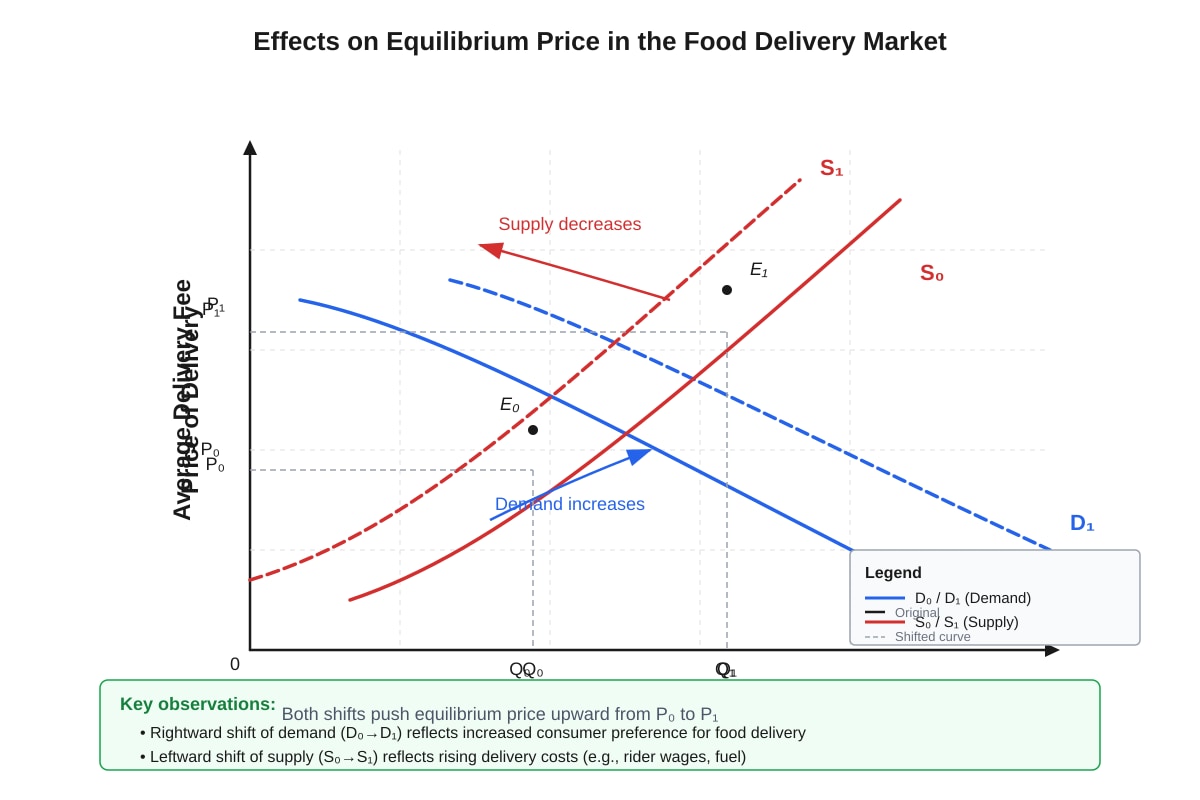
Generated diagram for this question.
Demand factors: Increased consumer preference for convenience and online ordering, especially post-pandemic, shifts demand curve rightward [2].
Supply factors: Rising labor costs for delivery riders and increased fuel prices raise production costs, shifting supply curve leftward [2]. The oligopolistic market structure may also allow platforms to exercise market power in setting prices [2].
Analysis: The combination of increased demand and decreased supply (or increased costs) results in higher equilibrium prices, explaining the 15% fee increase [2].
Marking Scheme:
- 2 marks: Correct diagram with labeled axes and curves
- 2 marks: Demand factors explanation
- 2 marks: Supply factors explanation
- 2 marks: Analysis linking to price increase
6. With reference to Extract 3, explain how negative externalities from food delivery services represent market failure. [6]
Answer: Negative externalities occur when the social cost of production exceeds the private cost [1]. Food delivery services generate external costs including traffic congestion, packaging waste, and poor working conditions that are not reflected in the market price [2]. This leads to overproduction relative to the socially optimal level [1] because firms only consider their private costs, not the full social costs [1]. The market fails to achieve allocative efficiency, creating deadweight loss [1]. Government intervention is needed to internalize these external costs [1].
Marking Scheme:
- 1 mark: Definition of negative externality
- 2 marks: Specific examples from extract
- 1 mark: Overproduction relative to social optimum
- 1 mark: Private vs social cost divergence
- 1 mark: Market failure/efficiency loss
7. Extract 3 states that "the social cost of delivery traffic exceeds private costs by approximately 20%." Using this information and a suitable diagram, explain how the government could use taxation to address this market failure. [8]
Answer: *
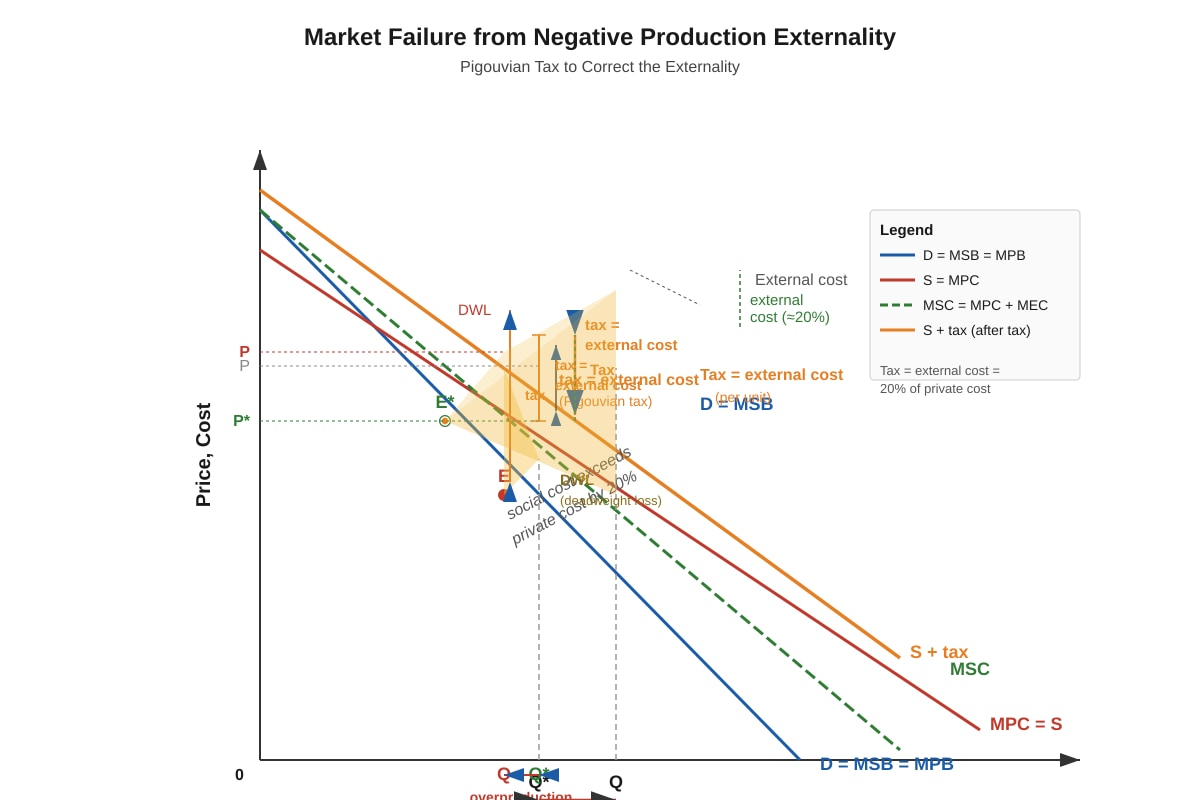
Generated diagram for this question.
The social cost exceeds private cost by 20%, indicating a negative externality [1]. The government can impose a Pigouvian tax equal to the external cost (20% of private cost) [2]. This tax shifts the supply curve upward from MPC to MSC [2], internalizing the external cost and forcing firms to consider the full social cost of their operations [2]. The new equilibrium occurs at the socially optimal quantity where MSB = MSC [1], eliminating the deadweight loss and achieving allocative efficiency [1].
Marking Scheme:
- 2 marks: Correct diagram showing MSC, MPC, tax, and equilibrium points
- 2 marks: Explanation of Pigouvian tax mechanism
- 2 marks: Internalization of external costs
- 1 mark: Socially optimal outcome
- 1 mark: Efficiency improvement
8. Using information from all extracts, evaluate whether government intervention in the online food delivery market is justified. In your answer, consider both market failure and other economic arguments. [13]
Arguments for intervention:
- Market failure: Negative externalities (congestion, waste) require correction through taxation or regulation [3]
- Oligopolistic concerns: Market dominance by two platforms may lead to anti-competitive behavior requiring CCCS monitoring [2]
- Worker protection: Gig economy workers need protection regarding working conditions and fair wages [2]
Arguments against intervention:
- Dynamic efficiency: The market is rapidly evolving with technological innovation; intervention may stifle progress [2]
- Consumer benefits: High consumer surplus from convenience and competitive pricing [2]
- Economic growth: The sector contributes significantly to GDP growth and employment [1]
Evaluation: Government intervention is justified but should be targeted and proportionate [1]. Focus should be on addressing clear market failures (externalities) and ensuring fair competition rather than heavy-handed regulation that could harm innovation and growth. The 20% external cost provides clear justification for Pigouvian taxation, while worker protection measures address social concerns without significantly distorting market mechanisms.
Marking Scheme:
- 4 marks: Arguments for intervention (market failure focus)
- 3 marks: Arguments against intervention
- 3 marks: Use of extract evidence
- 3 marks: Evaluation and reasoned conclusion
CASE STUDY 2: Macroeconomic Policy and Income Distribution [50 marks]
9. With reference to Table 2, compare Singapore's real GDP growth and unemployment rates over the period 2019 to 2023. [4]
Answer: Both indicators show an inverse relationship during the crisis period [1]. Real GDP growth fell sharply from 0.7% in 2019 to -5.4% in 2020, while unemployment rose from 2.3% to 4.1% over the same period [1]. During recovery, GDP growth rebounded strongly to 7.6% in 2021 while unemployment fell to 2.7% [1]. By 2023, GDP growth had moderated to 1.1% while unemployment stabilized at 2.1%, close to pre-crisis levels [1].
Marking Scheme:
- 1 mark: Identifying inverse relationship
- 1 mark: Crisis period comparison (2019-2020)
- 1 mark: Recovery period comparison (2021)
- 1 mark: Stabilization period (2022-2023)
10. Using Extract 4, explain how the government's fiscal stimulus measures would lead to economic expansion. [6]
Answer: The S$100 billion fiscal stimulus (20% of GDP) involved increased government spending and direct transfers [1]. This increases aggregate demand through the multiplier effect [2]. Direct cash transfers increase household consumption, while wage subsidies support business investment and employment [2]. Higher aggregate demand leads to increased output, employment, and economic growth [1].
Marking Scheme:
- 1 mark: Identifying fiscal stimulus measures
- 2 marks: Aggregate demand increase and multiplier effect
- 2 marks: Specific transmission mechanisms (consumption, investment)
- 1 mark: Economic expansion outcome
11. It is said that unemployment and inflation have an inverse relationship. With reference to Table 2 and Figure 1, explain this relationship and assess whether the data supports this theory. [8]
Theory explanation: The Phillips Curve suggests an inverse relationship between unemployment and inflation [1]. As aggregate demand increases, unemployment falls but wage and price inflation rise due to increased demand for labor and goods [2].
Data analysis: The 2020-2021 period supports the theory: as unemployment fell from 4.1% to 2.7%, inflation rose from -0.2% to 2.3% [2]. However, 2022-2023 shows mixed evidence: unemployment remained low (2.0-2.1%) while inflation was high (6.1% then 4.8%) [2].
Assessment: The data partially supports the Phillips Curve relationship, particularly during the recovery phase [1]. However, the high inflation in 2022-2023 despite low unemployment suggests supply-side factors (global inflation, supply chain disruptions) may have dominated demand-side effects [2].
Marking Scheme:
- 2 marks: Theory explanation
- 2 marks: Supporting evidence from data
- 2 marks: Contradictory evidence from data
- 2 marks: Balanced assessment with supply-side factors
12. Extract 5 mentions concerns about fiscal sustainability due to rising government debt. Explain two potential consequences of high government debt levels for the economy. [6]
Consequence 1: Crowding out of private investment - High government borrowing increases interest rates [1], making it more expensive for businesses to borrow for investment [1], potentially reducing long-term economic growth [1].
Consequence 2: Reduced fiscal flexibility - High debt levels limit the government's ability to respond to future economic crises [1] as debt servicing costs consume a larger share of the budget [1], constraining spending on essential services or counter-cyclical policies [1].
Marking Scheme:
- 3 marks per consequence (mechanism and impact)
- Accept: intergenerational burden, credit rating concerns, inflation risk
13. With reference to Extract 6, explain why Singapore's Gini coefficient after taxes and transfers is always lower than before taxes and transfers. [6]
Answer: The Gini coefficient measures income inequality (0 = perfect equality, 1 = perfect inequality) [1]. Progressive taxation takes a higher proportion from high earners, reducing their post-tax income [2]. Government transfers such as GST vouchers and Progressive Wage Model payments provide additional income to lower earners [2]. This redistribution narrows the income gap between rich and poor [1], making the post-tax and transfer income distribution more equal than the pre-redistribution distribution, hence the lower Gini coefficient [1].
Marking Scheme:
- 1 mark: Gini coefficient definition
- 2 marks: Progressive taxation effect
- 2 marks: Transfer payments effect
- 1 mark: Overall redistribution impact
14. Using Extract 6, analyze the potential trade-offs involved in implementing more aggressive redistributive policies in Singapore. [8]
Benefits of aggressive redistribution:
- Reduced income inequality and improved social cohesion [2]
- Higher consumption by lower-income groups due to higher marginal propensity to consume [1]
Costs of aggressive redistribution:
- Reduced work incentives if benefits are too generous, leading to welfare dependency [2]
- Higher tax rates may discourage entrepreneurship and investment, reducing economic competitiveness [2]
- Brain drain as high earners relocate to lower-tax jurisdictions [1]
Analysis: Singapore must balance social equity with economic efficiency. The current system (Gini falling from 0.51 to 0.38) suggests effective redistribution without severely compromising competitiveness. More aggressive policies risk undermining Singapore's position as a business hub while potentially creating unsustainable fiscal burdens.
Marking Scheme:
- 2 marks: Benefits of redistribution
- 4 marks: Costs/trade-offs (work incentives, competitiveness)
- 2 marks: Analysis and evaluation
15. Using information from all extracts, discuss the extent to which fiscal policy should be the main tool for achieving both economic growth and income equality in Singapore. In your evaluation, consider the effectiveness of fiscal policy compared to other policy approaches. [12]
Fiscal policy strengths:
- Growth: Stimulus spending (S$100 billion) successfully supported recovery from -5.4% to +7.6% GDP growth [2]
- Equality: Progressive taxation and transfers effectively reduced Gini from 0.51 to 0.38 [2]
- Flexibility: Can target specific sectors (education spending increase) and respond quickly to crises [1]
Fiscal policy limitations:
- Sustainability: Rising debt (109% to 131% of GDP) raises long-term concerns [1]
- Efficiency: May crowd out private investment and create work disincentives [1]
Alternative policies:
- Monetary policy: MAS exchange rate policy supports export competitiveness for growth [1]
- Supply-side policies: Education and reskilling programs address structural inequality while boosting productivity [2]
- Regulatory policy: Progressive Wage Model directly addresses low wages without fiscal cost [1]
Evaluation: Fiscal policy should be a key tool but not the main tool. Singapore's success stems from policy coordination: fiscal stimulus for crisis response, monetary policy for competitiveness, and supply-side policies for sustainable growth. Over-reliance on fiscal policy risks debt sustainability and economic efficiency. A balanced approach using fiscal policy for redistribution and crisis response, while relying on supply-side policies for long-term growth and equality, appears optimal for Singapore's context [1].
Marking Scheme:
- 3 marks: Fiscal policy effectiveness for growth and equality
- 2 marks: Fiscal policy limitations
- 3 marks: Alternative policy tools
- 2 marks: Use of extract evidence
- 2 marks: Evaluation and reasoned conclusion