AI Generated Quiz
A Level Chemistry H3 Redox Electrochemistry Quiz
Free A Level Chemistry H3 Redox Electrochemistry quiz, HY3 AI version, with questions, answers, and A Level-style practice for Singapore students.
These static practice materials are generated from the site's syllabus and paper-generation workflow, with source and model context shown so students and parents can evaluate the material before use.
Questions
A-Level Chemistry H3 Quiz - Redox Electrochemistry
Name:
Class:
Date:
Score:
Duration: 60 minutes
Total Marks: 40
Instructions:
This quiz covers Redox Electrochemistry as assumed H2 prerequisite knowledge for H3 Chemistry. Answer all 20 questions. Section A is short structured items (1 mark each unless stated). Section B requires calculations and explanations. Section C involves data interpretation and extended reasoning. Show all working for calculation questions. Use the Data Booklet if needed.
Section A: Fundamentals (Questions 1–8)
1. Define oxidation in terms of electron transfer. [1]
2. Write the half-equation for the reduction of MnO4− to Mn2+ in acidic solution. [1]
3. State the Nernst equation for a half-cell. [1]
4. Calculate the oxidation state of Cr in K2Cr2O7. [1]
5. Identify the species oxidised in: Zn(s)+Cu2+(aq)→Zn2+(aq)+Cu(s). [1]
6. What is the standard electrode potential E∘ of the SHE? [1]
7. State two conditions for a galvanic cell to operate. [1]
8. Write the cell notation for a Daniell cell. [1]
Section B: Calculations and Applications (Questions 9–14)
9. For the cell Zn∣Zn2+(1.0M)∣∣Cu2+(1.0M)∣Cu, given EZn2+/Zn∘=−0.76V and ECu2+/Cu∘=+0.34V, calculate Ecell∘. [2]
10. Using the Nernst equation at 298 K, calculate the cell potential for the above cell if [Zn2+]=0.10M and [Cu2+]=1.0M. (RT/F=0.0257V) [3]
11. A solution contains Fe2+ and Fe3+. The EFe3+/Fe2+∘=+0.77V. If [Fe3+]=0.50M and [Fe2+]=0.10M, calculate the electrode potential at 298 K. [3]
12. In the electrolysis of aqueous NaCl with inert electrodes, write the half-equations at anode and cathode, and state the overall cell reaction. [3]
13. Calculate the charge in coulombs required to deposit 2.00 g of Ag from Ag+ solution. (Ar of Ag = 108, F=96500Cmol−1) [3]
14. For the reaction 2Ag++Cu→2Ag+Cu2+, given EAg+/Ag∘=+0.80V and ECu2+/Cu∘=+0.34V, calculate ΔG∘ (in kJ mol−1) for the reaction as written. (n=2, F=96500Cmol−1) [3]
Section C: Data Interpretation and Extended Reasoning (Questions 15–20)
15. A student measures the following standard reduction potentials:
- I2+2e−→2I−: +0.54V
- Br2+2e−→2Br−: +1.07V
- Cl2+2e−→2Cl−: +1.36V
(a) Arrange Cl2,Br2,I2 in order of decreasing oxidizing strength. [1]
(b) Predict whether Cl2 will oxidize Br− to Br2. Explain. [2]
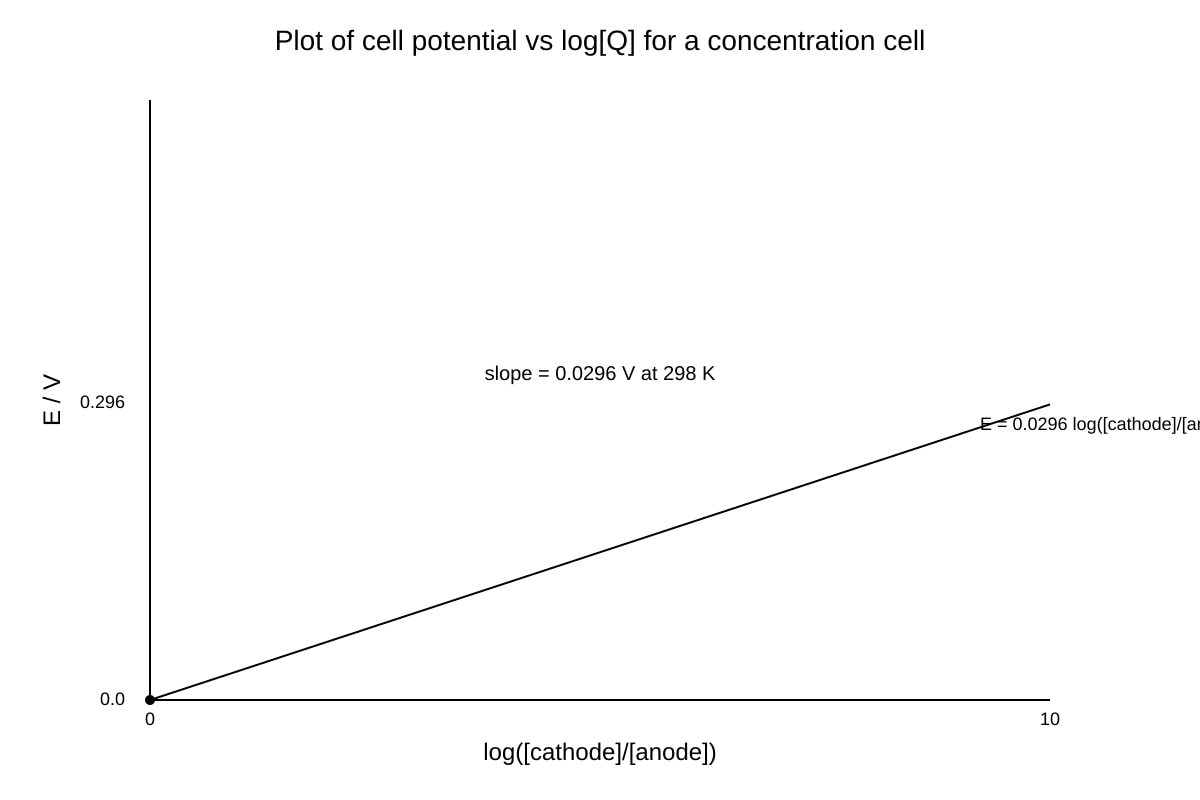
16.
Image pending generation: graph for Q16.
Using the plotted graph, explain how the cell potential varies with concentration ratio in a concentration cell at 298 K. [3]
17. Compare the operation of a galvanic cell and an electrolytic cell under the headings: (i) energy change, (ii) sign of Ecell, (iii) electrode labels. [3]
18. A fuel cell uses H2 and O2 to produce water. Write the half-equations and overall equation. Given EO2/H2O∘=+1.23V and EH+/H2∘=0.00V, calculate Ecell∘. [4]
19. Discuss how overpotential affects the products of electrolysis of aqueous Na2SO4 with inert electrodes. [3]
20. The table shows E∘ values for some metals:
| Metal | EM2+/M∘ / V |
|---|---|
| Mg | -2.37 |
| Fe | -0.44 |
| Ni | -0.25 |
| Au | +1.50 |
(a) Which metal is the strongest reducing agent? [1]
(b) Calculate Ecell∘ for a cell with Mg anode and Ni cathode. [2]
(c) State one application of such a cell. [1]
Answers
A-Level Chemistry H3 Quiz - Redox Electrochemistry: Answer Key
Total Marks: 40
Topic: Redox Electrochemistry (H2 assumed knowledge for H3)
Section A: Fundamentals
1. [1 mark] Oxidation is loss of electrons (OIL).
Teaching note: In redox, oxidation = electrons lost; reduction = electrons gained. A common mistake is defining by O₂, which is only one case.
2. [1 mark] MnO4−+8H++5e−→Mn2++4H2O
Teaching note: Balance O with H₂O, H with H⁺, charge with e⁻. In acidic medium, H⁺ is used.
3. [1 mark] E=E∘−nFRTlnQ (or E=E∘−n0.0591logQ at 298 K)
Teaching note: Q is reaction quotient. Nernst adjusts potential for non-standard conditions.
4. [1 mark] +6
Working: K = +1 (×2 = +2), O = -2 (×7 = -14); total 0 → 2 + 2x -14 = 0 → x = +6.
5. [1 mark] Zn (or Zn(s))
Teaching note: Zn goes from 0 to +2, loses e⁻ → oxidized.
6. [1 mark] 0.00 V by definition.
Teaching note: Standard Hydrogen Electrode is reference, assigned 0 V.
7. [1 mark] Any two: two different half-cells; salt bridge/ion pathway; external circuit; redox couples at non-equal potentials.
Marking: 1 mark total for two correct conditions.
8. [1 mark] Zn∣Zn2+(1M)∣∣Cu2+(1M)∣Cu
Teaching note: Anode left, cathode right, || salt bridge.
Section B: Calculations
9. [2 marks]
Ecell∘=Ecathode∘−Eanode∘=0.34−(−0.76)=+1.10V
Marking: 1 for identifying cathode Cu, anode Zn; 1 for correct value.
10. [3 marks]
Reaction: Zn+Cu2+→Zn2++Cu, n = 2.
Q=[Zn2+]/[Cu2+]=0.10/1.0=0.10
E=1.10−20.0257ln(0.10)
ln(0.10)=−2.303
E=1.10−0.01285×(−2.303)=1.10+0.0296=1.13V
Marking: 1 Nernst substitution, 1 ln/Q, 1 final.
11. [3 marks]
E=E∘−10.0257ln[Fe3+][Fe2+] (n=1)
=0.77−0.0257ln(0.10/0.50)=0.77−0.0257ln(0.20)
ln(0.20)=−1.609
E=0.77−0.0257(−1.609)=0.77+0.0414=0.811V
Marking: 1 equation, 1 calc, 1 answer.
12. [3 marks]
Cathode: 2H2O+2e−→H2+2OH− (or 2H++2e−→H2 if acidic)
Anode: 2Cl−→Cl2+2e− (overpotential makes Cl⁻ oxidize instead of O₂)
Overall: 2NaCl+2H2O→H2+Cl2+2NaOH
Marking: 1 each.
13. [3 marks]
m=2.00g, M=108gmol−1
n(Ag)=2.00/108=0.01852mol
Ag++e−→Ag, so mol e⁻ = 0.01852
Q=n×F=0.01852×96500=1787C≈1.79×10³C
Marking: 1 moles, 1 Faraday, 1 answer.
14. [3 marks]
Ecell∘=0.80−0.34=0.46V
ΔG∘=−nFE∘=−2×96500×0.46=−88780Jmol−1=−88.8kJmol−1
Marking: 1 Ecell, 1 formula, 1 value.
Section C
15. [3 marks]
(a) [1] Cl2>Br2>I2 (higher E° = stronger oxidant)
(b) [2] Yes. Ecell∘=1.36−1.07=+0.29V>0, spontaneous. Cl₂ is stronger oxidant than Br₂.
16. [3 marks]
Graph shows E=0.0296log([cathode]/[anode]) for n=1 at 298 K. As ratio increases, E increases linearly. Slope matches n0.0591 with n=2? Actually slope 0.0296 = 0.0591/2 so n=2.
Marking: 1 linear increase, 1 slope meaning, 1 reference to Nernst.
17. [3 marks]
(i) Galvanic: chemical→electrical (spontaneous); Electrolytic: electrical→chemical (non-spontaneous).
(ii) Galvanic E>0; Electrolytic E<0 (needs applied).
(iii) Galvanic: anode -, cathode +; Electrolytic: anode +, cathode -.
Marking: 1 each.
18. [4 marks]
Anode: 2H2→4H++4e−
Cathode: O2+4H++4e−→2H2O
Overall: 2H2+O2→2H2O
Ecell∘=1.23−0.00=1.23V
Marking: 1+1 half, 1 overall, 1 Ecell.
19. [3 marks]
At cathode: 2H2O+2e−→H2+2OH− (not Na due to reactivity). At anode: O₂ evolution expected from water (E∘=+1.23) but overpotential for O₂ on inert electrodes raises required V, yet still > S₂O₈²⁻ formation; Na₂SO₄ inert, so H₂ and O₂ produced. Overpotential prevents SO₄²⁻ oxidation.
Marking: 1 cathode, 1 anode, 1 overpotential note.
20. [4 marks]
(a) [1] Mg (most negative E° = best reducer)
(b) [2] E∘=−0.25−(−2.37)=+2.12V
(c) [1] Battery / corrosion protection / reference.
Caveat: No past-year H3 papers exist (first exam 2026). This is syllabus-first practice generated from H2 redox electrochemistry assumed knowledge.
Free quiz and exam paper access
Enter your details to view this paper
Your access is remembered on this device.