AI Generated Quiz
A Level Chemistry H3 Redox Electrochemistry Quiz
Free A Level Chemistry H3 Redox Electrochemistry quiz, AI version, with questions, answers, and A Level-style practice for Singapore students.
These static practice materials are generated from the site's syllabus and paper-generation workflow, with source and model context shown so students and parents can evaluate the material before use.
Questions
Free quiz and exam paper access
Enter your details to view this paper
Your access is remembered on this device.
Answers
Answer Key: A-Level Chemistry H3 Quiz - Redox Electrochemistry
Total Marks: 60
Section A: Multiple-Choice Questions (Questions 1–5, 10 marks)
1. C) [2]
- Explanation: A reducing agent is a species that is oxidised (loses electrons). The strongest reducing agent is the species with the most negative standard electrode potential, as it is most readily oxidised. Lithium has V, which is the most negative among the options. and are oxidised forms and would need to be reduced, not act as reducing agents. has a positive potential for its oxidation to (+1.36 V), making it a weak reducing agent.
2. A) +7 and +2 [2]
- Explanation: In , the total charge is -1. Oxygen has an oxidation state of -2. With 4 oxygen atoms, the sum is -8. Therefore, the oxidation state of Mn must be +7 to give a net charge of -1. In , the oxidation state is simply +2, as it is a monatomic ion.
3. C) Maintain electrical neutrality in the half-cells by allowing ion migration. [2]
- Explanation: The salt bridge contains an inert electrolyte (e.g., KNO₃) that allows ions to migrate between the half-cells. As oxidation occurs at the anode, positive ions are produced, and the solution becomes positively charged. The salt bridge provides anions to balance this charge. Conversely, at the cathode, cations are consumed, and the salt bridge provides cations. This maintains electrical neutrality and allows the cell to continue producing a current. Electrons flow through the external wire, not the salt bridge.
4. B) It consists of hydrogen gas at 1 atm bubbled over a platinum electrode in a solution of 1 mol dm⁻³ H⁺(aq). [2]
- Explanation: The standard hydrogen electrode (SHE) is the reference electrode with a potential of 0.00 V. It consists of a platinum electrode (coated with platinum black) immersed in a 1 mol dm⁻³ solution of H⁺(aq), with hydrogen gas at 1 atm pressure bubbled over it. The platinum provides a surface for the redox reaction: .
5. B) -0.34 V [2]
- Explanation: The standard electrode potential for the reduction is +0.34 V. The potential for the reverse reaction (oxidation) has the same magnitude but the opposite sign. Therefore, the oxidation potential is -0.34 V. The sign of the potential indicates the direction of spontaneity relative to the SHE.
Section B: Short-Answer Questions (Questions 6–15, 30 marks)
6. (a) Definition of standard electrode potential: The standard electrode potential, , is the electromotive force (emf) of a cell in which the electrode in question is coupled with a standard hydrogen electrode, measured under standard conditions. [2]
- Marking note: Award 1 mark for mentioning the coupling with the SHE, and 1 mark for the standard conditions.
(b) Conditions: Standard conditions are: [2]
- All solutions at a concentration of 1.0 mol dm⁻³.
- All gases at a pressure of 1 atm (101 kPa).
- A temperature of 298 K (25 °C).
- Marking note: Award 1 mark for concentration and pressure, 1 mark for temperature.
7. (a) Anode: Nickel electrode (oxidation occurs). Cathode: Silver electrode (reduction occurs). [2]
- Explanation: The more negative value indicates the species that is more readily oxidised. Ni has V, which is more negative than Ag's +0.80 V, so Ni is oxidised at the anode. Ag⁺ is reduced at the cathode.
(b) Overall cell reaction: [1]
- Explanation: Combine the oxidation half-reaction () and the reduction half-reaction (). Balance electrons by multiplying the silver half-reaction by 2.
(c) Calculation of : [2] V
- Marking note: Award 1 mark for correct formula/substitution, 1 mark for the correct answer with units.
8. (a) Balanced redox equation in acidic solution: [3]
- Step-by-step method:
- Oxidation half-reaction:
- Balance O by adding :
- Balance H by adding :
- Balance charge by adding :
- Reduction half-reaction:
- Balance Cr:
- Balance O by adding :
- Balance H by adding :
- Balance charge by adding :
- Combine half-reactions: Multiply the oxidation half-reaction by 3 to balance electrons (6e⁻ total). Add the two half-reactions and cancel common species: Simplify:
- Marking note: Award 1 mark for correct oxidation half-reaction, 1 mark for correct reduction half-reaction, 1 mark for correct final balanced equation.
(b) Oxidation states: [2]
- In : Cr is +7. (O is -2, total for 7 O is -14, net charge is -2, so 2Cr = +12, Cr = +6. Correction: Cr is +6.)
- In : S is +4. (O is -2, total for 3 O is -6, net charge is -2, so S = +4.)
- Marking note: Award 1 mark for each correct oxidation state. (Corrected: Cr is +6, not +7.)
9. (a) Anode half-equation: [1]
- Explanation: The anode is where oxidation occurs. In the cell notation, the anode is written on the left. is oxidised to .
(b) Cathode half-equation: [1]
- Explanation: The cathode is where reduction occurs. In the cell notation, the cathode is written on the right. is reduced to .
(c) Overall cell reaction: [1]
- Explanation: Balance the electrons by multiplying the anode half-equation by 2, then add the two half-equations.
(d) Calculation of and spontaneity: [2] V Since is positive, the reaction is spontaneous under standard conditions.
- Marking note: Award 1 mark for correct calculation, 1 mark for the correct conclusion about spontaneity.
10. (a) Disproportionation: A reaction in which a single species is simultaneously oxidised and reduced. [1]
(b) Explanation of instability of : [4]
- The relevant potentials are:
- V
- V
- For disproportionation:
- This can be split into:
- Oxidation: V (reverse of the first reduction)
- Reduction: V
- V
- Since is positive, the disproportionation is thermodynamically favourable, meaning is unstable in aqueous solution.
- Marking note: Award 1 mark for identifying the oxidation and reduction half-reactions, 1 mark for the correct calculation, 1 mark for linking positive to spontaneity, 1 mark for the conclusion.
11. (a) Function of platinum electrode: It provides an inert surface for the redox reaction to occur, allowing the transfer of electrons between the electrode and the species in solution. [1]
(b) Why platinum is used: Platinum is used because it is chemically inert (does not participate in the reaction) and is a good conductor of electricity. [1]
(c) Labelled diagram of a standard hydrogen electrode: [3]
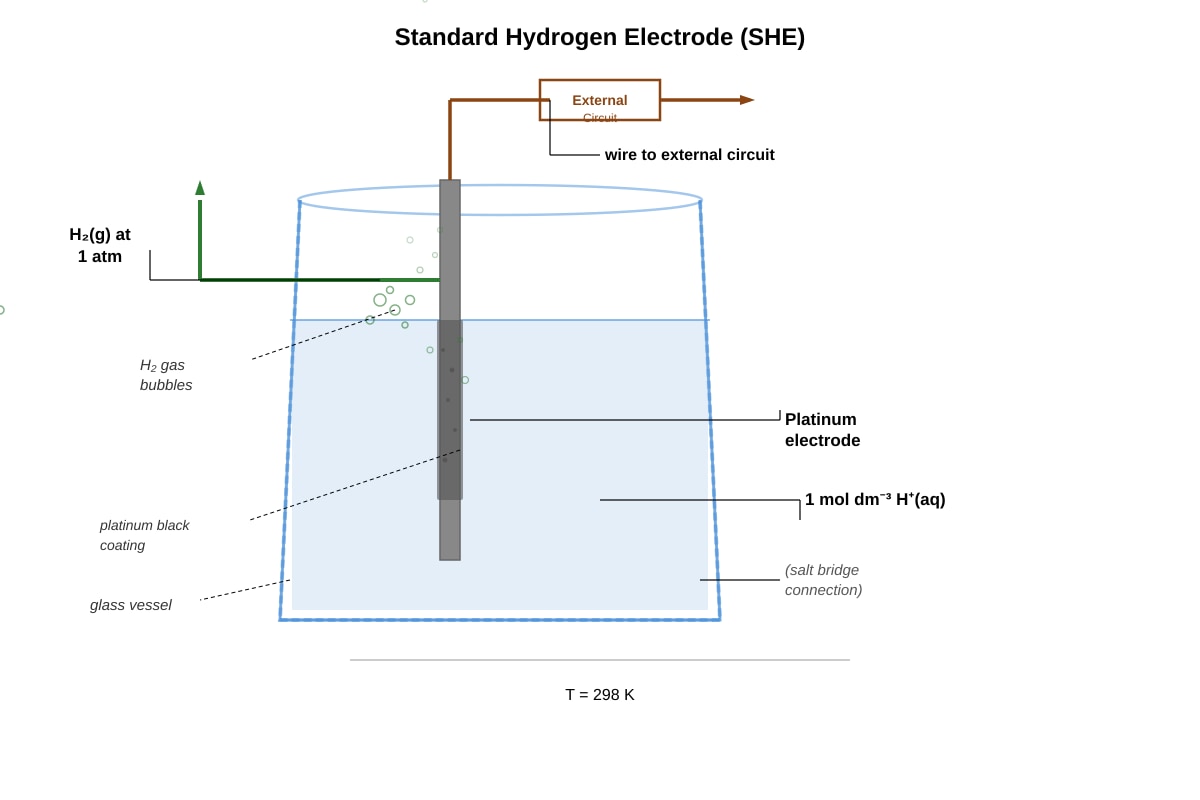
Generated diagram for Q11.
- Marking note: Award 1 mark for the platinum electrode, 1 mark for the H₂(g) at 1 atm, 1 mark for the 1 mol dm⁻³ H⁺(aq) and the external circuit.
12. (a) Nernst equation: or [1]
(b) Calculation of electrode potential: [4]
- For the half-cell: , .
- Using the Nernst equation at 298 K: V
- Marking note: Award 1 mark for correct Nernst equation, 1 mark for correct substitution of n and concentration, 1 mark for correct calculation of the log term, 1 mark for the final answer with units.
13. (a) Electrolytic cell: A cell in which electrical energy is used to drive a non-spontaneous redox reaction. [1]
(b) Products of electrolysis of molten NaCl: [4]
- Anode (oxidation): Chlorine gas (). Half-equation: [2]
- Cathode (reduction): Sodium metal (). Half-equation: [2]
- Marking note: Award 1 mark for each correct product and 1 mark for each correct half-equation.
14. (a) Faraday's first law: The mass of a substance liberated during electrolysis is directly proportional to the quantity of electricity passed through the electrolyte. [1]
(b) Calculation of mass of copper deposited: [4]
- Quantity of electricity (Q):
- Moles of electrons:
- Half-reaction:
- Moles of Cu:
- Mass of Cu:
- Marking note: Award 1 mark for calculating Q, 1 mark for calculating moles of electrons, 1 mark for the stoichiometric ratio, 1 mark for the final mass.
15. (a) Primary vs secondary cell: [2]
- A primary cell is a cell that cannot be recharged; the redox reaction is irreversible.
- A secondary cell is a cell that can be recharged by passing a current in the opposite direction; the redox reaction is reversible.
(b) Examples: [2]
- Primary cell: Zinc-carbon (Leclanché) cell, alkaline battery.
- Secondary cell: Lead-acid battery, nickel-cadmium (NiCd) battery, lithium-ion battery.
- Marking note: Award 1 mark for each correct example.
(c) Advantage of a fuel cell: Fuel cells have a higher efficiency and produce less pollution (e.g., only water is produced in a hydrogen-oxygen fuel cell) compared to conventional batteries. [1]
Section C: Extended-Response Questions (Questions 16–20, 20 marks)
16. (a) Construction of the galvanic cell: [4]
- To produce the highest cell potential, we need the largest difference between the cathode and anode potentials. The most positive potential is (+0.80 V) and the most negative is (-2.37 V).
- Anode: Magnesium electrode immersed in 1.0 mol dm⁻³ solution.
- Cathode: Silver electrode immersed in 1.0 mol dm⁻³ solution.
- Salt bridge: Contains an inert electrolyte (e.g., KNO₃) to maintain electrical neutrality.
- External circuit: A wire connecting the two electrodes, with a voltmeter to measure the cell potential.
- Marking note: Award 1 mark for correct choice of electrodes, 1 mark for correct electrolytes, 1 mark for the salt bridge, 1 mark for the external circuit/voltmeter.
(b) Calculation of : [2] V
- Marking note: Award 1 mark for correct substitution, 1 mark for the correct answer.
(c) Overall cell reaction: [1]
- Explanation: Balance the electrons: Mg loses 2e⁻, each Ag⁺ gains 1e⁻, so 2 Ag⁺ are needed.
(d) Effect of increasing anode electrolyte concentration: [3]
- The anode half-reaction is .
- According to the Nernst equation, .
- Increasing makes the log term more positive, which makes the electrode potential of the anode more positive (less negative).
- Since , a more positive anode potential will decrease the overall cell potential.
- Marking note: Award 1 mark for the correct Nernst equation, 1 mark for the qualitative effect on anode potential, 1 mark for the effect on cell potential.
17. (a) Standard conditions: [2]
- All solutions at a concentration of 1.0 mol dm⁻³.
- All gases at a pressure of 1 atm (101 kPa).
- A temperature of 298 K (25 °C).
- Marking note: Award 1 mark for concentration and pressure, 1 mark for temperature.
(b) Why SHE is used as a reference: [2]
- The SHE has a defined potential of exactly 0.00 V under standard conditions.
- It provides a consistent and reproducible reference point against which all other electrode potentials can be measured.
- Marking note: Award 1 mark for the defined 0.00 V, 1 mark for the reproducibility/reference point.
(c) Calculation of cell potential and electron flow: [4]
- Cathode (reduction): , V
- Anode (oxidation): , V
- V
- Electron flow: Electrons flow from the anode (copper electrode) to the cathode (silver electrode) through the external circuit.
- Marking note: Award 1 mark for identifying the cathode and anode, 1 mark for the correct calculation, 1 mark for the direction of electron flow, 1 mark for the correct answer.
(d) Effect of increasing concentration: [2]
- The cathode half-reaction is .
- According to the Nernst equation, .
- Increasing makes the log term more positive, which makes the cathode potential more positive.
- Since , a more positive cathode potential will increase the overall cell potential.
- Marking note: Award 1 mark for the correct Nernst equation, 1 mark for the qualitative effect on cell potential.
18. (a) Electrolysis: The decomposition of a compound in the molten or aqueous state by passing an electric current through it, resulting in a chemical change. [1]
(b) Products of electrolysis of aqueous : [4]
- Cathode (reduction): Hydrogen gas (). Half-equation: [2]
- Anode (oxidation): Oxygen gas (). Half-equation: [2]
- **Explanation
<stage5_quiz_answers_md>
A-Level Chemistry H3 Quiz - Redox Electrochemistry - ANSWERS
Total Marks: 60
Section A: Multiple-Choice Questions (Questions 1–5, 10 marks)
1. C) [2] 2. A) +7 and +2 [2] 3. C) Maintain electrical neutrality in the half-cells by allowing ion migration. [2] 4. B) It consists of hydrogen gas at 1 atm bubbled over a platinum electrode in a solution of 1 mol dm⁻³ H⁺(aq). [2] 5. B) -0.34 V [2]
Section B: Short-Answer Questions (Questions 6–15, 30 marks)
6. (a) The standard electrode potential, , is the potential difference (or electromotive force) of a half-cell under standard conditions measured against the standard hydrogen electrode. [2] (b) Standard conditions are: 298 K (25°C), 1 mol dm⁻³ concentration of all aqueous solutions, and 1 atm (100 kPa) pressure for any gases involved. [2] [4]
7. (a) Anode: Nickel (Ni) (since it has the more negative , it is more likely to be oxidised). Cathode: Silver (Ag). [2] (b) [1] (c) V [2] [5]
8. (a) [3] (b) Oxidation state of Cr in is +6. Oxidation state of S in is +4. [2] [5]
9. (a) Anode (oxidation): [1] (b) Cathode (reduction): [1] (c) [1] (d) V. Since is positive, the reaction is spontaneous. [2] [5]
10. (a) Disproportionation is a redox reaction in which the same species is both oxidised and reduced. [1] (b) For the disproportionation of : . The for the reduction of to is +0.52 V. The for the oxidation of to is the negative of the reduction potential for , which is -0.15 V. The overall for the disproportionation reaction is V. Since this is positive, the disproportionation is spontaneous, meaning is unstable in aqueous solution. [4] [5]
11. (a) A platinum electrode provides an inert surface for the transfer of electrons between the electrode and the species in solution. [1] (b) Platinum is used because it is chemically inert (does not react with the solution) and is a good conductor of electricity. [1] (c) A labelled diagram of a standard hydrogen electrode should include: a platinum electrode coated with platinum black, a 1 mol dm⁻³ H⁺(aq) solution, hydrogen gas at 1 atm bubbled over the electrode, and a temperature of 298 K. [3] [5]
12. (a) or at 298 K. [1] (b) V [4] [5]
13. (a) An electrolytic cell is a cell that uses electrical energy to drive a non-spontaneous chemical reaction. [1] (b) Anode (oxidation): (Chlorine gas is produced). Cathode (reduction): (Sodium metal is produced). [4] [5]
14. (a) The mass of a substance liberated during electrolysis is directly proportional to the quantity of electricity passed. [1] (b) Quantity of electricity (Q) = I × t = 2.50 A × (30.0 × 60) s = 2.50 × 1800 = 4500 C. Moles of electrons = Q / F = 4500 / 96500 = 0.04663 mol. Half-reaction: . Moles of Cu = 0.04663 / 2 = 0.02332 mol. Mass of Cu = 0.02332 × 63.5 = 1.48 g. [4] [5]
15. (a) A primary cell is a non-rechargeable cell where the chemical reaction is irreversible. A secondary cell is a rechargeable cell where the chemical reaction can be reversed by applying an external voltage. [2] (b) Primary cell example: Zinc-carbon cell (or alkaline cell). Secondary cell example: Lead-acid battery (or lithium-ion battery). [2] (c) Fuel cells have a higher efficiency than conventional batteries (or they produce electricity continuously as long as fuel is supplied, or they are more environmentally friendly). [1] [5]
Section C: Extended-Response Questions (Questions 16–20, 20 marks)
16. (a) To produce the highest cell potential, choose the most negative for the anode (Mg) and the most positive for the cathode (Ag). Diagram: Mg(s) | Mg²⁺(aq, 1 M) || Ag⁺(aq, 1 M) | Ag(s). Justification: Mg has the greatest tendency to be oxidised, and Ag⁺ has the greatest tendency to be reduced. [4] (b) V [2] (c) [1] (d) If the concentration of the anode electrolyte (Mg²⁺) is increased, the cell potential would decrease. According to the Nernst equation, . Increasing [Mg²⁺] increases the value of the log term, which is subtracted from , thus decreasing the cell potential. [3] [10]
17. (a) Standard conditions: 298 K (25°C), 1 mol dm⁻³ concentration for all solutions, 1 atm (100 kPa) pressure for gases. [2] (b) The SHE is used as a reference because its electrode potential is defined as exactly 0 V under standard conditions, and it is reproducible. [2] (c) V. Electrons flow from the copper electrode (anode) to the silver electrode (cathode) in the external circuit. [4] (d) If the concentration of Ag⁺ is increased, the cell potential would increase. According to the Nernst equation, . Increasing [Ag⁺] decreases the value of the log term (since it's in the denominator), which is subtracted from , thus increasing the cell potential. [2] [10]
18. (a) Electrolysis is the decomposition of a compound using electricity. [1] (b) Anode (oxidation): (Oxygen gas is produced). Cathode (reduction): (Hydrogen gas is produced). [4] (c) The concentration of sodium sulfate remains constant because the water is being electrolysed, not the sodium sulfate. The Na⁺ and SO₄²⁻ ions are spectators and are not discharged. [2] (d) Moles of electrons = Q / F = (1.93 × 1000) / 96500 = 0.02 mol. From the half-equation at the anode, 4 moles of electrons produce 1 mole of O₂. Moles of O₂ = 0.02 / 4 = 0.005 mol. Volume of O₂ at r.t.p. = 0.005 × 24.0 = 0.12 dm³. [3] [10]
19. (a) The function of a salt bridge is to maintain electrical neutrality in the half-cells by allowing the migration of ions. [1] (b) An inert electrode like platinum is necessary for the Fe³⁺/Fe²⁺ half-cell because both species are in solution and there is no solid metal to conduct electrons. Platinum provides a surface for electron transfer. [2] (c) . For the cell: , the overall reaction is . V. . V. [7] [10]
20. (a) The standard cell potential, , is the potential difference between two electrodes under standard conditions. [1] (b) V. [2] (c) The reaction is spontaneous because is positive. [1] (d) The cell potential would decrease as the cell discharges because the concentration of Zn²⁺ increases and the concentration of Cu²⁺ decreases. According to the Nernst equation, . As the ratio increases, the log term increases, and the cell potential decreases. [3] (e) The cell would stop producing electricity when the cell potential reaches 0 V. At this point, the system is at equilibrium, and the concentrations of Zn²⁺ and Cu²⁺ are such that the Nernst equation gives . [3] [10]