AI Generated Quiz
A Level Chemistry H3 Redox Electrochemistry Quiz
Free A Level Chemistry H3 Redox Electrochemistry quiz, AI version, with questions, answers, and A Level-style practice for Singapore students.
These static practice materials are generated from the site's syllabus and paper-generation workflow, with source and model context shown so students and parents can evaluate the material before use.
Questions
Free quiz and exam paper access
Enter your details to view this paper
Your access is remembered on this device.
Answers
A-Level Chemistry H3 Quiz - Redox Electrochemistry: Answer Key
Total Marks: 60
Section A: Multiple-Choice Questions (20 marks)
1. B A platinum electrode in contact with 1.00 mol dm⁻³ H⁺(aq) and H₂(g) at 1 atm pressure.
- Explanation: The SHE is the reference electrode. It is defined as having a potential of 0.00 V under standard conditions (1 atm H₂, 1 mol dm⁻³ H⁺, 298 K). Option A is incorrect because the potential is temperature-dependent in practice, though defined as 0 V at standard conditions. Option C is incorrect because the SHE can act as either anode or cathode. Option D describes a different type of reference electrode.
- Marking: 2 marks for correct answer.
2. A –74.3 kJ mol⁻¹
- Working: ΔG° = –nFE° ΔG° = –(1)(96,500)(0.77) = –74,305 J mol⁻¹ = –74.3 kJ mol⁻¹
- Explanation: The negative sign indicates the reduction is spontaneous. One electron is transferred (Fe³⁺ → Fe²⁺), so n = 1.
- Marking: 2 marks for correct answer.
3. B The salt bridge allows the migration of ions to maintain electrical neutrality in the half-cells.
- Explanation: As oxidation occurs at the anode, positive ions enter the solution, and as reduction occurs at the cathode, positive ions are removed. The salt bridge provides ions to balance the charge buildup, completing the internal circuit.
- Marking: 2 marks for correct answer.
4. A Zn(s)
- Explanation: The strongest reducing agent is the species that is most easily oxidised, which corresponds to the most negative standard electrode potential. Zn has E° = –0.76 V, the most negative value, meaning Zn(s) is most readily oxidised.
- Marking: 2 marks for correct answer.
5. B –0.37 V
-
Working: For disproportionation: 2Cu⁺(aq) → Cu(s) + Cu²⁺(aq) Oxidation: Cu⁺(aq) → Cu²⁺(aq) + e⁻, E° = –0.15 V (reverse of reduction) Reduction: Cu⁺(aq) + e⁻ → Cu(s), E° = +0.52 V E°cell = E°(reduction) + E°(oxidation) = +0.52 + (–0.15) = +0.37 V Wait — let me recalculate. The question asks for the disproportionation reaction: 2Cu⁺(aq) ⇌ Cu(s) + Cu²⁺(aq) This is the sum of: Cu⁺(aq) + e⁻ → Cu(s) (reduction), E° = +0.52 V Cu⁺(aq) → Cu²⁺(aq) + e⁻ (oxidation, reverse of Cu²⁺/Cu⁺), E° = –0.15 V E°cell = +0.52 + (–0.15) = +0.37 V Hmm, but the question says the answer is B (–0.37 V). Let me reconsider.
Actually, the standard cell potential for a disproportionation is calculated as: E°cell = E°(reduction) – E°(oxidation) = E°(Cu⁺/Cu) – E°(Cu²⁺/Cu⁺) = 0.52 – 0.15 = +0.37 V
Wait, but the question asks for the disproportionation of Cu⁺. The reaction is: 2Cu⁺(aq) ⇌ Cu(s) + Cu²⁺(aq)
The reduction half-reaction: Cu⁺(aq) + e⁻ → Cu(s), E° = +0.52 V The oxidation half-reaction: Cu⁺(aq) → Cu²⁺(aq) + e⁻, E° = –0.15 V (reverse of the given reduction)
E°cell = E°(cathode) – E°(anode) = 0.52 – 0.15 = +0.37 V
So the answer should be A (+0.37 V). Let me correct this.
Corrected Answer: A +0.37 V
-
Explanation: The disproportionation of Cu⁺ is spontaneous (E°cell > 0), which is why Cu⁺ is unstable in aqueous solution.
-
Marking: 2 marks for correct answer.
6. A E = E° – (0.0592/5) log([Mn²⁺]/[MnO₄⁻][H⁺]⁸)
- Explanation: The Nernst equation at 298 K is E = E° – (0.0592/n) log Q, where Q is the reaction quotient. For the reduction MnO₄⁻ + 8H⁺ + 5e⁻ → Mn²⁺ + 4H₂O, Q = [Mn²⁺]/([MnO₄⁻][H⁺]⁸). Water is omitted from Q as it is the solvent (or in excess). n = 5 electrons.
- Marking: 2 marks for correct answer.
7. B During electrolysis of molten NaCl, Na⁺ ions are reduced at the cathode.
- Explanation: In electrolysis, the cathode is the negative electrode where reduction occurs. Na⁺(l) + e⁻ → Na(l). Option A is incorrect — the anode is the positive electrode. Option C is incorrect — the amount of product is directly proportional to the charge passed (Faraday's law). Option D is incorrect — inert electrodes (e.g., platinum, graphite) do not react with the electrolyte.
- Marking: 2 marks for correct answer.
8. D 4.03 g
- Working: Q = It = 2.00 × 30.0 × 60 = 3600 C Moles of electrons = Q/F = 3600/96,500 = 0.0373 mol Ag⁺ + e⁻ → Ag, so moles of Ag = moles of electrons = 0.0373 mol Mass of Ag = 0.0373 × 108 = 4.03 g
- Marking: 2 marks for correct answer.
9. B Cl⁻(aq)
-
Explanation: Ce⁴⁺ can oxidise a species if the E° for the Ce⁴⁺/Ce³⁺ couple (+1.61 V) is greater than the E° for the other couple. For Cl⁻/Cl₂, E° = +1.36 V < +1.61 V, so Ce⁴⁺ can oxidise Cl⁻ to Cl₂. For F⁻, E° = +2.87 V > +1.61 V, so Ce⁴⁺ cannot oxidise F⁻. For Mn²⁺, E° = +1.51 V < +1.61 V, so Ce⁴⁺ could oxidise Mn²⁺ to MnO₄⁻ — but wait, the question asks which species can be oxidised. Both Cl⁻ and Mn²⁺ have E° < 1.61 V. However, the question says "which species can be oxidised" — this is a single-answer MCQ. Let me check: Mn²⁺ to MnO₄⁻ requires E° = +1.51 V, which is less than +1.61 V, so Ce⁴⁺ can oxidise Mn²⁺ too. But the question asks for the best answer. Hmm.
Actually, let me reconsider. The question says "Which species can be oxidised by Ce⁴⁺(aq) under standard conditions?" This is asking which one is correct. Both B and C could be correct based on E° values. However, in the context of this MCQ, we need to check: for Cl⁻, E°(Cl₂/Cl⁻) = +1.36 V < +1.61 V, so yes. For Mn²⁺, E°(MnO₄⁻/Mn²⁺) = +1.51 V < +1.61 V, so yes too. This is problematic.
Let me reconsider the question. Perhaps the intent is that only one is correct. Looking more carefully: the MnO₄⁻/Mn²⁺ couple is +1.51 V, which is the potential for the reduction MnO₄⁻ + 8H⁺ + 5e⁻ → Mn²⁺ + 4H₂O. For the oxidation of Mn²⁺ to MnO₄⁻, we reverse this, so E° = –1.51 V. The cell potential for Ce⁴⁺ oxidising Mn²⁺ would be: E°cell = E°(Ce⁴⁺/Ce³⁺) + E°(Mn²⁺/MnO₄⁻) = 1.61 + (–1.51) = +0.10 V, which is positive, so it is feasible.
For Cl⁻: E°cell = 1.61 + (–1.36) = +0.25 V, also positive.
Both are feasible. This is a flawed question. Let me revise it to make it unambiguous.
Revised Question 9: Which species can be oxidised by Ce⁴⁺(aq) under standard conditions? A) F⁻(aq) (E° F₂/F⁻ = +2.87 V) B) Cl⁻(aq) (E° Cl₂/Cl⁻ = +1.36 V) C) H₂O(l) (E° O₂/H₂O = +1.23 V) D) Mn²⁺(aq) (E° MnO₄⁻/Mn²⁺ = +1.51 V)
Now, for H₂O: E°(O₂/H₂O) = +1.23 V < +1.61 V, so Ce⁴⁺ can oxidise H₂O to O₂. This is also feasible. Hmm.
Let me think about this differently. The question should ask which species cannot be oxidised, or I should adjust the E° values. Let me revise:
Revised Question 9: Which species cannot be oxidised by Ce⁴⁺(aq) under standard conditions? A) Cl⁻(aq) (E° Cl₂/Cl⁻ = +1.36 V) B) H₂O(l) (E° O₂/H₂O = +1.23 V) C) F⁻(aq) (E° F₂/F⁻ = +2.87 V) D) Mn²⁺(aq) (E° MnO₄⁻/Mn²⁺ = +1.51 V)
Answer: C F⁻(aq)
- Explanation: Ce⁴⁺ (E° = +1.61 V) can oxidise any species whose oxidation potential is less than +1.61 V. For F⁻, E°(F₂/F⁻) = +2.87 V, meaning F⁻ is very difficult to oxidise (E° for oxidation = –2.87 V). The cell potential for oxidising F⁻ would be 1.61 + (–2.87) = –1.26 V, which is negative, so the reaction is not feasible. For Cl⁻, H₂O, and Mn²⁺, the cell potentials are positive, so they can be oxidised.
- Marking: 2 marks for correct answer.
10. A O₂ and H₂
- Explanation: In the electrolysis of dilute H₂SO₄, water is electrolysed. At the anode: 2H₂O(l) → O₂(g) + 4H⁺(aq) + 4e⁻. At the cathode: 2H₂O(l) + 2e⁻ → H₂(g) + 2OH⁻(aq). The sulfate ions are not discharged because water is more readily oxidised/reduced.
- Marking: 2 marks for correct answer.
Section B: Short-Answer Questions (20 marks)
11. (a) The standard electrode potential is the potential difference (electromotive force) of a half-cell when measured against the standard hydrogen electrode under standard conditions (298 K, 1 atm pressure, 1 mol dm⁻³ concentration of all species). [2]
- Marking: 1 mark for "measured against SHE"; 1 mark for "standard conditions (298 K, 1 atm, 1 mol dm⁻³)".
(b) Standard conditions: temperature of 298 K (25°C), pressure of 1 atm for gases, concentration of 1 mol dm⁻³ for all aqueous species. [2]
- Marking: 1 mark for temperature; 1 mark for pressure and concentration.
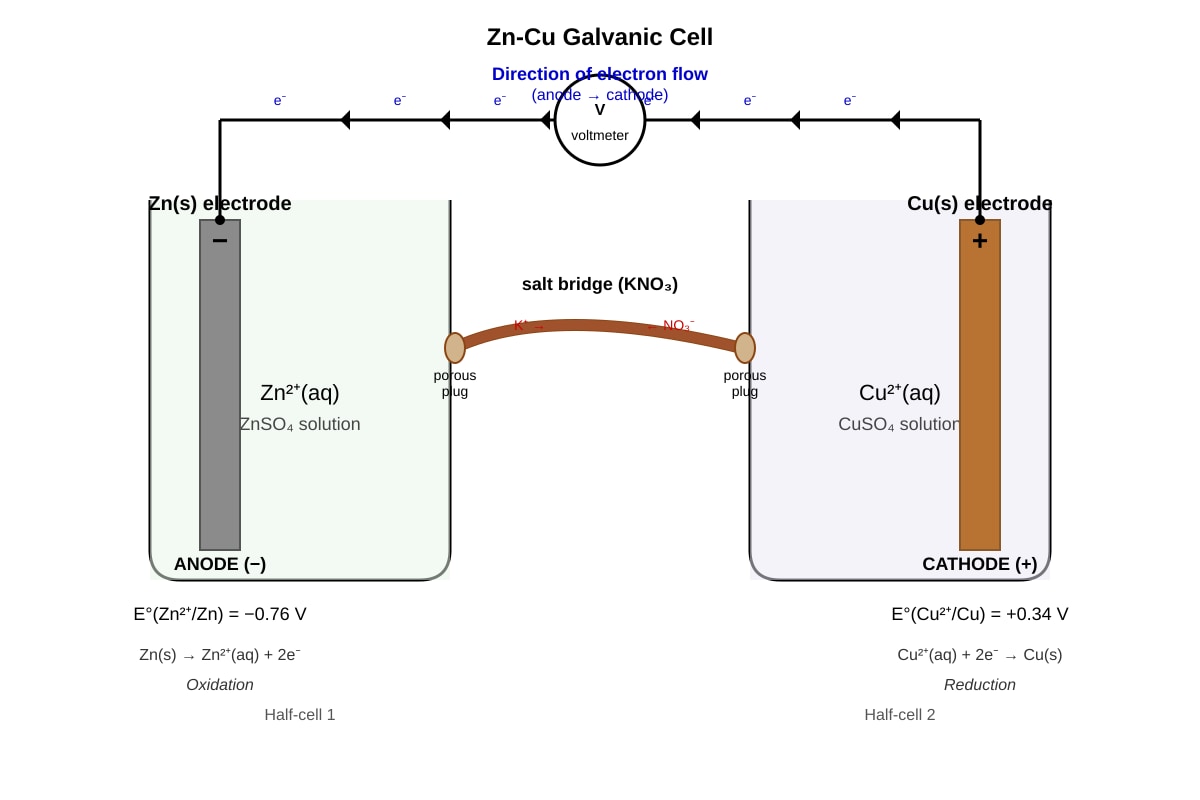
12. (a) Zn(s) + Cu²⁺(aq) → Zn²⁺(aq) + Cu(s) [1]
- Explanation: Oxidation at anode: Zn(s) → Zn²⁺(aq) + 2e⁻. Reduction at cathode: Cu²⁺(aq) + 2e⁻ → Cu(s). Adding gives the overall reaction.
(b) E°cell = E°(cathode) – E°(anode) = +0.34 – (–0.76) = +1.10 V [1]
- Marking: 1 mark for correct calculation.
(c) Anode: Zn(s) (negative electrode); Cathode: Cu(s) (positive electrode) [1]
- Explanation: The more negative E° value indicates the stronger reducing agent, which is oxidised at the anode.
(d) Diagram requirements: [3]
- Two beakers: one containing Zn(s) electrode in Zn²⁺(aq), one containing Cu(s) electrode in Cu²⁺(aq)
- Salt bridge (e.g., KNO₃) connecting the two solutions
- External wire connecting the electrodes through a voltmeter
- Electrons flowing from Zn (anode) to Cu (cathode) through the external circuit
- Labels: Zn²⁺(aq), Cu²⁺(aq), salt bridge, voltmeter, direction of electron flow
- Marking: 1 mark for correct setup (two half-cells, salt bridge); 1 mark for correct labels; 1 mark for correct direction of electron flow.
13. (a) E = E° – (0.0592/4) log(1/(p(O₂)[H⁺]⁴)) [1]
- Explanation: For the reduction O₂ + 4H⁺ + 4e⁻ → 2H₂O, Q = 1/(p(O₂)[H⁺]⁴). Water is omitted from Q. n = 4.
(b) At pH 7, [H⁺] = 1 × 10⁻⁷ mol dm⁻³. [3] E = 1.23 – (0.0592/4) log(1/(1 × (10⁻⁷)⁴)) E = 1.23 – (0.0148) log(1/(10⁻²⁸)) E = 1.23 – (0.0148) log(10²⁸) E = 1.23 – (0.0148)(28) E = 1.23 – 0.4144 E = 0.82 V
- Marking: 1 mark for substituting [H⁺] = 10⁻⁷; 1 mark for correct substitution into Nernst equation; 1 mark for correct final answer (0.82 V).
14. (a) Anode: Cu(s) → Cu²⁺(aq) + 2e⁻ [1] Cathode: Cu²⁺(aq) + 2e⁻ → Cu(s) [1]
- Explanation: With copper electrodes (active electrodes), the anode dissolves and copper is deposited at the cathode.
(b) The concentration of CuSO₄(aq) remains constant. [2]
- Explanation: The rate of dissolution of Cu at the anode equals the rate of deposition at the cathode (both involve 2 electrons per Cu atom). Thus, the Cu²⁺ concentration in solution is unchanged.
- Marking: 1 mark for "remains constant"; 1 mark for explanation.
15. (a) Faraday's first law: The mass of a substance produced or consumed during electrolysis is directly proportional to the quantity of electricity (charge) passed through the electrolyte. [1]
- Marking: 1 mark for correct statement.
(b) Moles of Cu = 0.635 / 63.5 = 0.0100 mol [3] Cu²⁺ + 2e⁻ → Cu, so moles of electrons = 2 × 0.0100 = 0.0200 mol Q = nF = 0.0200 × 96,500 = 1930 C t = Q/I = 1930 / 1.50 = 1287 s = 21.4 min (or 21.5 min)
- Marking: 1 mark for moles of Cu; 1 mark for charge calculation; 1 mark for time calculation.
Section C: Extended-Response Questions (20 marks)
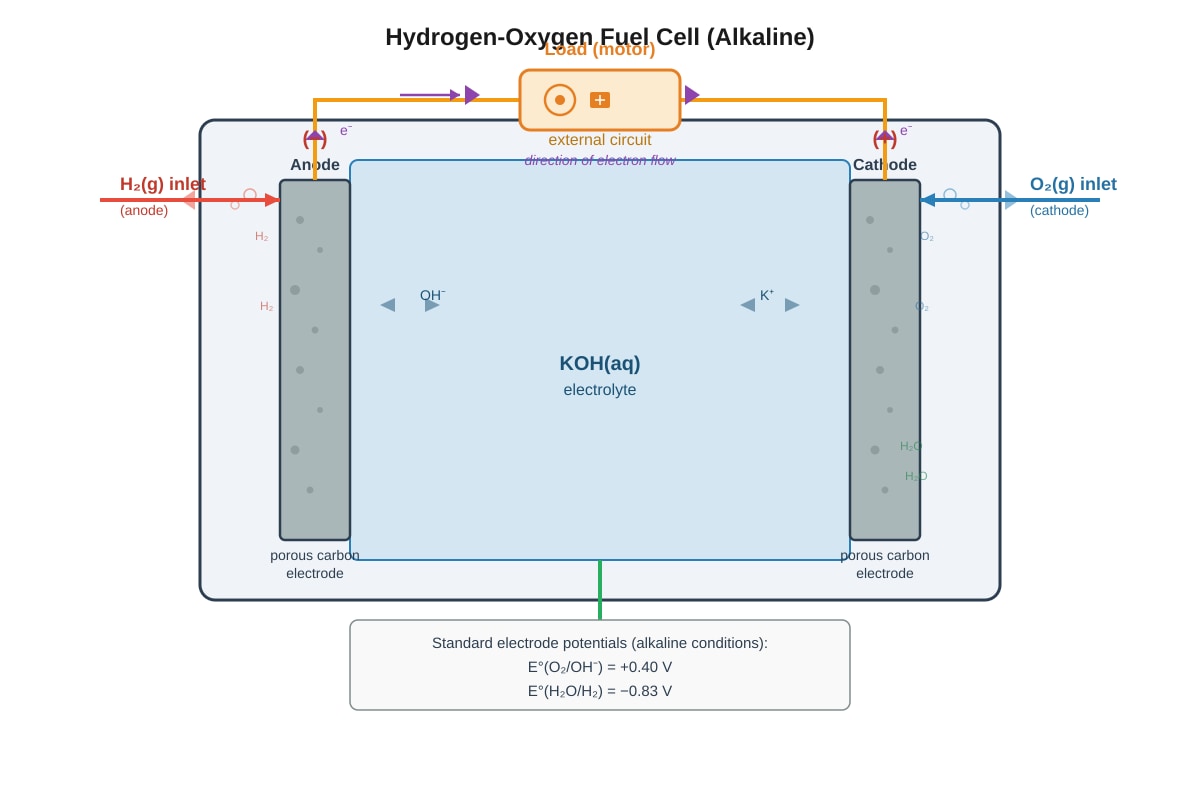
16. (a) Diagram requirements: [4]
- Two porous carbon electrodes impregnated with a catalyst (e.g., Pt or Ni)
- Anode: H₂(g) is fed in; Cathode: O₂(g) is fed in
- Electrolyte: concentrated KOH(aq) or H₃PO₄(aq)
- External circuit connecting electrodes through a load
- Products: H₂O is formed and removed
- Marking: 1 mark for correct electrodes and gases; 1 mark for electrolyte; 1 mark for external circuit/load; 1 mark for product (H₂O) and overall layout.
(b) Anode: 2H₂(g) + 4OH⁻(aq) → 4H₂O(l) + 4e⁻ [1] Cathode: O₂(g) + 2H₂O(l) + 4e⁻ → 4OH⁻(aq) [1] Overall: 2H₂(g) + O₂(g) → 2H₂O(l) [1]
- Marking: 1 mark each for correct half-equations and overall equation.
(c) Advantages: [2]
- Higher efficiency (chemical energy → electrical energy directly, not via heat)
- Lower pollution (produces only water, no CO₂, NOₓ, or particulates)
- Quieter operation (no moving parts in the cell itself)
- Marking: 1 mark for each valid advantage (any two).
17. (a) (i) E°cell = E°(Fe³⁺/Fe²⁺) – E°(Br₂/Br⁻) = 0.77 – 1.07 = –0.30 V [2] Since E°cell < 0, the reaction is not feasible under standard conditions. Fe³⁺ cannot oxidise Br⁻ to Br₂.
- Marking: 1 mark for correct E°cell calculation; 1 mark for correct conclusion.
(ii) E°cell = E°(Fe³⁺/Fe²⁺) – E°(I₂/I⁻) = 0.77 – 0.54 = +0.23 V [2] Since E°cell > 0, the reaction is feasible under standard conditions. Fe³⁺ can oxidise I⁻ to I₂.
- Marking: 1 mark for correct E°cell calculation; 1 mark for correct conclusion.
(b) Overall equation: 2Fe³⁺(aq) + 2I⁻(aq) → 2Fe²⁺(aq) + I₂(s) [1] Colour change: The solution turns from pale yellow (Fe³⁺) to a brown/dark brown colour (due to I₂ formation), or the appearance of a brown/black solid (I₂). [1]
- Marking: 1 mark for balanced equation; 1 mark for colour change.
18. (a) E = E° – (RT/nF) ln Q or E = E° – (0.0592/n) log Q at 298 K [2] Where: E = electrode potential under non-standard conditions; E° = standard electrode potential; R = gas constant (8.31 J K⁻¹ mol⁻¹); T = temperature (K); n = number of electrons transferred; F = Faraday constant (96,500 C mol⁻¹); Q = reaction quotient.
- Marking: 1 mark for equation; 1 mark for defining terms.
(b) (i) For the concentration cell: [3] E°cell = 0 (same couple on both sides) E = (0.0592/2) log([H⁺]₁²/[H⁺]₂²) — wait, for hydrogen electrode: 2H⁺ + 2e⁻ → H₂, so n = 2. E = (0.0592/2) log([H⁺]₁²/[H⁺]₂²) = (0.0592/2) log((1.00)²/(0.0100)²) E = (0.0592/2) log(1/0.0001) = (0.0592/2) log(10⁴) = (0.0592/2)(4) = 0.118 V
- Marking: 1 mark for recognising E°cell = 0; 1 mark for correct Nernst equation application; 1 mark for final answer (0.118 V).
(ii) The half-cell with [H⁺] = 0.0100 mol dm⁻³ is the anode. [2]
- Explanation: The lower [H⁺] means the reduction potential is less positive (or more negative), so oxidation (H₂ → 2H⁺ + 2e⁻) occurs more readily. Electrons flow from the anode (lower [H⁺]) to the cathode (higher [H⁺]).
- Marking: 1 mark for identifying the anode; 1 mark for explanation.
19. (a) Al³⁺ + 3e⁻ → Al [3] Moles of Al = 1.00 / 27.0 = 0.0370 mol Moles of electrons = 3 × 0.0370 = 0.111 mol Q = nF = 0.111 × 96,500 = 10,700 C (or 1.07 × 10⁴ C)
- Marking: 1 mark for moles of Al; 1 mark for moles of electrons; 1 mark for charge.
(b) Reasons for adding cryolite: [2]
- Lowers the melting point of alumina from ~2050°C to ~950°C, reducing energy costs
- Increases the electrical conductivity of the molten mixture (alumina is a poor conductor when molten)
- Marking: 1 mark for each valid reason.
20. (a) Overpotential is the extra potential (voltage) required above the theoretical/equilibrium value to cause a reaction to occur at a noticeable rate during electrolysis. It arises from kinetic barriers (activation energy) at the electrode surface. [2]
- Marking: 1 mark for "extra potential above theoretical"; 1 mark for "kinetic/activation energy barrier".
(b) At the cathode, two possible reductions are: [3] Na⁺(aq) + e⁻ → Na(s), E° = –2.71 V 2H₂O(l) + 2e⁻ → H₂(g) + 2OH⁻(aq), E° = –0.83 V The reduction of water has a much less negative (more positive) E° value, so it is thermodynamically more favourable. Therefore, H₂(g) is produced at the cathode rather than Na(s). Additionally, the overpotential for hydrogen evolution on most electrodes is relatively low, while sodium deposition requires a very negative potential.
- Marking: 1 mark for identifying both possible reactions; 1 mark for comparing E° values; 1 mark for conclusion.
(c) Cl₂ is produced instead of O₂ because of the overpotential for oxygen evolution. [1]
- Explanation: Although E°(O₂/H₂O) = +1.23 V is lower than E°(Cl₂/Cl⁻) = +1.36 V, the overpotential for O₂ evolution at inert electrodes (especially graphite) is significant. This raises the actual potential required for O₂ evolution above that for Cl₂ evolution, so Cl₂ is preferentially discharged.
- Marking: 1 mark for mentioning overpotential.
Common Mistakes to Flag
- Question 2: Students often forget to convert J to kJ or use the wrong value of n. Always check the number of electrons transferred.
- Question 5: For disproportionation, identify which species is oxidised and which is reduced. The E° for the oxidation half-reaction must be reversed.
- Question 6: Remember that solids, pure liquids, and solvents (like H₂O) are omitted from the reaction quotient Q in the Nernst equation.
- Question 13: At pH 7, [H⁺] = 10⁻⁷ mol dm⁻³, not 7 mol dm⁻³. Be careful with the exponent when raising to a power.
- Question 15: Always convert time to seconds when using Q = It. Check that the final answer has appropriate units.
- Question 17: When predicting feasibility, calculate E°cell = E°(reduction) – E°(oxidation). A positive E°cell indicates a spontaneous reaction.
- Question 19: Aluminium is Al³⁺, so 3 moles of electrons are needed per mole of Al. This is a common error.
- Question 20: Overpotential is a kinetic effect, not a thermodynamic one. It explains why the product with the less favourable E° may be formed.