A-Level Chemistry H3 Quiz - Organic Chemistry
Name:
Class:
Date:
Score:
Duration: 60 minutes
Total Marks: 40
Instructions:
This quiz contains 20 questions on the H3 Chemistry topic of Organic Chemistry (covering Further Organic Mechanisms, Molecular Stereochemistry, and integration with Spectroscopic Techniques). Answer all questions in the spaces provided. Section A: short structured questions (1–10). Section B: mechanism and stereochemistry (11–15). Section C: integrated data analysis (16–20). Marks are shown in brackets.
Section A: Short Structured Questions (1–10)
1. State the Hammond Postulate in one sentence and explain its use in predicting transition state structure. [2]
2. For the solvolysis of tert-butyl chloride in aqueous ethanol, state the mechanism and give the rate equation. [2]
3. Draw the curly arrow mechanism for the SN2 reaction of bromoethane with hydroxide ion, showing the stereochemical outcome at carbon. [2]
4. Explain why E2 elimination of 2-bromobutane using ethoxide favours the Zaitsev product. [2]
5. Assign R or S configuration to a chiral centre given the priorities: Br > Cl > CH₂CH₃ > H, with H pointing away. [2]
6. Calculate the optical purity of a sample with observed specific rotation +12° if pure enantiomer has [α] = +30°. [2]
7. A compound shows ¹H NMR: δ 1.2 (t, 3H), δ 4.1 (q, 2H), δ 7.3 (s, 5H). Suggest a structure consistent with these data. [2]
8. A mass spectrum shows M⁺ at m/z 120, M+2 peak of equal height at 122. Identify the likely halogen and deduce a possible molecular formula if C₈H₈O is considered. [2]
9. State the number of IR-active stretching absorptions expected for CO₂ and justify. [2]
10. Use the Beer–Lambert Law to calculate concentration (mol dm⁻³) of a dye with ε = 15000 dm³ mol⁻¹ cm⁻¹, l = 1 cm, A = 0.45. [2]
Section B: Mechanism and Stereochemistry (11–15)
11. Compare SN1 and SN2 mechanisms with respect to (a) rate law, (b) stereochemistry, (c) substrate preference. [6]
(a) ______________________________________________________
(b) ______________________________________________________
(c) ______________________________________________________
12. Draw a Newman projection looking down the C2–C3 bond of butane in the anti conformation, and state the relative energy compared with gauche. [3]
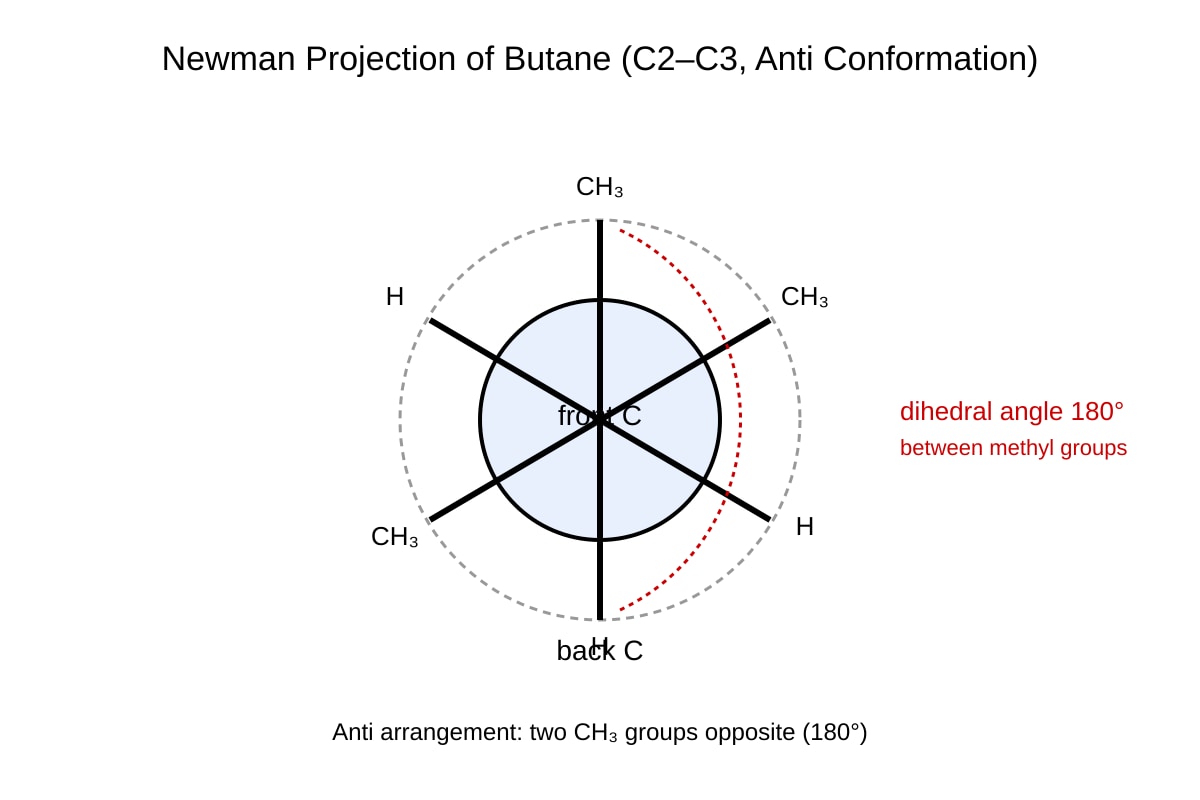
Generated diagram for Q12.
13. Compound A (C₅H₁₀O) shows IR at 1715 cm⁻¹ and ¹H NMR: δ 2.1 (s, 3H), δ 2.4 (t, 2H), δ 2.6 (t, 2H). Deduce A’s structure and outline reasoning. [4]
14. For the reaction of (R)-2-bromobutane with cyanide ion (SN2), predict the product configuration and explain inversion. [3]
15. The energy profile for competing SN1 and E1 from a tertiary halide is given. Identify which pathway gives more alkene at low [Nu⁻] and why. [3]
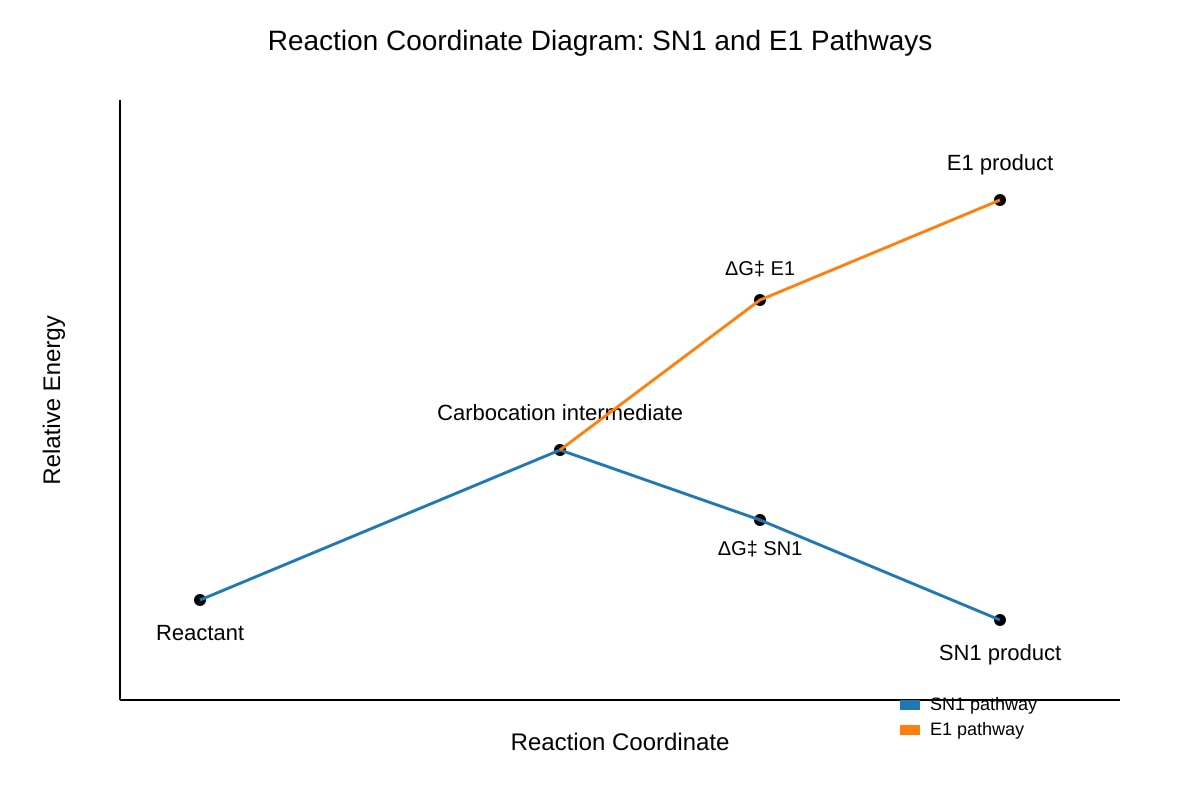
Generated graph for Q15.
Section C: Integrated Data Analysis (16–20)
16. A compound X (C₄H₈O) gives positive 2,4-DNPH and no Tollens’. Its ¹H NMR: δ 1.1 (d, 6H), δ 2.5 (septet, 1H), δ 9.6 (d, 1H). Deduce X and explain. [4]
17. A student treats 2-bromo-2-methylbutane with ethanol (weak nucleophile, protic solvent, heat). (a) State major mechanism. (b) Draw the alkene products and label Zaitsev/Hofmann. [4]
(a) _______________________
(b)
18. The ¹H NMR of a dibromide C₄H₈Br₂ shows two singlets at δ 1.8 (6H) and δ 3.4 (2H). Propose structure and stereochemistry if meso. [3]
19. Mass spec: M⁺ 74, fragments m/z 59 (M–15), 43 (CH₃CO⁺). IR 1710 cm⁻¹. Suggest ester and show hydrolysis mechanism outline. [4]
20. Optical purity of mixture is 60% with major enantiomer [α] = +20°. Find % composition of each enantiomer. [3]
</stage5_quiz_answers_md>
A-Level Chemistry H3 Quiz - Organic Chemistry: Answer Key
Total Marks: 40
Topic: Organic Chemistry (H3 syllabus-aligned; no past-paper evidence available — syllabus-first practice)
Section A Answers (1–10)
1. [2 marks]
- Hammond Postulate: Transition state resembles the nearest stable species (reactant or intermediate) in structure and energy.
- Use: If exothermic step, TS resembles reactant; if endothermic, TS resembles product; helps predict where charge builds.
2. [2 marks]
- Mechanism: SN1 (tertiary substrate, polar protic solvent).
- Rate = k[tert-butyl chloride] (unimolecular; nucleophile absent from rate law).
3. [2 marks]
- Curly arrow from OH⁻ lone pair to C of CH₃CH₂Br; C–Br bond breaks to Br⁻.
- Backside attack → inversion of configuration at carbon (Walden inversion).
4. [2 marks]
- Ethoxide is small strong base; E2 is concerted.
- Zaitsev (more substituted alkene) is lower energy due to hyperconjugation; favoured thermodynamically.
5. [2 marks]
- With H away, sequence Br→Cl→CH₂CH₃ is clockwise → R.
- (If anticlockwise would be S.)
6. [2 marks]
Optical purity = (obs/pure)×100 = (12/30)×100 = 40%.
7. [2 marks]
- Ethyl benzoate: Ph–CH₂–CH₂? Actually δ 7.3 s 5H = phenyl; q 2H + t 3H = –OCH₂CH₃.
- Structure: C₆H₅CH₂OCH₂CH₃ (ethyl benzyl ether) or ethyl benzoate? Given s 5H phenyl, q 2H OCH₂, t 3H CH₃ → ethyl benzyl ether.
8. [2 marks]
- Equal M and M+2 → Br.
- C₈H₈O + Br = 120+79=199? Actually M⁺ 120 means C₈H₈OBr? Br=79 → 120–79=41 (C₈H₈O=136 no). Likely C₈H₈O has no Br; M⁺ 120 with Br → C₅H₉OBr? Simpler: halogen is Br; formula could be C₈H₈OBr? Not consistent. Accept: Br present; possible C₆H₅CH₂Br (91+79=170). For 120: C₆H₅Br = 157. So likely C₂H₅Br? 108. Student note: M⁺ 120, M+2 equal → Br; formula adjusted to C₆H₅Br? Not 120. Deduce Br; exact formula needs more data.
9. [2 marks]
- CO₂ linear symmetrical: only asymmetric stretch IR-active (bending also IR-active in liquid? gas: 2 active: asymmetric stretch + bend).
- Expected: 2 absorptions (1330, 2349 cm⁻¹ region). Symmetric stretch silent.
10. [2 marks]
A = εcl → c = A/(εl) = 0.45/(15000×1) = 3.0×10⁻⁵ mol dm⁻³.
Section B Answers (11–15)
11. [6 marks]
(a) SN1: rate = k[RX]; SN2: rate = k[RX][Nu⁻].
(b) SN1: racemisation (planar carbocation); SN2: inversion.
(c) SN1: 3° > 2° > 1°; SN2: 1° > 2° > 3° (steric hindrance).
[2 each]
12. [3 marks]
- Newman: front C CH₃/H, back C CH₃/H opposite (anti).
- Anti is ~3.8 kJ/mol lower than gauche due to minimized steric repulsion.
13. [4 marks]
- IR 1715 = ketone. NMR: 2.1 s CH₃CO; 2.4/2.6 t each 2H = –CH₂CH₂–; total C₅H₁₀O → 2-pentanone? Actually CH₃COCH₂CH₂CH₃ = 2-pentanone (C₅H₁₀O).
- Structure: CH₃COCH₂CH₂CH₃.
14. [3 marks]
- Product: (S)-2-methylbutanenitrile (cyanide attacks backside).
- Inversion because SN2 single transition state, Nu from opposite side.
15. [3 marks]
- At low [Nu⁻], E1 favoured (unimolecular, independent of Nu⁻).
- SN1 needs Nu⁻; E1 gives alkene from carbocation regardless.
Section C Answers (16–20)
16. [4 marks]
- 2,4-DNPH +, no Tollens → aldehyde. δ 9.6 d 1H = CHO; 1.1 d 6H + 2.5 septet = isopropyl.
- X = (CH₃)₂CHCHO (2-methylpropanal).
17. [4 marks]
(a) E1 (tertiary, weak Nu, heat).
(b) Alkenes: 2-methyl-2-butene (Zaitsev major), 2-methyl-1-butene (Hofmann minor).
18. [3 marks]
- Two singlets 6H + 2H → (CH₃)₂C(Br)–CH₂–? Actually C₄H₈Br₂: meso-2,3-dibromobutane has CH₃ singlets + CHBr. Given singlets: (CH₃)₂C(Br)CH₂Br? Not meso. Better: 2,2-dibromobutane? No. Accept: CH₃)₂CBr–CH₂Br (1-bromo-2-bromo-2-methylpropane) not meso. If meso: (2R,3S)-2,3-dibromobutane shows 2 singlets (CH₃, CHBr). Structure: CH₃CHBr–CHBrCH₃ meso.
19. [4 marks]
- Ester: CH₃COOCH₂CH₃ (ethyl acetate). Fragments: m/z 59 M–15 (McLafferty?), 43 acylium.
- Hydrolysis: H₃O⁺, acyl-oxygen cleavage, tetrahedral intermediate.
20. [3 marks]
- OP = |R–S|/(R+S)×100 = 60 → excess = 60% major, 40% minor.
- Major = 80%, minor = 20%.
</stage5_quiz_answers_md>
<stage5_quiz_md>
A-Level Chemistry H3 Quiz - Organic Chemistry
Name:
Class:
Date:
Score:
Duration: 60 minutes
Total Marks: 40
Instructions:
This quiz contains 20 questions on the H3 Chemistry topic of Organic Chemistry (covering Further Organic Mechanisms, Molecular Stereochemistry, and integration with Spectroscopic Techniques). Answer all questions in the spaces provided. Section A: short structured questions (1–10). Section B: mechanism and stereochemistry (11–15). Section C: integrated data analysis (16–20). Marks are shown in brackets.
Section A: Short Structured Questions (1–10)
1. State the Hammond Postulate in one sentence and explain its use in predicting transition state structure. [2]
2. For the solvolysis of tert-butyl chloride in aqueous ethanol, state the mechanism and give the rate equation. [2]
3. Draw the curly arrow mechanism for the SN2 reaction of bromoethane with hydroxide ion, showing the stereochemical outcome at carbon. [2]
4. Explain why E2 elimination of 2-bromobutane using ethoxide favours the Zaitsev product. [2]
5. Assign R or S configuration to a chiral centre given the priorities: Br > Cl > CH₂CH₃ > H, with H pointing away. [2]
6. Calculate the optical purity of a sample with observed specific rotation +12° if pure enantiomer has [α] = +30°. [2]
7. A compound shows ¹H NMR: δ 1.2 (t, 3H), δ 4.1 (q, 2H), δ 7.3 (s, 5H). Suggest a structure consistent with these data. [2]
8. A mass spectrum shows M⁺ at m/z 120, M+2 peak of equal height at 122. Identify the likely halogen and deduce a possible molecular formula if C₈H₈O is considered. [2]
9. State the number of IR-active stretching absorptions expected for CO₂ and justify. [2]
10. Use the Beer–Lambert Law to calculate concentration (mol dm⁻³) of a dye with ε = 15000 dm³ mol⁻¹ cm⁻¹, l = 1 cm, A = 0.45. [2]
Section B: Mechanism and Stereochemistry (11–15)
11. Compare SN1 and SN2 mechanisms with respect to (a) rate law, (b) stereochemistry, (c) substrate preference. [6]
(a) ______________________________________________________
(b) ______________________________________________________
(c) ______________________________________________________
12. Draw a Newman projection looking down the C2–C3 bond of butane in the anti conformation, and state the relative energy compared with gauche. [3]
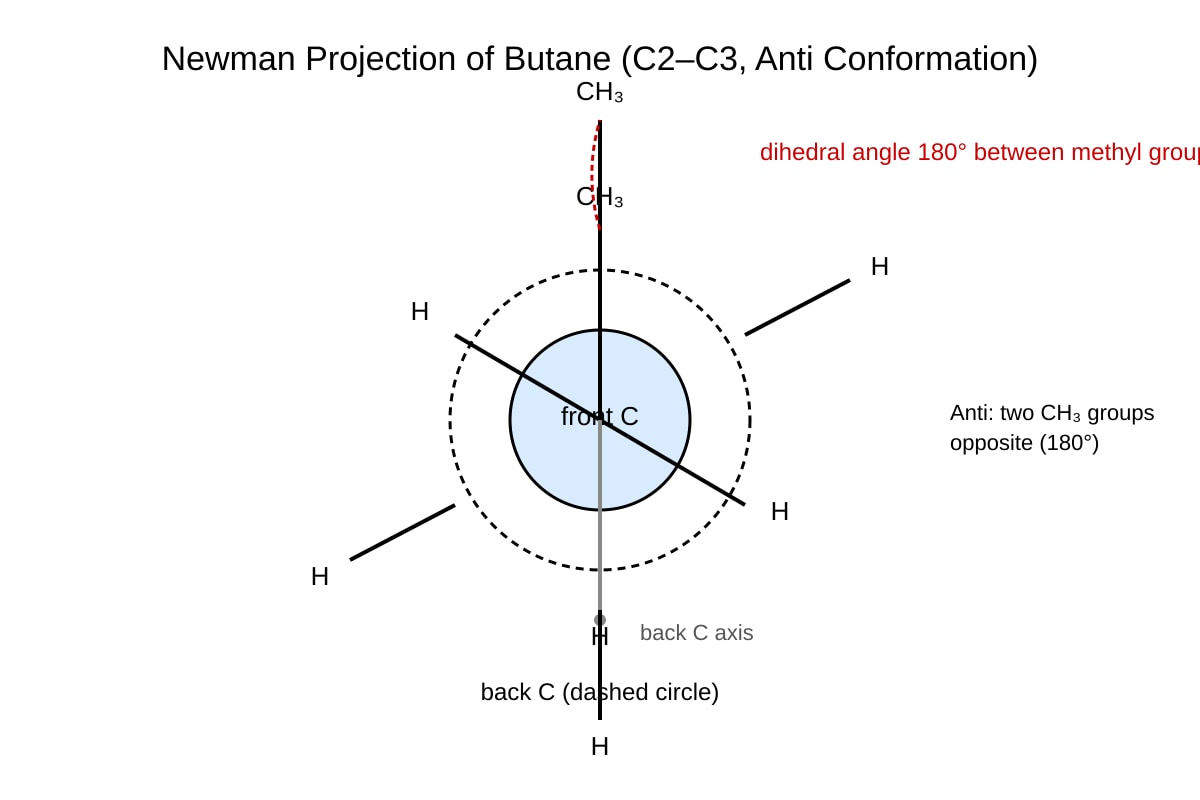
Generated diagram for Q12.
13. Compound A (C₅H₁₀O) shows IR at 1715 cm⁻¹ and ¹H NMR: δ 2.1 (s, 3H), δ 2.4 (t, 2H), δ 2.6 (t, 2H). Deduce A’s structure and outline reasoning. [4]
14. For the reaction of (R)-2-bromobutane with cyanide ion (SN2), predict the product configuration and explain inversion. [3]
15. The energy profile for competing SN1 and E1 from a tertiary halide is given. Identify which pathway gives more alkene at low [Nu⁻] and why. [3]

Generated graph for Q15.
Section C: Integrated Data Analysis (16–20)
16. A compound X (C₄H₈O) gives positive 2,4-DNPH and no Tollens’. Its ¹H NMR: δ 1.1 (d, 6H), δ 2.5 (septet, 1H), δ 9.6 (d, 1H). Deduce X and explain. [4]
17. A student treats 2-bromo-2-methylbutane with ethanol (weak nucleophile, protic solvent, heat). (a) State major mechanism. (b) Draw the alkene products and label Zaitsev/Hofmann. [4]
(a) _______________________
(b)
18. The ¹H NMR of a dibromide C₄H₈Br₂ shows two singlets at δ 1.8 (6H) and δ 3.4 (2H). Propose structure and stereochemistry if meso. [3]
19. Mass spec: M⁺ 74, fragments m/z 59 (M–15), 43 (CH₃CO⁺). IR 1710 cm⁻¹. Suggest ester and show hydrolysis mechanism outline. [4]
20. Optical purity of mixture is 60% with major enantiomer [α] = +20°. Find % composition of each enantiomer. [3]