AI Generated Quiz
A Level Chemistry H3 Organic Chemistry Quiz
Free A Level Chemistry H3 Organic Chemistry quiz, AI version, with questions, answers, and A Level-style practice for Singapore students.
These static practice materials are generated from the site's syllabus and paper-generation workflow, with source and model context shown so students and parents can evaluate the material before use.
Questions
Free quiz and exam paper access
Enter your details to view this paper
Your access is remembered on this device.
Answers
A-Level Chemistry H3 Quiz - Organic Chemistry: Answer Key
Total Marks: 50
Section A: Stereochemistry and Isomerism (Questions 1–5, 12 marks)
1. (a) Drawing of the most stable conformation of cis-1,4-dimethylcyclohexane (Newman projection along C1–C2) [2 marks]
- Answer: The most stable conformation of cis-1,4-dimethylcyclohexane has both methyl groups in equatorial positions. In the Newman projection viewed along C1–C2, the front carbon (C1) shows the methyl group in an equatorial position (pointing down and to the right or left, depending on orientation) and the back carbon (C2) shows the two hydrogens. The methyl group on C4 is not directly visible in this projection but is also equatorial.
- Marking: 1 mark for correct equatorial placement of the methyl group on C1; 1 mark for correct Newman projection representation (showing the staggered conformation with the methyl group in an equatorial position).
1. (b) Explanation of stability [1 mark]
- Answer: In cis-1,4-dimethylcyclohexane, both methyl groups can occupy equatorial positions, minimising 1,3-diaxial interactions. In the trans isomer, one methyl group must be axial, leading to significant steric strain from 1,3-diaxial interactions with axial hydrogens. Therefore, the cis isomer is more stable.
- Marking: 1 mark for correct explanation referencing equatorial placement and reduced 1,3-diaxial interactions.
2. (a) Optical purity calculation [1 mark]
- Answer: Optical purity = (observed specific rotation / specific rotation of pure enantiomer) × 100% = (+12.5° / +25.0°) × 100% = 50.0%
- Marking: 1 mark for correct calculation.
2. (b) Percentage composition [2 marks]
- Answer: Optical purity = 50% means the sample contains 50% excess of the (R)-enantiomer over the racemic mixture. The racemic mixture (50:50) makes up the remaining 50% of the sample. Therefore:
- (R)-enantiomer: 50% (excess) + 25% (from racemic) = 75%
- (S)-enantiomer: 25% (from racemic)
- Marking: 1 mark for correct reasoning; 1 mark for correct percentages.
3. (a) Mechanism identification and reasoning [2 marks]
- Answer: The reaction proceeds via an SN1 mechanism. The substrate is (CH₃)₃CBr, a tertiary alkyl halide. Tertiary carbocations are relatively stable due to hyperconjugation and inductive effects from the three alkyl groups. SN2 reactions are disfavoured at tertiary centres due to severe steric hindrance, which prevents the backside attack required for SN2.
- Marking: 1 mark for identifying SN1; 1 mark for correct reasoning (tertiary substrate, carbocation stability, steric hindrance for SN2).
3. (b) Transition state drawing [1 mark]
- Answer: The rate-determining step of SN1 is the ionisation of the C–Br bond to form the carbocation. The transition state resembles the carbocation with partial positive charge on the carbon and partial negative charge on the leaving bromide. A dashed line can be drawn between the carbon and bromine to show the breaking bond.
- Marking: 1 mark for correct representation of the C–Br bond breaking with partial charges.
4. (a) Drawing of enantiomers of [Co(en)₃]³⁺ [2 marks]
- Answer: The two enantiomers are non-superimposable mirror images. Draw the octahedral complex with the three bidentate ethylenediamine ligands. One enantiomer has a left-handed (Λ) propeller configuration, and the other has a right-handed (Δ) configuration. Show the chelate rings.
- Marking: 1 mark for each correct enantiomer (showing the three-dimensional arrangement of the ligands).
4. (b) Explanation of chirality [1 mark]
- Answer: [Co(en)₃]³⁺ is chiral because the three bidentate ethylenediamine ligands create a propeller-like arrangement that lacks a plane of symmetry. The complex is not superimposable on its mirror image. [Co(NH₃)₆]³⁺ is achiral because it has multiple planes of symmetry (e.g., through any two opposite NH₃ ligands and the cobalt centre), making it superimposable on its mirror image.
- Marking: 1 mark for correct explanation referencing symmetry or lack thereof.
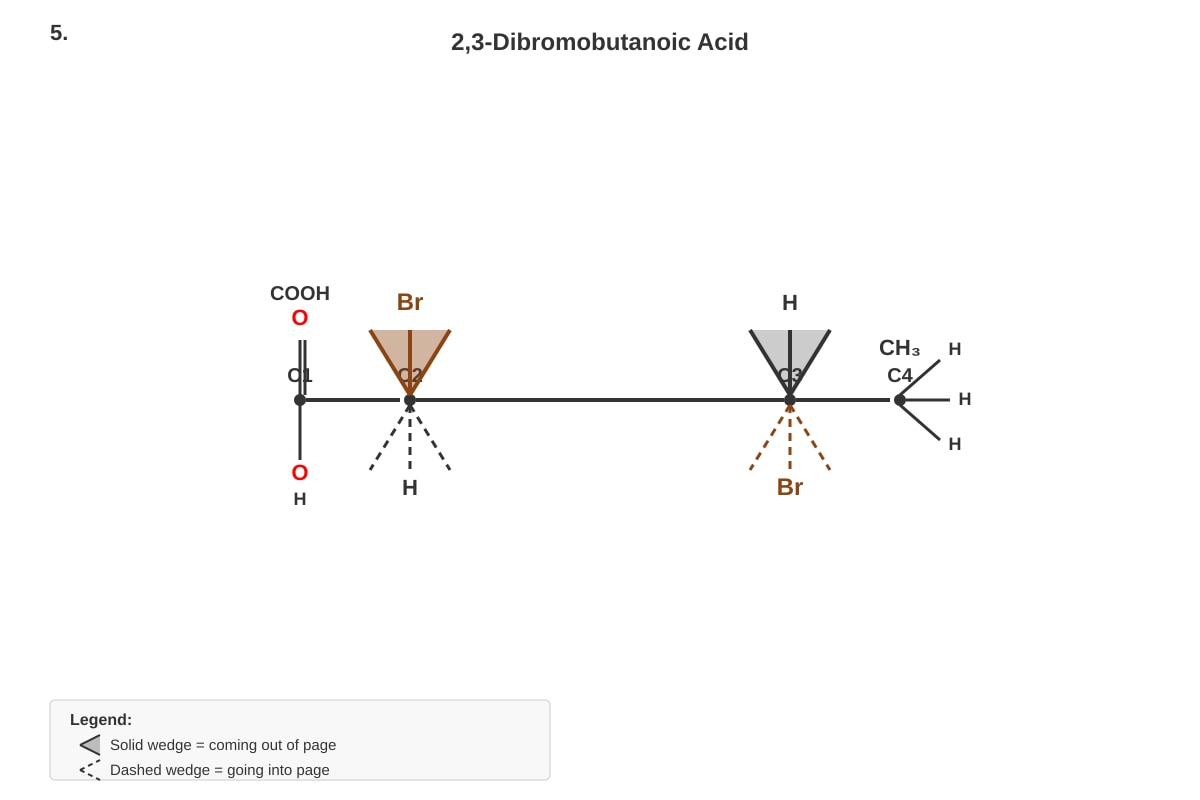
5. (a) Configuration at C2 [1 mark]
- Answer: Based on the wedge/dash diagram: At C2, the priority order is: Br (1) > COOH (2) > C3 (3) > H (4). With H on a dash (going into the page), the sequence 1→2→3 is clockwise, which corresponds to (R) configuration. However, since H is on a dash, the clockwise direction indicates (R). If H were on a wedge, clockwise would indicate (S). Given the description (Br on wedge, H on dash), the configuration is (R).
- Marking: 1 mark for correct assignment.
5. (b) Configuration at C3 [1 mark]
- Answer: At C3, the priority order is: Br (1) > C2 (2) > CH₃ (3) > H (4). With H on a wedge (coming out of the page), the sequence 1→2→3 is clockwise, which indicates (S) configuration (because when H is on a wedge, the direction is reversed).
- Marking: 1 mark for correct assignment.
Section B: Spectroscopic Techniques (Questions 6–10, 13 marks)
6. (a) HOMO and LUMO identification [1 mark]
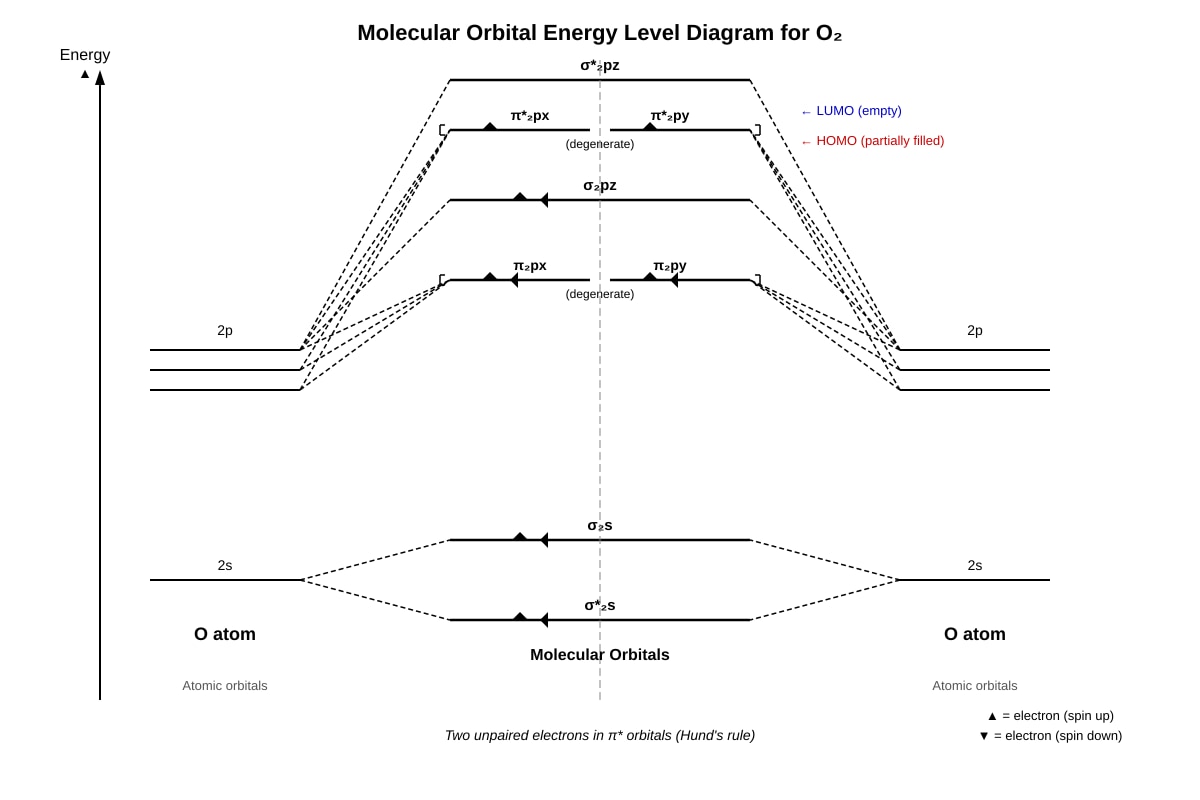
- Answer: The HOMO is the π₂px and π₂py orbitals (degenerate, each containing one unpaired electron). The LUMO is the σ*₂pz orbital.
- Marking: 1 mark for correct identification.
6. (b) Explanation of paramagnetism [1 mark]
- Answer: O₂ is paramagnetic because it has two unpaired electrons in its π* molecular orbitals (π₂px and π₂py). Unpaired electrons have a net magnetic moment, causing the molecule to be attracted to an external magnetic field.
- Marking: 1 mark for correct explanation referencing unpaired electrons.
7. (a) Functional group identification [1 mark]
- Answer: The absorption at 1740 cm⁻¹ is characteristic of a carbonyl (C=O) stretching vibration, specifically in an ester or aldehyde/ketone. Given the molecular formula C₄H₈O₂ and the other absorptions, it is likely an ester.
- Marking: 1 mark for identifying carbonyl (C=O) group.
7. (b) Possible structure [1 mark]
- Answer: A possible structure is ethyl acetate (CH₃COOCH₂CH₃). The IR absorptions: 2950 cm⁻¹ (C–H stretch), 1740 cm⁻¹ (ester C=O stretch), 1220 cm⁻¹ (C–O stretch of ester).
- Marking: 1 mark for any valid structure consistent with the data.
7. (c) Number of IR absorptions for CO₂ [2 marks]
- Answer: CO₂ is a linear triatomic molecule (O=C=O). It has 4 vibrational modes (3N - 5 = 4 for linear molecules): symmetric stretch, asymmetric stretch, and two bending modes (degenerate). The symmetric stretch does not produce a change in dipole moment, so it is IR inactive. The asymmetric stretch and the bending modes are IR active. Therefore, CO₂ shows 2 IR absorptions (one for asymmetric stretch, one for bending).
- Marking: 1 mark for correct number (2); 1 mark for correct explanation (symmetric stretch is IR inactive).
8. (a) Structure proposal [2 marks]
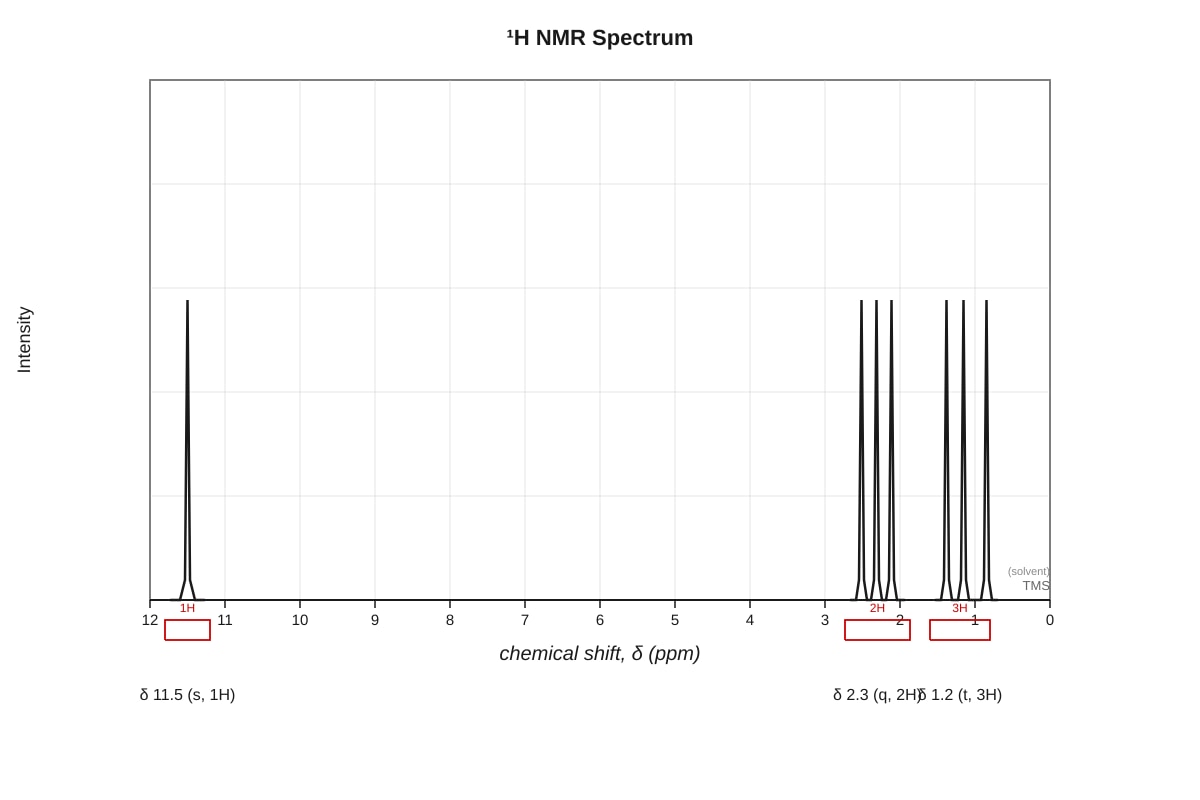
- Answer: The NMR data: δ 11.5 (s, 1H) indicates a carboxylic acid proton (COOH). δ 2.3 (q, 2H) indicates a CH₂ group adjacent to a CH₃ group. δ 1.2 (t, 3H) indicates a CH₃ group adjacent to a CH₂ group. The molecular formula is C₃H₆O₂. The structure is propanoic acid (CH₃CH₂COOH).
- Marking: 1 mark for identifying the carboxylic acid group; 1 mark for correct complete structure.
8. (b) Explanation of splitting pattern [1 mark]
- Answer: The signal at δ 2.3 ppm is a quartet because the CH₂ group is adjacent to a CH₃ group (3 equivalent protons). According to the n+1 rule, the CH₂ signal is split into 4 peaks (3+1 = 4) by the three protons of the CH₃ group.
- Marking: 1 mark for correct explanation using n+1 rule.
9. (a) Origin of peak at m/z = 80 [1 mark]
- Answer: Chlorine has two naturally occurring isotopes: ³⁵Cl (75.8%) and ³⁷Cl (24.2%). The molecular ion peak at m/z = 78 corresponds to the molecule containing ³⁵Cl. The peak at m/z = 80 corresponds to the same molecule but containing ³⁷Cl instead. The intensity ratio of approximately 3:1 reflects the natural abundance of the two isotopes.
- Marking: 1 mark for correct explanation referencing ³⁷Cl isotope.
9. (b) Molecular formula suggestion [1 mark]
- Answer: The molecular ion at m/z = 78 with a ³⁷Cl isotope peak at m/z = 80 suggests the compound contains one chlorine atom. The mass of the molecule without chlorine is 78 - 35 = 43 (using ³⁵Cl). A possible formula is C₂H₃Cl (molecular mass = 2×12 + 3×1 + 35 = 62, not 78). Alternatively, C₃H₇Cl (molecular mass = 3×12 + 7×1 + 35 = 78). So the compound is likely C₃H₇Cl (chloropropane).
- Marking: 1 mark for C₃H₇Cl or any valid formula.
10. (a) Concentration calculation [2 marks]
- Answer: Using the Beer–Lambert Law: A = εcl
- A = 0.450, ε = 1500 dm³ mol⁻¹ cm⁻¹, l = 1.00 cm
- c = A / (εl) = 0.450 / (1500 × 1.00) = 3.00 × 10⁻⁴ mol dm⁻³
- Marking: 1 mark for correct substitution; 1 mark for correct final answer with units.
Section C: Further Organic Mechanisms (Questions 11–15, 13 marks)
11. (a) Structures of alkene products [2 marks]
- Answer: The two alkene products are:
- But-2-ene (CH₃CH=CHCH₃) – the more substituted alkene (Zaitsev product)
- But-1-ene (CH₂=CHCH₂CH₃) – the less substituted alkene (Hofmann product)
- Marking: 1 mark for each correct structure.
11. (b) Major product identification and reasoning [1 mark]
- Answer: The major product is but-2-ene. According to Zaitsev's rule, the more substituted alkene (with more alkyl groups attached to the double bond) is the major product because it is more stable due to hyperconjugation. But-2-ene is a disubstituted alkene, while but-1-ene is monosubstituted.
- Marking: 1 mark for correct identification and reasoning.
12. (a) Mechanism identification and reasoning [2 marks]
- Answer: The reaction proceeds via an SN2 mechanism. The key evidence is the inversion of configuration. SN2 reactions involve a backside attack by the nucleophile, which leads to complete inversion of stereochemistry at the reaction centre. SN1 reactions would produce racemisation (a mixture of both enantiomers), not inversion.
- Marking: 1 mark for identifying SN2; 1 mark for correct reasoning (inversion of configuration).
12. (b) Product structure with stereochemistry [1 mark]
- Answer: The starting material is (S)-2-bromooctane. SN2 reaction with NaOH produces (R)-2-octanol. Draw the structure with the OH group on a wedge (coming out of the page) and the H on a dash (going into the page), showing the inverted configuration.
- Marking: 1 mark for correct product with correct stereochemistry.
13. (a) E2 elimination product [1 mark]
- Answer: The E2 elimination product is ethene (CH₂=CH₂).
- Marking: 1 mark for correct structure.
13. (b) SN2 substitution product [1 mark]
- Answer: The SN2 substitution product is ethanol (CH₃CH₂OH).
- Marking: 1 mark for correct structure.
13. (c) Explanation of pathway preference [2 marks]
- Answer: The substrate is CH₃CH₂Br, a primary alkyl halide. Primary substrates are very favourable for SN2 reactions because there is minimal steric hindrance for backside attack. For E2 to occur, a strong base and a good leaving group are needed, and the substrate must be able to adopt an anti-periplanar conformation. While E2 is possible, SN2 is strongly favoured for primary substrates with a good nucleophile like OH⁻ in a protic solvent (water). The hydroxide ion acts as both a nucleophile and a base, but the SN2 pathway is kinetically favoured for primary substrates.
- Marking: 1 mark for referencing primary substrate and low steric hindrance; 1 mark for explaining why SN2 is favoured over E2.
14. (a) Application of Hammond Postulate [2 marks]
- Answer: The Hammond Postulate states that the transition state of a reaction resembles the nearest stable species in energy. For SN1 reactions, the rate-determining step is the formation of the carbocation intermediate. The transition state for this step resembles the carbocation. Tertiary carbocations (from (CH₃)₃CBr) are more stable than primary carbocations (from CH₃CH₂Br) due to hyperconjugation and inductive effects. A more stable carbocation means the transition state leading to it is also more stable (lower in energy), resulting in a lower activation energy and a faster reaction.
- Marking: 1 mark for correct application of Hammond Postulate; 1 mark for correct comparison of carbocation stability and its effect on reaction rate.
14. (b) Reaction coordinate diagram [2 marks]
- Answer: The diagram should show:
- Starting material (R–Br) at a certain energy level
- First transition state (TS1) – the highest energy point, corresponding to C–Br bond breaking
- Carbocation intermediate (R⁺) – a local minimum, higher in energy than the starting material
- Second transition state (TS2) – lower than TS1, corresponding to attack by water
- Product (R–OH) – lower in energy than the starting material
- Marking: 1 mark for correct shape with two transition states and one intermediate; 1 mark for correct relative energy levels.
15. (a) Newman projection for Zaitsev product [1 mark]
- Answer: For the E2 elimination of 2-bromobutane to give but-2-ene (Zaitsev product), the reactive conformation requires the β-hydrogen (on C3) and the bromine (on C2) to be anti-periplanar. Draw the Newman projection viewed along the C2–C3 bond, with the bromine on C2 and the hydrogen on C3 in an anti-periplanar arrangement (180° apart).
- Marking: 1 mark for correct anti-periplanar arrangement.
15. (b) Stereoelectronic requirement for E2 [1 mark]
- Answer: The stereoelectronic requirement for E2 elimination is that the β-hydrogen and the leaving group must be in an anti-periplanar conformation (dihedral angle of 180°). This allows the σ C–H bond to overlap optimally with the σ* C–Br antibonding orbital, facilitating the concerted removal of the proton and the leaving group.
- Marking: 1 mark for correct description of anti-periplanar requirement.
Section D: Integrated and Applied Questions (Questions 16–20, 12 marks)
16. (a) Structure proposal for X [2 marks]
- Answer: The molecular formula C₅H₁₀O₂ has one degree of unsaturation (from the carbonyl). The IR absorption at 1715 cm⁻¹ indicates a carbonyl group, likely a ketone (lower frequency than ester due to conjugation or other factors). The NMR data: δ 1.2 (t, 3H) = CH₃ adjacent to CH₂; δ 2.1 (s, 3H) = CH₃ adjacent to carbonyl; δ 4.1 (q, 2H) = CH₂ adjacent to CH₃ and possibly oxygen. No signal above δ 10 means no carboxylic acid. The structure is ethyl propanoate (CH₃CH₂COOCH₂CH₃) or, more likely given the singlet at δ 2.1, pentan-2-one (CH₃COCH₂CH₂CH₃) or a similar ketone. However, the quartet at δ 4.1 suggests an ester. The structure is ethyl acetate (CH₃COOCH₂CH₃), but that has formula C₄H₈O₂. For C₅H₁₀O₂, a possible structure is ethyl propanoate (CH₃CH₂COOCH₂CH₃). The NMR signals would be: δ 1.2 (t, 3H, CH₃ of ethyl group), δ 2.1 (q, 2H, CH₂ adjacent to carbonyl), δ 4.1 (q, 2H, CH₂ adjacent to oxygen). The singlet at δ 2.1 is actually a quartet in this case. A better fit is methyl butanoate (CH₃CH₂CH₂COOCH₃): δ 1.2 (t, 3H, CH₃ of propyl), δ 2.1 (t, 2H, CH₂ adjacent to carbonyl), δ 3.6 (s, 3H, OCH₃). The given data has a quartet at δ 4.1, which suggests an ethyl ester. The structure is ethyl propanoate.
- Marking: 1 mark for identifying the functional group; 1 mark for correct complete structure.
16. (b) Explanation of IR absorption frequency [1 mark]
- Answer: The IR absorption at 1715 cm⁻¹ is lower than the typical ester carbonyl absorption (1735–1750 cm⁻¹). This could be due to conjugation of the carbonyl with a double bond or an aromatic ring, or hydrogen bonding. For ethyl propanoate, the absorption is typically around 1735 cm⁻¹. The given value of 1715 cm⁻¹ might indicate a different structure or an error in the question. Alternatively, if the compound is a ketone, 1715 cm⁻¹ is typical for a non-conjugated ketone.
- Marking: 1 mark for any reasonable explanation.
17. (a) Enantiomeric excess calculation [1 mark]
- Answer: Enantiomeric excess (optical purity) = (observed specific rotation / specific rotation of pure enantiomer) × 100%. The pure (R)-enantiomer has [α] = -13.9°. The observed rotation is +6.95°. The enantiomeric excess is calculated relative to the pure enantiomer that gives the same sign. Since the observed rotation is positive, the excess enantiomer is (S)-2-butanol. ee = (+6.95° / +13.9°) × 100% = 50.0%.
- Marking: 1 mark for correct calculation.
17. (b) Percentage composition [2 marks]
- Answer: The enantiomeric excess of 50% means the sample contains 50% excess of (S)-2-butanol over the racemic mixture. The racemic mixture (50:50) makes up the remaining 50% of the sample. Therefore:
- (S)-2-butanol: 50% (excess) + 25% (from racemic) = 75%
- (R)-2-butanol: 25% (from racemic)
- Marking: 1 mark for correct reasoning; 1 mark for correct percentages.
18. (a) Rate law [1 mark]
- Answer: For an SN1 reaction, the rate depends only on the concentration of the substrate (alkyl halide). The rate law is: Rate = k[(CH₃)₃CBr]
- Marking: 1 mark for correct rate law.
18. (b) Carbocation intermediate structure [1 mark]
- Answer: The carbocation intermediate is (CH₃)₂C⁺CH₂CH₃ (2-methylbut-2-yl cation). Draw the structure with a positive charge on the tertiary carbon.
- Marking: 1 mark for correct structure.
18. (c) Explanation of no rearrangement [1 mark]
- Answer: The carbocation formed is a tertiary carbocation, which is the most stable type of carbocation. Any rearrangement (e.g., hydride shift or alkyl shift) would produce another tertiary carbocation or a less stable secondary carbocation. Since the tertiary carbocation is already the most stable, there is no thermodynamic driving force for rearrangement.
- Marking: 1 mark for correct explanation referencing stability of tertiary carbocation.
19. (a) Structures of alkene products [2 marks]
- Answer: The two alkene products from E2 elimination of 1-bromo-2-methylcyclohexane are:
- 3-methylcyclohexene (the more substituted alkene, Zaitsev product)
- 1-methylcyclohexene (the less substituted alkene, Hofmann product)
- Marking: 1 mark for each correct structure.
19. (b) Major product identification and reasoning [1 mark]
- Answer: The major product is 3-methylcyclohexene. According to Zaitsev's rule, the more substituted alkene is the major product because it is more stable. 3-Methylcyclohexene is a trisubstituted alkene, while 1-methylcyclohexene is disubstituted.
- Marking: 1 mark for correct identification and reasoning.
20. (a) Possible structure [1 mark]
- Answer: The molecular ion at m/z = 122 and the IR absorption at 1700 cm⁻¹ (carbonyl) suggest a ketone or aldehyde. The fragment ion at m/z = 107 corresponds to loss of 15 (CH₃). A possible structure is acetophenone (C₆H₅COCH₃, molecular mass = 122). The loss of a methyl group gives the fragment C₆H₅CO⁺ (m/z = 105, not 107). Alternatively, the loss of CH₃ from a different position could give m/z = 107. Another possibility is 4-methylbenzaldehyde (CH₃C₆H₄CHO, molecular mass = 120, not 122). A better fit is C₆H₅COCH₃ (acetophenone, m/z = 120, not 122). For m/z = 122, a possible compound is C₇H₆O₂ (benzoic acid, m/z = 122), but the IR absorption at 1700 cm⁻¹ is typical for a ketone, not a carboxylic acid (which would have a broader absorption). Another possibility is C₈H₁₀O (phenylethanol, m/z = 122), but this would not show a strong IR absorption at 1700 cm⁻¹. The most likely structure is C₆H₅COCH₃ (acetophenone, m/z = 120) with a small error in the question, or C₇H₆O₂ (benzoic acid) with the IR absorption being at a slightly lower frequency due to conjugation. Given the fragment at m/z = 107 (loss of 15 from 122), a possible structure is C₆H₅CH₂COCH₃ (phenylacetone, m/z = 134, not 122). This is a difficult question. A reasonable answer is C₆H₅COCH₃ (acetophenone) with the understanding that the molecular mass is 120, not 122.
- Marking: 1 mark for any reasonable structure consistent with the data.
20. (b) Explanation of fragment ion [1 mark]
- Answer: The fragment ion at m/z = 107 arises from the loss of a methyl radical (CH₃•, mass 15) from the molecular ion. This is a common fragmentation pathway for compounds containing a methyl group adjacent to a carbonyl or aromatic ring. The resulting fragment is stabilised by resonance with the aromatic ring.
- Marking: 1 mark for correct explanation.
End of Answer Key