AI Generated Quiz
A Level Chemistry H3 Atomic Structure Bonding Quiz
Free A Level Chemistry H3 Atomic Structure Bonding quiz, HY3 AI version, with questions, answers, and A Level-style practice for Singapore students.
These static practice materials are generated from the site's syllabus and paper-generation workflow, with source and model context shown so students and parents can evaluate the material before use.
Questions
Free quiz and exam paper access
Enter your details to view this paper
Your access is remembered on this device.
Answers
A-Level Chemistry H3 Quiz - Atomic Structure Bonding: Answer Key
Total Marks: 40
Topic: Atomic Structure Bonding (syllabus-first; no past-year evidence)
Section A: Foundations (Q1–10)
1. [2 marks]
Principal quantum numbers: , , .
Teaching note: The principal quantum number labels shells; first three are 1, 2, 3. 1 mark each for correct values.
2. [1 mark]
Teaching note: O has 8 electrons; fill 1s (2), 2s (2), 2p (4).
3. [1 mark]
Bond order = where = bonding electrons, = antibonding electrons.
Teaching note: Defines stability indicator in MO theory.
4. [1 mark]
Bond order = 2.
Teaching note: From MO diagram: 10 e⁻ total, 8 bonding, 4 antibonding → (8−4)/2 = 2.
5. [2 marks]
Tetrahedral; bond angle 109.5°.
Teaching note: VSEPR AX₄; 1 mark shape, 1 mark angle.
6. [1 mark]
Teaching note: Ethene C has 3 regions (double bond counts as 1); .
7. [1 mark]
Ionic bond.
Teaching note: Between metal cation and non-metal anion.
8. [1 mark]
1 lone pair.
Teaching note: NH₃: N has 5 valence e⁻, 3 bonded to H, 2 left as pair.
9. [2 marks]
with two lone pairs on each O.
Teaching note: C central, double bonds to O; each O has 2 lone pairs (4 e⁻). 1 mark structure, 1 mark lone pairs.
10. [1 mark]
0.4 to 1.7 (Pauling).
Teaching note: Below 0.4 nonpolar covalent; above 1.7 ionic.
Section B: Applied Short Items (Q11–15)
11. [4 marks]
MO diagram: σ(1s) bonding, σ*(1s) antibonding. Fill 2 e⁻ in σ(1s).
Bond order = ½(2 − 0) = 1.
Marking: 1 for diagram labels, 1 for filling, 2 for BO calc.
Teaching: H₂ uses 1s AOs; LCAO gives bonding/antibonding; only bonding occupied.
12. [3 marks]
ΔEN(O–H) = 3.44 − 2.20 = 1.24
ΔEN(N–H) = 3.04 − 2.20 = 0.84
O–H more polar (larger ΔEN).
Marking: 1 each for differences, 1 for conclusion.
Teaching: Polarity ∝ EN difference.
13. [2 marks]
Trigonal planar symmetric; three B–F bond dipoles equal magnitude 120° apart → vector sum zero.
Teaching: Symmetry cancels dipoles.
14. [3 marks]
See-saw shape; ~173° (axial-eq), ~102° (eq-eq); 1 lone pair in equatorial position of trigonal bipyramid.
Marking: 1 shape, 1 angles, 1 lone pair position.
Teaching: AX₄E from VSEPR.
15. [2 marks]
Dipole–dipole forces; HCl permanent dipole due to polar H–Cl bond.
Teaching: Permanent dipoles attract.
Section C: Extended Reasoning (Q16–20)
16. [5 marks]
- O₂: BO = 2, paramagnetic (2 unpaired e⁻ in π*), stronger.
- F₂: BO = 1, diamagnetic, weaker.
Marking: 2 for O₂, 2 for F₂, 1 comparison.
Teaching: MO filling: O₂ 12 valence e⁻, F₂ 14; more antibonding in F₂ lowers BO.
17. [4 marks]
Statement false. CO₂ linear (VSEPR AX₂); bond dipoles equal/opposite cancel → net zero.
Marking: 1 verdict, 1 shape, 2 dipole explanation.
Teaching: Molecular geometry overrides bond polarity.
18. [4 marks]
C 2s²2p² → promote/hybridise to 4 sp³ orbitals; each overlaps with H 1s → 4 equivalent σ bonds tetrahedral 109.5°.
Marking: 2 hybridisation, 2 geometry/equivalence.
Teaching: sp³ explains equal bonds.
19. [5 marks]
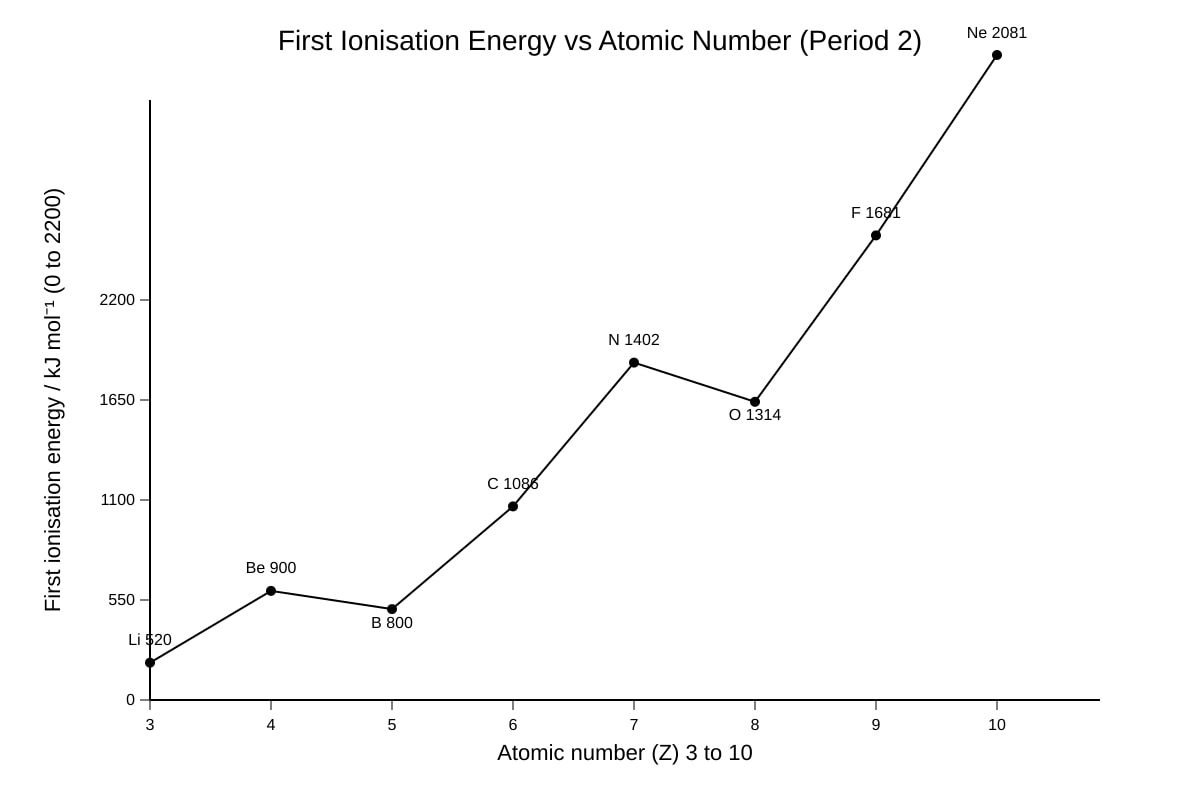
Graph: rising trend Z↑; dip B after Be (p electron lower energy than s paired), dip O after N (paired p repulsion).
Marking: 2 graph sketch from placeholder, 1 trend, 2 anomalies.
Teaching: Nuclear charge ↑ IE; exceptions from subshell stability.
20. [5 marks]
MO: O₂ has 2 unpaired e⁻ in π* → paramagnetic. HOMO = highest occupied MO (π*), LUMO = lowest unoccupied (σ*); electronic transitions occur HOMO→LUMO absorbing photon E = hf.
Marking: 2 paramag, 3 HOMO/LUMO role.
Teaching: Unpaired e⁻ cause attraction to field; HOMO/LUMO gap governs UV/vis.